Monthly Summaries
2025 Year End Retrospective
Special Issue 2025
A Review of Media Coverage of Climate Change and Global Warming in 2025
[DOI]
 has been another pivotal year when climate change and global warming fought for media attention amid competing issues, events, challenges and intersecting stories around the globe. This was a year when new vocabularies also continued to spike our consciousness: ‘rage bait’: “online content deliberately designed to elicit anger or outrage by being frustrating, provocative, or offensive, typically posted in order to increase traffic to or engagement with a particular web page or social media account” (named word of the year by Oxford Dictionary) and ‘slop’: “digital content of low quality that is produced usually in quantity by means of artificial intelligence” (named word of the year by Miriam-Webster) may indicate the times we’re currently navigating. Additional terms bandied about more regularly in 2025 like ‘touch grass’, ‘performative’, ‘vibe coding’ and ‘parasocial’ also help us understand our collective circumstances. Let’s also not forget the meaningless utterance by younger word (or number) smithers of ‘67’ that invaded our lives in 2025.
|
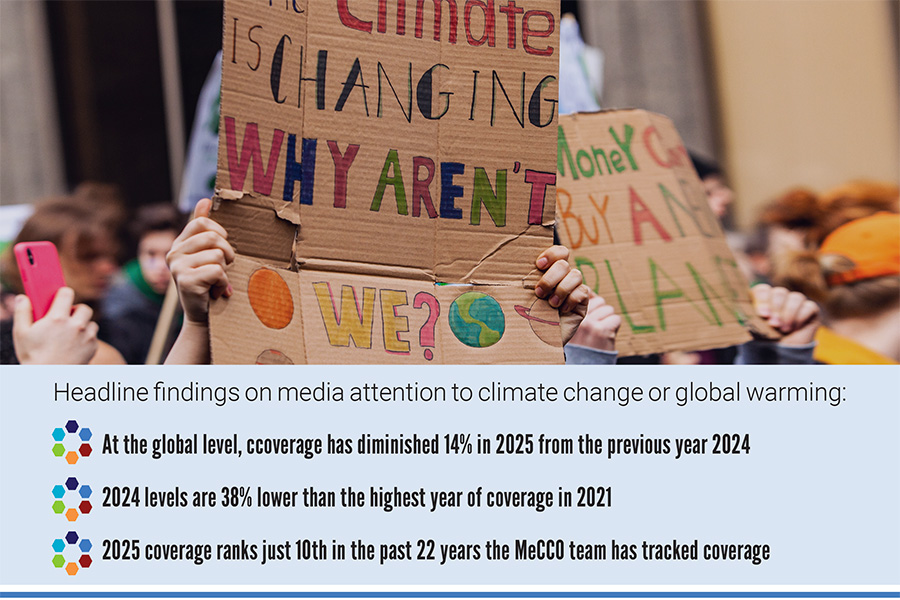
In 2025, our Media and Climate Change Observatory (MeCCO) has detected that climate-related issues, events, and developments garnered less frequent coverage through intersecting political, economic, scientific, cultural as well as ecological and meteorological themes than in recent years. Across the globe, coverage has diminished 14% in 2025 from the previous year 2024 and is 38% lower than the highest year of coverage in 2021. In fact, 2025 coverage ranks just 10th in the past 22 years the MeCCO team has tracked coverage of climate change or global warming across the global news sources.
When comparing the months of 2025 with the same months of previous years, a general decrease is observed compared to 2024 in all regions. This decrease is greater in the press of Africa, the Middle East, the North America, and Europe. And it is less pronounced in the press of Asia, Latin America, and Oceania.
Unlike in previous years, in 2025 no record was broken in the volume of articles referencing “climate change” or “global warming” per month in any region. Only in January 2025 did Asian newspapers break the record compared to the January of previous years. The drop in December is noteworthy, with the volume of coverage in Europe and the North America reaching levels not seen since August 2016 and February 2018, respectively (see Table 1 below).
Jan |
Feb |
Mar |
Apr |
May |
Jun |
Jul |
Aug |
Sep |
Oct |
Nov |
Dec |
AVG |
|
World |
4 |
11 |
10 |
9 |
9 |
11 |
9 |
8 |
9 |
11 |
11 |
17 |
9.92 |
Africa |
8 |
7 |
4 |
4 |
9 |
7 |
4 |
8 |
10 |
10 |
12 |
11 |
7.83 |
Asia |
1 |
2 |
4 |
5 |
6 |
7 |
6 |
5 |
7 |
7 |
5 |
12 |
5.58 |
Europe |
9 |
11 |
11 |
10 |
10 |
13 |
9 |
8 |
12 |
13 |
13 |
19 |
11.50 |
Latin America |
2 |
3 |
2 |
4 |
3 |
4 |
4 |
5 |
5 |
5 |
4 |
11 |
4.33 |
Middle East |
7 |
8 |
12 |
4 |
6 |
11 |
16 |
16 |
8 |
11 |
19 |
18 |
11.33 |
North America |
4 |
9 |
9 |
9 |
9 |
11 |
8 |
9 |
10 |
11 |
12 |
14 |
9.67 |
Oceania |
9 |
19 |
13 |
15 |
12 |
21 |
18 |
17 |
9 |
16 |
11 |
19 |
14.92 |
Table 1. Position of the month in 2025 with respect to the same month of previous years starting in 2004 (22 years).
How and how much the media cover climate change matters greatly. This 2025 downward trend appears in contrast with ongoing global warming where average temperatures in the most recent years have been the highest in nearly 150 years of recorded history. Meanwhile, 2025 has been the year with the highest carbon dioxide concentrations in the atmosphere in the last 14 million years.
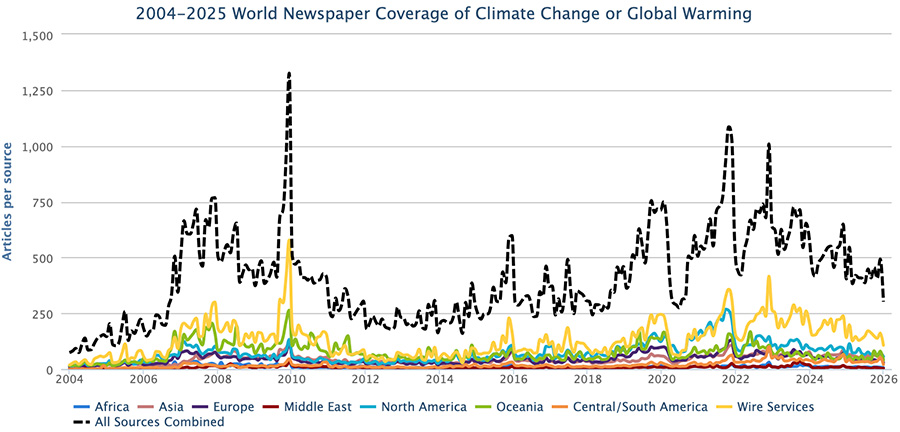
Figure 1. Media coverage of climate change or global warming in seven different regions around the world, from January 2004 through December 2025.
We continue to pursue this work because methodical tracking of patterns in media representations of climate change or global warming sheds light on what stories are told, what links are made and what remains untold and less understood. As many of us continue to rely on media outlets to help us make sense of these kinds of multi-scale, multi-faceted and complex issues, what constitutes ‘news’ about climate change or global warming is critical to our understanding and engagements. As climate change cuts to the heart of humans’ relationship with the environment, media provide powerful and important interpreters of climate science and policy, translating important issues and information in the public sphere. Media workers and institutions continue to powerfully shape and negotiate meaning as they influence how we all – as citizens of planet Earth – value and make sense of the world in our backyard and around the globe.
This is our 9th year end report, capturing the ebbs and flows of media attention paid to climate change around the world while pulling together the year’s monthly summaries from January through December (issues 97-108). Check out our previous year-end reports and monthly explainers here. Our monthly explainers and this year-end report provide guidance on the ebbs and flows in quantity of news coverage on climate change and global warming across the globe, and across regions and several countries around the world.
Washington Post president and publisher Philip Graham has asserted, “News is a first rough-draft of history”. Our ongoing MeCCO work is then effectively a first take on a first rough-draft of history as we monitor and examine media coverage of climate change over time. In the context of breaking news, new algorithmic AI and a swirl of events, developments, issues and challenges competing for our attention, this retrospective can help us recall, reflect on and learn from what has emerged in news coverage of climate change over the past year.
MeCCO was established at University of Oxford in 2007. Since 2009, MeCCO has been based at the University of Colorado Boulder in the Cooperative Institute for Research in Environmental Sciences (CIRES) and a new partnership with the SPIKE Center for Sustainability Education. MeCCO is a multi-university collaboration involving 30 researchers across 15 institutions. In partnership with the University of Colorado Libraries, each month MeCCO provides 25 updated open-source downloadable datasets (as Excel files) that accompany our 50 monthly downloadable figures (as PNG, JPEG, PDF or SVG vector images) capturing coverage across these media and at different scales.
We monitor news coverage across 59 countries in 14 languages and seven different regions (Africa, Asia, Europe, Latin America, Middle East, North America, and Oceania) around the world.
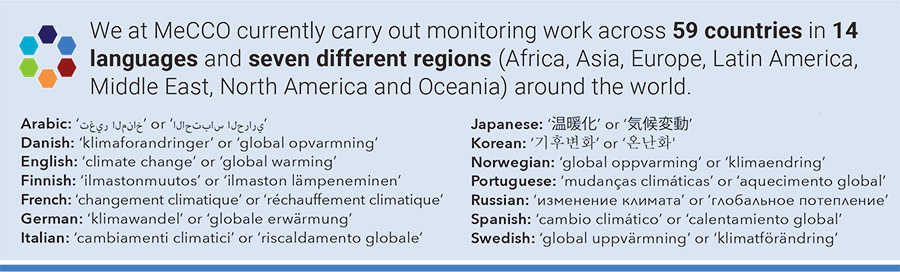
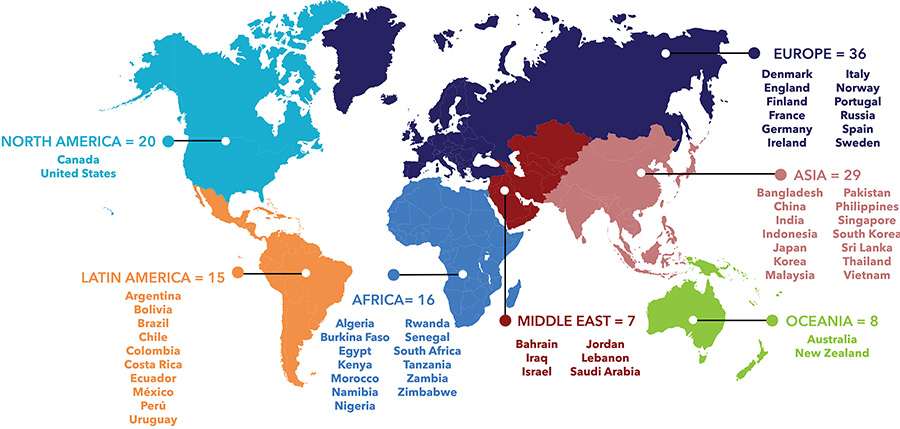
Figure 2. Map of the media sources we monitor for coverage of climate change or global warming across seven different regions around the world.
Our MeCCO team continues to provide a solid foundation for analysis of content and quality of coverage over time and place. Members of our team drew on these data as they published related research in many journals, books and other outlets. Examples in 2025 include contributions (by Lucy McAllister, Olivia Pearman and other co-authors) to the '2025 Report of the Lancet Countdown on Health and Climate Change: Climate change action offers a lifeline' that appeared in The Lancet and a chapter contribution (by Max Boykoff and other co-authors) called ‘Steering the Discourse: Legacy News, Social Media, Advertising and Public Relations’ to the book Climate Obstruction: A Global Assessment [edited by J. Timmons Roberts, Carlos Milani, Jennifer Jacquet, and Christian Downie] for Oxford University Press.
As we continue with this project, many interpret these data in the public sphere. For example, on his new Substack ReportEarth, Pulitzer Prize winning journalist Chris Mooney has commented:
“I’ve written extensively about their coverage of climate change, using the MeCCO (Media and Climate Change Observatory) dataset, which charts the volume of coverage in 5 major U.S. papers, among other indicators. In particular, I suggested a few months back that coverage levels appear to be in decline after a major rise from roughly 2015-2021. I advanced this thesis tentatively, with many caveats. But I’m growing more convinced of it. Why? Well we now have data updated through November, the month of the latest U.N. climate conference in Brazil, which ran from Nov. 10-21. These late-year conferences are often peak moments for climate coverage, driving a seasonal pattern in the data. This November, however, the volume of coverage at the 5 leading U.S. newspapers (362 articles in total) was lower than in any other month of 2025 except for May, and getting closer to the pandemic low value of 297 in June 2020. In other words, there was a climate conference, but no resulting spike in U.S. coverage. That’s pretty off pattern. Globally, in contrast, there was at least a small November uptick, as you can see in a different MeCCO dataset that tracks the world. What are the causes of this? Well, the Trump administration didn’t send representatives to the conference in Brazil, which may have detracted from the sense of journalistic urgency for some in the U.S., and nullified some possible storylines. However, I continue to think this is more a zeitgeist thing, where there’s a broader shift away from considering climate change an urgent issue, for reasons too complex to go into here. Nothing major about the science has changed, of course. But I think there is just fatigue, reflecting in part the domestic and global failures to show significant progress on the issue”.
Elsewhere, at WattsUpWithThat right-wing blogger Anthony Watts has assessed:
“Steve Milloy of junkscience.com posted a very interesting plot on X…the data comes from Media and Climate Change Observatory (MeCCO) which tracks media coverage of “climate change” or “global warming” in newspapers, radio, and TV across dozens of sources worldwide, with data starting in 2004 for global monitoring (and 2000 for US-specific). Pre-2004 data comes from earlier studies by MeCCO founder Max Boykoff and colleagues, which analyzed English-language newspapers from 1988 onward. Absolute article counts are not publicly available without accessing their datasets, but trends show low coverage in the late 1980s, spikes around key events (e.g., IPCC reports in 1990, 1995, 2001; Kyoto Protocol in 1997), and overall increases with major peaks in 2007, 2009, 2015, 2019, and especially 2021 (the highest since tracking began). The peak around 2006-2007 is likely due to Al Gore’s climate movie An Inconvenient Truth gaining traction. The peak in 2009 is clearly due to Climategate, which as you may recall, WUWT broke that story. The plunge afterwards was the loss of faith in “The Hockey Team” of climate scientists. Since then, climate as a topic in media coverage has clawed its way back uphill, peaking in 2021 with Biden’s green agenda and EV mandate. Coverage dipped during the 2018-2020 COVID-19 pandemic but has fluctuated with events like COP summits. Whether this short down trend will hold depends on us”.
In the pages that follow in this retrospective, our MeCCO team helps to explain the stories – on a month-to-month basis – that shaped overall 2025 coverage. The following month-to-month summaries are reprises of monthly summaries that our MeCCO team has compiled and posted each month on our website. We invite you page through each month of explainers that follow as you critically reflect on how the past year of media coverage of climate change sets the stage for 2026 and beyond.
Image credit: BBC.

January media coverage of climate change or global warming in newspapers around the globe increased 27% from December 2024. Furthermore, coverage in January 2025 went up 15% from January 2024. In January, international wire service coverage increased 40% from the month earlier (December) and 31% from the previous year (January 2024). Figure 1 shows trends in newspaper media coverage at the global scale – organized into seven geographical regions around the world – across 21 years, from January 2004 through January 2025.
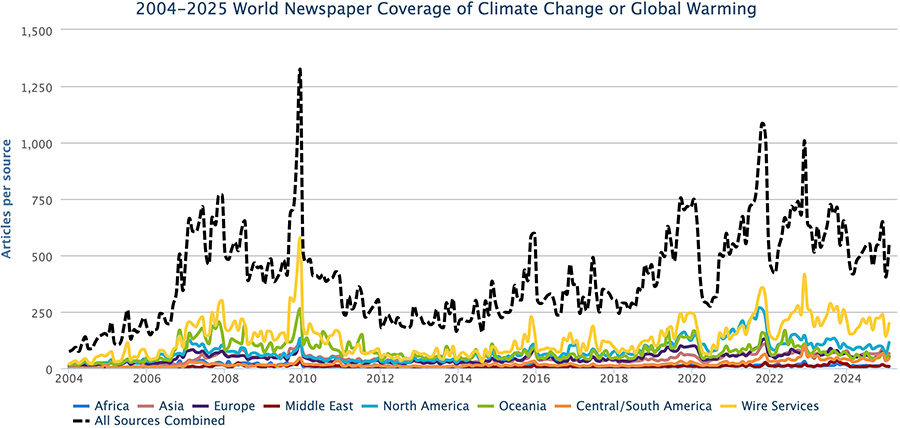
Figure 1. Newspaper media coverage of climate change or global warming in print sources in seven different regions around the world, from January 2004 through January 2025.
At the regional level, January 2025 coverage went up in Asia (+10%), Oceania (+21%), the European Union (EU) (+30%), and Latin America (+34%) while surging in North America (+74%) (see Figure 2). The large increase in media attention is attributed largely to a combination of devastating wildfires in the Los Angeles (LA), California (CA) area – with connections made to climate change or global warming – and the climate policy implications of the incoming United States (US) Trump Administration (such as the announced withdrawal from the Paris Agreement and the Federal funding for climate-related initiatives). Meanwhile, coverage diminished in Africa (-7%), and the Middle East (-14%) in January 2025 compared to the previous month. Comparing January 2025 to January 2024 levels of coverage, numbers were up in all regions except Africa (-7%), with coverage in the EU just about the same (+0.2%): the Middle East (+9%), Oceania (+14%), Latin America (+19%), Asia (+21%), and North America (+27%).
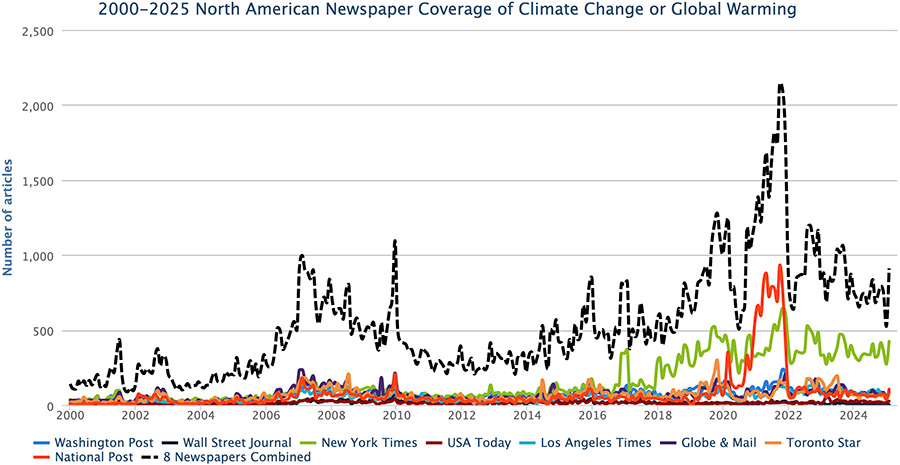
Figure 2. Coverage of climate change or global warming in North America from January 2000 through January 2025: Washington Post (US), Wall Street Journal (US), New York Times (US), USA Today (US), Los Angeles Times (US), Globe & Mail (Canada), Toronto Star (Canada), National Post (Canada).
Among our country-level monitoring, in January US print coverage (see Figure 3) went up 60% from December 2024 levels of coverage. Coverage in The Wall Street Journal held steady, while coverage was up 53% at USA Today, up 54% at The Washington Post, and up 55% in The New York Times, while doubling in The Los Angeles Times. At the same time, US television coverage jumped 168% in January. Storylines about the first steps of the US Trump Administration regarding climate policy, regulatory and funding rollbacks and the devastating climate change-influenced LA wildfires contributed to these increases.
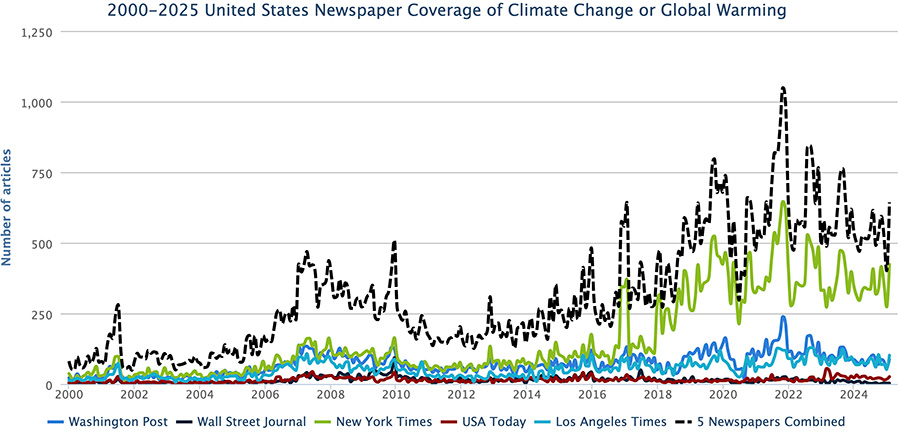
Figure 3. US newspapers’ – Los Angeles Times, New York Times, USA Today, Wall Street Journal, and Washington Post – coverage of climate change or global warming from January 2000 through January 2025.
Off-shore oil platform in the Santa Barbara channel, off Ventura, California. Photo credit: Russ Bishop/Alamy. |
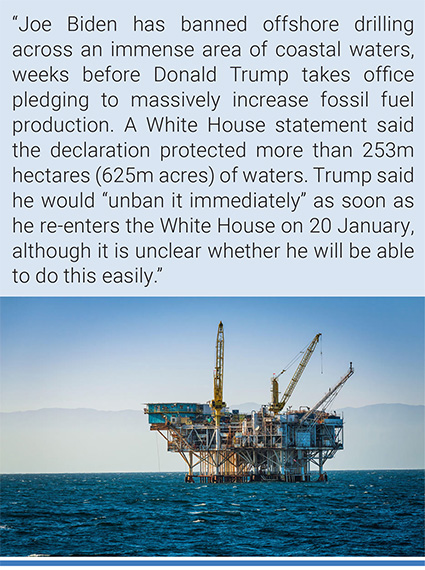
To start our analysis of themes of coverage, political and economic-themed media stories about climate change or global warming fought for attention in various outlets in January. Stories about the US presidential handoff from President Joe Biden to President Donald Trump – with their significantly contrasting views about climate policy – were prominent in domestic as well as international outlets. For example, just before leaving office the White House announced that President Biden would permanently ban new offshore oil and gas drilling across much of US coastal waters (over 600 million acres along the East Coast, West Coast, Gulf of Mexico and the Northern Bering Sea off Alaska). For example, Guardian journalist Oliver Milman wrote, “Joe Biden has banned offshore drilling across an immense area of coastal waters, weeks before Donald Trump takes office pledging to massively increase fossil fuel production. The US president’s ban encompasses the entire Atlantic coast and eastern Gulf of Mexico, as well as the Pacific coast off California, Oregon and Washington, and a section of the Bering Sea off Alaska. A White House statement said the declaration protected more than 253m hectares (625m acres) of waters. Trump said he would “unban it immediately” as soon as he re-enters the White House on 20 January, although it is unclear whether he will be able to do this easily. “As the climate crisis continues to threaten communities across the country and we are transitioning to a clean energy economy, now is the time to protect these coasts for our children and grandchildren,” Biden said in a statement. “In balancing the many uses and benefits of America’s ocean, it is clear to me that the relatively minimal fossil fuel potential in the areas I am withdrawing do not justify the environmental, public health, and economic risks that would come from new leasing and drilling,” he added. Scientists are clear that oil and gas production must be radically cut to avoid disastrous climate impacts. The ban does not have an end date and could be legally – and politically – tricky for Trump to overturn. Biden is taking the action under the Outer Continental Shelf Lands Act of 1953, which gives the federal government authority over the exploitation of offshore resources. A total of eight presidents have withdrawn territory from drilling under the act, including Trump himself who barred oil and gas extraction off the coasts of Florida, Georgia and South Carolina. However, the law does not expressly provide for presidents to unilaterally reverse a drilling ban without going through Congress. Despite this, Trump vowed to undo Biden’s move, with the president-elect’s spokesperson, Karoline Leavitt, calling it “a disgraceful decision” and saying the incoming administration would “drill, baby, drill””.
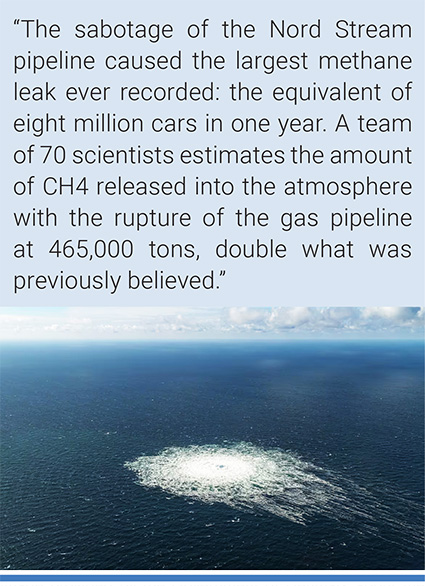
Elsewhere, the methane leak from the Nord Stream sabotage – with connections made to climate change – emerged in January media coverage. For example, El País journalist Manuel Planelles wrote, “The sabotage of the Nord Stream pipeline caused the largest methane leak ever recorded: the equivalent of eight million cars in one year. A team of 70 scientists estimates the amount of CH₄ released into the atmosphere with the rupture of the gas pipeline at 465,000 tons, double what was previously believed. In September 2022, the Nord Stream gas pipeline network, which transported natural gas from Russia to Western Europe via the Baltic, was destroyed with explosives. This sabotage, which remains unsolved, although several media reports this summer pointed to an operation carried out by Ukraine following the Russian invasion, not only had consequences for European energy security. It also resulted in a huge leak of methane (CH₄), a powerful greenhouse gas that is in the crosshairs of the fight against climate change (…) Around 465,000 metric tons were emitted into the atmosphere, to which around fifty more were added that dissolved in the sea in one way or another”.
Image provided by the Government of Denmark about the gas leak in Nord Stream. Credit: Ministerio de Defensa Danés/DPA/Europa Press. |
Also in January in political and economic-themed news about climate change, several banking institutions exhibited what Timothy Snyder has called ‘anticipatory obedience’ as they have withdrawn from the Network of Central Banks and Supervisors for Greening the Financial System. For example, Associated Press correspondent Christopher Rugaber reported, “The Federal Reserve said Friday that it is leaving an international grouping of central banks that focused on how regulation of the financial system could help combat climate change. The Fed’s membership has been criticized by Republicans in Congress. In a short statement, the Fed said it had “appreciated” working with the Network of Central Banks and Supervisors for Greening the Financial System. But it added that the organization “has increasingly broadened in scope, covering a wider range of issues that are outside of the Board’s statutory mandate.” The move is another example of the central bank, which is intended to be independent of politics, taking steps that could insulate it from criticism from the incoming Trump administration. Earlier this month, Michael Barr, who headed up the Fed’s financial regulatory efforts and was fiercely opposed by large banks, said he would step down at the end of this month as vice chair for financial supervision. He remains on the Fed’s governing board. Stephen Miran, whom President-elect Donald Trump has named as a top White House economic adviser, co-authored a paper last year at the Manhattan Institute that criticized the Fed’s consideration of climate change in bank regulation as “mission creep.” The Fed said it would join the NGFS in December 2020, after President Joe Biden was elected, and was one of the last major central banks to do so. Over 140 central banks and financial regulatory agencies around the world are members”.
As January marched on, further actions of the incoming US Trump Administration and Republican majority House and Senate relating to climate policy generated significant news attention. US House Speaker Mike Johnson’s declaration to ‘restore America’s energy dominance’ fed news attention. For example, New York Times journalist Lisa Friedman reported, “Moments after his election as House speaker on Friday, Mike Johnson, Republican of Louisiana, wasted no time in highlighting energy as one of his top priorities. He said the Republican Congress would expand oil and gas drilling, end federal support for electric vehicles and promote the export of American gas. “We have to stop the attacks on liquefied natural gas, pass legislation to eliminate the Green New Deal,” he said in a floor speech after accepting the gavel. “We’re going to expedite new drilling permits, we’re going to save the jobs of our auto manufacturers, and we’re going to do that by ending the ridiculous E.V. mandates.” The Green New Deal to which Mr. Johnson referred was proposed legislation that Congress never passed but that Republicans have seized on as shorthand for policies designed to help the United States transition away from fossil fuels, the burning of which is dangerously heating the planet. Likewise, there is no mandate that requires Americans to buy electric vehicles. Instead, there are federal subsidies to encourage consumers to buy electric vehicles and new regulations designed to cut tailpipe pollution and get automakers to sell more E.V.s. Still, Mr. Johnson was clearly signaling that energy policy would be on the front burner. “It is our duty to restore America’s energy dominance and that’s what we’ll do,” he said. The United States is already the world’s biggest producer of crude oil as well as the biggest exporter of liquefied natural gas. House Republicans on Friday also made it easier for Congress to give away federal lands to state and local governments, a move that conservation groups warned could lead to Americans’ losing access to parks and other protected areas. The measure essentially renders public lands as having no monetary value by directing the federal government not to consider lost revenues when it transfers land to a state, tribe or municipality. While the same provision has been in effect when Republicans controlled Congress in the past, activists worry that under the Trump administration it will result in a sell-off of public lands. Mr. Trump has promised to expand oil and gas drilling and mining, a goal shared by Republicans who now control both the House and Senate. Environmental groups said they feared the measure approved Friday could open the door to new efforts to liquidate public lands. States often lack the resources to adequately maintain natural areas, they argue, and are more likely to sell formerly federal lands to mining and drilling companies or other private development”.
A coal-fired power plant in Kansas in 2021. Photo credit: Charlie Riedel/Associated Press. |
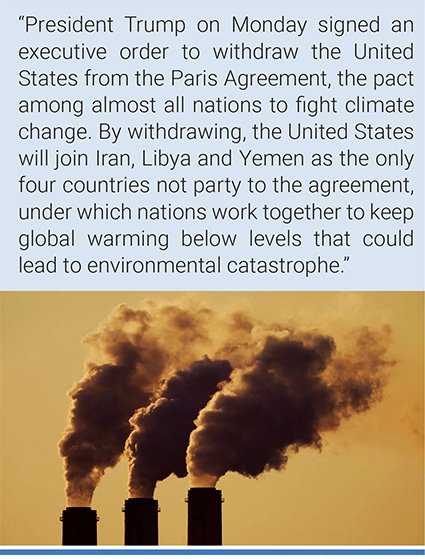
Then on his first day in office, Donald J. Trump again announced through Executive Order his administrations decision to withdraw from the 2015 United Nations (UN) Paris Climate Agreement. While Article 28 of the Paris Agreement states that the process requires one year before effective withdrawal, the Trump Administration definitively announced that by January 20, 2026 the US will join Yemen, Libya and Iran as the only parties to the UN to defect, leaving the global community of 196 cooperating parties working to address human contributions to climate change. For example, New York Times journalist Max Bearak reported, “President Trump on Monday signed an executive order to withdraw the United States from the Paris Agreement, the pact among almost all nations to fight climate change. By withdrawing, the United States will join Iran, Libya and Yemen as the only four countries not party to the agreement, under which nations work together to keep global warming below levels that could lead to environmental catastrophe. The move, one of several energy-related announcements in the hours following his inauguration, is yet another about-face in United States participation in global climate negotiations. During his first term Mr. Trump withdrew from the Paris accord, but then President Biden quickly rejoined in 2020 after winning the White House. Scientists, activists and Democratic officials assailed the move as one that would deepen the climate crisis and backfire on American workers. Coupled with Mr. Trump’s other energy measures on Monday, withdrawal from the pact signals his administration’s determination to double down on fossil-fuel extraction and production, and to move away from clean-energy technologies like electric vehicles and power-generating wind turbines”. Meanwhile, as an example of international media reaction Times journalist Oliver Wright wrote, “Sir Keir Starmer has refused to criticize Donald Trump’s plan to pull the United States out of the Paris climate change agreement as the prime minister attempts to avoid antagonizing the new American administration. The European Union led international criticism of the move, describing Trump’s decision as “truly unfortunate”. However, Downing Street refused to follow suit saying that the US was an “indispensable ally” and pointing out that Trump had been elected on a mandate to pull out of the agreement. Signed in 2015, the legally binding Paris Agreement requires countries to commit to progressively reduce their greenhouse gas emissions in a bid to limit global heating to below 2C. When he was first elected president in 2016, Trump pulled the US out of the agreement, leading to criticism by the then prime minister Theresa May. She warned that the move risked creating a “crisis of faith in multilateralism and global co-operation” that would “damage the interests of all our peoples”. When Joe Biden won the White in 2020, one of his first acts as president was to rejoin the agreement”. And on other world leaders including China’s reaction, Associated Press correspondents David Keyton and Sibi Arasu noted, “As expected, day two of the World Economic Forum at Davos, Switzerland witnessed strong responses to U.S. President Donald Trump’s decision to withdraw from the Paris climate agreement, with European leaders stating in no uncertain terms that they will hold fort and remain a part of the global climate pact. European Union chief Ursula von der Leyen said on Tuesday: “Europe will stay the course, and keep working with all nations that want to protect nature and stop global warming.” She insisted that the 27-nation bloc will stick to the landmark Paris climate accord. “The Paris Agreement continues to be the best hope for all humanity,” she said. The Paris accord is aimed at limiting long-term global warming to 2.7 degrees Fahrenheit (1.5 degrees Celsius) or, failing that, keeping temperatures at least well below 3.6 degrees Fahrenheit (2 degrees Celsius) above pre-industrial levels…In a session at Davos that looked at Europe’s transition to clean energy, Alexander De Croo, Belgium’s prime minister responded to Trump’s decision saying, “I mean, the world is full of uncertainty after yesterday even more, and maybe tomorrow there might be even more uncertainty. Let’s please, as Europeans within the European Union, not add to the uncertainty by creating ambiguity on our goals.” Business leaders at Davos chimed with the benefits of sticking to a global climate mandate. Jesper Brodin, chief executive officer of global furniture company, IKEA said: “For us, who have been on the bumpy train ride for a couple of years, we are discovering year by year how we actually not only can succeed to deliver to the Paris Agreement but actually how it benefits, business.” Climate scientists and activists from the Global South were more critical of the U.S.'s withdrawal from the climate pact. “Globally, Trump’s decision undermines the collective fight against climate change at a time when unity and urgency are more critical than ever. The most tragic consequences, however, will be felt in developing countries,” said New Delhi-based Harjeet Singh, of the Fossil Fuels Non Proliferation Treaty These vulnerable nations and communities, which have contributed the least to global emissions, will bear the brunt of intensifying floods, rising seas, and crippling droughts.” Speaking at Davos, Damilola Ogunbiyi, CEO and Special Representative of the UN Secretary-General for Sustainable Energy for All said, “We’re already collaborating at a scale where no one can stop, you know, not one country, not one leader making a decision. Because it’s just the right thing to do globally.” China also expressed concern over the U.S. move to withdraw from the Paris Agreement, Chinese Foreign Ministry spokesperson Guo Jiakun said: “Climate change is a common challenge facing mankind,” adding that “no country can be outside of it. No country can be immune to it””.
At the end of the month of January, New York Times journalist David Gelles reflected on the first two weeks of the US Trump Administration, writing, “Over the past four years during the Biden administration, the United States started spending ever-greater sums on efforts to blunt global warming and help communities adapt to a hotter world. Many analysts expected the total tab for this work to exceed $1 trillion over the next decade. But in a matter of days, President Trump has thrown much of that spending into question, though how much money is affected is unclear. Some funds are frozen. Some projects are paused. And while a portion of that money is already out the door, there is an acute sense of uncertainty among people doing climate-related work that relies on government funding and approvals. To take just one example of the chaos, consider the aid that the United States sends to foreign countries to deal with climate change. The United States Agency for International Development alone manages appropriations of roughly $40 billion annually, a fraction of which goes to climate-related projects. Raj Kumar, the chief executive officer of Devex, a media company that tracks foreign aid closely, said he had spent the past week on the phone with the leaders of organizations working on development projects around the world, and even he can’t make sense of this moment”. Moreover, New York Times correspondent Chris Flavelle noted, “President Trump’s energy agenda calls for drilling more oil and gas, something that could take years. But he took other actions this week that could more quickly affect the way the country prepares for and adapts to climate changes driven by the burning of fossil fuels. In 2021, President Biden ordered the Pentagon and Department of Homeland Security to study the security implications of climate change and to incorporate them into defense strategy and other national security plans. In response, the Pentagon, Homeland Security and the intelligence community detailed how food shortages could lead to social unrest, how countries may fight over dwindling water supplies and how people would flee climate shocks in places like Latin America, increasing migration to the United States. President Trump rescinded that order on Monday. That doesn’t prevent the Defense Department from considering climate change in its planning. But Pete Hegseth, Mr. Trump’s pick for defense secretary, has made comments that are dismissive of climate change, calling it an effort to establish government control”.
Earth surface temperature anomalies in 2024. Credit: C3S/ECMWF/El Mundo. |
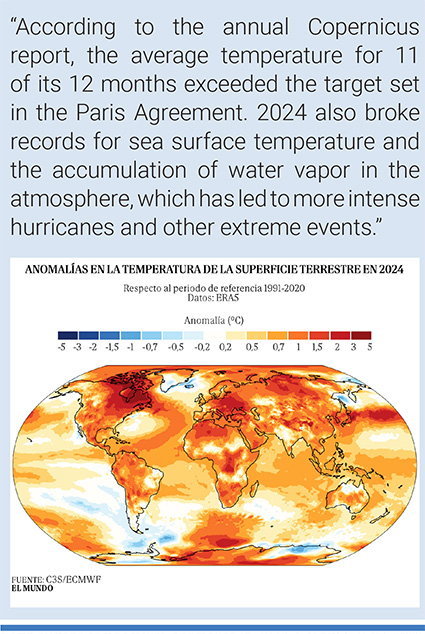
Next, media portrayals in January also focused on ecological and meteorological themes in various stories. To start the month there was news of global temperature surpassing a 1.5oC (2.7oF) temperature threshold in the heels of the warmest year (2024) on planet Earth. For example, BBC correspondents Mark Poynting, Erwan Rivault and Becky Dale wrote, “The planet has moved a major step closer to warming more than 1.5oC, new data shows, despite world leaders vowing a decade ago they would try to avoid this. The European Copernicus climate service, one of the main global data providers, said on Friday that 2024 was the first calendar year to pass the symbolic threshold, as well as the world's hottest on record. This does not mean the international 1.5C target has been broken, because that refers to a long-term average over decades, but does bring us nearer to doing so as fossil fuel emissions continue to heat the atmosphere. Last week UN chief António Guterres described the recent run of temperature records as "climate breakdown". "We must exit this road to ruin - and we have no time to lose," he said in his New Year message, calling for countries to slash emissions of planet-warming gases in 2025”. Elsewhere, El Mundo journalist Teresa Guerrero wrote, “According to the annual Copernicus report, the average temperature for 11 of its 12 months exceeded the target set in the Paris Agreement. 2024 also broke records for sea surface temperature and the accumulation of water vapor in the atmosphere, which has led to more intense hurricanes and other extreme events. It has also been a year with numerous extreme weather events around the world, from severe storms and floods to heat waves, droughts and forest fires. In fact, both the annual climate report by Copernicus and those of other organizations such as NASA, NOAA, the World Meteorological Organization (WMO) or the British Met Office - which will publish their analyses throughout this Friday - come the same week in which California suffers one of the worst fires in its history, fueled by very strong winds, and large areas of the USA have faced historic snowfalls.”
Also in January, winter weather with possible links made to climate change earned media attention. For example, BBC journalist Lucy Sheriff wrote, “Intense snowy wintry weather in the US has been fueled by activity of the polar vortex, slipping down to engulf large parts of the country. Early January's winter storm prompted seven states to declare states of emergency, with flights suspended, businesses shuttered and one area in New York recording 6.25ft (1.9m) of snowfall in just 24 hours. Another wave of Arctic air has kept temperatures lower than average through to the middle of January, and parts of the Midwest to the Appalachians and Atlantic Seaboard are expecting further wintry storms. This blast of cold weather is due to activity of the polar vortex… It is not known whether climate change will affect the polar vortex, says Amy Butler, an atmospheric scientist at the National Oceanic and Atmospheric Administration, and an expert on the polar vortex. There are several reasons why it is so hard to predict whether polar vortexes will strengthen or weaken in years to come”.
Satellite images collected by Maxar show the destruction of the Eaton Fire and Palisades Fire burning in Southern California. Credit: Maxar. |
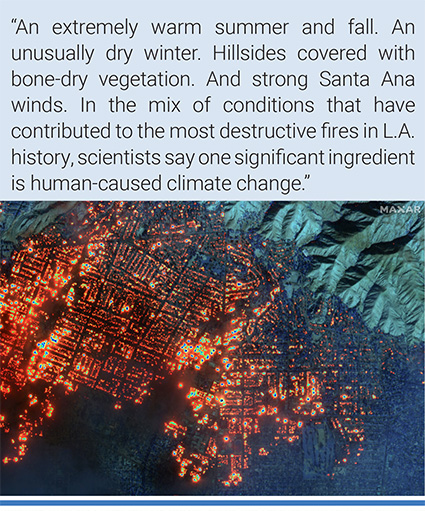
But most prominent in January news connecting the dots between ecological and meteorological events and climate change was attention paid to the devastating and destructive fire that spread across Los Angeles, California. While many stories about the fires did not address climate change, many still did. For example, US National Public Radio journalist Lauren Sommer reported, “In early January, the stage was set for a wildfire disaster in Los Angeles. A long, hot summer had dried out the plants and vegetation, making it more flammable. Drought conditions dragged on, as winter rains had yet to arrive. Then came powerful Santa Ana winds, gusting above 80 miles per hour. The result was more than 16,000 homes and buildings were destroyed after the fast-moving Eaton and Palisades fires exploded. In those extreme conditions, firefighters had little hope of getting control of the blazes. New studies are finding the fingerprints of climate change in these wildfires, which made some of the extreme conditions worse. In particular, the hotter temperatures and a drier atmosphere can be linked to heat-trapping gases that largely come from burning fossil fuels, according to two different analyses from the University of California, Los Angeles, and World Weather Attribution, a collaboration of international scientists. Still, for other extreme conditions that led to Los Angeles' fires, like the strong Santa Ana winds and lack of rain, discerning the role of climate change is scientifically trickier. While there may be a connection to climate change, it's harder to recognize given the state's highly variable weather, which normally swings from wet to dry years. The powerful computer models scientists use to analyze climate impacts also struggle with very small geographic areas or complex processes, like wildfire behavior. Climate scientists are developing ways to pinpoint the role climate change is playing in wildfires. Still, the most significant human influence may be how the wildfires started since there were no lightning storms at the time that would have sparked the fires”. Meanwhile, Los Angeles Times reporter Ian James wrote, “An extremely warm summer and fall. An unusually dry winter. Hillsides covered with bone-dry vegetation. And strong Santa Ana winds. In the mix of conditions that have contributed to the most destructive fires in L.A. history, scientists say one significant ingredient is human-caused climate change. A group of UCLA climate scientists said in an analysis this week that if you break down the reasons behind the extreme dryness of vegetation in Southern California when the fires started, global warming likely contributed roughly one-fourth of the dryness, one of the factors that fueled the fires’ explosive spread. Extreme heat in the summer and fall desiccated shrubs and grasses on hillsides, they said, enabling those fuels to burn more intensely once ignited. The scientists said without the higher temperatures climate change is bringing, the fires still would have been extreme, but they would have been “somewhat smaller and less intense.” The conditions that made such catastrophic fires possible are like three switches that all happened to be flipped on at the same time, said Park Williams, a climate scientist who prepared the analysis with colleagues Alex Hall, Gavin Madakumbura and others in UCLA’s Climate and Wildfire Research Initiative”. And Washington Post correspondent Diana Leonard wrote, “The unusually strong Santa Ana windstorm made the event a “recipe for disaster” he said, especially given the high population downslope of where the ignitions occurred. “To have almost no precipitation at this point in the year is very unusual for us,” Alex Hall, a climate scientist at the University of California at Los Angeles, said in an interview. “Typically, we have our first rains in November … and it’s enough to quench the thirst of the plants that have been dormant for much of the summer.” The rain would typically shut off the ability of Santa Ana winds — which ramp up in October and can blow through the winter — to create very large wildfires”.
Next, several January 2025 stories drew on primarily scientific themes when reporting on climate change or global warming. For instance, while links were being explored about connections between the fires in Los Angeles and climate change, the World Weather Attribution team published a study that earned significant media attention. For example, Guardian correspondent Damien Carrington noted, “A triple whammy of climate impacts boosted the risk of the ferocious fires that recently ravaged Los Angeles, a scientific study has shown. Firstly, the hot, dry and windy conditions that drove the fires were made 35% more likely by the global heating caused by fossil fuel burning. Secondly, the low rainfall seen from October to December is now about 2.4 times more likely than in the preindustrial past, before the climate crisis. Rains during these months have historically brought an end to the wildfire season around LA. Thirdly, conditions of high fire risk have extended by more than three weeks in today’s heated climate, now reaching into January. This means fires have more chance of breaking out during the peak Santa Ana winds, which can blow small fires into deadly infernos”. Also, BBC reporter Matt McGrath wrote, “Climate change was a major factor behind the hot, dry weather that gave rise to the devastating LA fires, a scientific study has confirmed. It made those weather conditions about 35% more likely, according to World Weather Attribution - globally recognized for their studies linking extreme weather to climate change. The authors noted that the LA wildfire season is getting longer while the rains that normally put out the blazes have reduced. The scientists highlight that these wildfires are highly complex with multiple factors playing a role, but they are confident that a warming climate is making LA more prone to intense fire events”. And El País journalist María Mónica Monsalves wrote, “Climate change made the conditions that fueled California's wildfires 35% more likely. The World Weather Attribution group of scientists presented the results of their latest study. Seasons with fire-prone factors are now 23 days longer. Climate change is making everything more extreme, and the tragic wildfires that hit Southern California earlier this year are no exception. According to a study published by the World Weather Attribution (WWA) initiative — a group of scientists seeking to answer the question of climate change’s role in these types of events as quickly as possible — it states that global warming did increase the likelihood of the Palisades and Eaton fires, the two that ignited Los Angeles, in which at least 28 people died and more than 16,000 properties were lost. “They have been the most destructive in the history of Los Angeles and potentially the most costly in the history of the United States,” the organization says in a statement”.

Figure 4. Examples of newspaper front pages with climate change stories relating to the Los Angeles, California area fires – with connections made to climate change – in January 2025.
An Electrify America public charging station in Monterey Park, California: Photo credit: Frederic J. Brown/AFP/Getty Images. |
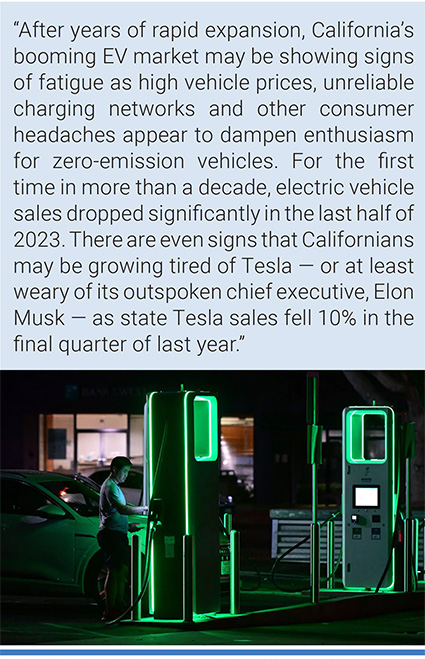
Last, cultural-themed stories relating to climate change or global warming also were evident in January, showing that climate change is not a single issue but a set of intersecting issues that thread through our lives and livelihoods, weaving through the many ways we work, play, recreate, play and rest in this world. To illustrate, while climate politics and policy dominated climate change news in January 2025, signs of a shifting electric vehicle (EV) market – with connections to avoiding climate change contributing emissions from gas-powered vehicles – were part of the January public discussion. For instance, Los Angeles Times reporter Russ Mitchell noted, “After years of rapid expansion, California’s booming EV market may be showing signs of fatigue as high vehicle prices, unreliable charging networks and other consumer headaches appear to dampen enthusiasm for zero-emission vehicles. For the first time in more than a decade, electric vehicle sales dropped significantly in the last half of 2023. There are even signs that Californians may be growing tired of Tesla — or at least weary of its outspoken chief executive, Elon Musk — as state Tesla sales fell 10% in the final quarter of last year”. Furthermore, New York Times journalist Lawrence Ulrich reported, “Many car buyers have come to rely on a $7,500 federal tax credit on electric vehicles to soften the blow of their high prices. But those credits could disappear after President-elect Donald J. Trump takes office, leading to an almost immediate drop in sales of the cars and trucks. Electric car sales could fall 27 percent if consumers lose the tax break, according to estimates published last week by three economics professors, Joseph Shapiro of the University of California, Berkeley, Felix Tintelnot of Duke University and Hunt Allcott of Stanford. Registrations of electric models are on track to hit 1.2 million this year, and estimates are that there would be about 317,000 fewer registered annually without the credit. Other countries that eliminated such subsidies have seen similar drops — in Germany, electric vehicle sales tumbled 27 percent in the first 10 months of the year, after the government last December abruptly canceled an incentive worth $4,900”.
In other culture-themed news, in January US billionaire Michael Bloomberg announced that his foundation was going to step in to fund the UN Framework Convention on Climate Change in the absence of Trump Administration contributions. For example, Straits Times reported, “Mr Bloomberg’s intervention aims to ensure that the United Nations Framework Convention on Climate Change (UNFCCC) remains fully funded, despite the US halting its contributions. The US typically provides 22 per cent of the UNFCCC secretariat’s budget, with the body’s operating costs for 2024 to 2025 projected at €88.4 million (S$124.9 million). “From 2017 to 2020, during a period of federal inaction, cities, states, businesses and the public rose to the challenge to uphold our nation’s commitments – and now, we are ready to do it again,” Mr Bloomberg, who serves as the UN Special Envoy on Climate Ambition and Solutions, said in a statement. This marks the second time Mr Bloomberg has stepped in to fill the gap left by US federal disengagement. In 2017, following the Trump administration’s first withdrawal from the Paris accord, Mr Bloomberg pledged up to US$15 million to support the UNFCCC. He also launched America’s Pledge, an initiative to track and report US non-federal climate commitments, ensuring the world could monitor US progress as if it were still a fully committed party to the Paris Agreement. Mr Bloomberg reiterated his commitment to upholding US reporting obligations this time as well”.

Figure 5. Examples of newspaper front pages with climate change stories in January 2025.
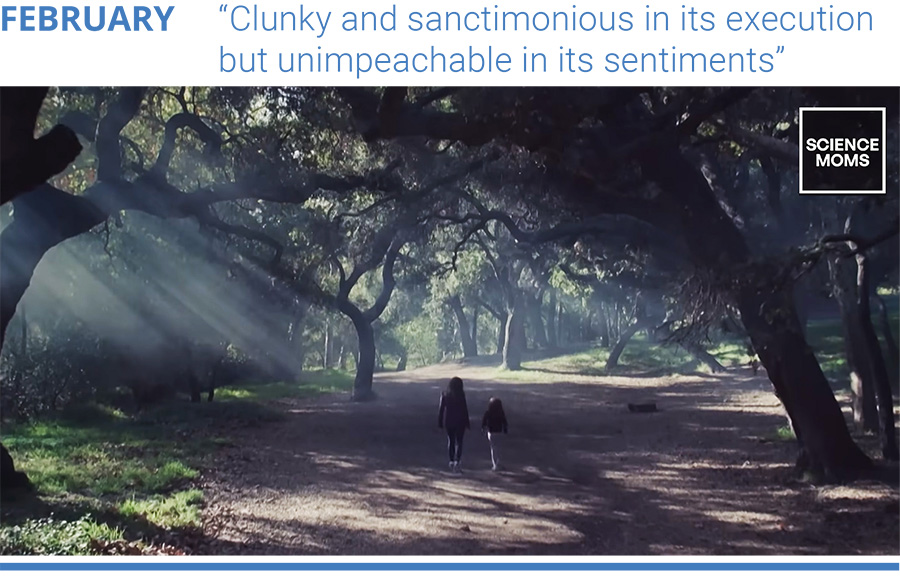
Image captured from Science Moms climate change advertisement. Credit: Science Moms.

February media coverage of climate change or global warming in newspapers around the globe dropped 23% from January 2025. Furthermore, coverage in February 2025 dipped 2% from February 2025. In February, international wire service coverage plunged 36% from the month earlier (January) and 18% from the previous year (February 2025). Figure 1 shows trends in newspaper media coverage at the global scale – organized into seven geographical regions around the world – across 21 years, from February 2004 through February 2025.
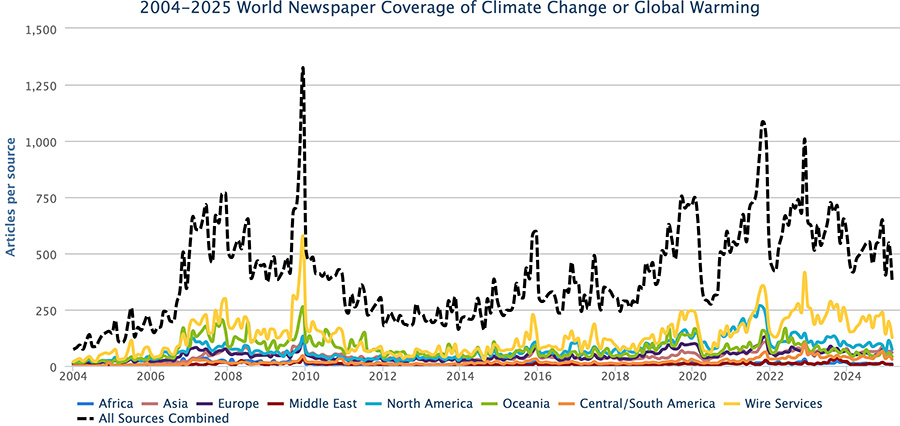
Figure 1. Newspaper media coverage of climate change or global warming in print sources in seven different regions around the world, from January 2004 through February 2025.
At the regional level, February 2025 coverage increased in Africa (+10%) compared to the previous month. Meanwhile, coverage went down in Asia (-9%), the European Union (EU) (-21%), Oceania (-30%), Latin America (-33%), North America (-36%) and the Middle East (-37%) (see Figure 2). It appears that climate change news coverage largely took a back seat in February to other issues that were not linked to a heating planet. Meanwhile, Comparing these February 2025 levels of coverage to a year previous (February 2024), numbers were up in Latin America (+7%), the Middle East (+9%), and Asia (+25%). Elsewhere, coverage dropped in Oceania (-4%), North America (-11%), the EU (-16%), and Africa (-26%).
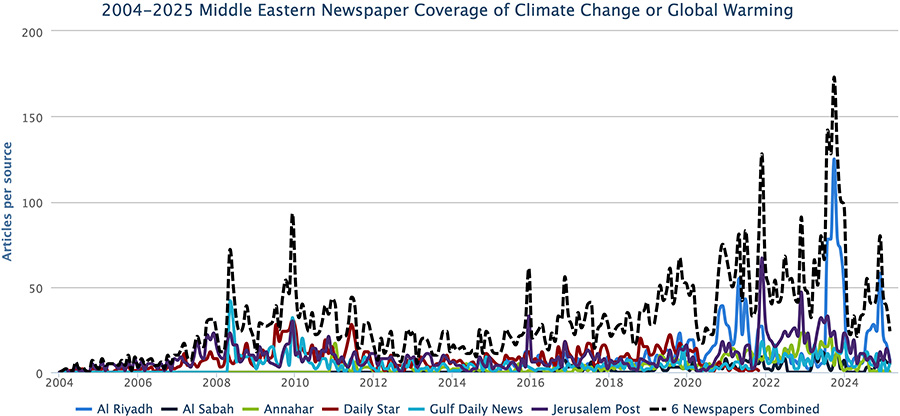
Figure 2. Coverage of climate change or global warming in the Middle East from January 2004 through February 2025: Al Riyadh (Saudi Arabia), Al Sabah (Iraq), Annahar (Lebanon), Daily Star (Lebanon), Gulf Daily News (Bahrain), and Jerusalem Post (Israel).
Among our country-level monitoring, in February US print coverage (see Figure 3) dropped 30% from January 2025 levels of coverage. Coverage in the Wall Street Journal held steady, while coverage dipped 19% at the USA Today, 28% lower in the New York Times, and down 30% at the Washington Post, while going down 44% in the Los Angeles Times.

Figure 3. US newspapers’ – Los Angeles Times, New York Times, USA Today, Wall Street Journal, and Washington Post – coverage of climate change or global warming from January 2000 through February 2025.
A rally against cuts to NOAA in front of the Commerce Department in Washington. Photo: Amelia Davidson/POLITICO's E&E News. |
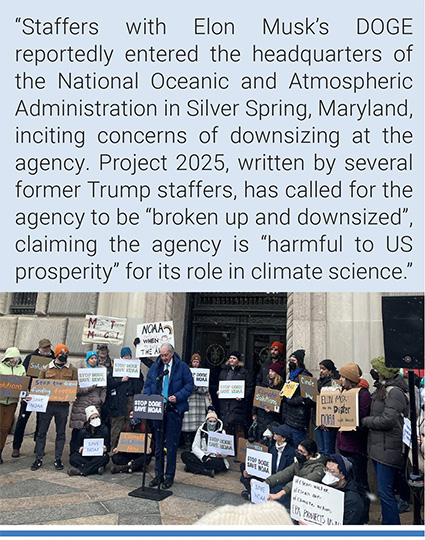
For what appeared in coverage of climate change or global warming in February 2025, political and economic-themed media stories were dominant among the larger pool of overall accounts. Stories about the consequences from the transition of power in the United States (US) to the Trump administration cycled throughout the month. For an example of one story among many throughout the month, early in February Guardian journalist Michael Sainato wrote about the Department of Government Efficiency (DOGE) efforts to disrupt federal climate science processes. He noted, “Staffers with Elon Musk’s “department of government efficiency” (DOGE) reportedly entered the headquarters of the National Oceanic and Atmospheric Administration (NOAA) in Silver Spring, Maryland, and the Department of Commerce in Washington DC today, inciting concerns of downsizing at the agency. “They apparently just sort of walked past security and said: ‘Get out of my way,’ and they’re looking for access for the IT systems, as they have in other agencies,” said Andrew Rosenberg, a former NOAA official who is now a fellow at the University of New Hampshire. “They will have access to the entire computer system, a lot of which is confidential information.” Project 2025, written by several former Trump staffers, has called for the agency to be “broken up and downsized”, claiming the agency is “harmful to US prosperity” for its role in climate science. Rosenberg noted it had been a longtime goal of corporations that rely on NOAA data to prevent the agency from making the data public, instead of giving it directly to private corporations that create products based on it, such as weather forecasting services. He also argued there was no legal authority to abolish NOAA or reduce its budget, outside of reducing it through Congress. In a second example, New York Times journalist Coral Davenport wrote, “One hundred and sixty-eight employees at the Environmental Protection Agency’s Office of Environmental Justice were placed on administrative leave on Thursday, according to agency officials. The notification of leave, sent via email to employees about 5 p.m., was a major step in President Trump’s widely expected plan to do away with the office. On his first day back in the White House, he signed an executive order to eliminate all government programs on environmental justice, which are aimed at helping poor and minority communities that are face disproportionate amounts of pollution. These communities are often located near industrial areas or other heavily contaminated places. “E.P.A. is working to diligently implement President Trump’s executive orders, including the ‘Ending Radical and Wasteful Government D.E.I. Programs and Preferencing,” said Molly Vaseliou, an E.P.A. spokeswoman, in a statement, referring to a directive to eliminate diversity, equity and inclusion programs. “President Trump was elected with a mandate from the American people to do just this.” Ms. Vaseliou said that the work of the staffers placed on leave “did not relate to the agency’s statutory duties or grant work.” Many of the agency’s additional 100 or so environmental justice employees who work in its regional offices around the country are expected to be the next in line to be placed on administrative leave, said two people familiar with the agency’s plans, who spoke anonymously out of fear of retaliation. By law, no employee can be on administrative leave for more than 10 days in a year. Observers said they interpret the administrative leave notices as a first step toward the eventual shuttering the office”.
FEMA has helped develop building codes for decades, including standards that reduce the risk that houses will flood in storms and hurricanes. Photo: Miguel J. Rodriguez Carrillo/AFP/Getty Images. |
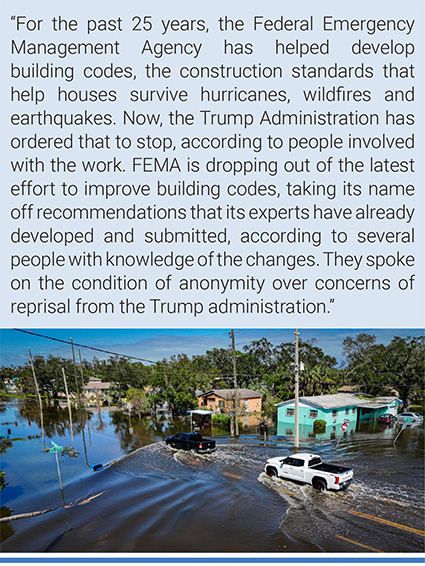
As a third example, US National Public Radio journalist Lauren Sommer shared, “For the past 25 years, the Federal Emergency Management Agency (FEMA) has helped develop building codes, the construction standards that help houses survive hurricanes, wildfires and earthquakes. Now, the Trump Administration has ordered that to stop, according to people involved with the work. NPR has learned that FEMA is dropping out of the latest effort to improve building codes, taking its name off recommendations that its experts have already developed and submitted, according to several people with knowledge of the changes. They spoke on the condition of anonymity over concerns of reprisal from the Trump administration. The recommendations FEMA submitted were filed with the International Code Council (ICC), an independent association that develops building codes used by states and local governments, since the U.S. does not have a national set of codes. The proposals FEMA is retracting its involvement from focus on helping homes survive strong winds, seismic shaking and rising floodwaters. FEMA did not respond to questions about why it made the request and the ICC did not respond to questions about whether they were honoring it. In recent years, Republican leaders have criticized FEMA and building codes, saying the regulations are burdensome. Strengthening building codes has historically been opposed by the homebuilding and construction industries over concerns about the cost. Studies show modern building codes have saved billions of dollars in damage from natural disasters. Disaster experts say it's a concerning move, one not seen under the first Trump Administration…. The ICC convenes experts and stakeholders in the building industry to review and improve building codes every three years and is developing a new set of standards now. After they're approved, many local and state governments across the country adopt the codes, which set the mandatory construction rules in their communities. Since FEMA pays out billions of dollars to help devastated communities rebuild, Congress directed the agency to encourage states to adopt more protective building codes for natural hazards. The damage from flooding alone hits $46 billion per year on average and is only expected to increase as hurricanes and rainstorms get more severe as the climate gets hotter”.
Wes Gillingham of the Northeast Organic Farming Association of New York, one of the plaintiffs. Photo: Bryan Anselm/New York Times. |

Meanwhile as the month unfolded, there were other stories linked to the US Trump Administration’s actions. For example, New York Times journalist Karen Zraick reported, “Organic farmers and environmental groups sued the Agriculture Department on Monday over its scrubbing of references to climate change from its website. The department had ordered staff to take down pages focused on climate change on Jan. 30, according to the suit, which was filed in the United States District Court for the Southern District of New York. Within hours, it said, information started disappearing. That included websites containing data sets, interactive tools and funding information that farmers and researchers relied on for planning and adaptation projects, according to the lawsuit. At the same time, the department also froze funding that had been promised to businesses and nonprofits through conservation and climate programs. The purge then “removed critical information about these programs from the public record, denying farmers access to resources they need to advocate for funds they are owed,” it said. The Agriculture Department referred questions about the lawsuit to the Justice Department, which did not immediately respond to a request for comment. The suit was filed by lawyers from Earthjustice, based in San Francisco, and the Knight First Amendment Institute at Columbia University, on behalf of the Northeast Organic Farming Association of New York, based in Binghamton; the Natural Resources Defense Council, based in New York; and the Environmental Working Group, based in Washington. The latter two groups relied on the department website for their research and advocacy, the lawsuit said. Peter Lehner, a lawyer for Earthjustice, said the pages being purged were crucial for farmers facing risks linked to climate change, including heat waves, droughts, floods, extreme weather and wildfires. The websites had contained information about how to mitigate dangers and adopt new agricultural techniques and strategies. Long-term weather data and trends are valuable in the agriculture industry for planning, research and business strategy”.
Outside of the dominant US political context, there were many other February news stories relating to political and economic issues. For example, in South America Associated Press correspondent Fabiano Maissonnave reported, “Brazil’s government on Tuesday approved joining OPEC+, a group of major oil-exporting nations, signaling the country’s evolution into a major oil state just nine months ahead of hosting the United Nations’ annual climate summit. The National Council for Energy Policy’s approval came in response to an official invitation in 2023. The group includes the 12 members of OPEC, the longstanding group set up to coordinate oil production to stabilize markets, plus 10 more significant oil-producing nations with Russia by far the largest. Though non-OPEC members agree to cooperate with OPEC nations, Brazil won’t have any binding obligation such as production cuts, Mines and Energy Minister Alexandre Silveira said at a news conference. The participation will be limited to the Charter of Cooperation, a permanent forum for OPEC and OPEC+ countries to discuss industry-related issues. The South American country will not participate in decisions… Lula’s pursuit of increased oil production, however, has met criticism as Brazil prepares to host the UN climate summit known as COP30 in November. A central push of the annual climate talks has been to reduce the use of fossil fuels, which when burned releases greenhouse gases that heat the planet”.
|
In Europe, the newspaper El País published an editorial entitled A Less Green Europe about how the European Commission presented a plan to simplify environmental rules with the aim of reducing the regulatory burden on people and businesses. The editors noted, “The core of the reforms is the exemption for small and medium-sized companies from complying with a large part of the new ecological requirements. Among them, the obligation to measure and document the environmental impact of their operations and include it in the information they provide to shareholders and the general public. Large firms must comply with this obligation, but they are given an extension to do so. The need to develop specific plans in this regard in particularly polluting sectors is also eliminated. The same happens with the mechanism for offsetting carbon dioxide emissions for imports, which requires certifying the payment of fees for the purchase from third countries of products such as cement, iron, steel, aluminum and fertilizers. Its objective was to compensate for less stringent emissions control and reduce environmental dumping.”
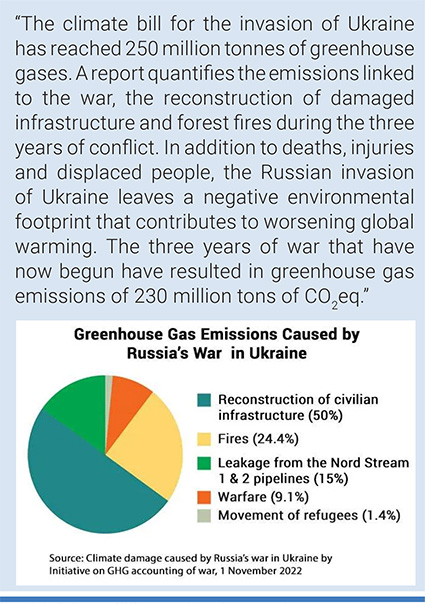
Moreover, much attention was being paid to Russia’s ongoing invasion of Ukraine, with some stories discussing emissions associated with this conflict. For example, El País journalist Manuel Planelles wrote, “The climate bill for the invasion of Ukraine has reached 250 million tonnes of greenhouse gases. A report quantifies the emissions linked to the war, the reconstruction of damaged infrastructure and forest fires during the three years of conflict. In addition to deaths, injuries and displaced people, the Russian invasion of Ukraine leaves a negative environmental footprint that contributes to worsening global warming. The three years of war that have now begun have resulted in greenhouse gas emissions of 230 million tons of CO₂eq (carbon dioxide equivalent, the unit used to measure these gases). This is an enormous amount, similar to what 120 million combustion cars would emit on average in an entire year. The calculation of the climate footprint of war has been prepared by several experts grouped together in the so-called Initiative on GHG Accounting of War.”
In other European news addressing politics and the economy, there were several stories about Artificial Intelligence and increased electricity demand from fossil fuel sources (thereby contributing more to climate change) in the coming years. For instance, La Vanguardia Piergiorgio M. Sandri noted, “In the midst of a technological race, Europe has this week formalized its commitment to artificial intelligence with an ambitious investment plan. The European data center market, valued at 42.98 billion dollars in 2023, is expected to reach 64.5 billion in 2029, according to a study by the consultancy firm Aritzon. The problem is that these facilities are thirsty not only for water (which they also need), but for electricity. For example, a query on ChatGPT consumes ten times more than one on Google. A recent report by the organization Beyond Fossils Fuels has calculated that electricity demand will soar in Europe by 160% over the course of this decade to serve these infrastructures. By 2030, some 287 Twh will need to be added to the grid per year, the equivalent of Spain's electricity consumption in 2022. It is as if a new member country were joining the European grid”.
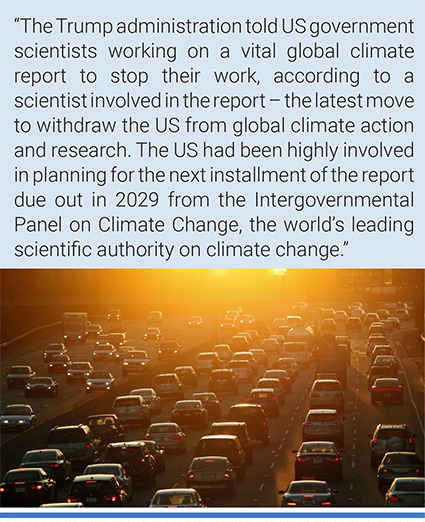
Eastbound 101 freeway traffic on a record-hot day in Los Angeles. The Trump administration is blocking federal scientists from working on the IPCC report due out in 2029. Those same scientists have warned global temperatures are rising precipitously. Photo: Al Seib/Los Angeles Times/Getty Images. |
Meanwhile in Asia, there were stories about how various countries – China in particular – are missing emissions reductions targets. Across the world, over 90% of member nation countries missed the February United Nations deadline to submit their 2035 climate pledges. For example, Straits Times reporters discussed how “China missed a key climate target in 2024 and emissions in the world’s second-largest economy rose slightly as coal remained dominant despite record renewable additions, official data showed on Feb 28. The figures mean the world’s biggest emitter is off-track on a key commitment under the Paris climate agreement, analysts said. Beijing’s National Bureau of Statistics (NBS) said carbon intensity, which measures emissions of planet-warming carbon dioxide per unit of gross domestic product, fell 3.4 per cent in 2024 – short of an official goal of 3.9. That also put the country well behind on its goal for an 18 per cent reduction from 2020 to 2025. The data showed carbon emissions rose slightly from 2024, though far short of previous jumps, as experts speculate about whether China may have reached peak emissions ahead of a 2030 target. Still, the data showed it will be “extremely hard” for China to meet a pledge to reduce carbon intensity by 65 per cent of 2005 levels by 2030, said Mr Lauri Myllyvirta, lead analyst at the Centre for Research on Energy and Clean Air”.
Meanwhile, back in North America CNN reporters Ella Nilsen and Laura Paddison noted, “The Trump administration told US government scientists working on a vital global climate report to stop their work, according to a scientist involved in the report – the latest move to withdraw the US from global climate action and research. The US had been highly involved in planning for the next installment of the report due out in 2029 from the Intergovernmental Panel on Climate Change, the world’s leading scientific authority on climate change. The IPCC assesses how the climate crisis is affecting the planet according to the latest science. Its reports take thousands of scientists many years to produce and are used to inform policymakers across the world of the risks posed by global warming. In a sense, all of the world’s current, accepted knowledge about climate change stems from the IPCC and its reports, the first of which was published in 1990. An international meeting of IPCC authors that was scheduled to take place in China next week is now in limbo. Kate Calvin, NASA’s chief scientist and senior climate advisor, was supposed to co-chair the discussion but was impacted by the stop-work order, according to the scientist involved in the report. The meeting was planned to talk about next steps in the development of the report”.
An aerial view of homes destroyed in the Palisades Fire, in Pacific Palisades, California. Photo: Mario Tama/Getty Images. |
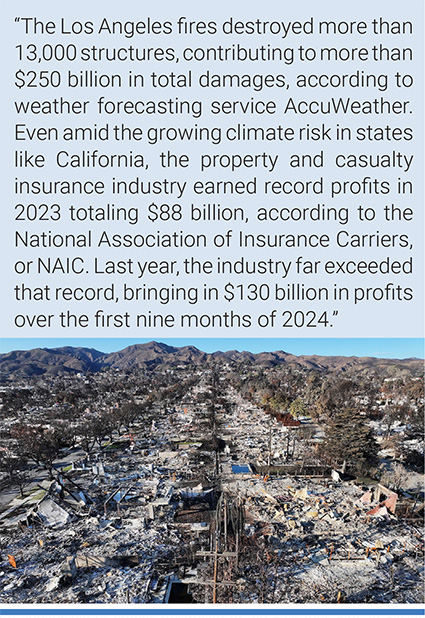
Next, cultural-themed stories relating to climate change or global warming filled in February in our lives. To illustrate, ongoing discussions regarding how climate change fueled wildfires across Los Angeles California in the US were pressing on the logics of insurance in many areas. For example, ABC News reporters Matt Gutman, Cho Park, Megan Christie, Kate Holland, Evan Simon, Tomas Navia, and Max Zahn noted, “Soon after wildfires broke out in Los Angeles, California, earlier this month, Jewlz Fahn received a panicked call from her husband, Terry, telling her they needed to evacuate their home in the Pacific Palisades. "For some reason, I wasn't thinking clearly. I grabbed a pair of shorts because I was like, well, it might be hot later today," Terry Fahn said. "I was thinking about packing more. But I was like, 'We'll be back.' And that was a mistake." The couple lost their home in the fire and nearly all of their possessions. While they wait for a rental property to become available, Jewlz and Terry are now living in a hotel room with their dog Coda. Jewlz and Terry Fahn make up one of thousands of Los Angeles households seeking to recover their losses after the devastation. The fires destroyed more than 13,000 structures, contributing to more than $250 billion in total damages, according to weather forecasting service AccuWeather. Insurance companies typically fill the gap, helping homeowners overcome their losses and rebuild their homes. After a natural disaster of this scale, however, questions abound over whether residents will be able to access the funds they need. It’s a nationwide trend amid increasingly frequent climate disasters that some experts say could lead to an "uninsurable future."… Even amid the growing climate risk in states like California, the property and casualty insurance industry earned record profits in 2023 totaling $88 billion, according to the National Association of Insurance Carriers, or NAIC. Last year, the industry far exceeded that record, bringing in $130 billion in profits over the first nine months of 2024, credit rating agency AM Best found. "They're supposed to be a risk-bearing industry, but now, even the slightest hint of what might be a new risk and they're walking away," Douglas Heller, director of insurance at the Consumer Federation of America, told ABC News. "The insurance companies have bulked up their profits even as they were walking away from our state and our communities." Kevelighan disputed such criticism, saying focus on the overall strength of the property insurance industry risks overlooking the business impact of high costs tied to climate events like the California wildfires. "So taking aggregate figures from an industry that represents a large amount of our economy and employs over 3 million people in this country, I think we want to also put it into perspective … these large numbers that we're talking about here," Kevelighan said. Criticism from consumer advocates not only targets the profits earned by insurance companies but also the investments made by the firms. The nation’s insurers hold more than $500 billion in fossil fuel-related assets, according to a study published last year by climate advocacy groups Ceres and Environmental Resources Management, as well as risk-assessment firm Persefoni. Insurers’ holdings in fossil fuel-related assets help perpetuate the climate risk the companies cite for their choice to pause or withhold coverage for some customers, Dave Jones, who served as the California insurance commissioner from 2011 to 2018, told ABC News”.
Also, a climate-related Superbowl advertisement generated news attention in February. For example, New York Times journalist Mike Hale described an advertisement put out by ‘Climate Moms’. He wrote, “the likely progress of climate change is charted along the timeline of a newborn girl’s life. A little clunky and sanctimonious in its execution but unimpeachable in its sentiments”.
Photo: scphoto/Alamy. |
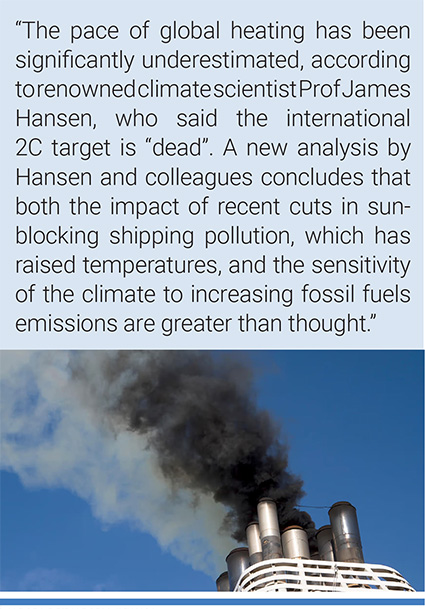
Next, there were February 2025 stories that drew on primarily scientific themes when reporting on climate change or global warming. For instance, new research in the journal Environment: Science and Policy for Sustainable Development current climate models underestimate the rate of actual temperature rise, and this generated considerable news attention. For example, Guardian correspondent Damien Carrington wrote, “The pace of global heating has been significantly underestimated, according to renowned climate scientist Prof James Hansen, who said the international 2C target is “dead”. A new analysis by Hansen and colleagues concludes that both the impact of recent cuts in sun-blocking shipping pollution, which has raised temperatures, and the sensitivity of the climate to increasing fossil fuels emissions are greater than thought. The group’s results are at the high end of estimates from mainstream climate science but cannot be ruled out, independent experts said. If correct, they mean even worse extreme weather will come sooner and there is a greater risk of passing global tipping points, such as the collapse of the critical Atlantic ocean currents”.
As a second illustration of new coverage of climate research in February involved new research in the journal Nature found weakening of the Atlantic Meridional Overturning Circulation due to global warming. For example, staff at The Jerusalem Post wrote, “while the Atlantic Meridional Overturning Circulation (AMOC) is expected to weaken this century due to climate change, a full collapse is unlikely. The study, led by Dr. Jonathan Baker of the Met Office, simulated the development of the AMOC under extreme conditions, including a quadrupling of atmospheric CO₂ levels and a massive influx of meltwater. The researchers used 34 climate simulation models to calculate interactions between the atmosphere, cryosphere, and oceans, considering the Southern and Indian Oceans. "Our modelling study suggests that the AMOC will resist pressures from rising global temperatures and inputs of freshwater into the North Atlantic, with the weakened system being largely driven by winds over the Southern Ocean," said Baker. The main reason for the AMOC's resilience is persistent upwelling in the Southern Ocean, driven by strong westerly winds, which compensates for AMOC weakening. The mechanism prevents a total collapse of the AMOC this century, even under the most extreme climate scenarios, the study found. However, scientists warn that even without a complete collapse, a weaker AMOC could have impacts on the global climate, including disruption to weather patterns, rising sea levels on North Atlantic coastlines, and effects on ocean ecosystems. According to New Scientist, weakening of the AMOC would change global rainfall patterns, impacting crop yields around the world, and in regions like the Mediterranean, there could be alterations in rainfall regimes, leading to more arid conditions and increased droughts”.
Last, media portrayals in February that focused on ecological and meteorological themes in various stories were much less abundant than in January. Yet to start the month, news that January was the warmest year on record generated news attention. For example, New York Times journalist Raymond Zhong wrote, “Even as much of the United States shivered under frigid conditions last month, the planet as a whole had its warmest January on record, scientists said on Thursday. The warmth came as something of a surprise to climate researchers. It occurred during La Niña conditions in the Pacific Ocean, which tend to lower the globe’s average temperature, at least temporarily. Earth’s surface has now been so warm for so much of the past two years that scientists are examining whether something else in the planet’s chemistry might have changed, something that is boosting temperatures beyond what carbon emissions alone can explain. Those emissions, the byproduct of burning coal, gas and oil, remain the main driver of global warming, which reached record levels in both 2023 and 2024. It’s because of La Niña that scientists expected this year to be slightly cooler than the past two years, both of which experienced the opposite pattern, El Niño. The waters of the eastern tropical Pacific oscillate between El Niño and La Niña conditions, influencing weather worldwide by changing the balance between heat in the ocean and heat in the air”.

Figure 4. Examples of newspaper front pages with climate change stories in February 2025.
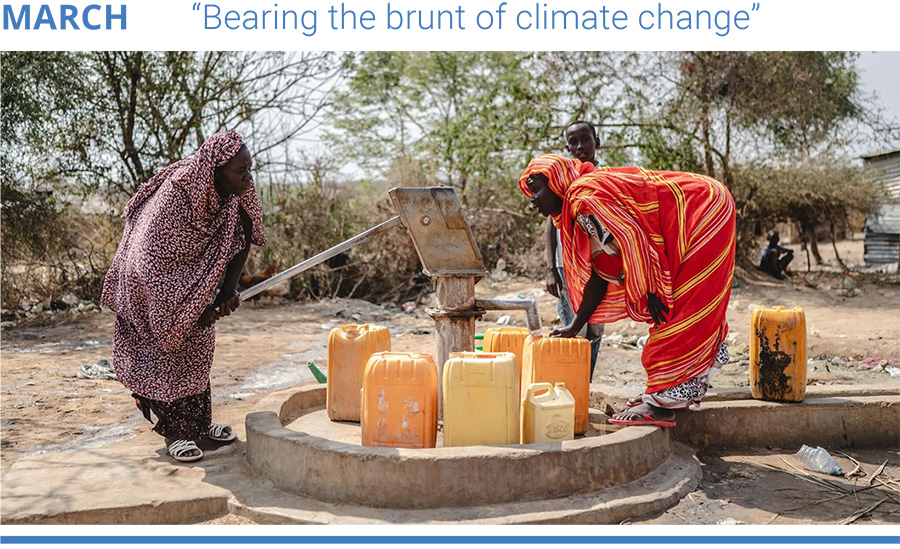
Displaced people collected water on the outskirts of Juba, South Sudan. Photo: Wang Guansen/Xinhua/Getty Images.

March media coverage of climate change or global warming in newspapers around the globe went up 7% from February 2025. However, coverage in March 2025 decreased 5% from March 2024. Figure 1 shows trends in newspaper media coverage at the global scale – organized into seven geographical regions around the world – across 21 years, from January 2004 through March 2025.
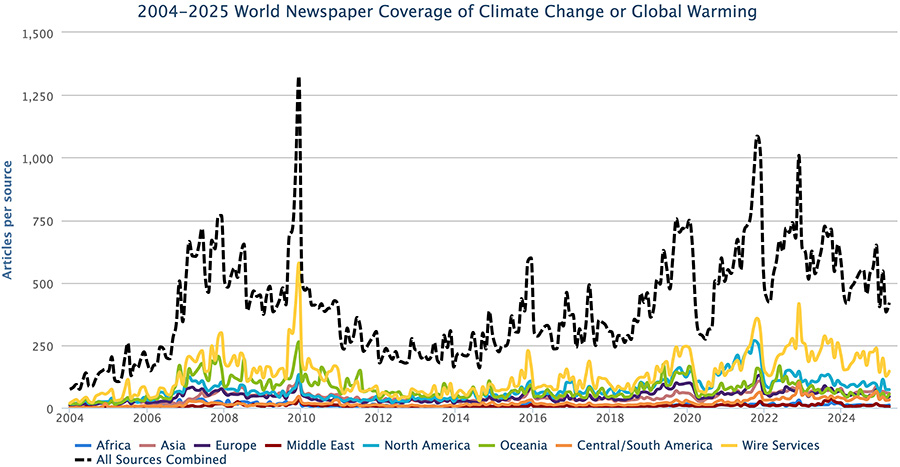
Figure 1. Newspaper media coverage of climate change or global warming in print sources in seven different regions around the world, from January 2004 through March 2025.
At the regional level, March 2025 coverage – compared to the previous month – increased everywhere but in North America (dipping slightly by 1%), Asia (decreasing 4%), and the Middle East (which dropped 12.5%): Latin America (+6%) (see Figure 2), the European Union (EU) (+9%), Africa (+21%), and Oceania (+33%). It appears that climate change news coverage largely took a back seat in March to other issues that were not linked to a heating planet. Meanwhile, comparing these March 2025 levels of coverage to a year previous (March 2024), counts increased only in Latin America (+4%), Asia (+11%), and Africa (+14%). Meanwhile, coverage dropped in the EU (-10%), Oceania (-12%), North America (-21%), and in the Middle East (-36%).
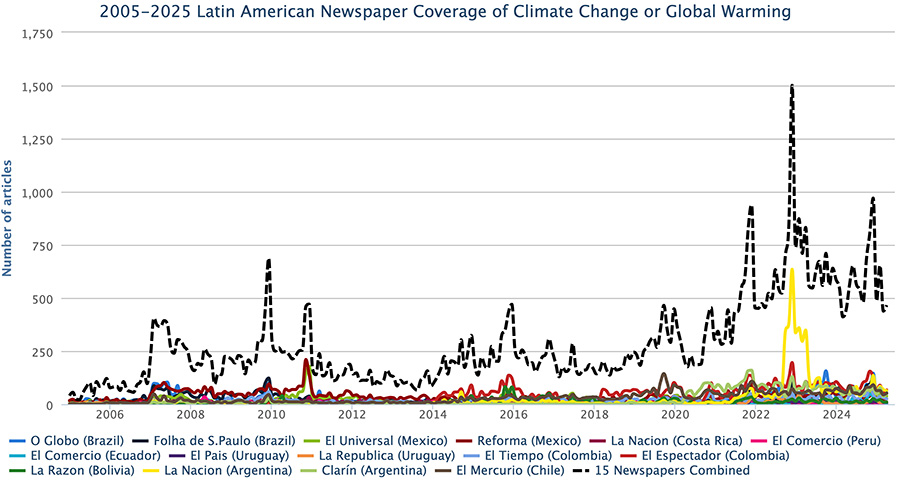
Figure 2. Coverage of climate change or global warming Latin America from January 2005 through March 2025: El Universal (México), Reforma (México), La Nación (Costa Rica), El Comercio (Perú), El Comercio (Ecuador), El País (Uruguay), La República (Uruguay), El Tiempo (Colombia), El Espectador (Colombia), La Razón (Bolivia), O'Globo (Brasil), Folha de S.Paulo (Brazil), La Nación (Argentina), Clarín (Argentina) and El Mercurio (Chile).
People queue to fill water during a heat wave at Chilla Village in New Delhi, India. Photo: Raj K Raj/Hindustan Times/Getty Images. |
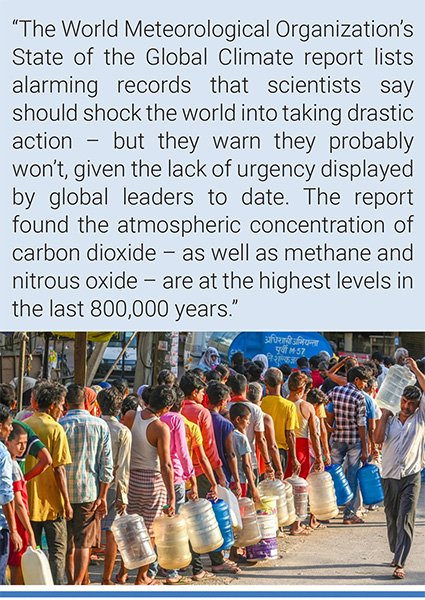
Turning to content of March 2025 coverage, several stories drew on primarily scientific themes when reporting on climate change or global warming. For instance, New York Times journalist Austyn Gaffney reported, “After a blistering February heat wave in South Sudan’s capital caused dozens of students to collapse from heat stroke, officials closed schools for two weeks. It was the second time in less than a year that the country’s schools closed to protect young people from the deadly effects of extreme heat. Climate change, largely caused by the burning of fossil fuels in rich nations, made at least one week of that heat wave 10 times as likely, and 2 degrees Celsius hotter, according to a new study by World Weather Attribution. Temperatures in some parts of the region soared above 42 degrees Celsius, or 107 degrees Fahrenheit, in the last week of February. The analysis used weather data, observations and climate models to get the results, which have not been peer reviewed but are based on standardized methods. South Sudan, in the tropical band of East Africa, was torn apart by a civil war that led to independence from Sudan in 2011. It’s also one of the countries least responsible for the greenhouse gas emissions that are heating up the globe. “The continent has contributed a tiny fraction of global emissions, but is bearing the brunt of climate change,” said Joyce Kimutai, a researcher at the Center for Environmental Policy at Imperial College London. Heat waves are one of the deadliest extreme weather events and have become more frequent and more severe on a warming planet. But analysis methods connecting heat to mortality vary between and within countries, and death tolls can be underreported and are often unknown for months after an event. Prolonged heat is particularly dangerous for children, older adults and pregnant women. For the last three weeks, extreme heat has settled over a large region of continental Eastern Africa, including parts of Kenya and Uganda. Residents have been told to stay indoors and drink water, a difficult directive for countries where many people work outdoors, electricity is sporadic, access to clean water is difficult and modest housing means there are few cooling systems”.
Also, scientific findings of a new all-time low in global sea ice garnered media attention. For example, United Press International journalist Jesse Farrell wrote, “Global sea ice reached a new record low in February, according to the European Union's Copernicus Climate Change Service. This data, which combines the extent of sea ice from the Arctic and Antarctic, has records that date back to the late 1970s. Previously, 2023 held the record low for global ice following decades of decline. Scientists blame an Arctic heat wave for the new record, which prevented the normal growth of ice in February. Arctic sea ice reached its lowest monthly extent for February, at 8 below the historical average, Copernicus said. The Arctic had previously set a record low for minimum (summer) ice just last year in September”.
Later in the month, the World Meteorological Organization’s ‘State of the Climate Report’ was released and earned media attention. For example, CNN journalist Hilary Whiteman wrote, “A report considered the world’s most trusted source of climate updates has laid out the parlous state of a planet that has recorded its 10 hottest years over the last decade. The World Meteorological Organization’s State of the Global Climate report lists alarming records that scientists say should shock the world into taking drastic action – but they warn they probably won’t, given the lack of urgency displayed by global leaders to date. The report found the atmospheric concentration of carbon dioxide – as well as methane and nitrous oxide – are at the highest levels in the last 800,000 years”.
A boat travels through a frozen sea inlet outside in Nuuk, Greenland on March 6, 2025. Photo: Evgeniy Maloletka/AP. |
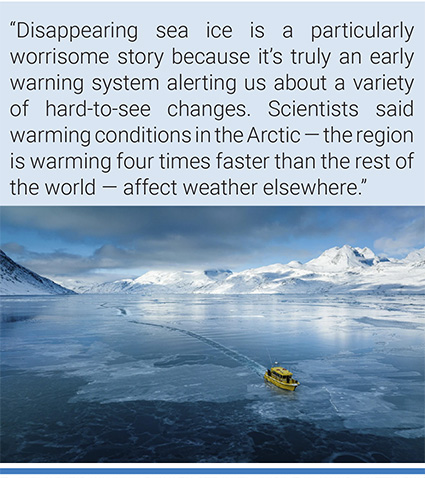
At the end of March, the University of Colorado National Snow and Ice Data Center reported record lows of Arctic sea ice. This earned media attention in several outlets. For example, Associated Press journalist Seth Borenstein reported, “Arctic sea ice had its weakest winter buildup since record-keeping began 47 years ago, a symptom of climate change that will have repercussions globally, scientists said Thursday. The Arctic reaches its maximum sea ice in March each year and then starts a six-month melt season. The National Snow and Ice Data Center said the peak measurement taken Saturday was 5.53 million square miles (14.33 million square kilometers) — about 30,000 square miles (80,000 square kilometers) smaller than the lowest previous peak in 2017. That’s a difference about the size of California. “Warming temperatures are what’s causing the ice to decline,’' ice data scientist Walt Meier said. “You know, sea ice in particular is very sensitive... 31 degrees is ice skating and 33 degrees it’s swimming.” Jennifer Francis, a scientist at the Woodwell Climate Research Center in Cape Cod, said this is yet another ringing alarm bell in the form of a broken record. “Disappearing sea ice is a particularly worrisome story because it’s truly an early warning system alerting us about a variety of hard-to-see changes,” Francis said in an email. Scientists said warming conditions in the Arctic — the region is warming four times faster than the rest of the world — affect weather elsewhere. Pressure and temperature differences between north and south shrink. That weakens the jet stream, that moves weather systems along, making it dip further south with cold outbreaks and storms that often get stuck and rain or snow more, according to the snow and ice center and Francis”.
Next, many media portrayals in March also focused on ecological and meteorological themes in various stories. For example, Times of India reporters wrote, “Climate change is rapidly intensifying, scientists warn that the cooling effects of La Nina may not be sufficient to offset the rising temperatures in a warming future. As India grapples with unusually high temperatures, the India Meteorological Department has predicted an early and intense summer this year, with prolonged heatwaves…human-caused climate change is leading to a ‘new normal’ of warmer winters and shorter springs. However, scientists emphasize that annual weather patterns, known as ‘year to year variability’ still play a crucial role in influencing seasonal conditions”.
Drone shots show scale of Amazon deforestation for COP30 road. Credit: BBC. |
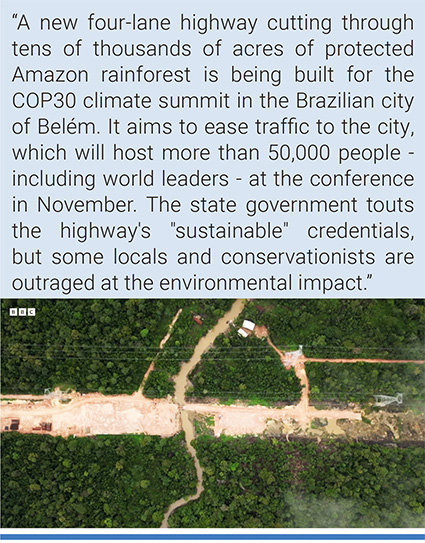
Meanwhile, in the lead up to the UN climate negotiation later this year in Brazil BBC journalist Ione Wells broke the story writing, “A new four-lane highway cutting through tens of thousands of acres of protected Amazon rainforest is being built for the COP30 climate summit in the Brazilian city of Belém. It aims to ease traffic to the city, which will host more than 50,000 people - including world leaders - at the conference in November. The state government touts the highway's "sustainable" credentials, but some locals and conservationists are outraged at the environmental impact. The Amazon plays a vital role in absorbing carbon for the world and providing biodiversity, and many say this deforestation contradicts the very purpose of a climate summit. Along the partially built road, lush rainforest towers on either side - a reminder of what was once there. Logs are piled high in the cleared land which stretches more than 13km (8 miles) through the rainforest into Belém. Diggers and machines carve through the forest floor, paving over wetland to surface the road which will cut through a protected area”.
Elsewhere, in March people in Korea battled record-breaking wildfires that were linked to a changing climate. For example, New York Times correspondent Jin Yu Young reported, “At least 26 people have died in the worst wildfires on record in South Korea, massive infernos that have spread quickly over the past week, consuming hundreds of structures including two ancient Buddhist temples, officials said. The Interior Ministry gave the updated death toll in a report issued Thursday morning local time. It also said the blazes, which began last Friday, had scorched or were still burning across 88,000 acres of land in the country’s southeastern region — double the figure from the previous day. The largest blaze previously was in 2000, when fires blazed across 59,000 acres, killing two people, according to government archives. Flames and smoke have damaged 317 buildings across the region, according to the ministry. That includes the two temples, each more than 1,000 years old”. Meanwhile, Korea Times journalist Lee Hae-rin reported, “Wildfires that swept through southeastern Korea were possibly the worst in the nation's history, killing at least 27 people, destroying almost 37,000 hectares of forest and displacing more than 37,000 residents, the government said Thursday. The fire that started in Uiseong, North Gyeongsang Province, on March 21 is spreading at a record speed of 8.2 kilometers per hour as of 2 p.m., the fire authorities said. According to the Central Disaster and Safety Countermeasures Headquarters, 37,185 people had evacuated their homes as of 5 a.m. Thursday. Among them, 29,911 are from Uiseong and Andong in North Gyeongsang Province, where the wildfire damage is most severe. While 20,486 evacuees have returned home, 16,700 remained in shelters. The fires have destroyed over 2,572 buildings, including houses, temples and factories”. And Japan Times reporter Tomoko Otake wrote, “A series of wildfires that broke out in Japan and South Korea last week were fueled by human-induced climate change, according to a new rapid analysis released by a group of European researchers. ClimaMeter, a European Union-backed project studying the impact of climate change on extreme weather, said the ongoing wildfires in both countries were made more intense due to persistently dry soil, strong winds and unusually high temperatures. The wildfires erupted between Friday and Sunday and are still raging in Okayama and Ehime prefectures in Japan, as well as in parts of South Korea”.
EPA's administrator, Lee Zeldin, center, canceled hundreds of grants many of them designated for environmental justice. Photo: Mark Abramson/New York Times. |
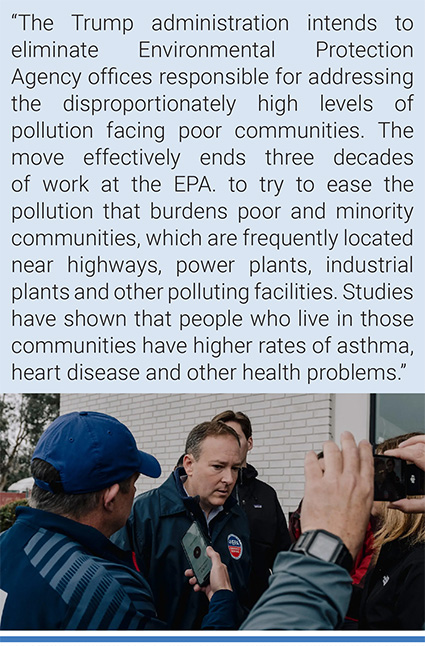
Also in March 2025, political and economic-themed media stories persisted. Prominently, laying off workers and closing units within US federal agencies, some of whom work on climate change like the Environmental Protection Agency (EPA), the National Aeronautic and Space Administration (NASA), and the National Oceanic and Atmospheric Administration (NOAA). For an example of news stories on EPA cuts, New York Times reporter Lisa Friedman wrote, “The Trump administration intends to eliminate Environmental Protection Agency offices responsible for addressing the disproportionately high levels of pollution facing poor communities, according to a memo from Lee Zeldin, the agency administrator. In the internal memo, viewed by The New York Times, Mr. Zeldin informed agency leaders that he was directing “the reorganization and elimination” of the offices of environmental justice at all 10 E.P.A. regional offices as well as the one in Washington. Mr. Zeldin’s move effectively ends three decades of work at the E.P.A. to try to ease the pollution that burdens poor and minority communities, which are frequently located near highways, power plants, industrial plants and other polluting facilities. Studies have shown that people who live in those communities have higher rates of asthma, heart disease and other health problems, compared with the national average. “If anybody needed a clearer sign that this administration gives not a single damn for the people of the United States, this is it,” said Matthew Tejada, a former E.P.A. official who is now a senior vice president for environmental health at the Natural Resources Defense Council, a nonprofit organization. Molly Vaseliou, an E.P.A. spokeswoman, described the moves as “organizational improvements” that align with President Trump’s orders to end wasteful spending and diversity, equity and inclusion programs. In a statement, Mr. Zeldin suggested that environmental justice — which the agency defined as “the fair treatment and meaningful involvement of all people regardless of race, color, national origin, or income” with respect to environmental laws — was tantamount to discrimination”.
For an example of news accounts of NASA cuts, New York Times correspondent Kenneth Chang noted, “NASA is eliminating its chief scientist and other roles as part of efforts by the Trump administration to pare back staff at the agency’s Washington headquarters. The cuts affect about 20 employees at NASA, including Katherine Calvin, the chief scientist and a climate science expert. The last day of work for Dr. Calvin and the other staff members will be April 10. That could be a harbinger of deeper cuts to NASA’s science missions and a greater emphasis on human spaceflight, especially to Mars. During President Trump’s address to Congress last week, he said, “We are going to lead humanity into space and plant the American flag on the planet Mars and even far beyond.” Mr. Trump did not give a timeline for astronauts to reach the red planet, and during an interview on Fox News on Sunday, he said it was not a top priority. “Is it No. 1 on my hit list?” he said. “No. It’s not really.” He added, “It’d be a great achievement.” The administration sent notice to Congress on Monday that NASA was abolishing the Office of the Chief Scientist and the Office of Technology, Policy and Strategy”.
The Mauna Loa Observatory is connected to the Global Monitoring Laboratory, whose lease is set to expire this year. Photo: Susan Cobb/NOAA. |
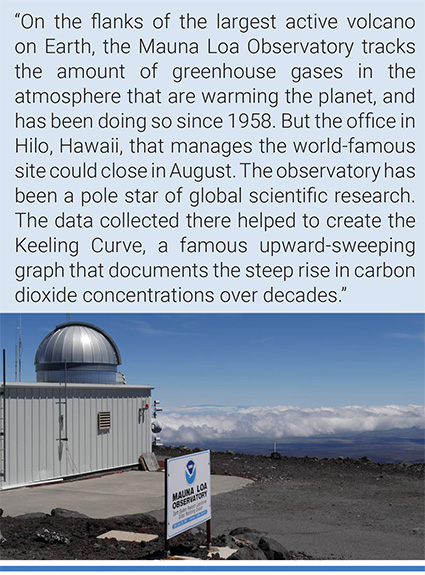
For an example of media coverage of NOAA cuts, Washington Post journalist Scott Dance reported, “The Trump administration is planning to cancel its lease at a government laboratory in Hawaii, a site where scientists support key observations of surging greenhouse gas levels in the atmosphere, according to a list obtained by Democratic members of Congress and shared with The Washington Post. The Global Monitoring Laboratory in Hilo, Hawaii, is on a list of dozens of National Oceanic Atmospheric Administration facilities whose leases are set to expire later this year. The lab is connected to the Mauna Loa Observatory, where scientists gather data from atop a volcano to produce the famed Keeling Curve, a chart on the daily status of atmospheric carbon dioxide concentrations. The observatory itself is not on the list of potential closures, but staff in the Hilo lab work to maintain it, according to the lab’s website. Data collected from the observatory have shown global carbon dioxide levels — the most significant driver behind record planetary warming — are rising faster than ever recorded. Trump has been dismissive of that data and the consensus around climate change, and his allies who wrote the policy playbook Project 2025 proposed dismantling NOAA, calling it a source of climate alarmism. The Hawaii lab is one of several NOAA facilities on the list whose lease termination has not been previously reported, as the Trump administration and Elon Musk’s U.S. DOGE Service announce massive cuts to government real estate and personnel”. Meanwhile, New York Times correspondent Austyn Gaffney noted, “On the flanks of the largest active volcano on Earth, the Mauna Loa Observatory tracks the amount of greenhouse gases in the atmosphere that are warming the planet, and has been doing so since 1958. But the office in Hilo, Hawaii, that manages the world-famous site could close in August, according to a copy of an internal federal document viewed by The New York Times. The observatory has been a pole star of global scientific research. The data collected there helped to create the Keeling Curve, a famous upward-sweeping graph that documents the steep rise in carbon dioxide concentrations over decades. “These data are our eyes on the planet,” said Ralph Keeling, a climate science professor at the Scripps Institution of Oceanography at the University of California San Diego and the son of Charles Keeling, the curve’s creator. “It’s really vital base line data for how things are going to change going forward.” The observatory’s office is among 30 buildings operated by the National Oceanic and Atmospheric Administration, the nation’s leading agency for climate research, that are listed on the spreadsheet for possible lease terminations, beginning as early as May. It is unclear what would happen to operations at the observatory if the office were to close. White House Press Secretary Karoline Leavitt declined to comment, writing in an email, “As a matter of policy, we do not respond to reporters with pronouns in their bios.” Over the course of a day, the levels of carbon dioxide rise and fall, and within a year, there are seasonal variations. But the Keeling Curve shows the number has risen by more than 100 parts per million since 1958. In 2024, more carbon was emitted than ever before, and the average annual reading showed a record jump from the year prior. That rise has warmed the atmosphere, causing climate change that has led to more frequent and intense extreme weather events like heat waves, floods and wildfires”.
Relating to monitoring of extreme weather events, National Public Radio reporter Adam Kemp noted, “Meteorologists and climate scientists are raising alarms about major cuts to the National Oceanic and Atmospheric Administration, saying they will harm the country’s ability to forecast and respond to major weather events and put lives at risk. Hundreds of employees, including some of the country’s top meteorologists and researchers, had their jobs terminated on Feb. 27, part of a broader elimination of probationary employees by billionaire Elon Musk and his team at the Department of Government Efficiency. NOAA is now tasked with cutting an estimated 10 percent of its workforce, or 1,029 jobs, current and former employees told PBS News. If plans for these latest cuts move forward, nearly 20 percent of NOAA’s 13,000-person workforce would be cut. The federal agency is responsible for monitoring and forecasting weather across the U.S. and tracking climate trends. NOAA also oversees the National Weather Service and the National Hurricane Center, maintaining a network of radar systems, satellites and weather balloons to help predict and track extreme weather events. The agency’s research supports marine commerce by providing up-to-the-minute weather forecasting for cargo ships and other vessels. Beyond meteorology, NOAA’s research arm also manages fisheries, protects endangered marine life, monitors ocean health and studies the long-term effects of climate change”.
Vice-Premier Ding Xuexiang of China speaks at the 55th annual World Economic Forum annual meeting. Chinese officials touted the country's commitment to fighting climate change. Photo: Yves Herman/Reuters. |
While this unfolded in March in the US, China was ramping up its climate policy plans and this generated international media attention. For example, Canadian Broadcasting Corporation reporter Lisa Xing noted, “As U.S. President Donald Trump announces plans to withdraw from various international organizations and agreements, China is positioning itself as a global leader and capitalizing on the opportunity to fill a void left by the United States on the world stage, analysts say. On his first day in office after Monday's inauguration, Trump signed executive orders that started the process of pulling out of the World Health Organization (WHO) and the 2015 Paris Agreement on climate change, as he did in his first term. The moves by the Republican president call into question the future of global public health responses and climate goals and leave a leadership vacuum that China could try to fill. "This creates potential for China to further bolster its influence in the multilateral institutions of the world and help govern the world," said Gregory Chin, associate professor of political economy at York University in Toronto. Indeed, China appears to be sending those signals already”. As a second example, China Daily journalist Hou Liqiang reported, “China will take steps to respond to green trade barriers as it advances toward carbon neutrality, says the Government Work Report that was delivered at the opening of the third session of the 14th National People's Congress on Wednesday. The country will diligently work toward peaking carbon dioxide emissions before 2030 and achieving carbon neutrality before 2060, the report said. It listed a series of concrete measures to promote the targets. The country will steadily advance the second batch of trials to reach peak carbon dioxide emissions and establish a group of zero-carbon industrial parks and factories. The establishment of a framework for controlling the total amount and intensity of carbon emissions will be accelerated, and the national carbon trading market will be expanded to cover more industries. The report highlights measures the country will adopt in response to green trade barriers, which often entail implementing regulations that impose restrictions or requirements on imported products to ensure adherence to specific environmental standards. The country will keep carbon emissions statistics and undertake accounting initiatives and develop systems for managing carbon emissions and conducting carbon labeling and certification, the report said. More will be done to promote new energy development, it said. The country will speed up the construction of new energy bases in deserts and other arid areas, develop offshore wind farms and promote both the integration of renewable energy into local grids and the construction of transmission routes, it said”.
Saudi Aramco's plant in Al Hawiyah, Saudi Arabia. Photo: Amr Nabil/AP/LaPresse. |
In Europe, attention was also paid to fossil fuel producers and climate change in March. For example, El País journalist Manuel Planelles wrote, “Twenty oil, gas, coal, and cement production companies were responsible for 40.8% of global carbon dioxide (CO₂) emissions from the fossil fuel sector in 2023, accounting for 17.5 gigatons of this gas. Furthermore, 16 of these 20 companies are state-owned. Among them, Chinese companies, primarily public, stand out, accounting for 23% of total emissions. These are some of the conclusions drawn from a report prepared by the British research center InfluenceMap based on its Carbon Majors database, which tracks the contribution to climate change of the world's major fossil fuel producers and cement companies. In total, they counted the activity of 169 companies active in 2023, the latest year for which they have final data. And, according to these experts, despite the fact that the impacts of the climate crisis are intensifying, these companies' emissions grew by 0.7% in 2023 compared to 2022.” In addition, La Vanguardia journalist Anna Buj noted, “A new team at the European Commission, a new geopolitical situation, a new mandate. EU President Ursula von der Leyen had hinted that she would be flexible regarding the multi-million-dollar fines that car manufacturers would have to pay if they failed to meet emissions targets by 2025, but this Monday she formally opened the door. After enormous pressure from the sector, Brussels is proposing to extend the deadline from one to three years to achieve the decarbonization targets, which remain unchanged. This is the first outcome of the strategic dialogue launched in January to address the concerns of one of the sectors experiencing the greatest difficulties in the transition toward decarbonization. The European automotive industry, hit by factory closures and job losses—54,000 in the last year—is now also facing the tariffs announced by Donald Trump and the dependence on China for essential materials.”
There was also media attention paid to political and economic developments relating to climate change in South America in March. For example, El País journalist Francesca Raffo wrote, “Peruvian Farmer Brings German Energy Company RWE to Court for Melting Glaciers. For 10 years, Saúl Luciano Lliuya (45, Huaraz, Peru), a Peruvian mountain guide and farmer, has been waiting for this day. He knows that his entire journey is already a "historic event." A decade ago, Lliuya decided to sue German energy company RWE to hold it responsible for the melting of glaciers and the risks to more than 50,000 residents in Huaraz, an Andean city located 3,000 meters above sea level in the central highlands of Peru. What has happened since then has set a precedent: an individual successfully bringing a large company to court, a German court arguing that the complaint is legally sound and then reaching the evidence gathering phase. This Wednesday (March 19), the Higher Regional Court of Hamm, in the state of North Rhine-Westphalia, in eastern Germany, concluded the first hearing (which took place on Monday and Wednesday) of the civil lawsuit filed by Lliuya. The Peruvian, along with the German NGO Germanwatch and environmental law specialist Roda Verheyen, are hoping for a landmark ruling that would allow for fines against large broadcasters that accelerate climate change.”
In North America in late March, the US Trump Administration met with 15-20 major oil and gas representatives from the American Petroleum Institute. This generated media interest. For example, Washington Post journalists Maxine Joselow and Anna Phillips reported, “As Trump sat with the nation’s top oil and gas executives at the White House last week, he asked what was on their minds. In response, the executives asked for help battling climate Superfund laws, according to two oil industry representatives who spoke on the condition of anonymity to describe a private conversation. The Wall Street Journal first reported this request. Executives also complained about dozens of climate lawsuits brought by state and local governments against oil companies, the two industry representatives said. The lawsuits accuse the companies of deceiving the public for decades about the harms they knew their petroleum products would cause — an allegation the industry rejects. After listening to the executives’ concerns, Trump told a White House staffer to look for ways the administration could help, the two industry representatives said. The president did not commit to taking any specific actions, they said. Some industry executives want the Justice Department to sue New York and Vermont over their climate Superfund laws. The American Petroleum Institute (API), the U.S. oil and gas industry’s top lobbying arm, has already sued over Vermont’s law, alleging that it encroaches on the federal government’s power to regulate greenhouse gas emissions. The U.S. Chamber of Commerce, the nation’s biggest business lobby, joined the lawsuit filed in December. The two groups argued that Vermont lacked the authority to impose penalties on greenhouse gas emissions beyond its borders — an authority, they said, that the Clean Air Act reserves for the federal government. “This partisan legislation illegally and retroactively penalizes U.S. oil and natural gas producers for delivering the energy consumers need, and that should be a concern for our leaders in Washington,” Justin Prendergast, an API spokesman, said in an email. “We are exploring all options to correct this overreach by certain states.” Representatives for several executives who attended last week’s meeting — including the CEOs of Chevron, ConocoPhillips, ExxonMobil and Phillips 66 — declined to comment or did not return requests for comment. A White House official said the meeting focused on boosting oil production on federal lands in red states. Republican-led states are also coming to the industry’s defense. A coalition of 22 red states, led by West Virginia, sued New York over its climate Superfund law in February, arguing that it would put coal and oil producers out of business. Critics of climate Superfund laws also argue that they unfairly punish oil companies instead of consumers who use fossil fuels, whether to drive their cars or heat their homes”.
Greenpeace representatives outside the Morton County Courthouse in Mandan, ND. Photo: Jack Dura/AP. |
Last, there were several cultural-themed stories relating to climate change or global warming in the month of March. To illustrate, a successful lawsuit by Energy Transfer against the activist group Greenpeace garnered media attention in March. For example, Associated Press reporter Jack Dura wrote, “Environmental group Greenpeace must pay more than $660 million in damages for defamation and other claims brought by a pipeline company in connection with protests against the Dakota Access oil pipeline’s construction in North Dakota, a jury found Wednesday. Dallas-based Energy Transfer and subsidiary Dakota Access had accused Netherlands-based Greenpeace International, Greenpeace USA and funding arm Greenpeace Fund Inc. of defamation, trespass, nuisance, civil conspiracy and other acts. Greenpeace USA was found liable for all counts, while the others were found liable for some. The damages owed will be spread out in different amounts over the three entities. Greenpeace said earlier that a large award to the pipeline company would threaten to bankrupt the organization. Following the nine-person jury’s verdict, Greenpeace’s senior legal adviser said the group’s work “is never going to stop.” “That’s the really important message today, and we’re just walking out and we’re going to get together and figure out what our next steps are,” Deepa Padmanabha told reporters outside the courthouse”.
Meanwhile, as Trump Administration tariffs go into effect US consumers have expressed concern. President Trump’s comments about this generated media attention. For example, Wall Street Journal reporters Gavin Bade, Alex Leary and Kristina Peterson wrote, “The Trump administration is scrambling to determine the specifics of its new tariff agenda ahead of its self-imposed deadline of Wednesday, weighing options as the president has promised to remake the American economy with a swath of new levies. One key point of debate is whether to impose individualized tariff rates for U.S. trading partners, as President Trump has previewed in recent weeks, or revert to his campaign pledge for an across-the-board tariff that would affect virtually every country doing business with the U.S., say people familiar with the conversations”.

Figure 3. Examples of newspaper front pages with climate change stories in March 2025.

Thousands demonstrate for science and research funding in Washington DC on March 7, 2025. Photo: Allison Bailey/NurPhoto/REX/Shutterstock.

April media coverage of climate change or global warming in newspapers around the globe dipped 4% from March 2025. Furthermore, coverage in April 2025 dropped 16% from April 2024. Figure 1 shows trends in newspaper media coverage at the global scale – organized into seven geographical regions around the world – across 21 years, from January 2004 through April 2025. The politics of climate change – driven in the United States (US) context with reactions in Canada – fueled increased media coverage in North America and more specifically in US print media, with the number climate change or global warming stories growing in April from the previous month across all outlets we monitor except for in the Wall Street Journal (-33%): Washington Post (+33%), New York Times (+18), Los Angeles Times (+26%), and USA Today (more than tripling).
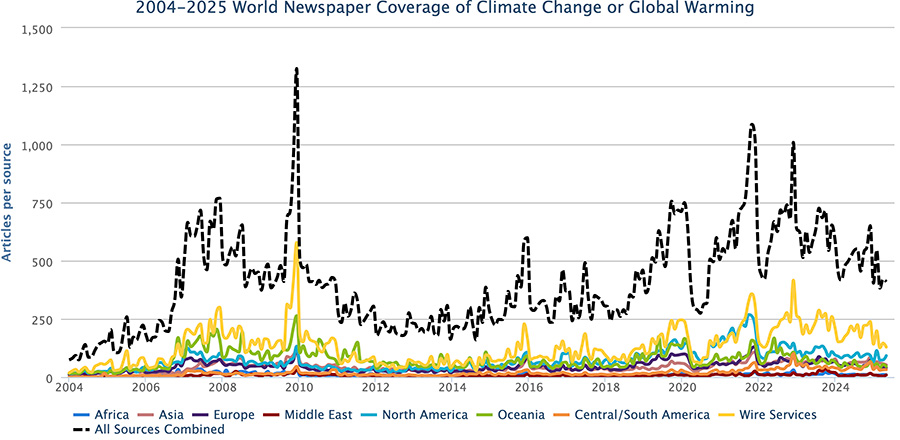
Figure 1. Newspaper media coverage of climate change or global warming in print sources in seven different regions around the world, from January 2004 through April 2025.
At the regional level, April 2025 coverage – compared to the previous month – decreased everywhere except in North America (increasing 25%) (see Figure 2), Latin America (rising 2%), and the Middle East (doubling): Africa (-7.5%), the European Union (EU) (-8%), Asia (-9%), and Oceania (-15%). Meanwhile, Comparing these April 2025 levels of coverage to a year previous (April 2024), counts increased only in the Middle East while numbers dropped in all other regions: North America (-1%), Africa (-5%), Oceania (-8%), Asia (-9%), the EU (-26%), and Latin America (-36%).
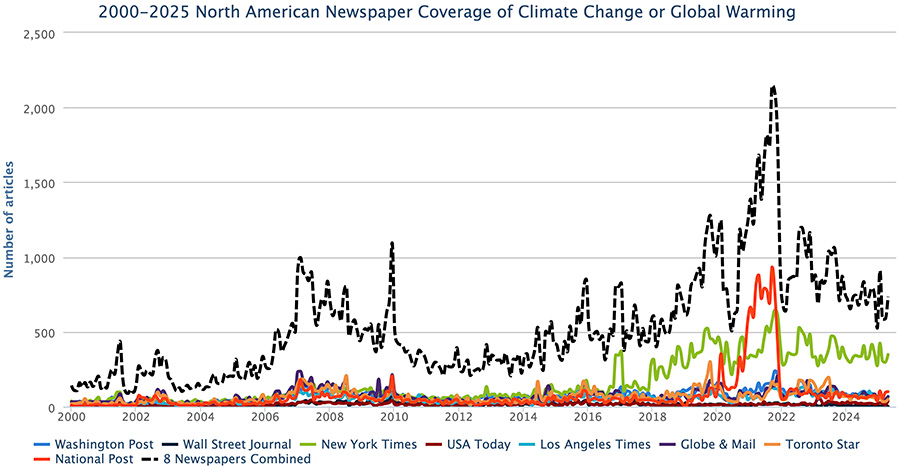
Figure 2. Coverage of climate change or global warming in North America from January 2005 through April 2025: Washington Post (US), Wall Street Journal (US), New York Times (US), USA Today (US), Los Angeles Times (US), Globe & Mail (Canada), Toronto Star (Canada), National Post (Canada).
Harmful bleaching of the world’s coral has grown to include 84% of the ocean’s reefs in the most intense event of its kind in recorded history. Credit: Associated Press. |
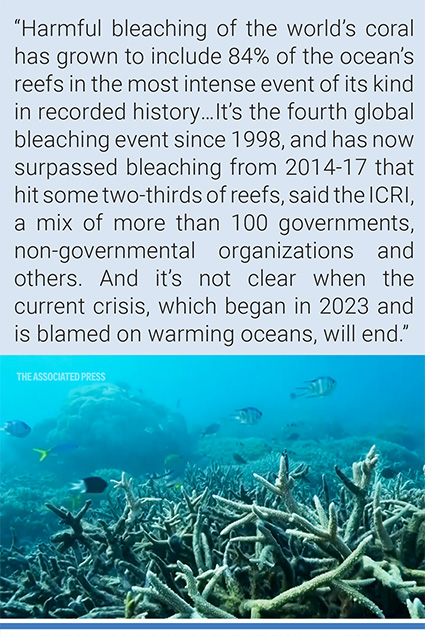
Moving to the content of coverage, April media representations covered various ecological and meteorological themes in accounts. To begin the month, warnings of upcoming heat waves in South Asia – with links to a changing climate – made news. For example, BBC (United Kingdom [UK]) journalist Meryl Sebastian reported, “Most parts of India will experience an intense heatwave this summer with above normal temperatures expected across most of the country, its weather department has said. Mrutyunjay Mohapatra, chief of the India Meteorological Department, said several states would experience more heatwave days than usual this year. Many states already reported weekly average minimum temperatures above normal by 1-3C in February. Hundreds die each year in India due to scorching heat. Sectors like agriculture also suffer as availability of water reduces. In 2024, India recorded its hottest day at 50.5C on 28 May in western Rajasthan state's Churu city. The country's health ministry attributed 143 deaths to heatwaves between 1 March and 20 June. Independent experts, however, believe the country is under counting the deaths caused by extreme heat. The Heat Watch 2024 report said 733 deaths due to heatstroke were reported across 17 states between March and June 2024. This year, states like Uttar Pradesh, Jharkhand, Chhattisgarh and Odisha could see as many as 10 to 11 heatwave days…” Meanwhile, reporter Gaurav Talwar at The Times of India noted, “the early arrival of the heatwave in April, scorching large parts of India and Pakistan with temperatures exceeding 40oC across North Indian and reaching 49oC in parts of Pakistan, was largely driven by human-induced climate change…the 2025 heatwave was not only unusually early but also alarmingly intense”.
Over in Europe, stories circulated about rising temperatures linked with climate change. For example, La Vanguardia journalist Antonio Cerrillo noted, “This is the warning issued by the 2004 State of the Climate report presented by the Copernicus climate service and the World Meteorological Organization (WMO). The document highlights that this trend was reinforced in 2024, which was the warmest year in Europe on record. The temperature in Europe in 2024 was around 1.5°C Celsius above the average for the past 30 years (i.e., between 1991 and 2020). This average temperature increase was 0.5°C per decade, while the global average was just over 0.2°C per decade, according to Samantha Burgess, climate strategy manager at the European Centre for Medium-Range Weather Forecasts (ECMWF). As in the rest of the planet, temperatures are rising in the old continent due to gas emissions from the burning of fossil fuels (coal, oil, and gas used in transportation or energy production); but Europe is the continent experiencing this warming most rapidly. And why is this? There are three main reasons. First, part of the continent includes territory within the Arctic Circle, which is the fastest warming region on Earth. And, since the poles are the area that warms the most on the planet, when temperatures are averaged across Europe, the result is higher temperatures. Changes in atmospheric circulation also play a role, favoring more frequent heat waves in summer. This oceanic circulation brings warm waters to European coasts, making them relatively warmer than those of other oceans, according to WMO spokespersons”.
It is estimated that global temperatures will rise by about 2.1°C in the coming years. Photo credit: Andrej Cubic/EFE. |

Elsewhere, alarms rang regarding coral bleaching as a result of rising ocean temperatures. For example, Associated Press correspondent Isabella O’Malley reported, “Harmful bleaching of the world’s coral has grown to include 84% of the ocean’s reefs in the most intense event of its kind in recorded history…It’s the fourth global bleaching event since 1998, and has now surpassed bleaching from 2014-17 that hit some two-thirds of reefs, said the ICRI, a mix of more than 100 governments, non-governmental organizations and others. And it’s not clear when the current crisis, which began in 2023 and is blamed on warming oceans, will end. “We may never see the heat stress that causes bleaching dropping below the threshold that triggers a global event,” said Mark Eakin, corresponding secretary for the International Coral Reef Society and retired chief of the Coral Reef Watch program of the U.S. National Oceanic and Atmospheric Administration. “We’re looking at something that’s completely changing the face of our planet and the ability of our oceans to sustain lives and livelihoods,” Eakin said. Last year was Earth’s hottest year on record, and much of that is going into oceans. The average annual sea surface temperature of oceans away from the poles was a record 20.87 degrees Celsius (69.57 degrees Fahrenheit). That’s deadly to corals, which are key to seafood production, tourism and protecting coastlines from erosion and storms. Coral reefs are sometimes dubbed “rainforests of the sea” because they support high levels of biodiversity — approximately 25% of all marine species can be found in, on and around coral reefs. Corals get their bright colors from the colorful algae that live inside them and are a food source for the corals. Prolonged warmth causes the algae to release toxic compounds, and the coral ejects them. A stark white skeleton is left behind, and the weakened coral is at heightened risk of dying. The bleaching event has been so severe that NOAA’s Coral Reef Watch program has had to add levels to its bleaching alert scale to account for the growing risk of coral death”. As a second example of coverage, Washington Post (US) journalists Leo Sands and Amudalat Ajasa noted, “The massive blow to marine habitats reported by the National Oceanic and Atmospheric Administration — the highest share ever recorded — comes as the planet experiences its fourth global coral bleaching event, which occurs when bleaching is confirmed in all of the oceans’ basins at once. It raises new concerns about the precarious nature of a living network that sustains vibrant fisheries worldwide and helps protect coastal communities from flooding. NOAA says the latest global event began on Jan. 1, 2023, and mass bleaching has now been observed across at least 83 countries and territories, threatening marine life from Fiji to the Florida Keys to Australia’s Great Barrier Reef”.
Further exploring April media coverage, many news accounts drew on primarily scientific themes when reporting on climate change or global warming. For instance, a new study in Environmental Research Letters about underestimates of costs relating to climate change earned media attention. For example, the Editors at El Espectador (Colombia) commented, “The global economy will also undergo serious changes if global warming worsens in the coming years. A new study by Australian scientists detail that the outlook for 2100 would be quite worrisome if the Earth's temperature exceeds 4°C above pre-industrial levels. This, in simpler terms, would have a much greater impact on the economic capacity of people with limited resources, as the global Gross Domestic Product (GDP) would decline by 16%, much higher than the 1.4% estimate of previous research. This would cause the middle class to become 40% poorer, not the 11% previously believed”. Meanwhile, Guardian (UK) journalist Graham Readfearn wrote, “Economic models have systematically underestimated how global heating will affect people’s wealth, according to a new study that finds 4C warming will make the average person 40% poorer – an almost four-fold increase on some estimates. The study by Australian scientists suggests average per person GDP across the globe will be reduced by 16% even if warming is kept to 2C above pre-industrial levels. This is a much greater reduction than previous estimates, which found the reduction would be 1.4%. Scientists now estimate global temperatures will rise by 2.1C even if countries hit short-term and long-term climate targets. Criticisms have mounted in recent years that a set of economic tools known as integrated assessment models (IAM) – used to guide how much governments should invest in cutting greenhouse gas emissions – have failed to capture major risks from climate change, particularly extreme weather events”.
Flooding in Frankfort, Kentucky. The next National Climate Assessment is due in 2027 or 2028. Credit: Michael Swensen/Getty Images. |
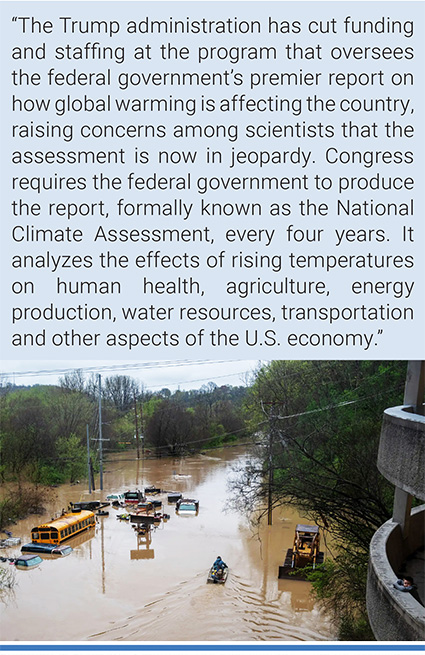
Meanwhile, in the US there were several media reports about Trump Administration threats to cutting funding to produce the next National Climate Assessment (NCA) report (though ultimate funding decisions are in the jurisdiction of US Congress). For example, New York Times (US) journalist Brad Plumer noted, “The Trump administration has cut funding and staffing at the program that oversees the federal government’s premier report on how global warming is affecting the country, raising concerns among scientists that the assessment is now in jeopardy. Congress requires the federal government to produce the report, formally known as the National Climate Assessment, every four years. It analyzes the effects of rising temperatures on human health, agriculture, energy production, water resources, transportation and other aspects of the U.S. economy. The last assessment came out in 2023 and is used by state and city governments, as well as private companies, to prepare for global warming. The climate assessment is overseen by the Global Change Research Program, a federal group established by Congress in 1990 that is supported by NASA and coordinates efforts among 14 federal agencies, the Smithsonian Institution and hundreds of outside scientists to produce the report. On Tuesday, NASA issued stop-work orders on two separate contracts with ICF International, a consulting firm that had been supplying most of the technical support and staffing for the Global Change Research Program. ICF had originally signed a five-year contract in 2021 worth more than $33 million and provided around two dozen staff members who worked on the program with federal employees detailed from other agencies. Without ICF’s support, scientists said, it is unclear how the assessment can move forward…Many climate scientists were already expecting that the next National Climate Assessment, due in 2027 or 2028, was very likely in trouble”. Then in late April, New York Times (US) journalists Brad Plumer and Rebecca Dzombak followed up, writing, “The Trump administration has dismissed the hundreds of scientists and experts who had been compiling the federal government’s flagship report on how global warming is affecting the country. The move puts the future of the report, which is required by Congress and is known as the National Climate Assessment, into serious jeopardy, experts said. Since 2000, the federal government has published a comprehensive look every few years at how rising temperatures will affect human health, agriculture, fisheries, water supplies, transportation, energy production and other aspects of the U.S. economy. The last climate assessment came out in 2023 and is used by state and local governments as well as private companies to help prepare for the effects of heat waves, floods, droughts and other climate-related calamities. On Monday, researchers around the country who had begun work on the sixth national climate assessment, planned for early 2028, received an email informing them that the scope of the report “is currently being re-evaluated” and that all contributors were being dismissed… It remains to be seen what happens next with the assessment, which is still mandated by Congress. Some scientists feared that the administration might try to write an entirely new report from scratch that downplays the risks of rising temperatures or contradicts established climate science”.
Thousands gathered at the Lincoln Memorial on March 7 to defend science. Photo: Astrid Riecken/The Washington Post. |
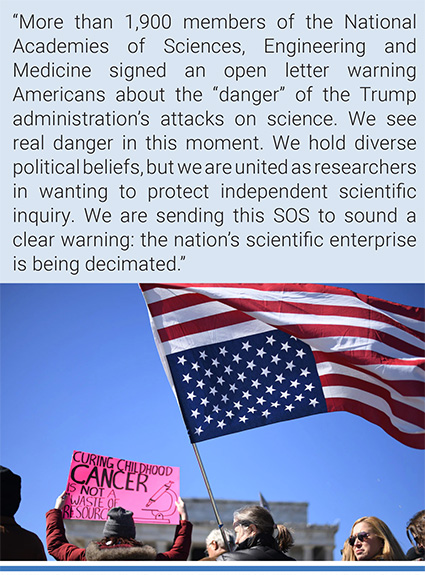
Also relating to scientific-themed stories, in the US a collection of about 2,000 scientists wrote an urgent message for everyday people, condemning Trump Administration attacks on issues like climate change. This generated media attention in the US and around the world. For example, Guardian (UK) journalist Jessica Glenza reported, “More than 1,900 members of the National Academies of Sciences, Engineering and Medicine signed an open letter warning Americans about the “danger” of the Trump administration’s attacks on science. The letter comes amid the administration’s relentless assault on US scientific institutions which has included threats to private universities, federal grant cancelations and ideological funding reviews, mass government layoffs, resignations and censorship. “We see real danger in this moment,” the letter states. “We hold diverse political beliefs, but we are united as researchers in wanting to protect independent scientific inquiry. We are sending this SOS to sound a clear warning: the nation’s scientific enterprise is being decimated.” The National Academies of Sciences was established by an act of Congress in 1863, during Abraham Lincoln’s administration. Today, the organization operates as a non-profit with two additional academies under its charter – the National Academies of Engineering and Medicine. The academies are seen as representing American scientific excellence and together claim more than 6,800 peer-elected members between the three branches. “The administration is slashing funding for scientific agencies, terminating grants to scientists, defunding their laboratories, and hampering international scientific collaboration,” the letter states. “The funding cuts are forcing institutions to pause research (including studies of new disease treatments), dismiss faculty, and stop enrolling graduate students – the pipeline for the next generation’s scientists.” The letter continued: “The quest for truth – the mission of science – requires that scientists freely explore new questions and report their findings honestly, independent of special interests. The administration is engaging in censorship, destroying this independence. It is using executive orders and financial threats to manipulate which studies are funded or published, how results are reported, and which data and research findings the public can access. The administration is blocking research on topics it finds objectionable, such as climate change, or that yields results it does not like, on topics ranging from vaccine safety to economic trends.” Scientific institutions have seen major upheaval since the beginning of this Trump administration and there are fears that the cuts are in preparation for privatization”.
An Amazon Web Services data center under construction in Stone Ridge, Virginia. Photo: Nathan Howard/Bloomberg/Getty Images. |
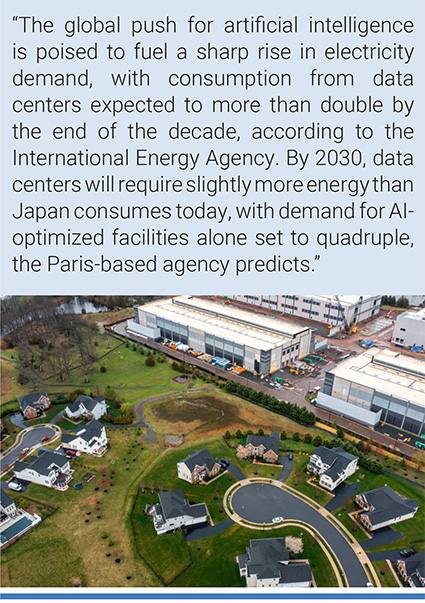
Next, there were many cultural-themed stories relating to climate change or global warming in April. For example, the increasing use of Artificial Intelligence (AI) has put increasing demands on data centers and running those data centers requires more energy (often derived from carbon-emitting sources). These developments have sparked many conversations in the cultural sphere and have led to several reports and media stories in April. Among them, an International Energy Agency report earned media attention. For example, The Times (UK) journalist Emily Gosden wrote, “Data centres will use more than twice as much electricity by 2030 than they do today as artificial intelligence drives demand, the International Energy Agency predicts. The agency forecast that all data centres globally will use about 945 terawatt-hours of electricity each year by 2030, roughly three times as much as the UK’s total annual demand of 317 terawatt-hours in 2023. The IEA, based in Paris, said centres serving AI would be “the most significant driver of this increase, with electricity demand from AI-optimised data centres projected to more than quadruple by 2030”. However, it said data centres would still account for only 3 per cent of global electricity consumption by the end of the decade. The IEA was founded in 1974 as a forum for energy co-operation to try to ensure secure access to oil supplies. It provides analysis and policy recommendations across the energy sector and has 32 member countries including the United States, the United Kingdom, France, Germany and Japan. Rapid advances in AI have raised concerns about the environmental footprint of the huge data centres needed to power it. Processing a request made to ChatGPT takes about ten times as much electricity as a typical Google search. Technology companies, including Amazon, Google and Microsoft, have agreed deals with nuclear power companies as they seek to secure energy supplies for data centres but there are fears that fossil fuel plants will power the centres in many parts of the world”. Elsewhere, Wall Street Journal (US) reporter Giulia Petroni noted, “The global push for artificial intelligence is poised to fuel a sharp rise in electricity demand, with consumption from data centers expected to more than double by the end of the decade, according to the International Energy Agency. By 2030, data centers will require slightly more energy than Japan consumes today, with demand for AI-optimized facilities alone set to quadruple, the Paris-based agency predicts”.
Inside a solar panel factory in Changzhou, China, last year. Photo: Alex Plavevski/EPA/Shutterstock. |
Later in the month, the passing of Pope Francis – who embraced scientific evidence on climate change and provided leadership for climate change action – generated news. For example, El País journalist Manuel Planelles wrote, “From the very first moment he made public the name he had chosen for his papacy, Jorge Mario Bergoglio linked his work as head of the Catholic Church to the environment and the defense of humanity's "common home," planet Earth. Pope Francis chose the name with Francis of Assisi in mind, patron saint of environmentalism for the Catholic Church, as well as a symbol of poverty. His first encyclical, in June 2015, was titled Laudato Si´-also taken from a hymn by the saint-. That text was entirely focused on the environment and the fight against global warming. The text cast aside any climate denialism and came in a key context: just months before the UN summit at which the Paris Agreement was to be finalized. In 2023, through an apostolic exhortation, he updated that encyclical to, among other things, scold governments for not replacing fossil fuels, responsible for the "climate crisis," with renewable energy at the necessary speed. In his autobiography, which came out in mid-January, he spoke again of the "climate emergency." He added: "Our common home asks us to pause our way of life, which pushes the planet beyond its limits and causes soil erosion, the disappearance of fields, the advance of deserts, the acidification of the seas, and the intensification of storms and other intense climate phenomena." That, point by point, is what science tells us: we are behind schedule, and extreme events are becoming more severe and frequent. Francis was, without a doubt, the pope who embraced scientific evidence on climate change and led the Catholic Church to take a stand on such a topical, strategic issue, one that ultraconservative and denialist populism has targeted with hoaxes and lies. Teresa Ribera, vice president of the European Commission and an international benchmark for climate diplomacy, recalls that Bergoglio "arrived in Rome enormously respected for his social commitment." But "he immediately understood and embraced environmental protection as a central axis of peace and justice among humanity." "His Laudato Si', perhaps the most important ecumenical product of his papacy, marked a turning point in global climate action.
A drone view shows coal being prepared for transport outside of Charleston, West Virginia. Photo: Reuters. |

Last, in April 2025 several political and economic-themed media stories circulated through news outlets. Arguably, the most prominent set of stories making news were connections between the US Trump Administration tariffs and climate change. For example, New York Times (US) reporter Claire Brown wrote, “The U.S. Department of Commerce has determined that solar cell imports from four countries in Southeast Asia should face tariffs of up to 3,521 percent. The decision is the result of an investigation started last year at the request of seven U.S. solar manufacturers, which argued that companies in Thailand, Vietnam, Cambodia and Malaysia were exporting solar components at artificially low prices, made possible by support from China. The highest rates, 3,521 percent, landed on Cambodian companies that stopped cooperating with the investigation. The inquiry found that, on average, solar cells from the four Southeast Asian countries were being subsidized at effective rates of 34 percent to 652 percent, a calculation that included the combined impact of dumping and government support. Now, the International Trade Commission, which has been conducting its own review, will determine whether these solar imports have harmed U.S. manufacturers. The fees will go into place if it decides the answer is yes. China currently controls more than 80 percent of the supply chain for solar panels globally, according to the International Energy Agency. In theory, high import tariffs combined with manufacturing subsidies could shelter the U.S. solar industry as companies build factories and position themselves to better compete. But making up that ground is a tall order: Chinese companies make solar panels for 16 to 19 cents per watt, while American companies face costs of about 28 cents, according to an estimate last year. In practice, experts say that any benefits from the new fees will be distributed unevenly, and that increased U.S. isolation is not likely to result in a better, cheaper domestic supply chain for solar power. The end result? Some overseas factories might move from the targeted countries to nations with lower tariffs. A few solar suppliers will get a leg up. And buyers of U.S. solar power may have to pay more for energy. But, at least for now, the added costs are unlikely to slow the rollout of solar power in the United States, said Pol Lezcano, a solar analyst at BloombergNEF, a research group. Even if it becomes a little more expensive, solar remains one of the cheapest and quickest-to-build energy sources, he said”. Meanwhile, CNN (US) journalist John Towfighi added, “The lack of clarity about Trump’s trade policy has kept traders in the dark about how to best position their investments — and raised concerns about US economic growth. “While any delay of tariffs is beneficial on the margin, it is not the same as their removal,” analysts at Morgan Stanley said in a Friday note. “History suggests that elevated and prolonged uncertainty that weighs on business confidence can have detrimental effects on business spending and hiring.” Goldman Sachs CEO David Solomon said in an earnings press release Monday that the climate is a “markedly different operating environment than earlier this year.” “The prospect of a recession has increased with growing indications that economic activity is slowing down,” Solomon said on a call with analysts. “Our clients, including corporate CEOs and institutional investors, are concerned by the significant near-term and longer-term uncertainty that has constrained their ability to make important decisions.” Billionaire Ray Dalio over the weekend said Trump’s tariffs have helped push the US close to a recession — or perhaps even “something worse.” “Right now, we are at a decision-making point and very close to a recession,” the hedge fund manager told NBC News Sunday. “And I’m worried about something worse than a recession if this isn’t handled well.” Analysts at Citi on Friday lowered their year-end target for the S&P 500 to 5,800 from 6,500, joining a group of Wall Street giants in cutting their forecasts for corporate earnings and growth this year amid an uncertain tariff environment”.
Tugboats assist a container ship as it prepares to dock at the Manila International Container Terminal. Photo: Aaron Favila/AP. |
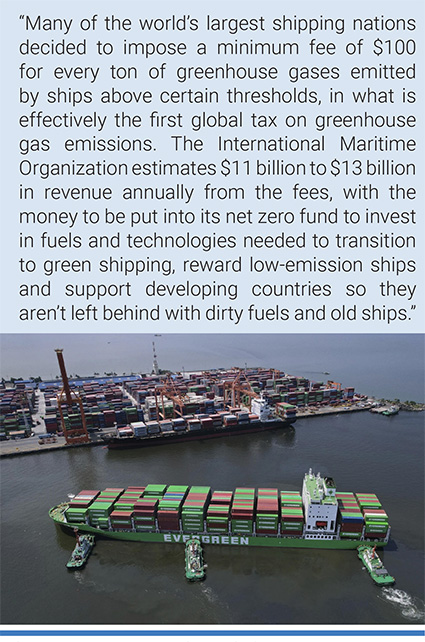
Also, news of the US Trump Administration seeking to revive the coal industry earned news attention. For example, New York Times (US) journalists Brad Plumer and Mira Rojanasakul wrote, “President Trump signed a flurry of executive orders Tuesday aimed at expanding the mining and burning of coal in the United States, in an effort to revive the struggling industry. One order directs federal agencies to repeal any regulations that “discriminate” against coal production, to open new federal lands for coal mining and to explore whether coal-burning power plants could serve new A.I. data centers. Mr. Trump also said he would waive certain air-pollution restrictions adopted by the Biden administration for dozens of coal plants that were at risk of closing down. In a move that could face legal challenges, Mr. Trump directed the Energy Department to develop a process for using emergency powers to prevent unprofitable coal plants from shutting down in order to avert power outages. Mr. Trump proposed a similar action in his first term but eventually abandoned the idea after widespread opposition. Flanked by dozens of miners in white hard hats at the White House, Mr. Trump said he was also instructing the Justice Department to identify and fight state and local climate policies that were “putting our coal miners out of business.” He added that he would issue “guarantees” that future administrations could not adopt policies harmful to coal, but did not provide details”. Meanwhile, Guardian (UK) correspondent Oliver Milman noted, “Donald Trump signed four executive orders on Tuesday aimed at reviving coal, the dirtiest fossil fuel that has long been in decline, and which substantially contributes to planet-heating greenhouse gas emissions and pollution. Environmentalists expressed dismay at the news, saying that Trump was stuck in the past and wanted to make utility customers “pay more for yesterday’s energy”. The US president is using emergency authority to allow some older coal-fired power plants scheduled for retirement to keep producing electricity. The move, announced at a White House event on Tuesday afternoon, was described by White House officials as being in response to increased US power demand from growth in datacenters, artificial intelligence and electric cars”.
Internationally, a new agreement brokered by the International Maritime Organization on shipping emissions reductions garnered media attention. For example, Associated Press journalists Jennifer McDermott and Sibi Arasu reported, “Many of the world’s largest shipping nations decided on Friday to impose a minimum fee of $100 for every ton of greenhouse gases emitted by ships above certain thresholds, in what is effectively the first global tax on greenhouse gas emissions. The International Maritime Organization estimates $11 billion to $13 billion in revenue annually from the fees, with the money to be put into its net zero fund to invest in fuels and technologies needed to transition to green shipping, reward low-emission ships and support developing countries so they aren’t left behind with dirty fuels and old ships. The thresholds set through the agreement will get stricter over time to try to reach the IMO’s goal of net zero across the industry by about 2050. The agreement, reached with the United States notably absent, is expected to be formally adopted at an October meeting to take effect in 2027. The IMO, which regulates international shipping, also set a marine fuel standard to phase in cleaner fuels. Shipping emissions have grown over the last decade to about 3% of the global total as vessels have gotten bigger, delivering more cargo per trip and using immense amounts of fuel”.

Figure 3. Examples of newspaper front pages with climate change stories in April 2025.
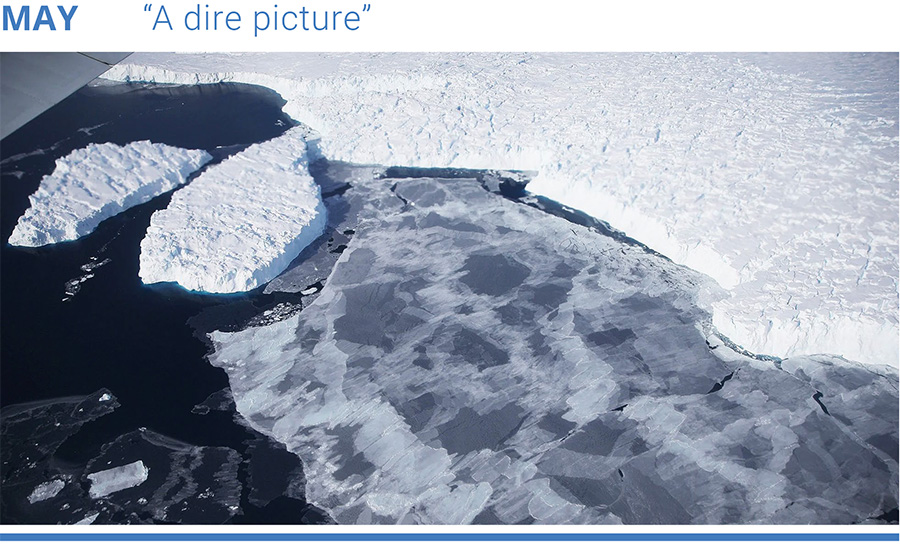
Ice floats near the coast of West Antarctica. Scientists are concerned the West Antarctic Ice Sheet may be in a state of irreversible decline directly contributing to rising sea levels. Photo: Mario Tama/Getty Images.

May media coverage of climate change or global warming in newspapers around the globe crept up 0.2% from April 2025. Yet, coverage in May 2025 dipped 17% from May 2024. Figure 1 shows trends in newspaper media coverage at the global scale – organized into seven geographical regions around the world – across 21 years, from January 2004 through May 2025. Across wire services we monitor – The Associated Press, Agence France Presse, The Canadian Press, and United Press International (UPI) – coverage increased 5% from April 2025 but was 38% lower than coverage in May 2024.
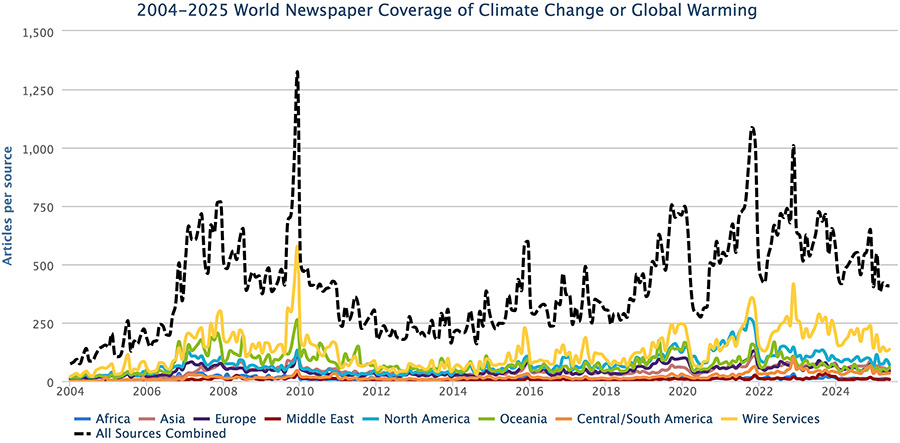
Figure 1. Newspaper media coverage of climate change or global warming in print sources in seven different regions around the world, from January 2004 through May 2025.
At the regional level, May 2025 coverage – compared to the previous month – went up in Latin America. (+6%) (see Figure 2), the European Union (EU) (+6 %), and Oceania (+30%). Meanwhile, coverage dropped 1% in Asia while it dipped 18% in Africa, went down 21% in the Middle East, and decreased 24% in North America. Comparing these May 2025 levels of coverage to a year previous (May 2024), counts increased 6% in the Middle East and 38% in Oceania but decreased in Africa (-18%), Asia (-1%), the EU (-13%), Latin America (-22%) (see Figure 2) and North America (-24%).
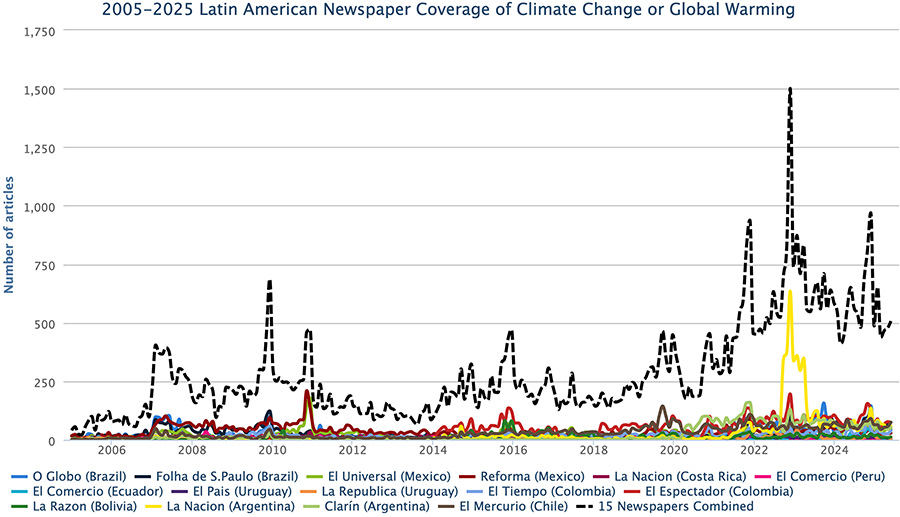
Figure 2. Coverage of ‘cambio climático’ or ‘calentamiento global’ in Spanish and ‘mudanças climáticas’ or ‘aquecimento global’ in Portuguese in Latin America from January 2005 through May 2025 in El Universal (México), Reforma (México), La Nación (Costa Rica), El Comercio (Perú), El Comercio (Ecuador), El País (Uruguay), La República (Uruguay), El Tiempo (Colombia), El Espectador (Colombia), La Razón (Bolivia), O'Globo (Brasil), Folha de Sao Paulo (Brazil), La Nación (Argentina), Clarín (Argentina) and El Mercurio (Chile).
Refrigerators on display at a Home Depot in Orlando, Florida. Photo: John Raoux/AP. |

Moving to the content of coverage, many media portrayals in May 2025 covered various political and economic themes in stories. To begin the month, the May 3 election in Australia – with climate change policy stances embedded in the voter priorities and candidate comments – generated media attention. For example, CNN journalists Harry Whiteman and Angus Watson reported, “Australia’s Prime Minister Anthony Albanese has secured a second term in office in a disastrous night for his conservative rivals, as voters chose stability over change against a backdrop of global turmoil inflicted by US President Donald Trump. Australia’s return of a left-leaning government follows Canada’s similar sharp swing towards Mark Carney’s Liberal Party, another governing party whose fortunes were transformed by Trump. The loss of Liberal Party leader Peter Dutton’s seat mirrors that of Conservative Party leader Pierre Poilievre. While Australia wasn’t facing the same threats to its sovereignty as Canada, Trump’s global tariffs and policy swings have undermined Australians’ trust in the US, according to recent surveys… Albanese first took office in the so-called “climate election” of 2022, with promises to cut Australia’s carbon emissions and reach net zero by 2050. Despite a rapid rollout of renewable projects – enough to power 10 million homes – his government has been criticized for also approving new coal and gas projects. On Saturday, Albanese reiterated his commitment to climate action in contrast to the rolling assault inflicted by the new US administration on environment agencies and research”.
Back in the US, further Trump Administration cuts to climate change and environmental research continued to flow into the news. For example, Washington Post journalist Maxine Joselow reported, “The Environmental Protection Agency plans to end Energy Star, a popular program whose iconic blue labels have certified the energy efficiency of home appliances for more than three decades, according to three people briefed on the matter and documents reviewed by The Washington Post. During an all-hands meeting Monday of the EPA’s Office of Atmospheric Protection, Trump administration officials announced that the office would be dissolved and that Energy Star would be eliminated, the three people said, speaking on the condition of anonymity because they were not authorized to comment publicly. Officials also outlined the changes in slide presentations obtained by Democrats on the Senate Environment and Public Works Committee. The presentations, which were shared with The Post, state that “staff in restructured/eliminated organizations may be reassigned to other positions” …The end of Energy Star, first reported by CNN, builds on the Trump administration’s broader attacks on energy efficiency standards for appliances found in millions of American homes. Such standards have become a flash point in the nation’s culture wars and a source of conservative resistance to President Joe Biden’s environmental agenda. President Donald Trump floated canceling or privatizing Energy Star during his first term, but that plan didn’t materialize before he left office. Now, his partial budget proposal calls for eliminating the EPA’s Office of Atmospheric Protection but is silent on Energy Star. The office, according to the proposal, “is an overreach of Government authority that imposes unnecessary and radical climate change regulations on businesses and stifles economic growth.” The Energy Department also plays a small role in running Energy Star, and Trump’s budget calls for slashing around $2.6 billion from the agency’s Office of Energy Efficiency and Renewable Energy. A spokeswoman for the Association of Home Appliance Manufacturers, which represents companies that make a variety of appliances, suggested that the EPA could transfer Energy Star to the Energy Department”. As a second example, New York Times correspondents Rebecca Dzombak and Hiroko Tabuchi wrote, “The National Oceanic and Atmospheric Administration said on Thursday it would stop tracking the cost of the country’s most expensive disasters, those which cause at least $1 billion in damage. The move would leave insurance companies, researchers and government policymakers without information to help understand the patterns of major disasters like hurricanes, drought or wildfires, and their economic consequences, starting this year. Those events are becoming more frequent or severe as the planet grows hotter, although not all disasters are linked to climate change. It’s the latest effort from the Trump administration to restrict or eliminate climate research. In recent weeks the administration has dismissed the authors working on the nation’s biggest climate assessment, planned to eliminate National Parks grants focused on climate change, and released a budget plan that would cut significantly climate science from the U.S. Geological Survey and the Energy and Defense departments”.
Surfside Beach, Texas, after Hurricane Beryl, one of 27 billion-dollar weather or climate disasters. Photo: Adrees Latif/Reuters. |
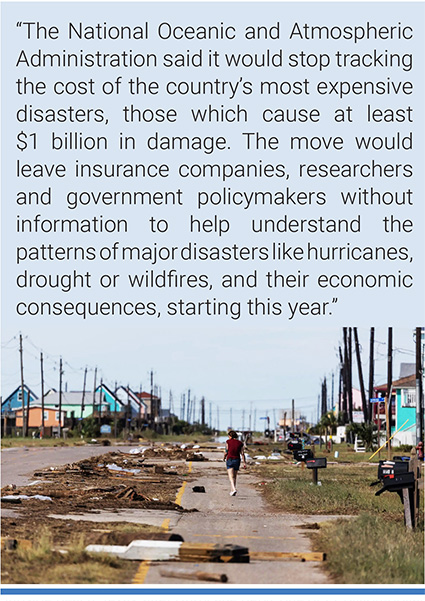
Several ecological and meteorological-themed media stories continued to be carried in news outlets in May. To begin, in Europe, drought – connected to a changing climate – was prominent in news account. For example, El País journalists Matías Helbig, Raquel Villaécija and Eva Millán noted, “while on the Iberian Peninsula, the first four months of the year were, according to the Ministry for Ecological Transition, the eighth wettest in the historical record—which begins in 1961—in countries such as Ireland, the United Kingdom, Germany, Sweden, and Poland, barely a drop of rain has fallen since February. This is demonstrated by the precipitation maps of the European climate change observation organization Copernicus. If the trend continues, in a territory that stretches from northern France to the Scandinavian Peninsula, the arrival of a hot and dry summer could make things difficult. The climate reversal occurring in Europe is due to the anomalous behavior of what is known as the jet stream”.
Meanwhile, in South Asia analysis of the heat waves in the previous month revealed connections with a changing climate. This generated news. For example, Times of India journalist Gaurav Talwar wrote, “The early arrival of the heatwave in April, scorching large parts of India and Pakistan with temperatures exceeding 40oC across North India and reaching 49oC in parts of Pakistan was largely driven by human-induced climate change, finds a study by climate experts from several countries”.
A fire in on the city boundaries of Flin Flon, a community of some 5,000 people. Photo: Government of Manitoba, Canada. |
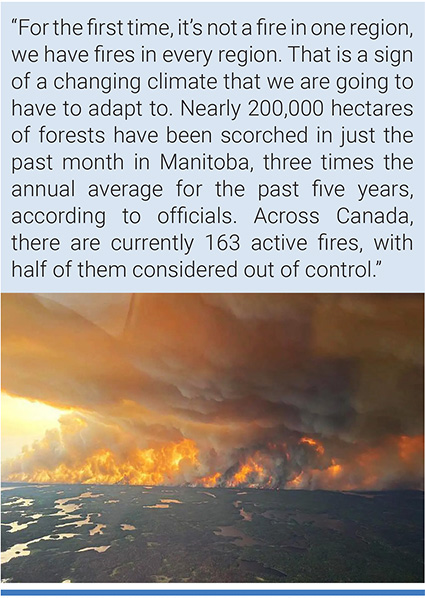
In late May in North America, Canadian wildfires earned media coverage with some stories making links with climate change. For example, Le Monde reported, “The western Canadian province of Saskatchewan declared a wildfire emergency on Thursday, May 29, becoming the second to do so after neighboring Manitoba had ordered 17,000 people to quickly flee their homes in remote communities a day earlier. "It's a very serious situation that we're faced with in Saskatchewan," the province's Premier Scott Moe told a news conference…Manitoba Premier Wab Kinew has said the province was experiencing its worst start to a wildfire season in years. "This is the largest evacuation Manitoba will have seen in most people's living memory," he told a news conference late Wednesday. The widespread nature of the fires was also cause for alarm, he warned. "For the first time, it's not a fire in one region, we have fires in every region. That is a sign of a changing climate that we are going to have to adapt to." Nearly 200,000 hectares of forests have been scorched in just the past month in Manitoba, three times the annual average for the past five years, according to officials. Across Canada, there are currently 163 active fires, with half of them considered out of control. Flin Flon, a mining town about 800 kilometers north of Winnipeg with about 5,000 residents, is the largest single community to be evacuated so far this year”. As a second example, BBC correspondent Nadine Yousef reported, “Canadian officials are warning of tough days ahead for fighting growing wildfires in Saskatchewan and Manitoba with hot and dry weather in the weekend forecast. The wildfires have forced thousands to evacuate in the two central prairie provinces, with both this week declaring states of emergency. In Manitoba, the entire city of Flin Flon has been emptied, except for firefighters and support workers, as a large blaze threatens the community. Smoke from the fires has triggered air quality alerts in Canada and as far as Chicago…There is also concern smoke from Canada's fires could affect the G7, being held in mid-June in Alberta. Fires are currently burning in the northern part of the province. There are currently seven fires considered "of note", meaning they may pose a threat to people or infrastructure, out of 50 burning in the province. Canada experienced its worst wildfire season on record in 2023, when over 42 million acres (17.3m hectares) burned - an area larger than all of England - and more than double the previous record. Smoke from those wildfires blanketed cities south of Canada's border into the US, including New York City. But the 2023 fires were more acutely felt in Alberta, British Columbia, the Northwest Territories, Nova Scotia, Ontario and Quebec. This year, it is Saskatchewan and Manitoba that are seeing the largest fires to date. Fires happen naturally in many parts of the world. It is difficult to know if climate change has caused or worsened a specific wildfire because other factors are also relevant, such as changes to the way land is used. But climate change is making the weather conditions needed for wildfires to spread more likely, the IPCC, the UN's climate body, says”.
Data is from the third quarter of 2022 through the first quarter of 2025. Excludes roughly $14 billion where the congressional district is unclear or the seat is vacant. Source: Clean Investment Monitor. |
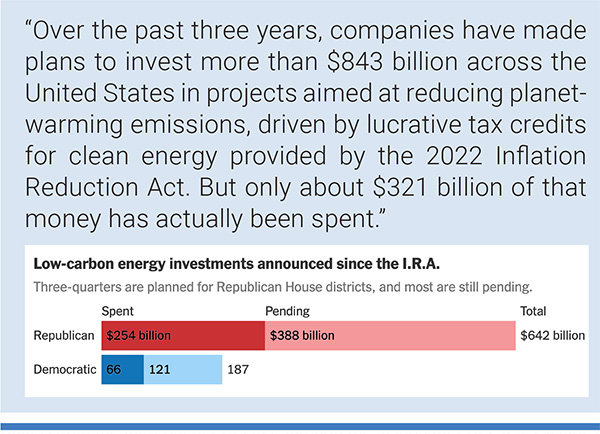
Next, there were cultural-themed stories relating to climate change or global warming in May. For example, Washington Post journalist Scott Dance noted, “some National Weather Service forecasting teams are so critically understaffed that the agency is offering to pay moving expenses for any staff willing to transfer to those offices, according to notices recently sent to employees and obtained by The Washington Post. The worker shortages have forced several offices to stop operating 24 hours a day — a drastic step for an agency whose ethos is to prepare and warn a “weather-ready” nation. The 155 vacancies the agency is seeking to fill by May 27 include key weather forecasting positions at offices in coastal Texas and Louisiana, states that could face threats when the Atlantic hurricane season begins in a few weeks. The National Oceanic and Atmospheric Administration, the weather service’s parent agency, is also asking large numbers of meteorologists to move to offices in Alaska and across the northern Plains in Nebraska, Wyoming and South Dakota. In four forecasting offices — two in California’s Central Valley, one in western Kansas and another in eastern Kentucky — the staffing is so thin that there aren’t enough meteorologists to cover an overnight shift, according to the National Weather Service Employees Organization, a union representing NOAA rank and file. Offices in Wyoming, Michigan, Oregon and Alaska are expected to soon follow suit, the union said. That development is elevating fears that without the transfers or new hires, more offices will struggle to monitor coming weather threats, issue aviation forecasts and launch weather balloons around-the-clock, according to current and former weather service officials who spoke on the condition of anonymity because they were not authorized to speak for the agency. The circumstances lay bare how significantly the Trump administration has whittled away the corps of public servants responsible for the forecasting, warnings and information that can protect lives and property when extreme weather strikes. An estimated 500 National Weather Service employees have been fired or taken early retirements this year, out of a staff that numbered more than 4,200 before President Donald Trump began his second term, the officials said”.
Also, New York Times correspondents Brad Plumer and Harry Stevens reported, “Sprawling wind farms in Wyoming. A huge solar factory expansion in Georgia. Lithium mines in Nevada. Vacuums that suck carbon from the air in Louisiana. Over the past three years, companies have made plans to invest more than $843 billion across the United States in projects aimed at reducing planet-warming emissions, driven by lucrative tax credits for clean energy provided by the 2022 Inflation Reduction Act. But only about $321 billion of that money has actually been spent, with many projects still on the drawing board, according to data made public this month by the Clean Investment Monitor, a joint project of the Rhodium Group and the Massachusetts Institute of Technology. Now, much of the rest, about $522 billion, will depend on action playing out on Capitol Hill. Republicans in Congress are hotly debating proposals to roll back tax credits for low-carbon energy as they search for ways to pay for a roughly $4 trillion tax cut package favored by President Trump… The prospect of repeal has set off a furious lobbying battle in Washington, with energy companies pleading with lawmakers to preserve the tax breaks. At least three dozen Republicans have asked their colleagues to keep at least some tax credits to protect jobs in their districts and reduce electricity prices. But a nearly equal number of conservative House members are pushing publicly to kill the climate law altogether”.
The remains of businesses destroyed in the Palisades fire in Pacific Palisades, California. Photo: Mario Tama/Getty Images. |
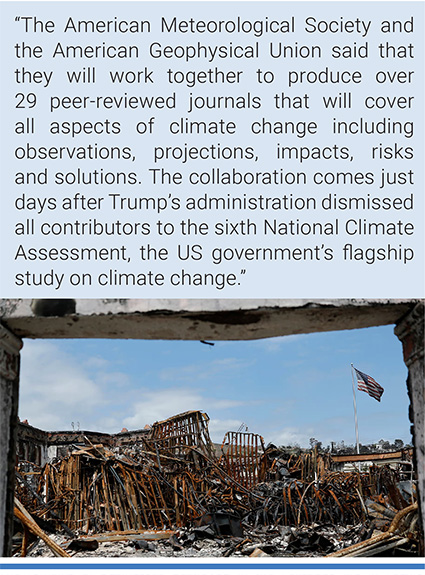
Last, many scientific themes within news stories about climate change or global warming persisted in the month of May. For instance, media stories captured how politics shaped ongoing pursuits of scientific research in the US. For example, Guardian reporter Maya Yang wrote, “two major US scientific societies have announced they will join forces to produce peer-reviewed research on the climate crisis’s impact days after Donald Trump’s administration dismissed contributors to a key Congress-mandated report on climate crisis preparedness. On Friday, the American Meteorological Society (AMS) and the American Geophysical Union (AGU) said that they will work together to produce over 29 peer-reviewed journals that will cover all aspects of climate change including observations, projections, impacts, risks and solutions. The collaboration comes just days after Trump’s administration dismissed all contributors to the sixth National Climate Assessment, the US government’s flagship study on climate change. The dismissal of nearly 400 contributors had left the future of the study in question; it had been scheduled for publication in 2028. The NCA had been overseen by the Nasa-supported Global Change Research Program – a key US climate body which the Trump administration also dismissed last month. The reports, which have been published since 2000, coordinated input from 14 federal agencies and hundreds of external scientists. In its announcement on Friday, the two societies said: “This effort aims to sustain the momentum of the sixth National Climate Assessment (NCA), the authors and staff of which were dismissed earlier this week by the Trump administration, almost a year into the process.” According to the AMS and AGU, the collection will not replace the NCA but instead create a mechanism for important work on climate change’s impact to continue”.
The loss of ice from the Greenland and Antarctic ice sheets has quadrupled since the 1990s. Photo: Bernhard Staehli/Shutterstock. |
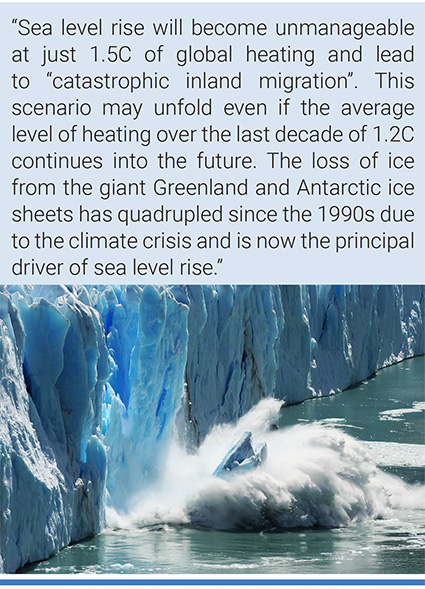
Also in May 2025, new research in Nature Communications about global warming and polar ice sheets earned media coverage in May. For example, CNN correspondent Laura Paddison reported, “The world’s ice sheets are on course for runaway melting, leading to multiple feet of sea level rise and “catastrophic” migration away from coastlines, even if the world pulls off the miraculous and keeps global warming to within 1.5 degrees Celsius, according to new research. A group of international scientists set out to establish what a “safe limit” of warming would be for the survival of the Greenland and Antarctic ice sheets. They pored over studies that took data from satellites, climate models and evidence from the past, from things like ice cores, deep-sea sediments and even octopus DNA. What they found painted a dire picture. The world has pledged to restrict global warming to 1.5 degrees Celsius above pre-industrial levels to stave off the most catastrophic impacts of climate change. However, not only is this limit speeding out of reach — the world is currently on track for up to 2.9 degrees of warming by 2100. But the most alarming finding of the study, published Tuesday in the journal Communications Earth and Environment, is that 1.5 might not even be good enough to save the ice sheets. Even if the world sustains today’s level of warming, at 1.2 degrees, it could still trigger rapid ice sheet retreat and catastrophic sea level rise, the scientists found. The Greenland and Antarctic ice sheets together hold enough fresh water to raise global sea levels by around 213 feet — an unlikely scenario but one that must be acknowledged to fully understand the risk”. As a second example, Guardian environment editor Damien Carrington wrote, “Sea level rise will become unmanageable at just 1.5C of global heating and lead to “catastrophic inland migration”, the scientists behind a new study have warned. This scenario may unfold even if the average level of heating over the last decade of 1.2C continues into the future. The loss of ice from the giant Greenland and Antarctic ice sheets has quadrupled since the 1990s due to the climate crisis and is now the principal driver of sea level rise. The international target to keep global temperature rise below 1.5C is already almost out of reach. But the new analysis found that even if fossil fuel emissions were rapidly slashed to meet it, sea levels would be rising by 1cm a year by the end of the century, faster than the speed at which nations could build coastal defences. The world is on track for 2.5C-2.9C of global heating, which would almost certainly be beyond tipping points for the collapse of the Greenland and west Antarctic ice sheets. The melting of those ice sheets would lead to a “really dire” 12 metres of sea level rise. Today, about 230 million people live within 1 metre above current sea level, and 1 billion live within 10 metres above sea level. Even just 20cm of sea level rise by 2050 would lead to global flood damages of at least $1tn a year for the world’s 136 largest coastal cities and huge impacts on people’s lives and livelihoods. However, the scientists emphasised that every fraction of a degree of global heating avoided by climate action still matters, because it slows sea level rise and gives more time to prepare, reducing human suffering. Sea level rise is the biggest long-term impact of the climate crisis, and research in recent years has shown it is occurring far faster than previously estimated. The 1.5C limit was seen as a way to avoid the worst consequences of global heating, but the new research shows this is not the case for sea level rise. The researchers said the “safe limit” temperature for ice sheets was hard to estimate but was likely to be 1C or lower. Sea level rise of at least 1-2 metres was now inevitable, the scientists said”.
Scientists warn of an increased frequency of wildfires and other extreme events. Photo: AP. |
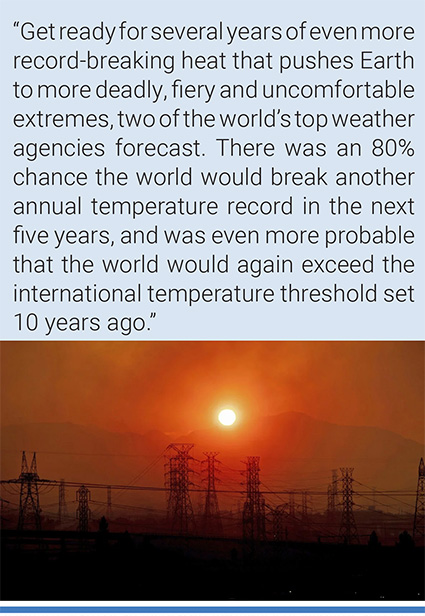
Meanwhile, a new World Meteorological Organization report was released that forecasted that global average temperatures were on pace to ‘remain at or near’ the 2oC temperature threshold that has been considered to be the threshold for dangerous anthropogenic interference with the climate and planet. This temperature threshold has consequently been identified in the 2015 Paris Climate Agreement as a target not to hit or exceed. This report generated media attention in part because it was seen as the first time that convergent climate modeling have pointed to an emergent possibility that this could be reached as soon as 2029. The report also noted an 80% probability that ‘at least one year’ in the next five years will surpass the year 2024 as the warmest year documented since record keeping began. For example, The South China Morning Post reported, “Get ready for several years of even more record-breaking heat that pushes Earth to more deadly, fiery and uncomfortable extremes, two of the world’s top weather agencies forecast. There was an 80 per cent chance the world would break another annual temperature record in the next five years, and was even more probable that the world would again exceed the international temperature threshold set 10 years ago, according to a five-year forecast released Wednesday by the World Meteorological Organization and the UK Meteorological Office”. Elsewhere, Guardian journalist Jonathan Watts wrote, “For the first time, the data also indicated a small likelihood that before 2030, the world could experience a year that is 2C hotter than the preindustrial era, a possibility scientists described as “shocking”. Coming after the hottest 10 years ever measured, the latest medium-term global climate update highlights the growing threat to human health, national economies and natural landscapes unless people stop burning oil, gas, coal and trees. The update, which synthesises short-term weather observations and long-term climate projections, said there was a 70% chance that five-year average warming for 2025-2029 will be more than 1.5C above preindustrial levels. This would put the world perilously close to breaking the most ambitious target of the Paris Agreement, an international climate change treaty, though that goal is based on an average over 20 years. It also reported an 86% likelihood that 1.5C would be passed in at least one of the next five years, up from 40% in the 2020 report. In 2024, the 1.5C threshold was breached on an annual basis for the first time – an outcome that was considered implausible in any of the five-year predictions before 2014. Last year was the hottest in the 175-year observational record. Underscoring how rapidly the world is warming, even 2C is now appearing as a statistical possibility in the latest update, which is compiled by 220 ensemble members from models contributed by 15 different institutes, including the UK’s Met Office, Barcelona Supercomputing Centre, the Canadian Centre for Climate Modelling and Analysis, and Deutscher Wetterdienst. The likelihood of 2C before 2030 is tiny – about 1% – and would require a convergence of multiple warming factors, such as a strong El Niño and positive Arctic Oscillation, but it was previously considered impossible in a five-year timeframe”.
A vendor wipes dust off refrigerators displayed outside a shop as he waits for customers on a hot day in Amritsar, India. Photo: Narinder Nanu/AFP. |
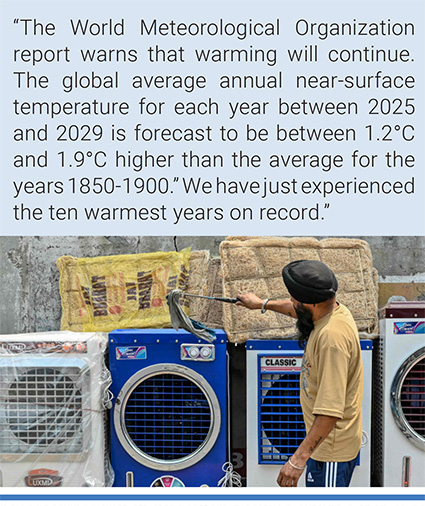
As a third example, La Vanguardia journalist Antonio Cerrillo wrote, “the WMO report warns that warming will continue. The global average annual near-surface temperature for each year between 2025 and 2029 is forecast to be between 1.2°C and 1.9°C higher than the average for the years 1850-1900."We have just experienced the ten warmest years on record. Regrettably, this WMO report offers no indication of an improvement in the coming years, which means there will be an increasing negative impact on our economies, our daily lives, our ecosystems, and our planet," said WMO Assistant Secretary-General Ko Barrett. Every additional fraction of a degree of warming matters, the report's authors argue, as it leads to more damaging heat waves, more extreme precipitation, and intense droughts, as well as melting of ice sheets, sea ice, and glaciers, all accompanied by ocean warming and rising sea levels.”
Then, in late May 2025 scientists coordinated a livestream set of presentations across 100 hours to raise awareness about scientific understanding about climate change. As designed, this generated news. For example, New York Times reporter Christina Kelso noted, “Before he started livestreaming a presentation on the history of climate research at NASA’s Goddard Institute for Space Studies from its New York City lab, David Rind gave viewers a small heads-up. “If you hear any noise in the background, this place is literally being torn apart with us still in it,” he said. Researchers were told to vacate the office and transition to remote work after NASA said it had ended the lease, as a result of vast federal cuts in recent months by the Trump administration. Dr. Rind’s presentation was the first of many in a planned, 100-hour-long livestream featuring hundreds of climate scientists and meteorologists from across the United States. They are protesting cuts to funding for atmospheric science and calling out potential risks to weather forecasts. The livestream started on Wednesday and is scheduled to run continuously through June 1, the first day of the Atlantic hurricane season. Since January, the Trump administration has made sweeping cuts to climate and weather research, including firing hundreds of scientists at the National Oceanic and Atmospheric Administration and the National Weather Service, ending federal monitoring of greenhouse gas emissions and dismissing authors of the National Climate Assessment, the United States’ flagship climate report”.
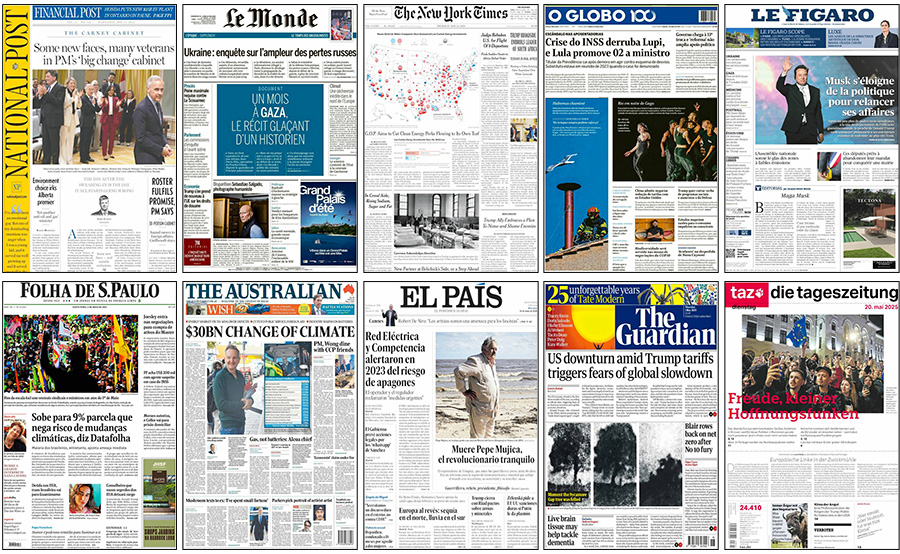
Figure 3. Examples of newspaper front pages with climate change stories in May 2025.
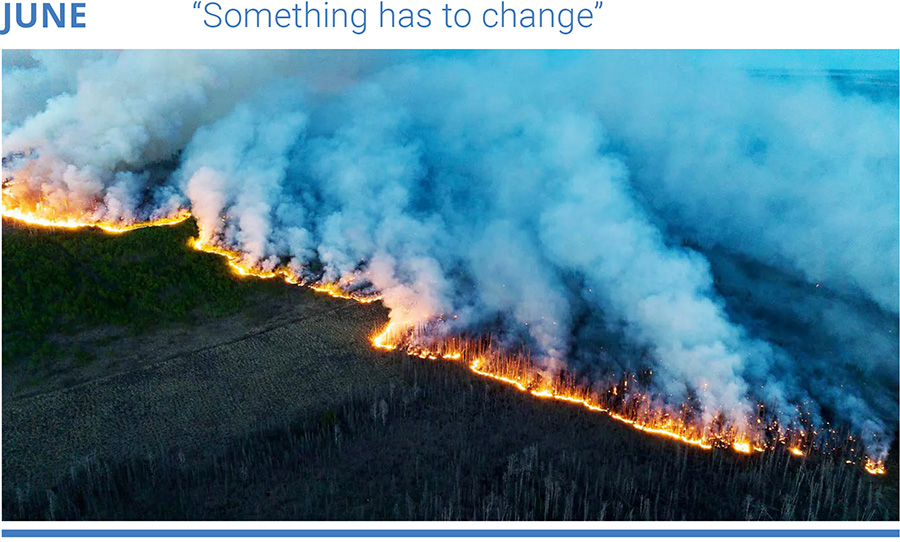
Canada has seen weeks of unprecedented wildfires, with thousands of people evacuated. Photo: Alamy.

June media coverage of climate change or global warming in newspapers around the globe dropped 6% from May 2025, while it was markedly down 28% from June 2024. Meanwhile, international wire services increased 9% from May 2025 but still decreased 26% from June 2024. Figure 1 shows trends in newspaper media coverage at the global scale – organized into seven geographical regions around the world – across 21.5 years, from January 2004 through June 2025.
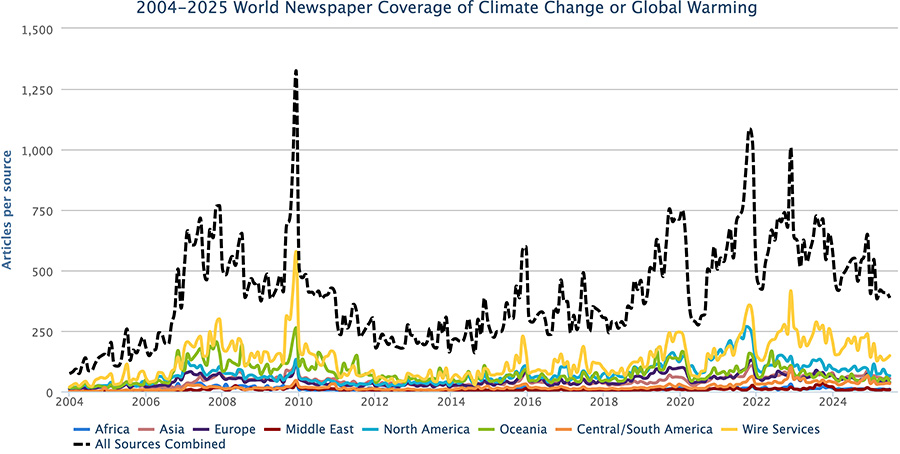
Figure 1. Newspaper media coverage of climate change or global warming in print sources in seven different regions around the world, from January 2004 through June 2025.
At the regional level, June 2025 coverage – compared to the previous month – stayed steady in the Middle East while it went up 4% in Asia as well as up 17% in Africa. However, coverage went down in Latin America (-3%), North America (-7%), Europe (EU) (-12%), and Oceania (-43%). Comparing these June 2025 levels of coverage to a year previous (June 2024), counts decreased in all regions: in the Middle East (-3%), North America (-7%), Latin America (-13%), Asia (-16%), Africa (-25%), the EU (-35%), and Oceania (-54%). As an example, at the country level of coverage that we at the Media and Climate Change Observatory (MeCCO) monitor, coverage in Canada in June 2025 increased 24% from May 2024 but remained 19% lower than levels of coverage in June 2024 (see Figure 2).
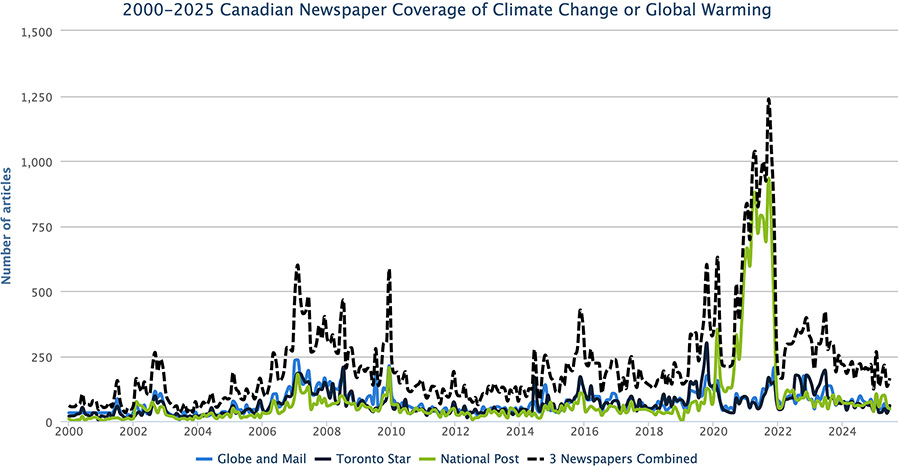
Figure 2. Canadian newspaper coverage – in Globe and Mail, Toronto Star, and National Post – of climate change or global warming from January 2000 through June 2025.
The Bald Mountain Wildfire is shown in the Grande Prairie Forest Area on Friday May 12, 2023 this handout image provided by the Government of Alberta. Photo: HO /The Canadian Press. |
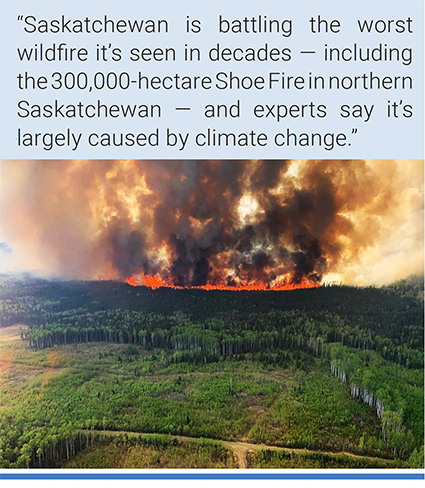
In terms of content, there were many ecological and meteorological-themed media stories carried in outlets in June. To begin the month, in Canada and in the United States (US) there were growing concerns about heat and wildfire activity in the West. For example, reporting in Le Monde shared, “Canada's wildfires, which have already forced the evacuation of more than 26,000 people, continued their stubborn spread on Tuesday, June 4, with heavy smoke choking millions of Canadians and Americans and reaching as far away as Europe. Alerts were issued for parts of Canada and the neighboring United States, warning of hazardous air quality… Climate change has intensified the impact of extreme weather events in Canada, which is still recovering from the apocalyptic summer of 2023 when 15 million hectares of forests were scorched. As of Tuesday, there were 208 active fires across Canada. Half of them were listed as out of control, according to the Canadian Interagency Forest Fire Centre. Many of the affected populations are Indigenous, and some small communities have been burned to the ground”. As a second example, CBC News reporter Aliyah Marko-Omene wrote, “Saskatchewan is battling the worst wildfire it's seen in decades — including the 300,000-hectare Shoe Fire in northern Saskatchewan — and experts say it's largely caused by climate change. "This is classic climate change," said Colin Laroque, head of soil science and professor at the University of Saskatchewan. Laroque said climatology is studied using 30-year timeframes of weather patterns, which "weren't that different" until recently… Lori Daniels, professor and researcher at the University of British Columbia's department of forest and conservation sciences, said the emergency wildfire situation in the province is the result of an emergency global climate situation. "The further we are from the equator, we're seeing that those changes are amplified," Daniels said. "In Northern Canada and the northern parts of our provinces and up into the territories … we're experiencing more than three times what the global average is in terms of temperature change." Daniels said climate change is "the new reality" and it's unclear how long the province will be dealing with these fires”. As a third example, writing for The Guardian Eric Holthaus noted, “Unusually warm springtime temperatures have contributed to rapid reductions in snowpacks across the western US that rival the fastest rates on record, increasing concerns around wildfire season. The rapid snowmelt, in addition to reduced staffing and budget constraints initiated by the Trump administration, has set the stage for a particularly dangerous season across the west, according to an analysis of publicly available data by the Guardian and interviews with experts in the region. The National Weather Service has issued flash flood warnings across the south-west this week as warm weather ushered in rainfall at higher-than-usual elevations, worsening the runoff. In several lower-elevation locations within the headwaters of the Colorado River, mountain terrain is already snow-free – the earliest complete melting of snowpack on record…The rapid onset of summer-like conditions is a clear symptom of the climate crisis, and it has been occurring more frequently in the western US in recent years. There are more than a million homes in the wildland-urban interface in Washington state – about the same as in southern California – and the number is growing quickly”.
Wildfire activity – with links to climate change – generated concern and news coverage in other regions on the planet as well. For example, in Greece BBC journalist Nikos Papanikolaou reported, “A large wildfire swept through the coastal towns of Palaia Fokaia and Thymari 40 km (25 miles) southeast of Athens, destroying homes and forcing evacuations as it neared the beach. The flames erupted in low vegetation but quickly spread into residential areas, as Greece experienced its first heatwave of the summer. At least 20 homes were destroyed and many others suffered structural damage, according to local officials. Strong winds and soaring temperatures of up to 40°C made the fire extremely difficult to control… Greece has sought to beef up its response to wildfires, which have become increasingly common because of its long, hot summers and warming climate”.
June coverage also involved new information about how fire devastated more of the Amazon in 2024 than at any time in 40 years. For example, El País journalist Naiara Galarraga Gortázar wrote, “We now know that the fire that devoured South America last September, just as the Southern Hemisphere entered spring, caused historic devastation in the Brazilian Amazon. In 2024, intentional fires scorched more of the world's largest rainforest than at any time in the past 40 years, according to satellite measurements. The flames burned exactly 156,000 square kilometers of rainforest, according to the report presented by Mapbiomas, a Brazilian organization comprised of universities, NGOs, and technology companies. That's more than all of Greece. According to Mapbiomas, this explosion of Amazon fires is due to intentional fires to open new pastures, aggravated by a historic drought and other effects of climate change. The fires in the Amazon were only half of those suffered in Brazil. But the damage could be severe or very severe. The report adds that two-thirds of the area burned in the country over these four decades was native vegetation, the most resilient and the most effective contributor to mitigating global warming”.
A fruit vendor pushes her cart on the Brooklyn Bridge during a heatwave in New York. Photo: Olga Fedorova/AP. |
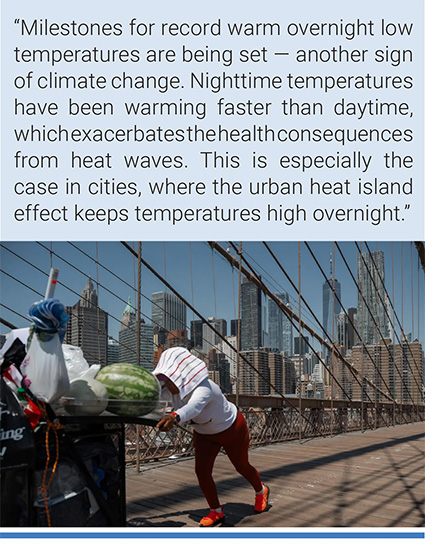
In mid-June, a heat wave across North America made news as several stories made links with a warming planet. For example, at CNN journalist Andrew Freedman wrote, “The intensifying and expansive heat wave affecting around 150 million people in the United States from Wisconsin to Washington, DC, bears the hallmarks of human-caused global warming. Hundreds of daily temperature records are threatened during the next few days, particularly along the East Coast, and some all-time June high temperature records could be tied or broken as well. Milestones for record warm overnight low temperatures are also being set — another sign of climate change. Nighttime temperatures have been warming faster than daytime, which exacerbates the health consequences from heat waves. This is especially the case in cities, where the urban heat island effect keeps temperatures high overnight. The US heat wave comes nearly in tandem with searing high temperatures in Western Europe, which global warming made far more likely and intense. Of all the forms of extreme weather — droughts, floods, hurricanes — heat waves are the ones that scientists can most reliably tie to climate change caused by fossil fuel pollution. As the world warms, the odds of extreme heat events increase dramatically, while the odds and severity of record cold extremes decrease”. Meanwhile, Guardian correspondent Edward Helmore noted, “The list of climate-related disasters in the US was long last week as vast swathes of America sweated under a brutal heatwave. There was a “mass-casualty event” of fainting high-schoolers in New Jersey as a K-pop concert was cut short in Washington. Young hikers had to be rescued in New Hampshire as tarmac roads bucked and melted in South Dakota and Nebraska. Luckless Amtrak passengers were stuck on a train with no air conditioning in a Baltimore tunnel, while some subway services in New York were suspended. The Trump administration declared a power emergency in the US south-east, and in Georgia the agriculture commissioner advised residents to make sure their animals had water and shade. These incidents – and many more – were the result of the highest temperatures across the northern and middle swath of the US at this early summer date in some cases since the late 19th century. Nearly 130 million people were under extreme heat warnings or heat advisories on Thursday, according to NOAA’s Weather Prediction Center, with 282 locations breaking daily heat records this week, with another 121 equaling with previous highs, NOAA data showed. Daily heat records were set in at least 50 cities in the eastern US on Tuesday alone, according to the National Weather Service, with New York City recording its hottest day since 2012, according to NOAA. Climate scientists blamed a rapidly warming Arctic for the heat dome – a consequence that they say is the result of the “stuck” weather patterns that come from a wavier polar jet stream, which can cause not just heatwaves but also heavy rainfall and floods”. Elsewhere, New York Times journalists Achi Kitajima Mulkey, Claire Brown and Mira Rojanasakul reported, “Summer started barely a week ago, and already the United States has been smothered in a record-breaking “heat dome.” Alaska saw its first-ever heat advisory this month. And all of this comes on the heels of 2024, the hottest calendar year in recorded history. The world is getting hotter, faster. A report published last week found that human-caused global warming is now increasing by 0.27 degrees Celsius per decade. That rate was recorded at 0.2 degrees in the 1970s, and has been growing since. This doesn’t surprise scientists who have been crunching the numbers. For years, measurements have followed predictions that the rate of warming in the atmosphere would speed up. But now, patterns that have been evident in charts and graphs are starting to become a bigger part of people’s daily lives”.
A homeless person shelters from the sun under a bench on the Rambla de Sants in Barcelona, Spain. Photo: Toni Albir/EFE. |
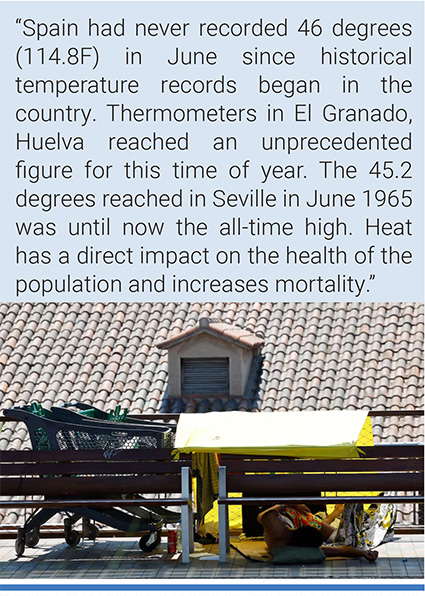
A heat wave in Europe also generated news that linked the warmth to a changing climate. For example, Guardian correspondent Sam Jones wrote, “Authorities across Europe are on alert as the first heatwave of the summer pushes temperatures up to 42C (107.6F), as the fastest-warming continent continues to suffer the effects of the climate emergency. Spain’s state meteorological office, AEMET, issued a special heat warning on Friday, saying temperatures could reach 42C in some southern areas of the country over the coming days. “Very high and persistent temperatures are expected, both during the day and at night, which could pose a risk to exposed and/or vulnerable people,” AEMET said. Madrid’s health ministry also warned people to take extra care in the heat, reminding them to stay out of the sun, keep hydrated and pay close attention to those who are older, pregnant or who have chronic health conditions. Two-thirds of Portugal will be on high alert on Sunday for extreme heat and forest fires as temperatures of up to 42C are expected in Lisbon. As temperatures in Marseille approach 40C, authorities in France’s second-largest city have ordered public swimming pools to be made free of charge to help residents beat the Mediterranean heat. With peaks of 39C expected in Naples and Palermo, Sicily has ordered a ban on outdoor work in the hottest hours of the day, as has the Liguria region in northern Italy. The country’s trade unions are campaigning to extend the measure to other regions. In Venice – which has played host to the lavish three-day wedding celebrations of Amazon founder Jeff Bezos and his wife, Lauren Sánchez, guests, visitors and protesters are feeling the heat”. As a second example, El País journalists Oriol Güell, Jacob Vicente y Montse Hidalgo Pérez noted, “Spain had never recorded 46 degrees in June since historical temperature records began in the country. Until this Saturday, when thermometers in El Granado (Huelva) reached an unprecedented figure for this time of year, according to the State Meteorological Agency (AEMET). The 45.2 degrees reached in Seville in June 1965 was until now the all-time high. Heat has a direct impact on the health of the population and increases mortality”.
Source: Daily Mail Online. |
Several cultural-themed stories relating to climate change or global warming were evident in media accounts. To begin, the Club World Cup that kicked off in the US generated media attention as players and fans were subjected to hot temperatures at match times. For example, Daily Mail journalist Zac Campbell reported, “Former Liverpool manager Jurgen Klopp has slammed the current Club World Cup as 'the worst idea ever in football' in a brutally honest swipe at FIFA. Klopp, 58, appeared to be wholly unimpressed with the path taken by the sport's decision-makers to introduce a newly-expanded 32-team format this summer. The tournament, which is currently being held in the United States, has come in for heavy criticism for adding to what many players and managers believe to be a saturated schedule…The German, who is now Red Bull's global chief of football, was an outspoken advocate on the importance of player welfare during his time as Liverpool manager. In August 2022, he compared the issue of player welfare to climate change ahead of that year's World Cup taking place mid-season in Qatar. He said at the time: 'If you go to the final at a World Cup and win it or lose or a third-place match you are already quite busy and then the rest starts a week later. 'If all the players then have a break it is not a problem, it is good. It is like a winter break which I had that in Germany as a player a lot, four weeks (off), stuff like that. 'When I start talking about it, I get really angry... It is like with the climate. We all know it has to change but nobody is saying what we have to do.' 'My problem is that as much as everybody knows it's not right, nobody talks often enough about it that it will be changed. Something has to change”. As a second example, CBS News sports reporter Pardeep Cattry wrote, “Each and every one of those teams was caught in the middle of USA's summertime weather extremes, all of which will likely play a big part at next summer's World Cup co-hosted by the country, as well as Canada and Mexico. It will add an extra layer of accommodation and preparation for the teams that make the trip, be it for this year's tournament or next year's. The climate realities are somewhat unique to the country, even if the heat issues remind one of Qatar's conditions that paved the way for the first winter World Cup. By selecting North America as the host for next year's World Cup, FIFA will have to deal with the unavoidable climatic realities, though some are of their own creation…Lightning-related delays fall in the former category, a natural result of hot and humid temperatures that are a hallmark of American summers. There is a reason why Florida and Texas, two states that will host matches at next summer's World Cup, are sometimes known as the U.S.' "lightning capitals" — few places are as steamy as those in the summer months, though researchers suggest climate change could increase the number of lightning strikes across the country”.
Photo: Financial Times. |
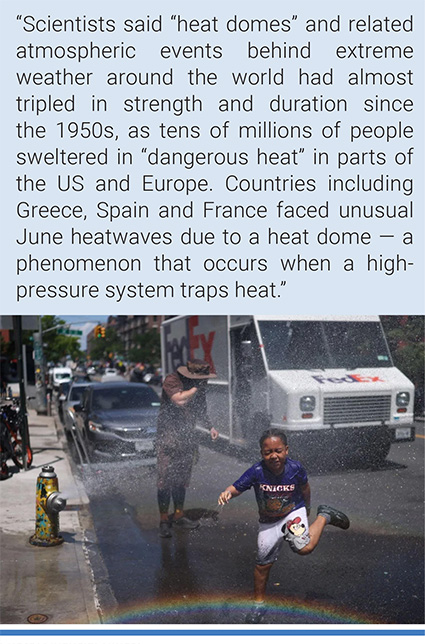
In the UK, the hottest opening day on record (June 30) at the Wimbledon tennis tournament generated news coverage making links to global warming and climate change. For example, The Mainichi Shimbun reported, “Wimbledon players and spectators were hit by record-breaking Day 1 heat as the temperature rose to 91 degrees Fahrenheit -- 33 Celsius -- at the oldest Grand Slam tournament on Monday…Some sweat-soaked athletes sought help from ice-filled towels wrapped around their necks while they sat on sideline chairs. Others said it actually wasn't all that unbearable, especially given that the weather was not extraordinary compared to what often occurs during the local summers when the Australian Open is held in Melbourne in January or the U.S. Open is in New York in August and September. At those events, temperatures regularly get to 90 degrees F (32 degrees C) and can top 100 degrees F (38 degrees C). A 2023 Associated Press analysis showed the average high temperatures felt during the U.S. Open and the three other major tennis tournaments steadily have gotten higher and more dangerous in recent decades, reflecting the climate change that has created record heat waves. For the players, it can inhibit them from playing their best and, worse, increase the likelihood of heat-related illness. By local standards, this certainly was significant”. Meanwhile, with a headline photograph from Wimbledon with the caption ‘Spectators during the first round match at the Wimbledon All England Lawn Tennis and Croquet Club in London, where temperatures were expected to peak at 35C on Tuesday’, Financial Times journalists Attracta Mooney and Steven Bernard wrote, “Scientists said “heat domes” and related atmospheric events behind extreme weather around the world had almost tripled in strength and duration since the 1950s, as tens of millions of people sweltered in “dangerous heat” in parts of the US and Europe. Countries including Greece, Spain and France faced unusual June heatwaves due to a heat dome — a phenomenon that occurs when a high-pressure system traps heat — having formed over part of Europe. The UK Met Office said June was the hottest on record for England and the second hottest for the UK since 1884, according to provisional data”.
Next, there were many scientific themes in the news about climate change or global warming. For instance, a new study in the journal Nature found that evaporation due to climate change has increased drought severity by about 40% in recent years. This generated news attention. For example, New York Times journalist Rebecca Dzomback reported, “Higher temperatures caused by climate change are driving complex processes that make droughts bigger and more severe, new research shows…The new study aimed to figure out how atmospheric thirst has changed over more than one hundred years, including how to best model it and how it can improve monitoring and predictions of drought. Dr. Gebrechorkos and his co-authors used multiple precipitation data sets, climate models and ways of calculating drought from 1901 to 2022 to assess how to capture atmospheric thirst and how it has been affecting droughts. They found that it played an even bigger role than previously thought, drying out historically arid and wet regions alike. Drought has been spreading and getting more intense since the 1980s almost everywhere around the world except for southeastern Asia, the study found. Atmospheric thirst, a direct result of global warming, made those droughts about 40 percent more severe, the study found. The Western United States, large areas of Africa and South America, Australia and Central Asia are particularly prone to drought because of increased atmospheric thirst, the study found”.
Source: Copernicus Climate Change Service. Graphic: M.K. Wildeman. |
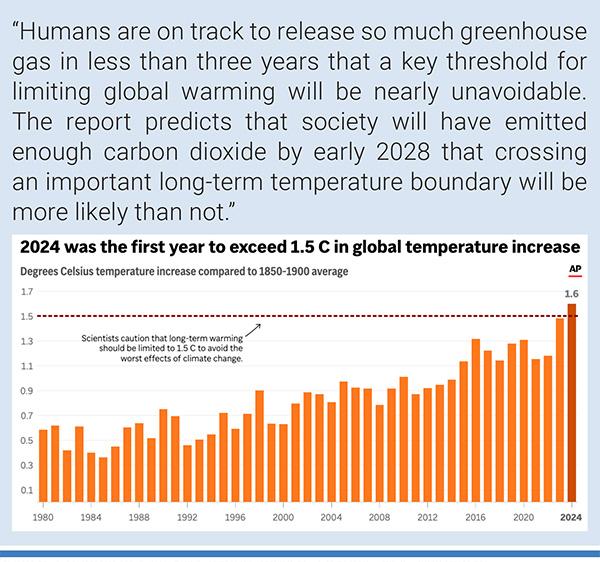
Meanwhile, news reports circulated about new scientific assessments about the 1.5oC threshold of temperature rise since pre-industrial times due to global warming is on course to be surpassed in the next 3-5 years. For example, BBC reporter Mark Poynting noted, “The Earth could be doomed to breach the symbolic 1.5C warming limit in as little as three years at current levels of carbon dioxide emissions. That's the stark warning from more than 60 of the world's leading climate scientists in the most up-to-date assessment of the state of global warming. Nearly 200 countries agreed to try to limit global temperature rises to 1.5C above levels of the late 1800s in a landmark agreement in 2015, with the aim of avoiding some of the worst impacts of climate change. But countries have continued to burn record amounts of coal, oil and gas and chop down carbon-rich forests - leaving that international goal in peril. Climate change has already worsened many weather extremes - such as the UK's 40C heat in July 2022 - and has rapidly raised global sea levels, threatening coastal communities. "Things are all moving in the wrong direction," said lead author Prof Piers Forster, director of the Priestley Centre for Climate Futures at the University of Leeds. "We're seeing some unprecedented changes and we're also seeing the heating of the Earth and sea-level rise accelerating as well." These changes "have been predicted for some time and we can directly place them back to the very high level of emissions", he added. At the beginning of 2020, scientists estimated that humanity could only emit 500 billion more tonnes of carbon dioxide (CO2) - the most important planet-warming gas - for a 50% chance of keeping warming to 1.5C. But by the start of 2025 this so-called "carbon budget" had shrunk to 130 billion tonnes, according to the new study. That reduction is largely due to continued record emissions of CO2 and other planet-warming greenhouse gases like methane, but also improvements in the scientific estimates… Last year was the first on record when global average air temperatures were more than 1.5C above those of the late 1800s. A single 12-month period isn't considered a breach of the Paris agreement, however, with the record heat of 2024 given an extra boost by natural weather patterns. But human-caused warming was by far the main reason for last year's high temperatures, reaching 1.36C above pre-industrial levels, the researchers estimate. This current rate of warming is about 0.27C per decade – much faster than anything in the geological record. And if emissions stay high, the planet is on track to reach 1.5C of warming on that metric around the year 2030”. Meanwhile, Associated Press journalist Seth Borenstein wrote, “Humans are on track to release so much greenhouse gas in less than three years that a key threshold for limiting global warming will be nearly unavoidable, according to a study to be released Thursday. The report predicts that society will have emitted enough carbon dioxide by early 2028 that crossing an important long-term temperature boundary will be more likely than not. The scientists calculate that by that point there will be enough of the heat-trapping gas in the atmosphere to create a 50-50 chance or greater that the world will be locked into 1.5 degrees Celsius (2.7 degrees Fahrenheit) of long-term warming since preindustrial times. That level of gas accumulation, which comes from the burning of fuels like gasoline, oil and coal, is sooner than the same group of 60 international scientists calculated in a study last year”.
2025 Bonn Climate Change Conference. Photo: Wikimedia Commons. |
Last, there were lots of June 2025 media segments and articles with political and economic themes in June. Animating these themes, the annual Bonn climate talks – that take place mid-year between the main United Nations climate negotiations – produced limited progress on climate action at a time when such progress is deemed urgently needed. This generated some news attention. For example, Hindustan Times correspondent Jayashree Nandi reported, “The Bonn meeting is critical to thrash out differences before the parties meet in November for a climate deal, which will take place amid severe geopolitical turmoil and renewed tensions as Israel strikes Iran. The shadow of failed climate finance talks at COP29, Baku, also shroud these meetings. There are divergent views on the Baku to Belem road map to 1.3T, which is expected to be finalised at COP30 in Brazil this November. For example, according to an analysis made by the Centre for Science and Environment (CSE), G77 and China demand that equity and Common but Differentiated Responsibilities (CBDR) must be at the core of climate finance, and developing countries must be allowed to self-determined pathways to use finance; the Like Minded Developing Countries (LMDC), another coalition of developing nations, has sought exclusion of international taxes, levies and debt approaches as they violate sovereignty”. Meanwhile, Indian Express journalist Amitabh Sinha wrote, “In a small but important victory in climate negotiations, developing countries led by India have managed to force a reopening of discussions on the obligations of developed nations to “provide” finance, and not just make efforts towards “mobilising” financial resources, for climate action. The issue of climate finance was sought to be settled last year at the COP29 meeting in Baku, Azerbaijan, where developed nations had agreed to mobilise a sum of at least USD 300 billion per year from 2035. The figure is three times the amount that developed countries are currently obligated to raise, but well short of the USD 1.3 trillion a year that is the assessed minimum requirement of the developing countries. At the ongoing annual climate talks in Bonn, Germany, a formal ‘consultation’ was held on the issue Monday after developing countries made a united pushback, seeking inclusion of a dedicated agenda item to discuss the obligation of the developed countries under the 2015 Paris Agreement to provide financial resources to the developing countries”.
In terms of energy use with links to fossil fuels that contribute to climate change, everyday use was reported in several media outlets to be at record levels. For example, Times (London) reporter Emily Gosden wrote, “Global demand for every main type of energy hit a new record high last year as green power continued to add to rather than displace fossil fuels, analysis shows. For the first time since 2006, world demand for oil, gas, coal, nuclear, hydro and renewable energy all grew year-on-year, according to the Energy Institute’s annual statistical review of world energy. The continued growth in demand for fossil fuels propelled climate-harming carbon emissions from energy up 1 per cent to hit a new record high for the fourth consecutive year, driven by emissions from China and India”.
A worker at their station at the National Hurricane Center in Miami. Photo: Marco Bello/Reuters. |
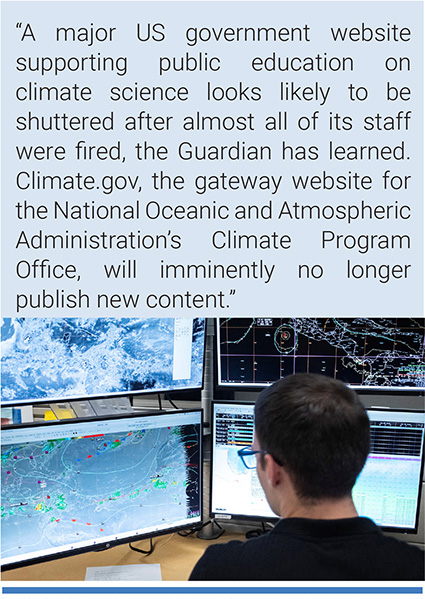
Also in June, at CNN journalist Andrew Freedman covered the back and forth of terminations relating to the US Trump Administration’s Department of Government Efficiency (DOGE) efforts. In particular, hiring back at the National Weather Service marked discrepancies between ideology and realities of need for weather and climate forecasting in the US. Freedman wrote, “After losing more than 560 employees to layoffs and early retirement incentives earlier this year, the National Weather Service has received permission to hire about 125 new meteorologists and specialists for its forecast offices around the country, sources tell CNN, as an active hurricane season looms. The temporary lifting of the federal hiring freeze for the agency could reduce the number of weather forecast offices that must cut back on their hours or no longer staff the overnight shift during periods of non-threatening weather. About half a dozen forecast centers are in that predicament right now, including facilities in Goodland, Kansas, and Sacramento, California. The news comes amid concerns that neither the NWS nor the Federal Emergency Management Agency are nearly as prepared for hurricane season as they have been in past years, and after a spate of deadly severe weather in the Midwest and South prompted speculation the staffing issues might have negatively affected tornado warning lead times. The new hires would not make up for all the personnel lost in the Trump administration’s cutbacks to the NWS and its parent organization, the National Oceanic and Atmospheric Administration. More offices are slated to transition to less-than-24/7 operations if additional staffing is not secured. The additional staff might allow the agency to boost the number of data-gathering weather balloon launches after a pronounced downturn due to the staffing shortage. Weather balloons are typically launched all over the world twice a day to provide crucial data for computer models used to help predict the weather, and fewer launches have sparked concern forecasts are being made less accurate. The weather service is also still moving forward with a stopgap measure of transferring meteorologists from well-staffed offices to ones that are down multiple meteorologists, radar technicians and other specialists. NOAA announced last month it was seeking 155 transfers to fill these “critical” positions”.
Also in June, DOGE cuts to the National Oceanic and Atmospheric Administration (NOAA) led to further stories of negative implications for ongoing monitoring and research. For example, Guardian journalist Eric Holthaus reported, “A major US government website supporting public education on climate science looks likely to be shuttered after almost all of its staff were fired, the Guardian has learned. Climate.gov, the gateway website for the National Oceanic and Atmospheric Administration (NOAA)’s Climate Program Office, will imminently no longer publish new content, according to multiple former staff responsible for the site’s content whose contracts were recently terminated. “The entire content production staff at climate.gov (including me) were let go from our government contract on 31 May,” said a former government contractor who wished to remain anonymous for fear of retaliation. “We were told that our positions within the contract were being eliminated.” Rebecca Lindsey, the website’s former program manager, who was fired in February as part of the government’s purge of probationary employees, described a months-long situation within NOAA where political appointees and career staff argued over the fate of the website”.
A coal-fired power plant in Indiana. The power sector is the country’s second largest source of pollution, behind transportation. Photo: Joshua A. Bickel/AP. |
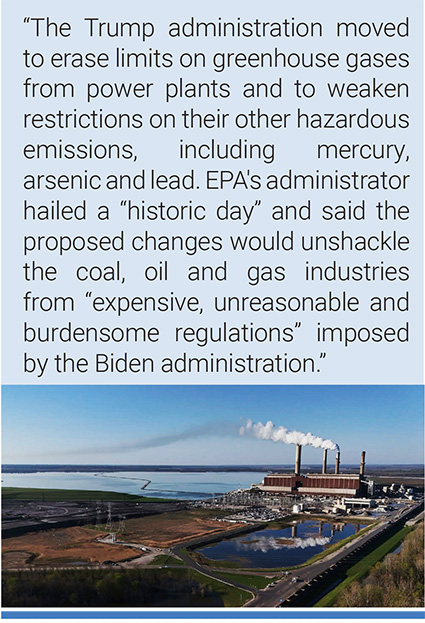
Meanwhile, New York Times journalist Lisa Friedman wrote about changes at the US Environmental Protection Agency (EPA), noting, “The Trump administration moved Wednesday to erase limits on greenhouse gases from power plants and to weaken restrictions on their other hazardous emissions, including mercury, arsenic and lead. Lee Zeldin, the administrator of the Environmental Protection Agency, hailed a “historic day” and said the proposed changes would unshackle the coal, oil and gas industries from “expensive, unreasonable and burdensome regulations” imposed by the Biden administration. Together, the moves mark a major blow to efforts to tackle climate change and to reduce threats to public health. The power sector is the country’s second largest source of pollution that is heating the planet, behind transportation. The Trump administration is pursuing an aggressive agenda to bolster the production and use of fossil fuels, while also scrapping policies that reduce planet-warming emissions. “E.P.A. is helping pave the way for American energy dominance, because energy development underpins economic development, which in turn strengthens national security. And, most importantly, the American public voted for it last November,” Mr. Zeldin said at a news conference at the agency’s headquarters in Washington. He labeled efforts to fight climate change a “cult” and said the pollution limits written by the Biden administration were designed “to destroy industries that didn’t align with their narrow-minded climate change zealotry.” Mercury emissions are a particular hazard from power plants that burn coal and oil. Those plants account for 44 percent of all mercury emissions in the United States, according to the E.P.A. Once in the atmosphere, mercury converts into methylmercury, which can accumulate in fish and other food. Exposure can cause serious neurological damage in developing fetuses and children, and has been associated with respiratory ailments and heart disease in adults. The use of coal, the dirtiest fossil fuel, has been precipitously dropping in the U.S., replaced by cheaper natural gas. But President Trump has taken several recent actions aimed at trying to revive coal, and on Wednesday, Mr. Zeldin said the country needed to produce and burn more coal to meet rising electricity demand”.
Then beginning in late June, world leaders gathered in Seville for the United Nations International Conference on Financing for Development and this generated climate change-related news coverage. For example, El País journalists Joseph Stiglitz and Winnie Byanyima wrote “Initially, the hope was to find the additional money needed to reduce poverty, promote growth, and combat climate change. Now, the concern is that the situation could worsen. Aid cuts have severely impacted humanitarian action and critical global health issues. Economic uncertainty, coupled with unsustainable debt, is straining government budgets. This means there is not enough money left to address pandemics, violent conflicts, and the climate crisis, which in turn could destabilize societies around the world. No country will be safe”. As a second example, an Agence France Press article running in the Bangkok Post noted, “UN Secretary-General Antonio Guterres urged the world to "rev up the engine of development" at an aid conference in Spain on Monday at a time when US-led cuts are jeopardising the fight against poverty and climate change. Dozens of world leaders and more than 4,000 representatives from businesses, civil society and financial institutions are gathering in the city of Seville for the June 30-July 3 conference to seek fresh impetus for the crisis-hit aid sector. But the United States is snubbing the biggest such talks in a decade, underlining the erosion of international cooperation on combating hunger, disease and climate change. Guterres told delegates at the opening of the conference that two-thirds of United Nations sustainable development goals set for 2030 were "lagging" and more than $4.0 trillion of annual investment would be needed to achieve them. US President Donald Trump's gutting of his country's development agency, USAID, is the standout example. But Germany, Britain and France are also making cuts while they boost spending in areas such as defense”.

Figure 3. Examples of newspaper front pages with climate change stories in June 2025.

Climate activists and campaigners demonstrate outside the International Court of Justice in The Hague, Netherlands, ahead of the reading of a landmark advisory opinion that said countries harmed by the effects of climate change could be entitled to reparations. Photo: Marta Fiorin/Reuters.

June media coverage of climate change or global warming in newspapers around the globe went up 15% from June 2025. However, coverage in July 2025 was down 13% from July 2024 levels. In this larger context, Figure 1 shows that international wire services stories in July 2025 went up 16% from the previous month while remaining 24% lower than a year earlier (July 2024).
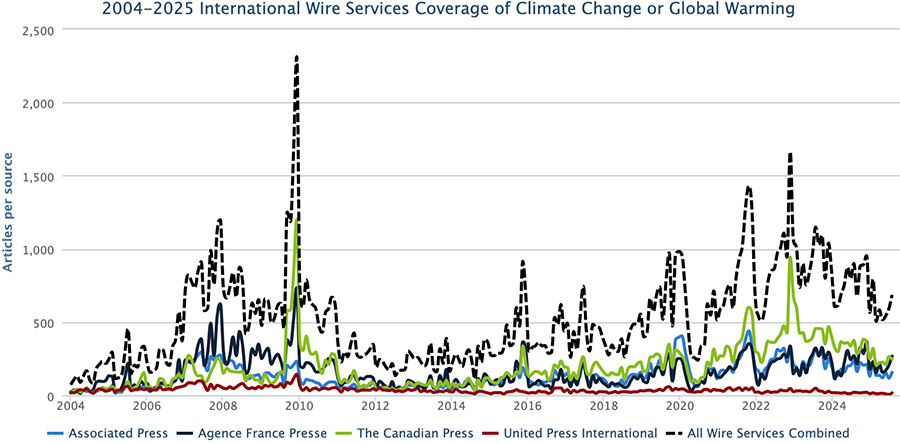
Figure 1. International wire services coverage – across The Associated Press, Agence France Presse, The Canadian Press, and United Press International (UPI) – of climate change or global warming from January 2000 through July 2025.
At the regional level, levels of July 2025 coverage went up in Africa (+1%), Latin America (+3%), Asia (+14%), the European Union (EU) (+14%), North America (+18%), and Oceania (+45%) compared to June 2025. Coverage decreased in the Middle East (-38%). Figure 2 shows trends in newspaper media coverage at the global scale – organized into seven geographical regions around the world – from January 2004 through July 2025.
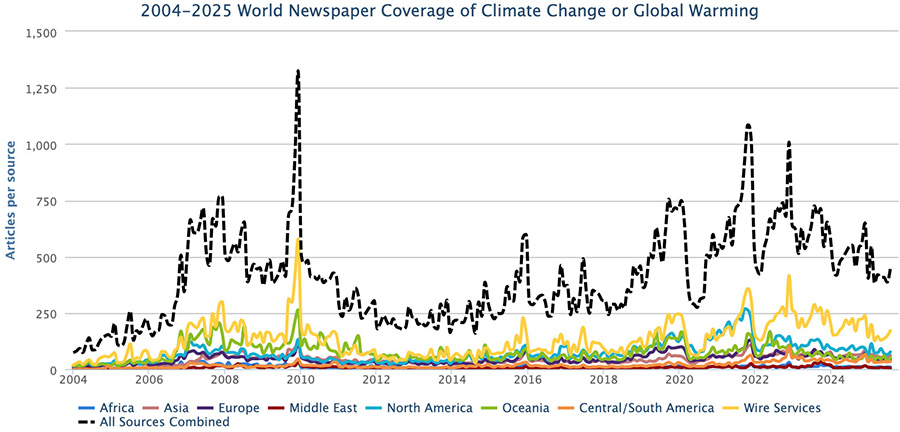
Figure 2. Newspaper media coverage of climate change or global warming in print sources in seven different regions around the world, from January 2004 through July 2025.
Our Media and Climate Change Observatory (MeCCO) team continues to provide three international and seven ongoing regional assessments of trends in coverage, along with 16 country-level appraisals each month. Visit our website for open-source datasets and downloadable visuals.
A municipal employee pours water on a tourist at the Eiffel Tower. Photo: AFP. |
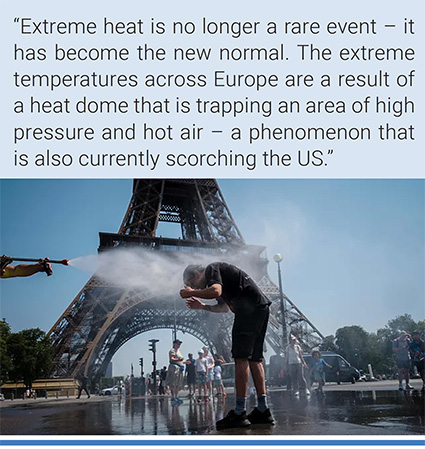
Moving to the content of news coverage about climate change in July 2025, there were several ongoing media stories relating to ecological and meteorological dimensions of climate change or global warming. To begin, heatwaves across Europe – with links to a changing climate – sparked news attention. For example, BBC News journalist Malu Cursino reported, “A wildfire in Spain and high temperatures elsewhere in Europe have claimed another six lives as the continent swelters in temperatures topping 40C. Two farmers died when they became trapped by flames near the town of Coscó in Spain's Catalonia region. Authorities said a farm worker had appealed to his boss for help, but they were unable to escape as fire spread over a large area. In Italy, two men died after becoming unwell on beaches on the island of Sardinia, and a man in his 80s died of heart failure, after walking into a hospital in Genoa. A 10-year-old American girl collapsed and died while visiting the Palace of Versailles south-west of Paris, reports said. According to French broadcaster TF1, she collapsed at the courtyard of the royal estate, in front of her parents, at around 18:00 local time on Tuesday. Despite efforts by the castle's security team and emergency services, she was pronounced dead an hour later. France's ecological transition minister Agnès Pannier-Runacher said earlier that two heat-related fatalities had been recorded in France and that more than 300 people had been given emergency care. The European continent is experiencing extremely high temperatures, a phenomenon that the UN's climate agency said is becoming more frequent due to "human-induced climate change". Both Spain and England had their hottest June since records began. Spain's weather service, AEMET, said last month's average temperature of 23.6C (74.5F) "pulverised records", surpassing the normal average for July and August”. Elsewhere, Guardian correspondent Ajit Niranjan reported, “vicious heatwave has engulfed southern Europe, with punishing temperatures that have reached highs of 46C (114.8F) in Spain and placed almost the entirety of mainland France under alert. Extreme heat, made stronger by fossil fuel pollution, has for several days scorched Portugal, Spain, France, Italy and Greece as southern Europe endures its first major heatwave of the summer. The high temperatures have prompted the authorities in several countries to issue new health warnings and scramble firefighters to prevent wildfires from breaking out. More than 50,000 people in Turkey have been evacuated from their homes due to forest fires, according to the interior ministry’s disaster and emergency management authority. António Guterres, the UN secretary general, said at a development conference in Seville on Monday: “Extreme heat is no longer a rare event – it has become the new normal” … The extreme temperatures across Europe are a result of a heat dome that is trapping an area of high pressure and hot air – a phenomenon that is also currently scorching the US. It comes amid an ongoing marine heatwave that has left the Mediterranean 5C hotter than normal, according to data from the University of Maine’s climate change institute. Dr Michael Byrne, a climate scientist at the University of St Andrews, said heat domes were nothing new but the temperatures they delivered were. “Europe is more than 2C warmer than in preindustrial times, so when a heat dome occurs it drives a hotter heatwave,” he said. Doctors across the continent warned people to take extra care in the hot weather, encouraging them to stay out of the heat, drink lots of water, wear loose clothing and check in on vulnerable neighbours. Researchers estimate that dangerous temperatures in Europe will kill 8,000 to 80,000 more people a year by the end of the century, as the lives lost to stronger heat outpace those saved from milder cold”. In Spain, El Mundo journalist Carlos Fresneda noted, “Heat waves in southern Europe are increasingly earlier and more intense, affecting larger geographic areas. France, with 90% of its territory on red or orange alert and temperatures 10 degrees above average at the end of June, has been the most affected country, along with Spain and Portugal, where 46.6 degrees were recorded in Mora, about 100 kilometers east of Lisbon. Italy and Greece have also suffered the impact of the heat, with temperatures hovering around 40 degrees, and in the United Kingdom (which already surpassed the mark three years ago), the hottest start in the history of the Wimbledon tournament was confirmed with 33 degrees. "Europe has experienced very high temperatures since the beginning of June, more typical of July and August, which used to occur rarely throughout the summer," says Samantha Burgess of the European Centre for Medium-Range Weather Forecasts (ECMWF).”
Ontario's northwest region is prairie-influenced says Alison Lake, a fire information officer with the Ministry of Natural Resources. Photo: Ministry of Northern Development, Mines, Natural Resources and Forestry. |
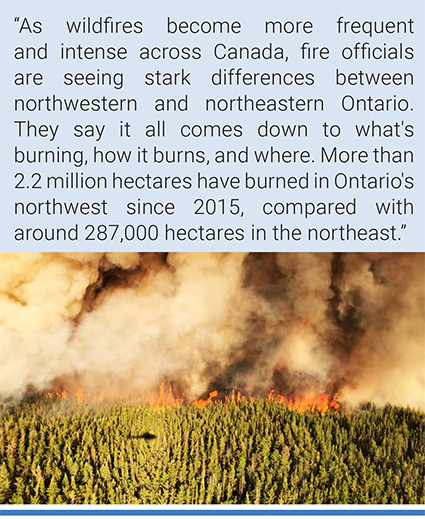
Media coverage of wildfires – with connections made to climate change – continued in July. For example, UK Telegraph journalist Niamh Robinson reported, “Wildfires raged through Greece for a second day with several popular tourist islands among the worst-hit areas. Firefighters battled five fires on Sunday across the islands of Evia, Kythira and Crete, as well as in the Peloponnese area, west of Athens, as temperatures reached highs of 40C. Giorgos Komninos, the deputy mayor of the island, told ERT News channel: “If air assets don’t come here, we will burn.” He spoke of “unimaginable destruction” and claimed there had been delays in the aerial response, with flames now threatening monasteries and tourist areas”. Elsewhere, Canadian Broadcasting Service correspondent Faith Greco reported, “As wildfires become more frequent and intense across Canada, fire officials are seeing stark differences between northwestern and northeastern Ontario. They say it all comes down to what's burning, how it burns, and where. More than 2.2 million hectares have burned in Ontario's northwest since 2015, according to the Ministry of Natural resources, compared with around 287,000 hectares in the northeast. "The three things that we need to consider when we talk about the differences here is the climate and the weather, the fuels and the topography," said Chelene Hanes, a wildland fire research scientist at the Great Lakes Forestry Centre in Sault Ste. Marie. Northwestern Ontario typically gets a minimal amount of rain, whereas the northeast has a wetter climate and vast peatlands, she explained.
Weather in the northwest region is prairie-influenced, said Alison Lake, a fire information officer with the Ontario Ministry of Natural Resources, in a statement to CBC News. It's marked by large and highly convective storm systems — severe local storms associated with thunder, heavy rain, hail, strong winds, sudden temperature changes and lightning — resulting in lightning-caused fires, Lake said”. Meanwhile, a feature article by New York Times journalists Sachi Kitajima Mulkey and Harry Stevens noted, “In 2023 and 2024 the world’s forests absorbed only a quarter of the carbon dioxide they did in the beginning of the 21st century, according to data from the World Resources Institute’s Global Forest Watch. Those back-to-back years of record-breaking wildfires hampered forests’ ability to tuck away billions of tons of carbon dioxide, curbing some of the global warming caused by emissions from burning fossil fuels. Those two years also marked the first time wildfires surpassed logging or agriculture-driven deforestation as the biggest factor lowering forests’ carbon-capturing ability. It’s an emerging pattern that’s different from the last big drop, in 2016 and 2017, which was largely the result of increased deforestation for agriculture. Carbon dioxide, a greenhouse gas, acts as a blanket in the atmosphere, trapping the sun’s heat and warming the environment. In some places, rampant burning and deforestation have tipped the scales, turning forests into a source of carbon dioxide emissions instead of a tool for capturing them”.
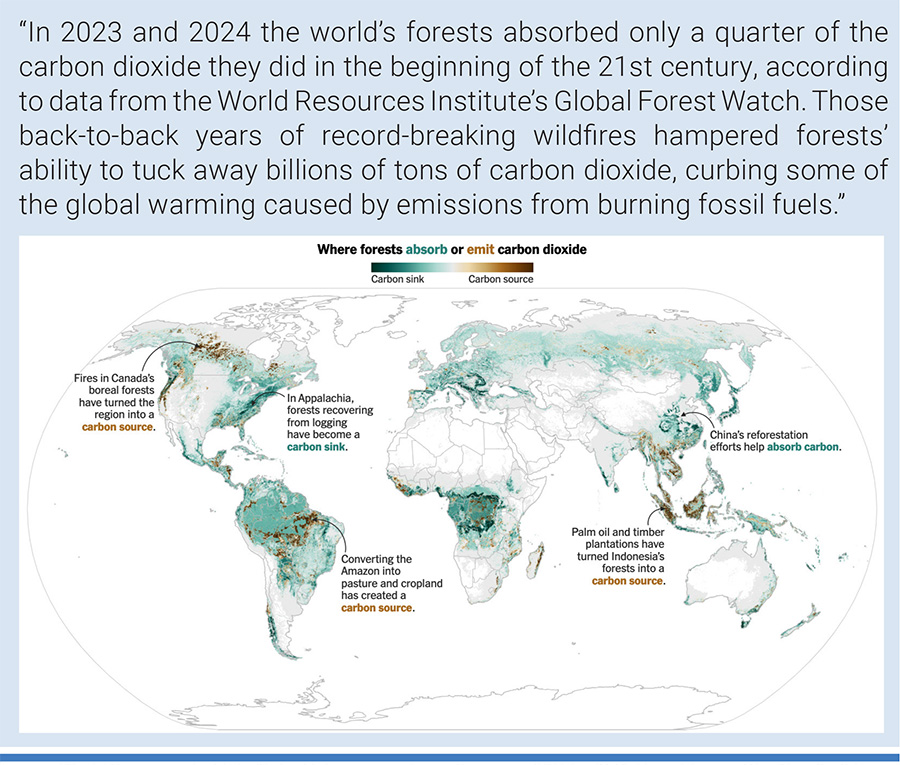
Source: World Resources Institute Note: Data averaged over the years 2001 to 2024. Harry Stevens/The New York Times.
Media portrayals in July 2025 also featured related and ongoing cultural-themed stories relating to climate change or global warming. To illustrate, in the US the ongoing ‘war on woke’ mapped onto developments in Artificial Intelligence (AI) and climate change in several ways. For example, US National Public Radio correspondent Bobby Allyn reported, “President Trump on Wednesday signed an executive order requiring artificial intelligence companies that do business with the federal government to strip AI models of "ideological agendas." Speaking at an AI summit in Washington, Trump said: "The American people do not want woke Marxist lunacy in the AI models." The order bans federal agencies from contracting with tech companies that operate AI chatbots displaying partisan bias, which the action defines as diversity, equity and inclusion, critical race theory, "transgenderism" — forces the order says pose "an existential threat to reliable AI." "From now on, the U.S. government will deal only with AI that pursues truth, fairness and strict impartiality," Trump said. The White House is also planning to revise Biden-era federal guidelines for AI safety to remove references to diversity, equity and inclusion, climate change and misinformation, according to the Trump administration's AI action plan”.
Also, ongoing tariff threats and negotiations led by US Trump Administration officials permeated culture-themed (as well as political- and economic-themed) news stories in July. For example, US National Public Radio correspondent Jaclyn Diaz reported, “At a small, industrial roastery in Washington, D.C., the nutty, inviting smell of roasting coffee hangs heavy in the air. It's where Lost Sock Roasters, a local company, roasts and packages its coffee beans — destined for its two cafes, customers' homes and local bakeries and restaurants. But something else is grabbing his attention these days: tariffs. This month, President Trump announced plans to levy a 50% tariff on all goods from Brazil — the world's largest coffee producer and the source of about 30% of U.S. coffee imports. That's on top of the 10% tariff that impacts nearly everything the U.S. brings in. This looming tariff threat has sent shock waves through the U.S. coffee industry, raising fears especially among small roasters like Lost Sock…The past several years have been volatile for the coffee industry, contributing to a major increase in market prices for coffee even in the last year, Barr says. The price volatility can be attributed, in part, to the COVID-19 pandemic and back-to-back low-yield coffee harvests in Brazil in the last year, Yerxa says. Those weak harvests, in turn, are due to drought and high temperatures and more generally climate change, which has negatively impacted coffee harvests for several years”.
Meanwhile, Pope Leo XIV's comments about climate change and the environment earned media attention in July. For example, La Vanguardia journalist Francesco Olivo wrote, “The tone is always serene, but the words are sharp. Leo XIV begins to mark his pontificate and he does so also by speaking about the environment, in an “ecological” mass in which he invoked the conversion of climate change deniers (…) In a mass celebrated last July 9 in the gardens of Castel Gandolfo, the residence where he retired for a few days of rest, the Pope focused his message on “the care of creation” and in the homily, delivered largely improvised, he launched a message of extreme clarity: the world “is burning as much from global warming as from armed conflicts”, and the “mission of Christians is to protect creation, to bring it peace and reconciliation” (…) Robert Francis Prevost also spoke of the “conversion of so many people, inside and outside the Church, who still do not recognize the urgency of caring for our common home”, marked by “so many natural disasters” that “in large part or at least in part” are caused by “excesses of the human being.”
In later July, an opinion by the International Court of Justice on human rights and climate change generated news. For example, US Public Broadcasting Service correspondent Kenichi Serino reported, “The International Court of Justice, the United Nations’ top court, issued an advisory opinion Wednesday that found all nations must tackle climate change and those that do not act could be obliged to pay reparations for the harm caused to the environment. Nikki Reisch, director of climate and energy at the Center for International Environmental Law, said she was “floored” when she heard the judgment. “This is a truly game-changing, momentous ruling that opens the door for climate justice and accountability and shuts the door on big polluters’ impunity,” she said. The ruling was the result of years of efforts by activists and small island nations. The case was first initiated by Pacific Islands Students Fighting Climate Change, a group of young Pacific Islanders facing the existential threat of rising sea levels, and led by the island nation of Vanuatu. Their lobbying resulted in the U.N. General Assembly voting in 2023 to ask the court to take up the legal question of climate change and issue an advisory opinion, a ruling that would not be binding but would provide guidance to other courts and governments”. As a second example, UK Times environment editor Adam Vaughan wrote, “Britain should not apologise for its role in the Industrial Revolution a minster has insisted, after the UN’s highest court opened the door to climate reparations. In a decision that could increase the chance of nations hit by extreme weather claiming damages from other governments, the International Court of Justice (ICJ) said that inaction on tackling climate change by a state could constitute “an internationally wrongful act”, suggesting reparations were a possibility. The court’s 140-page advisory opinion on states’ obligations on curbing global warming — and the consequences if they fail to — was the first time the ICJ had issued a stance on the subject. The view is non-binding on governments, including Britain, and the US does not recognise the court’s jurisdiction. However, the ICJ’s advisory opinions carry great legal weight and are seen to contribute to the clarification of international law”.
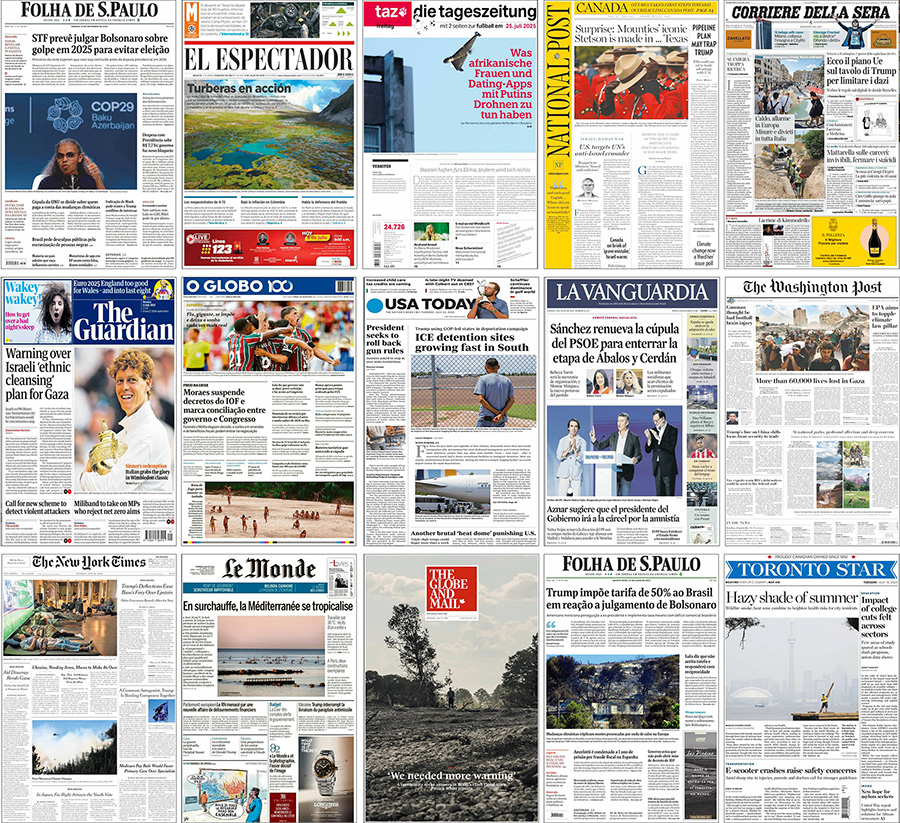
Figure 3. Examples of newspaper front pages with climate change stories in July 2025.
Inside a NOAA WP-3D Orion Hurricane Hunter research plane at the National Oceanic and Atmospheric Administration's Aircraft Operations Center. Photo: Miguel J. Rodriguez Carrillo/AFP/Getty Images. |
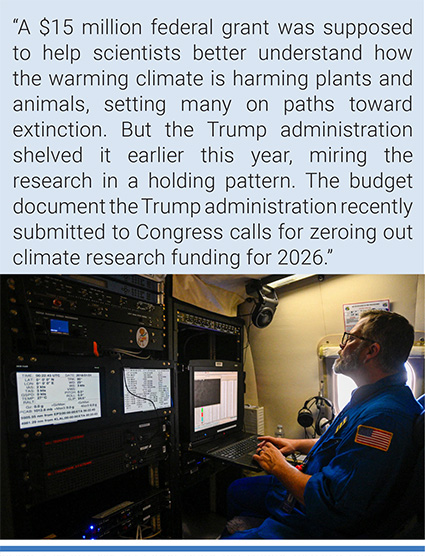
In July, many political and economic-themed media stories about climate change or global warming were evident. For instance, the US Trump Administration’s approach to budget cutting had several detrimental impacts on climate action. This generated several news stories across the country and around the world. For example, Fox News reporter Alec Schemmel noted, “Critics of President Donald Trump wasted no time blaming staffing cuts at the National Weather Service (NWS) for the widespread death and destruction caused by the floods in Texas, a reaction the White House called "shameful and disgusting." Washington Democratic Gov. Jay Inslee did not directly blame Trump's approach to climate change for the deaths, but he suggested the president's efforts to peel back green energy funding are a contributing factor to increased catastrophic natural disasters, like this weekend's flood in Texas. "It is hard to make the Texas flood tragedy worse, except to know that on the same day Trump signed a bill cratering solar and wind energy that is vital in the battle against the climate change making these torrential rains more frequent," Inslee wrote on X this weekend. During an interview with CNN, Rep. Joaquin Castro, D-Texas, added that he didn't think it was helpful to have open leadership positions that, if filled, could "help prevent these strategies." "I don’t think it’s helpful to have missing key personnel from the National Weather Service not in place to help prevent these tragedies," Castro said, adding "we have to figure out in the future how we make sure that it doesn’t happen again”. Meanwhile, Washington Post correspondent Scott Dance wrote, “A $15 million federal grant was supposed to help scientists better understand how the warming climate is harming plants and animals, setting many on paths toward extinction. But the Trump administration shelved it earlier this year, miring the research in a holding pattern… budget document the Trump administration recently submitted to Congress calls for zeroing out climate research funding for 2026, something officials had hinted at in previous proposals but is now in lawmakers’ hands. But even just the specter of President Donald Trump’s budget proposals has prompted scientists to limit research activities in advance of further cuts. Trump’s efforts to freeze climate research spending and slash the government’s scientific workforce have for months prompted warnings of rippling consequences in years ahead. For many climate scientists, the consequences are already here. With so much uncertainty across scientific agencies and academic research centers, even prominent scientists are hitting dead ends”. With an international lens, journalist Mike Phillips at The Associated Press reported, “The sprawling tax and policy bill that passed Congress repeals a multibillion-dollar green bank for financing climate-friendly projects, and the Trump administration should be allowed to freeze its funding and cancel related contracts with nonprofits, federal officials said in a court filing. Climate United Fund and other nonprofits in March sued the Environmental Protection Agency, its administrator Lee Zeldin and Citibank, which held the program’s money. The lawsuit argued the defendants had illegally denied the groups access to billions awarded last year through the Greenhouse Gas Reduction Fund, commonly referred to as a “green bank.” The program was created by the 2022 Inflation Reduction Act”.
Workers on scaffolding repaint the NASA logo near the top of the Vehicle Assembly Building at the Kennedy Space Center. Photo: John Raoux/AP. |
Further climate-related US federal program and job cuts were documented extensively by various media accounts in July. For example, Associated Press journalist Seth Borenstein wrote, “the Trump administration on Monday took another step to make it harder to find major, legally mandated scientific assessments of how climate change is endangering the nation and its people. Earlier this month, the official government websites that hosted the authoritative, peer-reviewed national climate assessments went dark. Such sites tell state and local governments and the public what to expect in their backyards from a warming world and how best to adapt to it. At the time, the White House said NASA would house the reports to comply with a 1990 law that requires the reports, which the space agency said it planned to do. But on Monday, NASA announced that it aborted those plans”. As a second example, Guardian correspondents Nina Lakhani and Gabrielle Canon noted, “Thousands of employees at the US Department of Agriculture will be forced to take salary cuts and relocate out of the Washington DC area, as part of a major restructuring that experts warn will further weaken support for American farmers and complicate wildfire response. In a memorandum issued on Thursday, the agriculture secretary, Brooke Rollins, outlined the “key pillars” behind the department’s reorganization, focused on reducing its financial footprint, removing resources from the capital, eliminating management and consolidating workforces responsible for a range of functions, including freedom of information requests, tribal relations, grants and human resources. More than half of employees working in the Washington DC area will be relocated to five locations – Raleigh, North Carolina; Kansas City, Missouri; Indianapolis, Indiana; Fort Collins, Colorado; and Salt Lake City, Utah. Several key USDA offices will be shuttered in the capital region. The move follows wide-ranging and often chaotic cuts to staff and services being implemented under Trump 2.0, as the administration seeks to dismantle the federal government and fund tax cuts for the wealthy including the president’s billionaire donors… experts warned that the latest cuts and consolidation of key departments focused on civil rights and small and disadvantaged businesses will further hamstring the agency, which is already reeling. The latest upheaval follows widespread cuts to Biden era agricultural programs, research grants and staff across the country, which along with Trump’s tariff chaos and deepening climate chaos has caused panic among many farmers”.
Photo: Getty Images. |
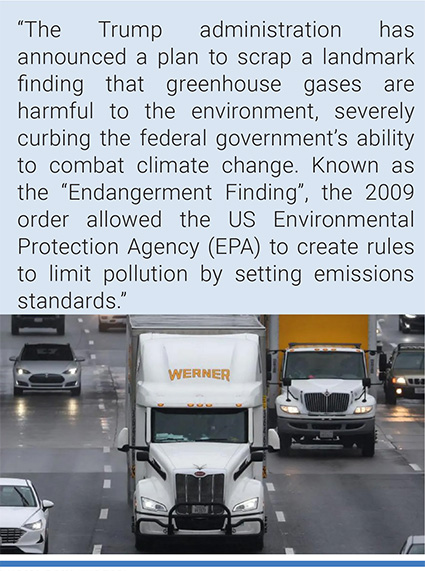
At the end of the month, US Trump Administration moves through the Environmental Protection Agency to potentially stop regulating carbon emissions earned media coverage in the US and around the world. For example, New York Times reporters Maxine Joselow and Lisa Friedman wrote, “Lee Zeldin, the administrator of the Environmental Protection Agency, said on Tuesday the Trump administration would revoke the scientific determination that underpins the government’s legal authority to combat climate change. Speaking at a truck dealership in Indianapolis, Mr. Zeldin said the E.P.A. planned to rescind the 2009 declaration, known as the endangerment finding, which concluded that planet-warming greenhouse gases pose a threat to public health. The Obama and Biden administrations used that determination to set strict limits on greenhouse gas emissions from cars, power plants and other industrial sources of pollution. “The proposal would, if finalized, amount to the largest deregulatory action in the history of the United States,” Mr. Zeldin said. He said the proposal would also erase limits on greenhouse gas emissions from cars and trucks on the nation’s roads. Without the endangerment finding, the E.P.A. would be left with no authority under the Clean Air Act to regulate the greenhouse gas emissions that are accumulating in the atmosphere from the burning of fossil fuels. The proposal is President Trump’s most consequential step yet to derail federal climate efforts. It marks a notable shift in the administration’s position from one that had downplayed the threat of global warming to one that essentially flatly denies the overwhelming scientific evidence of climate change. It would not only reverse current regulations, but, if the move is upheld in court, it could make it significantly harder for future administrations to rein in climate pollution from the burning of coal, oil and gas. Without the United States working to reduce emissions, it becomes far tougher for the world to collectively prevent average global temperatures from rising by more than 1.5 degrees Celsius, or 2.7 degrees Fahrenheit, above preindustrial levels. That is the threshold beyond which climate scientists say there is significantly greater risk from increasingly destructive storms, droughts, wildfires and heat waves, as well as from species extinction”. As a second example, BBC News journalist Bernd Debusmann Jr reported, “The Trump administration has announced a plan to scrap a landmark finding that greenhouse gases are harmful to the environment, severely curbing the federal government's ability to combat climate change. Known as the "Endangerment Finding", the 2009 order from then-President Barack Obama allowed the US Environmental Protection Agency (EPA) to create rules to limit pollution by setting emissions standards. The US is a major contributor to global climate change, and ranks second only to China which emits more planet-warming gases like carbon dioxide – and the US still emits more per person. Experts have warned that the move could have a devastating impact on the environment. President Donald Trump has long argued that climate regulations stifle US economic growth, and on his first day back in office in January ordered that the EPA submit recommendations "on the legality and continuing applicability" of the Endangerment Finding. The Endangerment Finding stemmed from a 2007 Supreme Court case in which the court ruled that greenhouse gases are "air pollutants" - meaning that the EPA has the authority and responsibility to regulate them under the US Clean Air Act. In 2009, the EPA made an official decision, the Endangerment Finding, which found that greenhouse gas emissions from sources such as cars, power plants and factories cause climate change and could pose a public health risk. The decision forms the core of the federal government's authority to impose limits on carbon dioxide, methane and other greenhouse gases. In a statement, the EPA said that, if finalised, the move will save Americans $54bn (£40bn) in costs annually through the repeal of greenhouse gas standards, including an electric vehicle mandate passed by the Biden administration”.
UN Summit attendees tour the facilities of the Seville Conference Center. Photo: Rocío Ruz/Europa Press. |
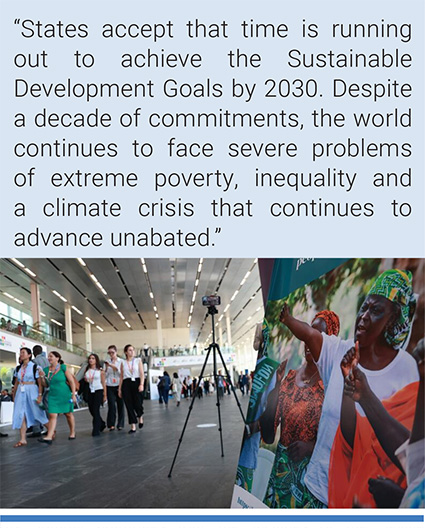
The aforementioned meeting in Sevilla generated several political and economic themed stories relating to climate change too. For example, El País explained, “States accept that time is running out to achieve the Sustainable Development Goals by 2030. Despite a decade of commitments, the world continues to face severe problems of extreme poverty, inequality and a climate crisis that continues to advance unabated…Although the Commitment, despite its name, is not a binding text nor has the status of an international treaty, it at least provides countries with a minimum framework to work within in the coming years, which will undoubtedly be marked by Donald Trump's transactional vision of international relations…The Seville summit highlights both the enormous financing problem facing cooperation and the need to reform the so-called international financial architecture, to prevent the debt of some countries from continuing to perpetuate their poverty.”
Last, several July 2025 media stories featured several scientific themes in news accounts. In early July, reports linking the devastating flooding in the US state of Texas with climate change made news. For example, CNN journalist Andrew Freedman reported, “Once synonymous with leisure and reprieve, summer has increasingly become a season marked by anxiety and disruption. Fossil fuel pollution — alongside other compounding factors — has transformed these months into a time of mounting peril, punctuated by relentless heat waves, rampant wildfires and catastrophic flooding. This summer, in particular, has been defined by a tragic surge in deadly flash floods across the United States, underscoring the escalating volatility of our warming world. It’s no accident this is the summer of flooding, climate scientists say, with 100-year to 1,000-year deluges happening nearly simultaneously in multiple states on multiple days. Large parts of the US have seen an unusually humid summer with record amounts of moisture in the air. When cold fronts and other weather systems come along, that moisture can get wrung out, squeezed like a water-laden sponge, yielding heavy and often highly localized downpours. For much of the summer, the atmospheric conditions over the US have funneled humid air north from the unusually warm Gulf and western Atlantic, including the Gulf Stream, UCLA climate researcher Daniel Swain told CNN. This has yielded unusually high levels of moisture at all levels of the atmosphere across the US east of the Rockies, Swain said. It has led to record levels of what meteorologists call precipitable water, which is the amount of rain that would result from instantaneously extracting all the water in the air”. Meanwhile, turning back to political elements Fox News reporter Lindsay Kornick noted, “Rep. Jasmine Crockett, D-Texas, accused Republicans on Friday of wanting to "bury their constituents" after the deadly Texas floods by rolling back ways to combat climate change… More than 120 people were killed in the flash flooding with dozens reported missing. Since last week, several Democratic figures have been quick to politicize the floods by blaming climate change and President Donald Trump’s government cuts to the National Weather Service (NWS) for exacerbating the damage”. Bridging to ecological- and meteorological-themed stories (see above), New York Times journalist David Gelles wrote, “The floods that ravaged Texas last week, leaving more than 105 people dead, occurred in a region known as Flash Flood Alley. And while the storm developed quickly, the National Weather Service offered what appears to have been a relatively good forecast in a rapidly developing situation, according to former Weather Service officials. But despite known risks in the area and warnings that were first issued around midnight Thursday, the floods became one of the deadliest weather events in recent American history. How did that happen? It’s too early to say with certainty that the slow-moving thunderstorms were made worse by man-made climate change. But the weather pattern that unleashed more than 10 inches of rain in a matter of hours is precisely the kind of phenomenon that scientists say is becoming more common because of global warming”.

Figure 4. Examples of newspaper front pages covering the Texas flooding with connections to climate change in early July 2025.
Meanwhile, new research shared in July linked glacial melt and volcanic eruptions: this earned media attention. For example, Guardian environment editor Damien Carrington wrote, “The melting of glaciers and ice caps by the climate crisis could unleash a barrage of explosive volcanic eruptions, a study suggests. The loss of ice releases the pressure on underground magma chambers and makes eruptions more likely. This process has been seen in Iceland, an unusual island that sits on a mid-ocean tectonic plate boundary. But the research in Chile is one of the first studies to show a surge in volcanism on a continent in the past, after the last ice age ended. Global heating caused by the burning of fossil fuels is now melting ice caps and glaciers across the world. The biggest risk of a resurgence of volcanic eruptions is in west Antarctica, the researchers said, where at least 100 volcanoes lie under the thick ice. This ice is very likely to be lost in the coming decades and centuries as the world warms. Volcanic eruptions can cool the planet temporarily by shooting sunlight-reflecting particles into the atmosphere. However, sustained eruptions would pump significant greenhouse gases into the atmosphere, including carbon dioxide and methane. This would further heat the planet and potentially create a vicious circle, in which rising temperatures melt ice that leads to further eruptions and more global heating”.

Houses destroyed by fires in Wennington in East London. Photo: Adam Gerrard/Daily Mirror.

August media coverage of climate change or global warming in newspapers around the globe diminished by 7% overall from July 2025. Coverage in August 2025 was also down 25% from August 2024 levels. Figure 1 shows trends in newspaper media coverage at the global scale – organized into seven geographical regions around the world – from January 2004 through August 2025. International wire services stories in August 2025 went down 5% from July 2025 as well as decreasing 4% from August 2024. Nonetheless, humans continue to contribute to disruptions through the burning of fossil fuels and patterns of land use. Carbon dioxide concentrations in the atmosphere – the greenhouse gas that contributes most to climate change – is 50% higher than it was at the dawn of the Industrial Revolution (and the highest in the last 14 million years). Meanwhile, 2024 remains the warmest year in nearly 150 years of recorded history while the last ten years have been the ten hottest years since record-keeping began. The quantity of media coverage is struggling to keep pace with the pace of change.
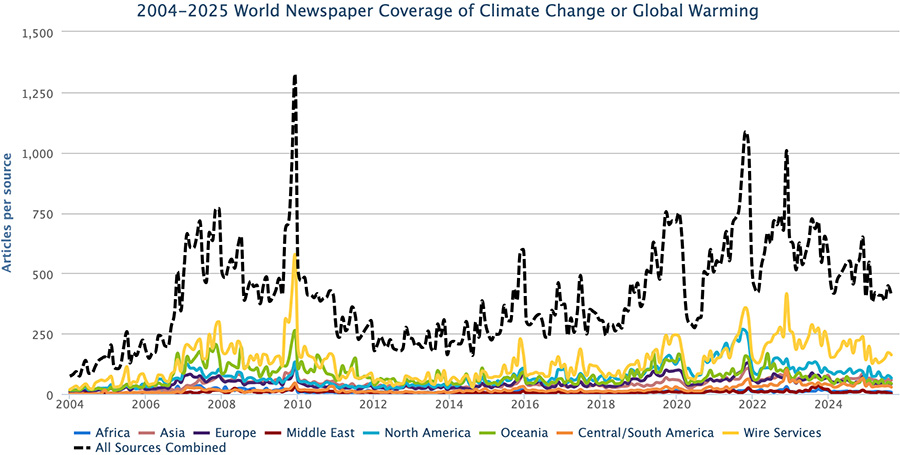
Figure 1. Newspaper media coverage of climate change or global warming in print sources in seven different regions around the world, from January 2004 through August 2025.
At the regional level, overall downward trends matched decreased levels of August 2025 coverage in all regions: the European Union (EU) (-2%), Asia (-6%), Oceania (-11%), Latin America (-15%), North America (-14%), Africa (-19%), and in the Middle East (-67%) compared to July 2025. In the United States (US), print media coverage dropped 17% from July 2025 and went down 21% from August 2024 (Figure 2). A drop off in US television coverage was even more pronounced, with a 36% decrease from July 2025 and a 50% drop from August 2024.
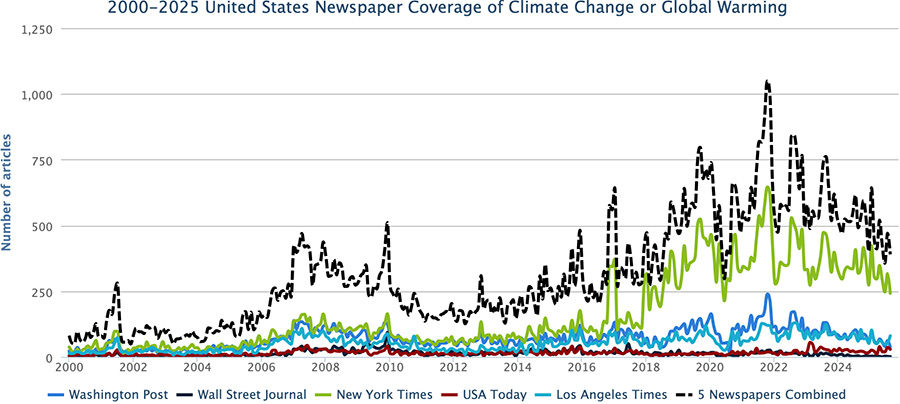
Figure 2. US newspaper coverage of climate change or global warming from January 2000 through August 2025.
Moving to the content of news coverage about climate change in August 2025, there were many political and economic-themed media stories about climate change or global warming were evident. For instance, El País journalist Naiara Galarraga Gortázar wrote about the difficulties in holding the climate summit in Belém, noting “With 90 days to go until COP30 in Belém, skyrocketing hotel prices and a shortage of beds are monopolizing preparatory contacts. Hoteliers are encouraging room-sharing…the logistical nightmare is overshadowing any discussion of the truly crucial issues: what consequences will there be if the US—historically the country most responsible for global warming—withdraws (again) from the Paris Agreement; what temperature increase target each country adopts and how to ensure it is met; how to finance the transition away from fossil fuels; how to plan global adaptation to the fires, floods, and hurricanes that will arrive with greater frequency and intensity… Instead of focusing on negotiating joint solutions to these complex issues, they are trapped in negotiations over beds and prices in a corner of Brazil”.
A resident of Altadena, California, during wildfires in January 2025. Wildfires are getting more extreme because of climate change. The Trump administration has taken down the website for the National Climate Assessment. Ethan Swope/AP. |
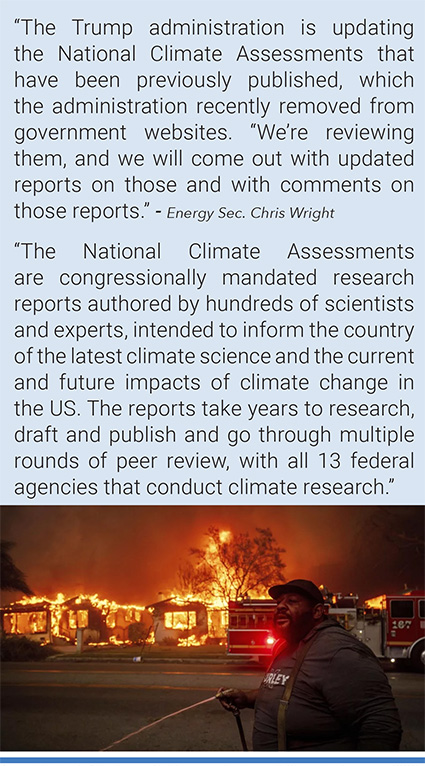
Elsewhere – in news linking climate change and net zero conversations in the economic arenas – Guardian journalist Kalyeena Makortoff reported, “Aviva’s chief executive, Amanda Blanc, has reiterated the insurer’s commitment to climate goals in the face of growing pushback against net zero ambitions in the US and UK. On Thursday Aviva’s shares hit their highest level since the 2008 financial crisis, with investors cheering a rise in profits, and fresh payouts for investors worth 13.1p a share. Blanc told journalists that the insurer was not wavering on climate transition plans, which she said were an important step in responding to a further rise in extreme weather events affecting its insurance business”.
Next, August 2025 media stories featured several scientific themes in news accounts. In early August, news continued to follow the ongoing battles between the US Environmental Protection Agency, US Department of Energy and expert scientists about various aspects of a changing climate. For example, CNN correspondent Ella Nilsen reported, “Energy Sec. Chris Wright said Tuesday night the Trump administration is updating the National Climate Assessments that have been previously published, which the administration recently removed from government websites. “We’re reviewing them, and we will come out with updated reports on those and with comments on those reports,” Wright told CNN’s Kaitlan Collins in an interview on “The Source.” Wright dismissed the past reports, saying “they weren’t fair in broad-based assessments of climate change.” “When you get into departments and look at stuff that’s there and you find stuff that’s objectionable, you want to fix it,” he said. Energy spokesperson Andrea Woods said, “The National Climate Reports are published by NOAA, not DOE. He was not suggesting he personally would be altering past reports.” The interagency process and publication is overseen by the US Global Change Research Program, which was established by Congress. The National Climate Assessments are congressionally mandated research reports authored by hundreds of scientists and experts, intended to inform the country of the latest climate science and the current and future impacts of climate change in the US. The reports take years to research, draft and publish and go through multiple rounds of peer review, with all 13 federal agencies that conduct climate research. An independent National Academy of Sciences panel signs off on the content. The first Trump administration signed off on and released the Fourth US National Climate Assessment in 2018, although it attempted to bury the report’s news by releasing it on Black Friday. The current administration has deleted all previous reports from government websites, fired the scientists working on the next iteration of the report, and recently issued a separate report compiled by five researchers that questioned the severity of climate change. Altering or revising previously published assessments would be a significant escalation in the administration’s attempts to wipe credible climate science off the record”.
Fires at Arthur's Seat in Edinburgh. Photo: Sarah Grossman. |
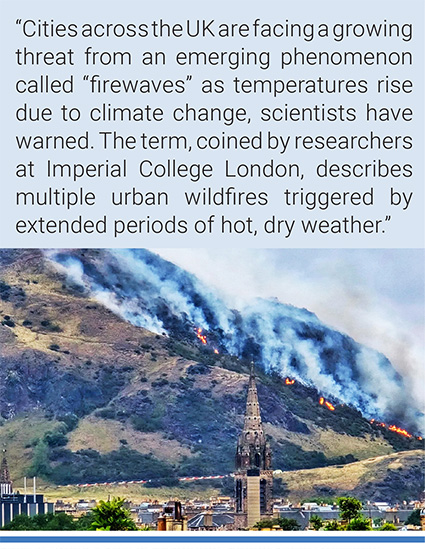
Several media accounts also continued to report on new research about climate change and global warming. For example, Associated Press correspondent Menelaos Hadjicostis reported, “Climate change that has driven scorching temperatures and dwindling rainfall made massive wildfires in Turkey, Greece and Cyprus this summer burn much more fiercely, said a new study…The study by World Weather Attribution said the fires that killed 20 people, forced 80,000 to evacuate and burned more than 1 million hectares (2.47 million acres) were 22% more intense in 2025, Europe’s worst recorded year of wildfires. Hundreds of wildfires that broke out in the eastern Mediterranean in June and July were driven by temperatures above 40 degrees Celsius (about 104 Fahrenheit), extremely dry conditions and strong winds. WWA, a group of researchers that examines whether and to what extent extreme weather events are linked to climate change, called its findings “concerning””.
Many news outlets connected scientific understanding with observations of our changing climate in August. For example, BBC journalist Justin Rowlett reported, “Cities across the UK are facing a growing threat from an emerging phenomenon called "firewaves" as temperatures rise due to climate change, scientists have warned. The term, coined by researchers at Imperial College London, describes multiple urban wildfires triggered by extended periods of hot, dry weather. The warning comes as firefighters battled three separate heath fires in London and a dramatic gorse blaze on Arthur's Seat in Edinburgh in recent days, as this summer's latest heatwave left vegetation across both capitals dangerously dry. These fires, though now contained, highlight the increasing vulnerability of urban areas to wildfires - a risk that was once considered largely rural. Guillermo Rein, professor of fire science at Imperial College London, has been working alongside the London Fire Brigade to help predict when conditions are ripe for a "firewave". Based on current forecasts, he believes London could be at risk again by this weekend. London Fire Brigade Assistant Commissioner Tom Goodall said he welcomes any research that helps predict the likelihood of wildfires occurring”.
Tourists try to cool off in a fountain in Rome. Photo: Daniel Cáceres/EFE. |
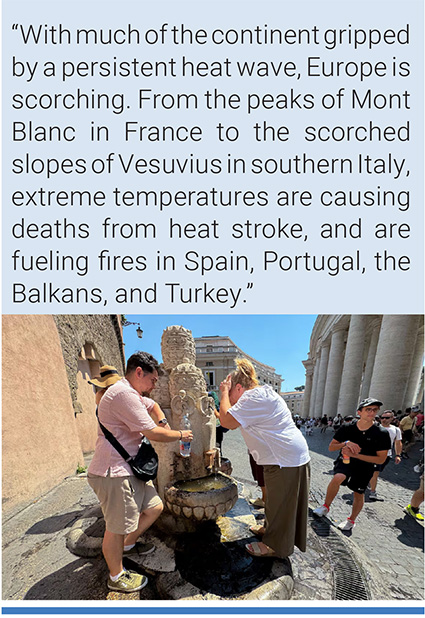
In August there were also many ongoing media stories relating to ecological and meteorological dimensions of climate change or global warming. To begin, media stories about heat waves suffocating Europe – with links made to climate change – proliferated. For example, Guardian correspondent Ajit Niranjan reported, “Cold Nordic countries are being seared by “truly unprecedented” heat, as hot weather strengthened and lengthened by carbon pollution continues to roast northern Europe. A weather station in the Norwegian part of the Arctic Circle recorded temperatures above 30C (86F) on 13 days in July, while Finland has had three straight weeks with 30C heat. Scientists say it is the longest streak in records going back to 1961, and 50% longer than the previous record. “Truly unprecedented heatwave still in full swing with maximum today about 32-33C,” said Mika Rantanen, a climate scientist at the Finnish Meteorological Institute, in a social media post on Thursday. “Even the Arctic regions … have seen three weeks above 25C, and may rival tomorrow their August heat records.” The Norwegian Meteorological Institute said temperatures above 30C were recorded on 12 days in July by at least one station in its three northernmost counties. Although the country had a brief respite last week as hot weather moved north and east, the institute said it expected temperatures of 30C might be reached again over the weekend”. Elsewhere, El País noted, “With much of the continent gripped by a persistent heat wave, Europe is scorching. From the peaks of Mont Blanc in France to the scorched slopes of Vesuvius in southern Italy, extreme temperatures are causing deaths from heat stroke, such as that of a farmworker this Tuesday in Lleida, and are fueling fires in Spain, Portugal, the Balkans, and Turkey. Nor are northern countries like Germany, unaccustomed to forecasts of 38 and 39 degrees for the coming days, nor are the United Kingdom, where they are experiencing their fourth heat wave of the summer, spared. Images of empty streets in major European cities, explored only by hard-working tourists seeking relief, as in Rome, mingle with those of blazing forests in Spain or at the gates of towns like Tarifa and Tres Cantos, near Madrid”.
Torrential rains across the northern Pakistan have caused flooding and landslides that have swept away entire villages. Photo: AFP. |
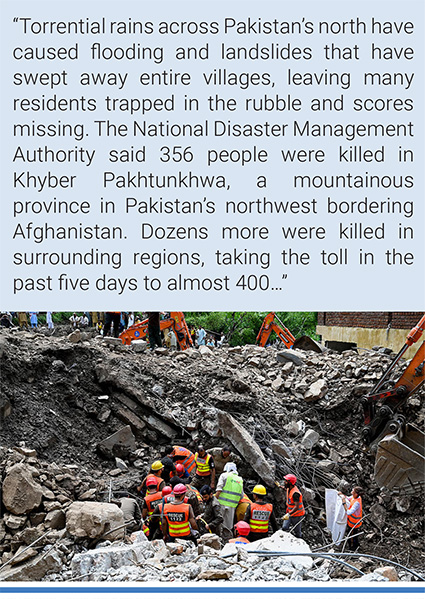
More broadly, many stories in August connected ecological and meteorological developments with a changing climate. For example, in Spain El País journalist Manuel Planelles wrote, “Extreme heat, record fires, and a warming Mediterranean: Spain is trapped in a climate emergency. After a summer of soaring temperatures and raging wildfires, the rains are now worrying scientists. The summer that ends this Sunday—the meteorological summer, because the astronomical summer lasts until September 22—closes another tragic chapter of the climate emergency in which Spain is trapped and which, crisis after crisis, has settled into our lives. This summer's extreme temperatures have contributed to a brutal wave of fires that, in addition to killing eight people fighting the flames and damaging the economies of many towns and the habitats of hundreds of species, threatens to shatter the fire records of the last three decades. The fires have already affected around 400,000 hectares, according to the provisional perimeter calculated by the European Forest Fire Information System (EFFIS), part of the European environmental monitoring program Copernicus. Although these are estimates, preliminary data indicate that 2025 will exceed 2022 in terms of affected area, which in turn had been the worst year for fires since the mid-1990s”. As another example, The Times of India reported on flooding and climate change, noting, “more than one cloudburst in Uttarakhand’s Uttarkashi district triggered flash flood and caused large-scale damage in high-altitude villages such as Dharali and Sukhi Top. The incident is the latest in a series of extreme weather events to hit the region during the monsoon season…the Indian Himalayan region is considered particularly prone to extreme weather, including cloudbursts, flash floods, avalanches, and heavy precipitation. These risks are projected to increase with climate change”. As a third example, Agence-France Press reported, “Rescuers and residents resumed searching on Tuesday for survivors as the death toll from five days of torrential rain rose to almost 400, with authorities warning monsoon downpours would continue until the weekend. Torrential rains across Pakistan's north have caused flooding and landslides that have swept away entire villages, leaving many residents trapped in the rubble and scores missing. The National Disaster Management Authority (NDMA) said 356 people were killed in Khyber Pakhtunkhwa, a mountainous province in Pakistan's northwest bordering Afghanistan, since Thursday evening. Dozens more were killed in surrounding regions, taking the toll in the past five days to almost 400…Landslides and flash floods are common during the monsoon season, which typically begins in June and lasts until the end of September. Pakistan is among the world's most vulnerable countries to the effects of climate change and is increasingly facing extreme weather events. Monsoon floods submerged one-third of Pakistan in 2022, resulting in approximately 1,700 deaths”.
A towering cloud of dust engulfs part of Phoenix Sky Harbor International Airport on Monday. Photo: Associated Press. |
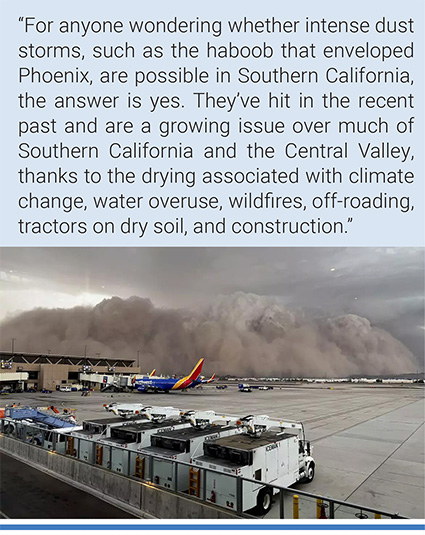
As a fourth example, Canadian Broadcasting Corporation journalist Alessio Donnini wrote, “There's heightened emphasis on the role climate change may play in the spread of legionnaires' disease as London, Ont., deals with its second deadly outbreak since the summer of 2024. Some scientists point to the Earth's warming temperatures and changing weather patterns — some of the signals of climate change — as playing a big role in accelerating the growth and spread of legionella, the bacteria that cause the serious respiratory condition. The Public Health Agency of Canada (PHAC) says legionella infection rates have increased dramatically, particularly between 2004 and the present. Experts also say most infections are never reported”. As a final example (among many), Los Angeles Times reporter Suzanne Rust noted, “For anyone wondering whether intense dust storms, such as the haboob that enveloped Phoenix this week, are possible in Southern California, the answer is yes. They’ve hit in the recent past and are a growing issue over much of Southern California and the Central Valley, thanks to the drying associated with climate change, water overuse, wildfires, off-roading, tractors on dry soil, and construction, experts say. In 2022, for instance, there was a massive haboob in the Salton Sea area. The dust from that nighttime storm — with a 3,000-foot-high wall of dust and 60-mph winds — went all the way to Los Angeles. “It was insane,” said Amato Evan, a climate researcher at UC San Diego’s Scripps Institution of Oceanography. It was so thick that cameras picked it up in Riverside, he said. More sensitive instruments measured the particles all the way from Lake Elsinore to Pasadena and downtown Los Angeles. He said a similar storm occurred in 2023. Both of those storms were on the same scale as the one in Arizona this week, but they happened at night and in far less populated areas…The consequences are potentially serious for human health, experts say, because disease- and chemical-laden particles coat human lungs. The particles also cover solar panels and darken mountain snow, making it melt faster”.
Media portrayals about ecological and meteorological dimensions of a changing climate in August 2025 also threaded into related and ongoing cultural-themed stories relating to climate change or global warming. To illustrate, New York Times journalist Claire Brown noted, “This summer, record wildfires have raged across Europe, burning more than a million hectares of land and forcing people to evacuate their homes. A five-day stretch of extreme heat killed hundreds of people. Spain baked through its most intense heat wave on record, and the United Kingdom is all but certain to have seen its hottest summer ever. In Europe, which has warmed about twice as fast as the global average, climate change has begun to force difficult questions about the economic and cultural costs of adapting to a dangerously warming planet. Hotter summers are reshaping Europe’s tourism industry, prompting cities to plan for days of asphalt-melting heat, and sparking national debates about the use of air conditioning. Wildfires have added to the summer’s health risks. At the same time, this summer’s overall temperatures across the region were “normal-ish,” according to Carlo Buontempo, director of the Copernicus Climate Change Service, the European Union monitoring agency…A five-day period of extreme heat in late June and early July resulted in 2,300 heat-related deaths across 12 European cities, according to an early statistical estimate by scientists at World Weather Attribution. Their analysis found that the influence of climate change may have tripled the death toll.

Figure 3. Examples of newspaper front pages with climate change stories in August 2025.

Art pieces of Mark Zuckerberg and Elon Musk with bloody hands carrying globes are marched through Manhattan at the “Make Billionaires Pay” climate protest, September 2025, in New York. Photo: Angelina Katsanis/AP.

September media coverage of climate change or global warming in newspapers around the globe increased 22% from August 2025. However, coverage in September 2025 decreased 16% from September 2024 levels. Figure 1 shows trends in newspaper media coverage at the global scale – organized into seven geographical regions around the world – from January 2004 through September 2025. International wire services stories in September 2025 were down 9% from August 2025 as well as down 33% from September 2024. For another month in 2025, the quantity of media coverage nonetheless still struggles to keep pace with the pace of a changing climate itself.
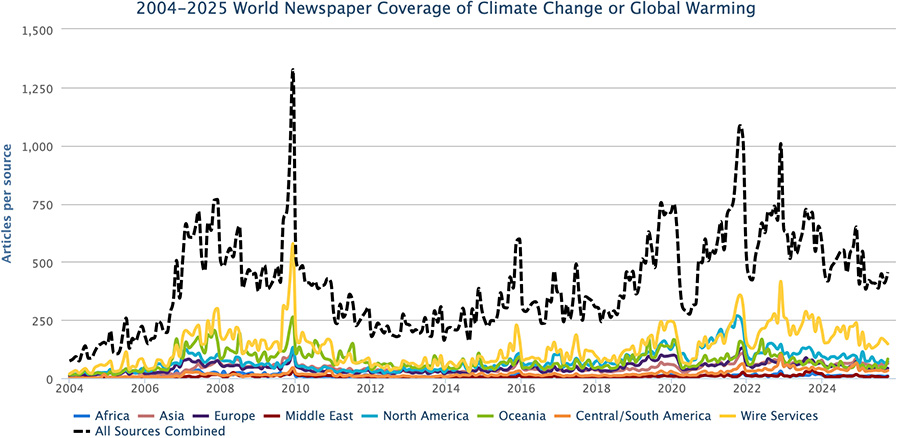
Figure 1. Newspaper media coverage of climate change or global warming in print sources in seven different regions around the world, from January 2004 through September 2025.
At the regional level, September 2025 coverage increased in all regions compared to August 2025: the European Union (EU) (+5%), North America (+8%), Asia (+10%), Latin America (+15%), Africa (+22%), Oceania (+88%), and in the Middle East (more than doubling) compared to August 2025. In the United States (US), print media coverage went up 12% from August 2025 yet was still 18% lower than coverage in September 2024 (Figure 2). Meanwhile, US television coverage surged from low levels of August 2025 coverage is it was up 57% despite still remaining 19% lower than September 2024 levels.
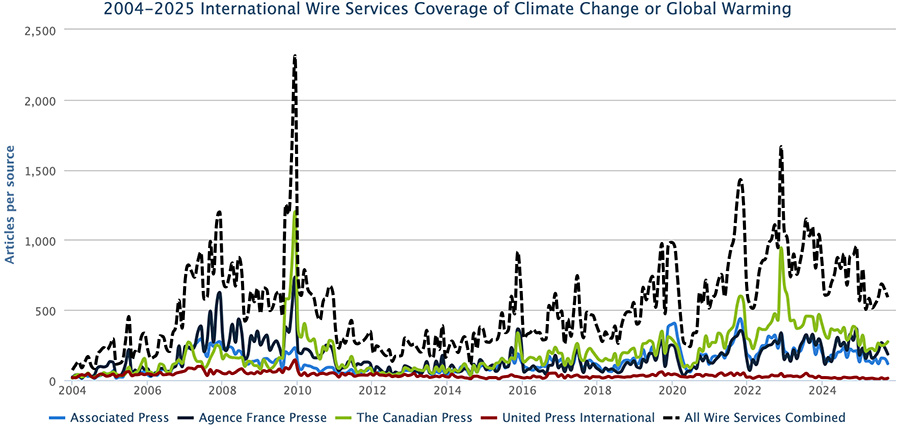
Figure 2. International wire services coverage of climate change or global warming from January 2000 through September 2025.
Moving to the content of news coverage about climate change in September 2025, topping news reporting were many political and economic-themed media stories about climate change or global warming. To begin, early September news of California Attorney General’s office lawsuit – and counter lawsuit – against ExxonMobil – regarding recent developments was part of an ongoing set of stories. For example, New York Times journalist Karen Zraick wrote, “did California’s attorney general and several other groups defame Exxon Mobil when they sued the oil giant last year over its role in widespread plastic pollution? That was the question looming over a recent hearing in federal court in Beaumont, Texas, where Exxon Mobil has countersued Attorney General Rob Bonta of California and the nonprofit groups, accusing them of mounting a conspiracy to destroy its recycling business. Exxon’s aggressive move signaled a sharp escalation by the oil giant as it tries to ward off similar suits in the future… Paul Nolette, a professor at Marquette University in Milwaukee and author of a book on state attorneys general, said that a company filing a defamation lawsuit against an attorney general was highly unusual. He said it was most likely a tactic to push back on what he described as the “soft power” that state attorneys general possess, such as the ability to pursue legal investigations and make public statements that can influence public opinion and potentially pressure corporate defendants. He also noted the similarities between Mr. Bonta’s plastics lawsuit and another batch of litigation: the roughly three-dozen suits filed by state and local governments since 2017 against oil companies over their role in climate change. Those cases allege that the oil companies covered up what they knew about global warming to protect profits. The climate change lawsuits are generally being filed by states led by Democrats, Mr. Nolette noted, which has the effect of making them look more political, which in turn encourages companies like Exxon to push back more aggressively. He added that he thought Exxon was trying to raise the costs of bringing plastics-related litigation to discourage other states from following California’s lead. There have been lawsuits related to plastics pollution filed by officials in New York and Minnesota, for example, but they are far fewer in number than climate change lawsuits. “It’s something of a branch off of the existing climate litigation,” Mr. Nolette said of the plastics lawsuit. “I think, from the company’s perspective, once the genie is out of the bottle, or whatever cliché you want to use, then it becomes a lot more difficult for them to deal with these claims. So they’re trying to push back early”.”
In mid-September, as US President Donald Trump made remarks out of step with the global community, many news outlets covered his remarks as well as early signs of their reverberations. For example – in an article titled ‘In front of drowning nations, Trump calls climate change a ‘con job.’ Here are the facts and context’ – Associated Press journalists Melinda Walling and Seth Borenstein reported, “Some countries’ leaders are watching rising seas threaten to swallow their homes. Others are watching their citizens die in floods, hurricanes and heat waves, all exacerbated by climate change. But the world U.S. President Donald Trump described in his speech at the United Nations General Assembly on Tuesday didn’t match the one many world leaders in the audience are contending with. Nor did it align with what scientists have long been observing. “This ‘climate change,’ it’s the greatest con job ever perpetrated on the world, in my opinion,” Trump said. “All of these predictions made by the United Nations and many others, often for bad reasons, were wrong. They were made by stupid people that have cost their countries fortunes and given those same countries no chance for success. If you don’t get away from this green scam, your country is going to fail.” Trump has long been a critic of climate science and polices aimed at helping the world transition to green energies like wind and solar. His speech Tuesday, however, was one of his most expansive to date. It included false statements and making connections between things that are not connected.” As another example, El Mundo journalist Luis de la Cal wrote, “One day after Trump called climate change "the biggest hoax ever perpetrated in the world," Chinese President Xi Jinping appeared on the giant screen at a climate summit on the sidelines of the assembly. In a recorded message, he announced his country's new plans to reduce greenhouse gas emissions by between 7% and 10% by 2035. "While some countries are acting contrary [to the fight against climate change], the international community must stay focused in the right direction," Xi said in a message addressed to the United States.” “China promises for the first time to reduce its gases to stop global warming” was the main cover story of La Vanguardia on the 26th.
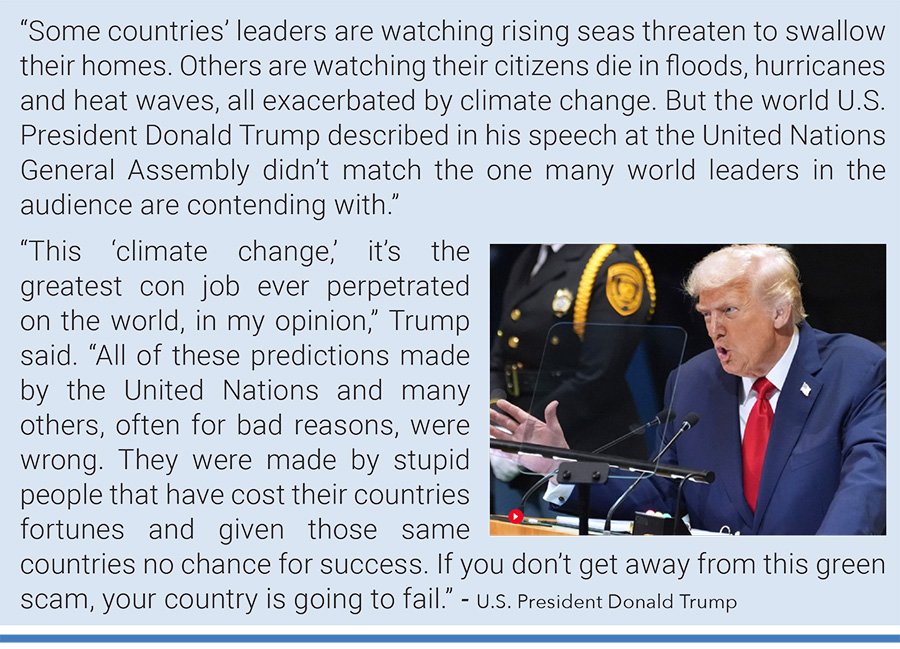
President Donald Trump returned to the United Nations to boast of his foreign policy record, inflating his role at times, and lash out at the world body. Source: Associated Press.
Chinese President Xi Jinping speaks remotely during the 2025 Climate Summit at the UN on September 24, 2025. Photo: Charly Triballeau/AFP. |
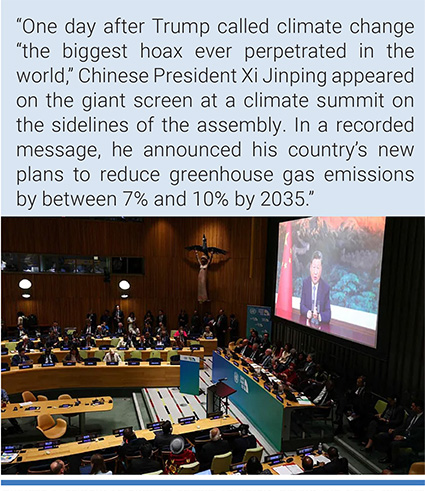
Many news outlets also covered US Trump Administration climate affairs in and around the UN General Assembly in New York City up to the end of the month and the looming US government shutdown. For example, New York Times journalist Max Bearak reported, “Energy Secretary Chris Wright and Interior Secretary Doug Burgum defended the Trump administration’s pivot away from renewable energy in Italy on Wednesday, saying their plans to sharply expand U.S. fossil fuel exports were crucial to “peace and prosperity.” The secretaries are swinging through Europe this week on a mission to secure contracts to sell more American fossil fuels and lobby the European Union to loosen environmental regulations that they have said are too onerous. Mr. Wright said he would be in Brussels on Thursday to discuss the European Union’s requirements that oil and gas companies limit leaks of methane, one of the most potent greenhouse gases, and a law requiring companies to prevent adverse human rights and environmental effects in their production process.” Elsewhere, Washington Post journalists Kasha Patel, Jake Spring, Brady Dennis and Hannah Natanson reported, “Tracking bird populations after hurricanes. Mapping the risk of megafires across the Midwest. Identifying less expensive ways to battle invasive plants. Preparing communities’ stormwater drains against intense flooding. A third of the nation’s offices that do this work — known as the U.S. Geological Survey’s Climate Adaptation Science Centers — are expected to drastically wind down and possibly close after Tuesday because of a lack of funds, according to employees and an announcement by one of the closing centers. The potential shuttering of the South Central, Northeast and Pacific Islands centers, which collectively cover about one-third of the U.S. population and are funded under the Interior Department, would hamper projects aimed to help people, wildlife, land, and water adapt to a changing climate locally. Their demise is unconnected to a possible federal shutdown: Instead, employees say, Interior Department officials have not approved paperwork that would help fund them for another five years.”
Meanwhile, in the international energy policy arena there was September news of other global cooperation across nations both positive and negative in terms of climate change. For an example of the former, Times of India correspondent Vishwa Mohan reported, “in what could be a positive outcome of India’s growing renewable energy footprint, a new analysis based on official monthly data has shown that the country’s carbon dioxide (CO2) emissions from its power sector fell by 1% year-on-year in the first half of 2025 and by 0.2% over the past 12 months – this is only the second instance of such a drop in almost half a century. The analysis also indicates that emissions from India’s power sector could peak before 2030 if clean-energy capacity and electricity demand grow as expected”. As a second example of the former, BBC News journalists Mark Poynting and Matt McGrath wrote, “China, the world's biggest source of planet-warming gases, has for the first time committed to an absolute target to cut its emissions. In a video statement to the UN in New York, President Xi Jinping said that China would reduce its greenhouse gas emissions across the economy by 7-10% by 2035, while "striving to do better"”.
A U.S. Geological Survey scientist collects a water quality sample in the Grand Canyon in Arizona. Photo: USGS Climate Adaptation Science Centers. |
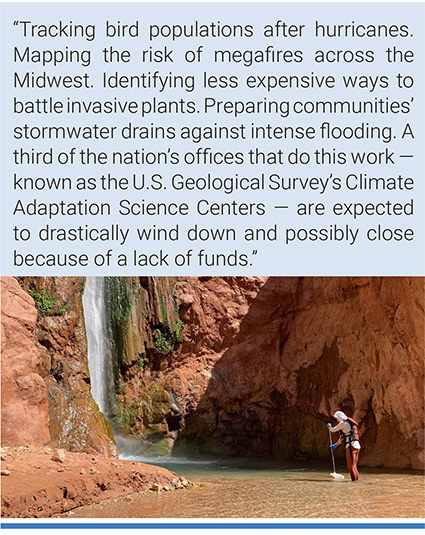
For an example of the latter, CNN journalists Simone McCarthy, Nectar Gan and Darya Tarasova wrote, “Russian President Vladimir Putin hailed a relationship with Beijing at an “unprecedentedly high level” on Tuesday, as the two countries reportedly inked a long-stalled agreement to build a massive new pipeline to send natural gas to China via Mongolia. Putin and Xi Jinping spent hours together on Tuesday, meeting with Mongolia’s president, sitting down for their own formal talks, and sipping tea at the Chinese leader’s official residence – in the latest show of solidarity between the two strongmen seeking to present a new world order. On Tuesday afternoon, Russia’s state-owned energy company Gazprom announced that a legally binding agreement had been signed for the construction the massive Power of Siberia-2 gas pipeline, which Moscow has been trying to push off the drawing board for years”. As another example of the latter, the EU's climate leadership was weakened by the disagreement over the new greenhouse gas cuts, diluting its commitment to climate action. La Vanguardia journalist Anna Buj wrote, “Europe noted the enormous differences between EU countries regarding the direction the European Union should follow. The Commission's proposal to reduce greenhouse gas emissions by 90% by 2040 compared to 1990 met with opposition from several countries. And the EU will not be able to submit its updated climate action plan to the United Nations before September 30, as required by the Paris Agreement”.
Next, media portrayals about ecological and meteorological dimensions of a changing climate in September 2025 also threaded political dimensions of climate stories into related and ongoing cultural-themed stories relating to climate change or global warming. To illustrate, further fallout from the contrarian US Department of Energy (DOE) report on climate change made news in September. For example, CNN correspondent Ella Nilsen wrote, “Climate scientists are declaring victory after the Trump administration dissolved a working group of five well-known climate contrarians that authored a recent federal report questioning the severity of climate change and even portraying it as potentially beneficial. A letter dated September 3 from Energy Sec. Chris Wright confirming the dissolution of the group was sent to the five researchers — John Christy and Roy Spencer, both at the University of Alabama at Huntsville, Steven E. Koonin of Stanford University’s Hoover Institution, Georgia Tech professor emeritus Judith Curry and Canadian economist Ross McKitrick. The group’s end can be traced to a lawsuit filed by the Environmental Defense Fund and Union of Concerned Scientists alleging the group’s formation violated the Federal Advisory Committee Act in several ways, mainly by failing to disclose the group’s formation “until months after it began working,” and by choosing members of a federal government working group to deliberately represent a one-sided argument. Though the group has been disbanded, DOE will not withdraw the report it authored, which sparked resistance across the climate science community and stirred a coordinated response during the required public-comment period.”
Smoke billows from the cooling towers of a coal-fired power plant in Ahmedabad, India. Photo: Amit Dave/Reuters. |
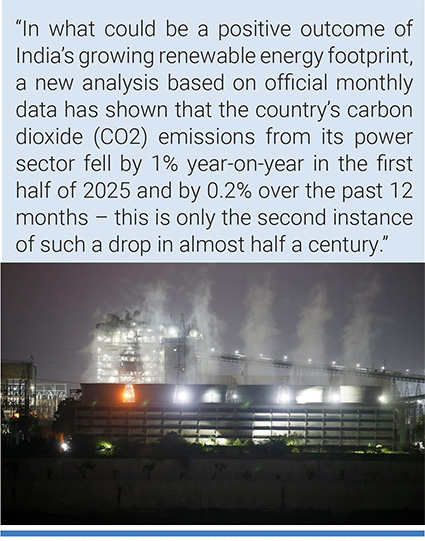
As news coverage ramps up ahead of the UN climate negotiations in November in Brazil, some stories with a cultural lens punctuated the news cycle. For example, Folha de São Paulo reporter Luciana Cavalcante wrote, “hundreds of construction workers decided to go on strike for an indefinite period…the strike will directly affect construction work on hotels and properties for COP30, the United Nations climate change summit which takes place in less than two months in the city”.
Then, several September 2025 media stories featured several scientific themes in news accounts. As a first example, research from Imperial College London garnered media attention. For example, Guardian correspondent Ajit Niranjan wrote, “Human-made global heating caused two in every three heat deaths in Europe during this year’s scorching summer, an early analysis of mortality in 854 big cities has found. Epidemiologists and climate scientists attributed 16,500 out of 24,400 heat deaths from June to August to the extra hot weather brought on by greenhouse gases. The rapid analysis, which relies on established methods but has not yet been submitted for peer review, found climate breakdown made the cities 2.2C hotter on average, greatly increasing the death toll from dangerously warm weather. “The causal chain from fossil fuel burning to rising heat and increased mortality is undeniable,” said Friederike Otto, a climate scientist at Imperial College London and a co-author of the report. “If we had not continued to burn fossil fuels over the last decades, most of the estimated 24,400 people in Europe wouldn’t have died this summer.” The scientists used local relationships between temperature and death to model excess mortality during the hottest months of the year, and compared their results – which cover cities where almost one-third of the European population lives – with a hypothetical world without any climate change. They found the extra heat was responsible for about 68% of the estimated deaths. Older people were hit hardest by punishing temperatures, the study found, with 85% of the dead over the age of 65, and 41% over the age of 85”.
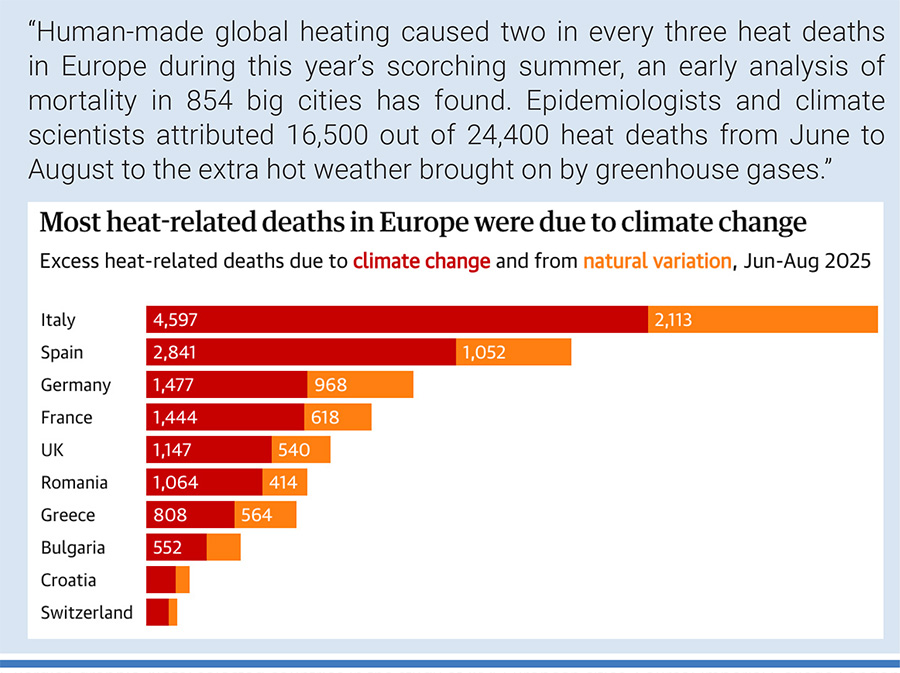
Guardian graphic. Note: selected countries in the study of 854 European cities. Source: Imperial College London and London School of Hygiene & Tropical Medicine.
As a second example, the first National Climate Risk Assessment in Australia generated media accounts. BBC News correspondent Lana Lam noted, “One and a half million Australians living in coastal areas are at risk from rising sea levels by 2050, a landmark climate report has warned…[and] predicted more frequent and severe climate hazards like floods, cyclones, heatwaves, droughts, and bushfires. "Australians are already living with the consequences of climate change today," Climate Change Minister Chris Bowen said, "but it's clear every degree of warming we prevent now will help future generations avoid the worst impacts in years to come." The report looked at three global warming scenarios - above 1.5C, above 2C and above 3C. Australia - one of the world's biggest polluters per capita - has already reached warming of above 1.5C, the report said, noting that at 3C, heat-related deaths in Sydney may rise by more than 400% and almost triple in Melbourne. The 72-page report - released days before the government announces its emissions reduction targets for 2035 - found that no Australian community will be immune from climate risks that will be "cascading, compounding and concurrent". It warned of more heatwave-related deaths, poorer water quality due to severe flooding and bushfires, and a A$611bn ($406bn; £300bn) drop in property values. By 2050, the report found the number of coastal communities located in "high and very high risk areas" in Australia will increase and if populations levels remain stable, this will mean more than 1.5 million people will be at risk”.

Figure 3. Examples of newspaper front pages with climate change stories in September 2025.
Among stories elsewhere, La Vanguardia journalist Andrés Actis noted, “The planet is already exceeding seven of the nine limits that give it stability: ocean acidification is the new threshold that has entered the red zone.” The article reported that “The first scanner, in 2009, showed three limits exceeded. Ten years ago, in 2015, the check added a fourth. In 2023, the number rose to six. Now, to seven. For the first time, the ocean acidification limit has been exceeded. This endangers much of marine life. The acidity of the seas has increased by 40% since the beginning of the industrial era. “Humanity is crossing the boundaries of a safe operating space, which increases the risk of destabilizing the planet,” warns Johan Rockström, director of the Potsdam Institute for Climate Impact Research and lead author of this study.”
Last, in September there were also many ongoing media stories relating political themes to ecological and meteorologicaldimensions of climate change or global warming. To illustrate, New York Times correspondent Hannah Dreier reported, “The U.S. government will provide wildfire fighters with masks to protect against smoke — reversing a decades-long ban that exposed workers to toxins known to cause cancer and other serious diseases. The Forest Service posted new guidance on Monday acknowledging for the first time that masks can protect firefighters against harmful particles in wildfire smoke. The move is part of a flurry of safety improvements in recent weeks as the government faces increasing pressure to aid firefighters. For years, the Forest Service had barred workers from wearing masks, arguing that they were too cumbersome for the job. But current and former officials have said the agency did not want to deal with the potentially costly consequences of admitting the long-term dangers of smoke exposure… The shift comes after a series of articles in The New York Times documented a growing occupational health crisis among wildfire crews. As climate change makes fire season longer and more intense, firefighters are spending more time in smoke. Many are developing cancer or lung disease at young ages, and some are dying. The Forest Service, which employs the largest share of the country’s 40,000 wildland firefighters, has come under intense scrutiny by Congress…

Figure 4. Examples of newspaper front pages from U.S. President Donald Trump's described speech at the United Nations General Assembly in September 2025.
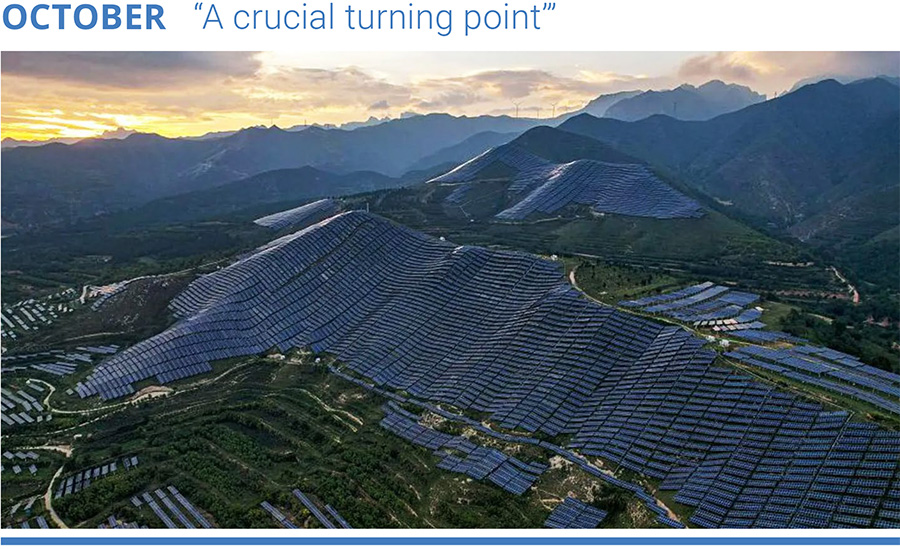
Blue solar photovoltaic panels neatly arranged in Yuncheng City, China. Photo: Getty Images.

October media coverage of climate change or global warming in newspapers around the globe decreased 10% from September 2025. Moreover, coverage in October 2025 decreased 23% from October 2024 levels. Figure 1 shows trends in newspaper media coverage at the global scale – organized into seven geographical regions around the world – from January 2004 through October 2025. International wire services stories in October 2025 were down 7% from September 2025 as well as down 38% from October 2024. For yet another month in 2025, the quantity of media coverage struggles to keep pace with the pace of a changing climate.

Figure 1. Newspaper media coverage of climate change or global warming in print sources in seven different regions around the world, from January 2004 through October 2025.
At the regional level, October 2025 coverage decreased in all regions compared to September 2025 except in Latin America, where coverage increased 8%, and in Africa, where coverage remained level: North America (-8%), Asia (-9%), the European Union (EU) (-9%), the Middle East (-11), and Oceania (-31%) compared to September 2025. As an example at the country level (where we provide 15 country profiles around the world in 14 different languages overall), coverage in Indian print newspapers – The Indian Express, The Hindu, Hindustan Times, and The Times of India – dropped nearly 4% from the previous month of September 2025 and dropped 1% from October 2024 (Figure 2).

Figure 2. Indian print media coverage – in The Indian Express, The Hindu, Hindustan Times, and The Times of India – of climate change or global warming from January 2000 through October 2025.
Turning to the content of news coverage, in October there were many media stories relating to ecological and meteorological dimensions of climate change or global warming. To illustrate, connections were made between hurricane Melissa and climate change in media accounts in mid- to late- October. For example, El País journalist María Mónica Monsalves wrote, “since Hurricane Melissa intensified from a Category 1 to a Category 5 on the Saffir-Simpson scale in just 48 hours last Monday, the question of how much climate change might have contributed to its growth became unavoidable. Even before making landfall in Jamaica last Tuesday, meteorologists were already warning that it was the third most intense hurricane ever recorded in the Caribbean, after Wilma (2005) and Gilbert (1988). In the following days, it devastated several Caribbean islands, leaving at least 50 dead and causing billions of dollars in damage. With a general increase in ocean surface temperatures, which broke records in 2024, it is almost impossible that storms arising under the current climate emergency will not be strengthened and intensified by this phenomenon (…) “Human-caused climate change clearly made Hurricane Melissa stronger and more destructive,” said Ralf Toumi, director of the Institute, in a statement. “These storms will be even more devastating in the future if we continue to overheat the planet by burning fossil fuels,” he added (…) The cyclone is estimated to cause between $7 billion and $20 billion in losses. “It’s a reminder of how climate injustice works,” says one of the authors”. As a second example, Washington Post correspondents Ben Noll, Ruby Mellen, Brady Dennis and Douglas MacMillan reported, “A slow, lumbering storm like Melissa is cause for great concern. “In many cases, it’s a worst-case kind of scenario,” said Jeff Masters, a meteorologist who writes on climate change and weather for Yale Climate Connections and for years served with NOAA’s Hurricane Hunters. A storm that inches along can subject places in its path to longer stretches of torrential rainfall, sustained winds and heightened storm surge. With Melissa, Masters said, he worries about the potential rainfall most of all…Jim Kossin, a retired NOAA climate scientist and hurricane expert, said that while it is clear climate change is making the strongest storms even stronger, researchers are continuing to investigate whether the planetary changes are also leading to more slow-moving storms that dump huge amounts of rain”. As a third example, Guardian journalists Natricia Duncan, Anthony Lugg, Tom Phillips and Oliver Holmes added, “Melissa is so unusually strong that the US military said it had moved its forces – likely to be ships and aircraft – in the vicinity of the storm to safer areas. Climate scientists have said the intensification of Hurricane Melissa – with winds doubling from 70mph to 140mph in just a day – is probably a symptom of the rapid heating of the world’s oceans, part of the human-driven climate crisis”.

Figure 3. Examples of newspaper front pages covering Hurricane Melissa while making connections with climate change in October 2025.
Firefighters tackle a blaze in Chaves, Portugal, in August. Photo: Pedro Sarmento Costa/EPA. |

Next, many October 2025 media stories featured several scientific themes in news accounts. To illustrate, new research about warming in the Antarctic generated news. For example, Daily Mail (UK) reporter Xantha Leatham wrote, “When it comes to the fight against climate change, the Southern Ocean is on our side. For around 200 years it has acted as a major buffer against global warming by absorbing harmful carbon dioxide. But the ocean around Antarctica is building up a colossal 'burp' that could trigger an increase in global temperatures, experts have warned. Rather than a Homer Simpson–esque belch, this 'burp' signifies an 'abrupt discharge of heat' that could take place over decades. Over time, deep currents bring warm water – which has gradually been heating up over centuries – to the surface of the ocean, where it directly reheats the atmosphere. This would cause temperatures to increase, ice sheets to melt, sea levels to rise and reverse decades of climate change progress, the researchers cautioned. And the impact could be comparable to global warming caused by humans, they said”.
News of record carbon dioxide (CO2) levels generated media attention. For example, La Vanguardia journalist Antonio Cerrillo noted, “between 2023 and 2024, the global average concentration of CO2 increased by 3.5 ppm, the largest increase since modern measurements began in 1957. In 2004, the annual average CO2 level measured by the WTO network of stations was 377.1 ppm, while in 2024 it reached 423.9 ppm. Approximately half of the total CO2 emitted each year remains in the atmosphere and the rest is absorbed by terrestrial ecosystems and oceans. The likely reason for the record growth between 2023 and 2024 was the large contribution of forest fire emissions and less CO2 absorption on land and in the ocean in 2024, the warmest year on record, with a strong El Niño phenomenon”. Meanwhile, Associated Press journalists Jamey Keaton and Seth Borenstein wrote, “Heat-trapping carbon dioxide levels in the atmosphere jumped by the highest amount on record last year, soaring to a level not seen in human civilization and “turbo-charging” the Earth’s climate and causing more extreme weather, the United Nations weather agency said Wednesday. The World Meteorological Organization said in its latest bulletin on greenhouse gases, an annual study released ahead of the U.N.’s annual climate conference, that CO2 growth rates have now tripled since the 1960s, and reached levels that existed more than 800,000 years ago”.
While other federal employees have been furloughed, this week the Interior Department prepared to open more than 250,000 acres of land in Wyoming and Nebraska to oil drilling. Photo: Kristina Barker/The New York Times. |

In late October, the release of the annual report 'The Lancet Countdown' (co-authored with MeCCO team members Lucy McAllister and Olivia Pearman) earned media attention. For example, Guardian environment editor Damien Carrington reported, “Rising global heat is now killing one person a minute around the world, a major report on the health impact of the climate crisis has revealed. It says the world’s addiction to fossil fuels also causes toxic air pollution, wildfires and the spread of diseases such as dengue fever, and millions each year are dying owing to the failure to tackle global heating. The report, the most comprehensive to date, says the damage to health will get worse with leaders such as Donald Trump ripping up climate policies and oil companies continuing to exploit new reserves. Governments gave out $2.5bn a day in direct subsidies to fossil fuel users and producers in 2023, the researchers found, while people lost about the same amount because of high temperatures preventing them from working on farms and building sites. Reduced coal burning has saved about 400 lives a day in the last decade, the report says, and renewable energy production is rising fast. But the experts say a healthy future is impossible if fossil fuels continue to be financed at current rates”. As a second example, El Mundo journalist C. G. Lucio noted, “The data from the new report is devastating. According to their analysis, 12 of the 20 indicators that measure health threats have reached unprecedented levels. “This year's health report presents a grim and undeniable picture of the devastating health damage reaching every corner of the world, with unprecedented health threats caused by heat, extreme weather events, and smoke from wildfires that are killing millions of people"”.
In terms of content of news coverage about climate change in October 2025, news reporting included many political and economic-themed media stories about climate change or global warming. To begin, media attention paid to the United States (US) government shutdown made several connections with climate change. For example, New York Times journalist Lisa Friedman reported, “More than 700,000 federal employees have been sidelined and thousands more are at risk of being fired as the government shutdown drags on. But the workers responsible for carrying out the president’s plans for more fossil fuels and less wind and solar power are still hard at work. Some are approving permits for companies that want to extract metals, coal, oil and gas from public lands and federal waters. Others are rolling back limits on the greenhouse gas emissions that are driving climate change. On Thursday the Bureau of Land Management approved the expansion of a copper mine on public land in Utah. Earlier this week the Interior Department prepared to open more than 250,000 acres of land in Wyoming and Nebraska to oil drilling, and held a coal lease sale for access to Montana’s Powder River Basin. And at the Environmental Protection Agency, employees are finalizing a plan to allow more mercury emissions from coal plants, according to two people familiar with the work underway. Charlotte Taylor, a spokeswoman for the Interior Department, said the agency was doing what was necessary in light of President Trump’s declaration in January of a national energy emergency”.
Photo: AFP via Getty Images. |

At the global level, many media stories about renewables and climate change circulated in October. For example, BBC News correspondent Justin Rowlatt reported, “Renewable energy overtook coal as the world's leading source of electricity in the first half of this year - a historic first, according to new data from the global energy think tank Ember. Electricity demand is growing around the world but the growth in solar and wind was so strong it met 100% of the extra electricity demand, even helping drive a slight decline in coal and gas use. However, Ember says the headlines mask a mixed global picture. Developing countries, especially China, led the clean energy charge but richer nations including the US and EU relied more than before on planet-warming fossil fuels for electricity generation. This divide is likely to get more pronounced, according to a separate report from the International Energy Agency (IEA). It predicts renewables will grow much less strongly than forecast in the US as a result of the policies of President Donald Trump's administration. Coal, a major contributor to global warming, was still the world's largest individual source of energy generation in 2024, a position it has held for more than 50 years, according to the IEA. Even though China is still adding to its fleet of coal-fired power stations, it also remains way ahead in clean energy growth, adding more solar and wind capacity than the rest of the world combined. This enabled the growth in renewable generation in China to outpace rising electricity demand and helped reduce its fossil fuel generation by 2%. India experienced slower electricity demand growth and also added significant new solar and wind capacity, meaning it too cut back on coal and gas. In contrast, developed nations like the US, and also the EU, saw the opposite trend. In the US, electricity demand grew faster than clean energy output, increasing reliance on fossil fuels, while in the EU, months of weak wind and hydropower performance led to a rise in coal and gas generation. In a separate report the IEA has halved its forecast for the growth of renewable energy in the US this decade. Last year, the agency predicted the US would add 500GW of new renewable capacity – mostly from solar and wind – by 2030. That has been cut that back to 250GW. The IEA analysis represents the most thorough assessment to date of the impact the Trump administration's policies are having on global efforts to transition to cleaner energy sources and underscores the dramatically different approach of the US and China. As China's clean tech exports surge, the US is focusing on encouraging the world buy more of its oil and gas. Despite these regional differences, Ember calls this moment a "crucial turning point"”.
Demonstrators hold up placards reading “water and electricity are basic human rights,” “Malagasy people, wake up,” “Let’s not remain in the dark with our yellow cans” in Antananarivo, Madagascar. Photo: Sarah Tetaud/Associated Press. |

Last, media portrayals also touched on ongoing cultural-themed stories relating to climate change or global warming. To illustrate, protest movements were cast in the spotlight in October. For example, BBC News reporter Leigh Boobyer wrote, “Just Stop Oil protesters who sprayed Stonehenge with orange powder "carefully planned" the act, a court was told. Salisbury Crown Court heard on Monday the prehistoric stones were covered in orange powder paint as part of a protest by the campaign group on 19 June last year. Rajan Naidu, 74, Niamh Lynch, 22, Luke Watson, 36, are accused of damaging an ancient, protected monument and causing a public nuisance. They deny the charges. Simon Jones told the jury: "The prosecution say that this is an act of blatant and clear vandalism." Mr. Naidu, of Gosford Street, Birmingham and University of Oxford student Ms. Lynch, of Norfolk Road, Bedford, are accused of using two fire extinguishers filled with corn flour, talc and an orange dye to spray the monument”. Taking another perspective, Fox News correspondent Emma Colton reported, “Climate protesters have grown more confrontational in recent years, experts say, including publicly cataloging energy sector leaders and conservatives as "climate criminals," staging disruptive protests outside conservative organizations in the U.S., while climate activists in the U.K. have gone as far as attempting citizen's arrests of water company CEOs…Climate activists have increasingly become more confrontational in splashy and often costly acts of protests, including throwing soup at glass protecting the "Mona Lisa" at the Louvre in Paris while protesting food insecurity in 2024, vandalizing Berlin’s Brandenburg Gate in 2023 with orange paint while calling on the German government to stop using all fossil fuels by 2030, and a yearslong international campaign that has vandalized and deflated thousands of tires on SUVs since 2021. Fox News Digital took a look back at how climate protests have intensified in recent years, most notably in Europe, and how the activism is also playing out on U.S. soil and in the court system”. However, Associated Press journalist Sheikh Saaliq reported, “From the Andes to the Himalayas, a new wave of protests is unfolding across the world, driven by generational discontent against governments and anger among young people. This week, Madagascar’s President Andry Rajoelina was forced out of power and out of the country after a military mutiny, the culmination of weeks of demonstrations led by young protesters referring to themselves as “Gen Z Madagascar.” The rage against the political establishment in the Indian Ocean island country mirrors other recent protests across the world, in countries like Nepal, the Philippines, Indonesia, Kenya, Peru and Morocco. These protests have been sparked by specific grievances but are driven by long-simmering issues like widening inequality, economic uncertainty, corruption, and nepotism of leaders. But they have one thing in common: Mostly leaderless, they are made up primarily of young people who brand themselves as “Gen Z,” defined as those born roughly between 1996 and 2010 — the first generation to grow up entirely in the internet age. “What connects these youth-led protests is a shared sense that traditional political systems aren’t responsive to their generation’s concerns, whether that’s corruption, climate change, or economic inequality. Protest then becomes the logical outlet when institutional channels feel blocked,” said Sam Nadel, director of Social Change Lab, a U.K.-based nonprofit that researches protests and social movements”.

Figure 4. Examples of newspaper front pages with climate change stories in October 2025.

Cars and houses are submerged in floodwaters in Songkhla province, Southern Thailand, on November 26, 2025. Photo: Arnon Chonmahatrakool/AP.

November media coverage of climate change or global warming in newspapers around the globe rose 23% from October 2025. Yet, coverage in November 2025 decreased 24% from November 2024 levels. Figure 1 shows trends in newspaper media coverage at the global scale – organized into seven geographical regions around the world – from January 2004 through November 2025. In particular, stories in Latin American outlets in November 2025 increased nearly 48% from October 2025 while the United Nations Conference of Parties meeting (COP30) on climate change took place in Belém, Brazil (Figure 2).
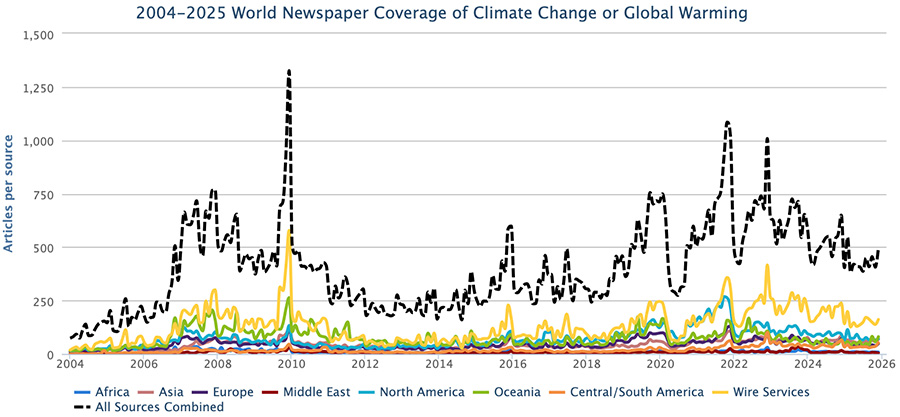
Figure 1. Newspaper media coverage of climate change or global warming in print sources in seven different regions around the world, from January 2004 through November 2025.
At the regional level, November 2025 coverage increased in most regions compared to October 2025, with exceptions in the Middle East (down 42%) and in Africa (down 9%): North America (+9%), Asia (+18%), the European Union (EU) (+25%), Oceania (+43%) and aforementioned Latin America (+48%) compared to October 2025. As an example at the country level (where we provide 15 country profiles around the world in 14 different languages overall), coverage in United Kingdom (UK) print newspapers – The Daily Mail & Mail on Sunday; Guardian & Observer; Sun, The News of the World & Sunday Sun; Telegraph & Sunday Telegraph; The Daily Mirror & Sunday Mirror; and Times & Sunday Times – increased 28% from the previous month of October 2025 yet was still 34% lower than coverage in November 2024.
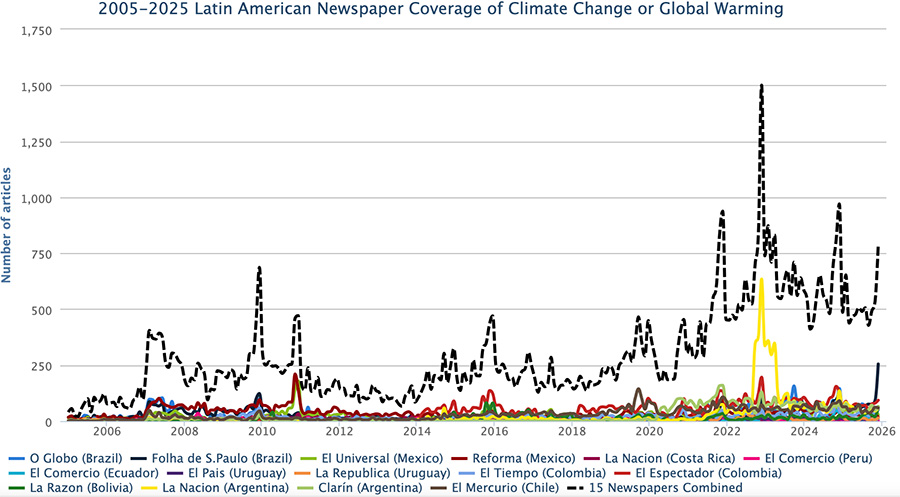
Figure 2. Latin America print media coverage of climate change or global warming from January 2005 through November 2025.
Turning to the content of news coverage in November 2025, news reporting included many political and economic-themed media stories about climate change or global warming. The annual UN climate change negotiations (COP30) dominated news stories in the first weeks of the month, with many angles on facets of the negotiations and related activities. For example, Guardian journalists Jonathan Watts and Fiona Harvey reported, “The failure to limit global heating to 1.5C is a “moral failure and deadly negligence”, the UN secretary general has said at the opening session of the Cop30 climate summit in the Brazilian city of Belém. António Guterres said even a temporary overshoot would have “dramatic consequences. It could push ecosystems past catastrophic tipping points, expose billions to unlivable conditions and amplify threats to peace and security.” Speaking to heads of state from more than 30 countries, Guterres called the target of limiting global heating to 1.5C above preindustrial levels a “red line” for a habitable planet and urged his audience to bring about a “paradigm shift” so that the effects of the overshoot could be minimized”.
A delegate from the Russian Federation raised the country’s nameplate to interrupt the session and protest the conduct of Latin American countries during negotiations. Photo: Alessandro Falco/The New York Times. |

At the end of the two-week COP30, there were many stories covering the progress made. For example, New York Times journalists Max Bearak and Lisa Friedman reported, “Global climate negotiations ended on Saturday in Brazil with a watered-down resolution that made no direct mention of fossil fuels, the main driver of global warming. The final statement, roundly criticized by diplomats as insufficient, was a victory for oil producers like Saudi Arabia and Russia. It included plenty of warnings about the cost of inaction but few provisions for how the world might address dangerously rising global temperatures head-on. Without a rapid transition away from oil, gas and coal, scientists warn, the planet faces increasing devastation from deadly heat waves, droughts, floods and wildfires. A marathon series of frenetic Friday night meetings ultimately salvaged the talks in Belém, on the edge of the Amazon rainforest, from total collapse. Oil-producing countries like Saudi Arabia were adamant that their key export not be singled out. They were joined by many African and Asian countries that argued, as they have in earlier talks, that Western countries bear unique responsibility in paying for climate change because they are historically responsible for the most greenhouse gas emissions. Around 80 countries, or a little under half of those present, demanded a concrete plan to move away from fossil fuels. Outside of Europe, they did not include any of the world’s major economies. After the gavel fell, André Corrêa do Lago, the Brazilian diplomat leading the talks, announced that his country would lead an independent effort to rally nations to develop specific plans for transitioning away from fossil fuels and for protecting tropical forests. The political effort would have no force of international law, but there was a round of polite applause from delegates.” As a second example, La Vanguardia published an editorial “Limited Progress Against Climate Change,” which stated, “while there were no major steps forward at the Belém climate conference, as the EU itself acknowledges, there were no steps backward. This is important because, despite current geopolitical tensions, collective progress in the right direction—multilateralism and solidarity—is being maintained. However, the conclusions of this COP30 lack the necessary force to increase pressure on governments and fall far short of what scientists consider necessary to achieve a truly stable and safe climate. Intensive, collective, and coordinated work will be needed on a global scale to achieve better results at COP31, to be held next year in Türkiye, where Australia will chair the negotiations.”
Following COP30 in Belém, the G20 summit was held in Johannesburg and there was coverage of climate change from that meeting as well. For example, La Vanguardia journalist Joaquín Vera wrote, “The host country's government warned, before the meeting began, that Donald Trump's boycott, which left the US chair vacant for the first time, would not cloud the proceedings: “The sun will continue to rise in the east and set in the west…the (almost) white smoke was announced: a minimal declaration addressing global challenges that strongly resent the US president, such as the importance of multilateralism and the severity of climate change. “Faced with this challenging political and socioeconomic environment, we reaffirm our commitment to multilateral cooperation to collectively address shared challenges,” the declaration reads, adding that “we recognize the urgency and severity of climate change.”

Figure 3. Examples of newspaper front pages with COP30 climate change stories in November 2025.
A couple sits on Tourkovounia hill as southerly winds sweep in waves of Saharan dust, in Athens. Photo: Angelos Tzortziis/AFP. |
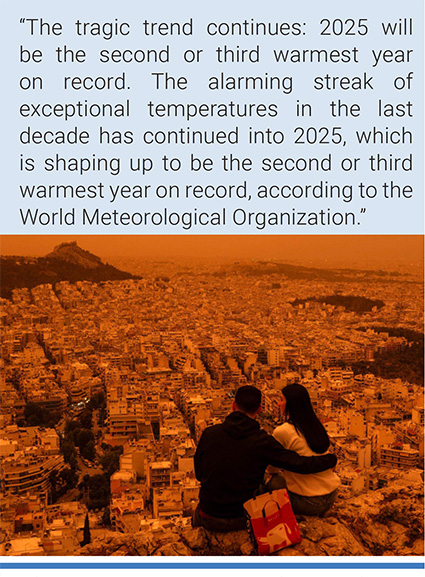
Meanwhile, many November 2025 media stories featured several scientific themes in news accounts. The timing of the publication of several scientific reports and findings threaded into political and economic dimensions of COP30 negotiations as well. For example, in coverage relating to a UN Emissions Gap report released in early November New York Times correspondent Brad Plumer noted, “Countries have made very slight headway in the fight against global warming over the past year by tightening their policies to limit emissions of carbon dioxide and other greenhouse gases, according to a United Nations report released Tuesday. But there’s a catch: Some of that modest progress in tackling climate change could end up being canceled in the years ahead as the United States dismantles its pollution controls and other climate policies under President Trump, the report said. The U.N.’s annual Emissions Gap Report measures the disparity between what world leaders have promised to do to limit the rise in global temperatures and what they are actually doing to rein in carbon dioxide and other planet-warming gases from fossil fuels and deforestation. It typically finds that this gap is very large. This year’s report is no exception: Based on policies that countries have put in place and current technology trends, Earth is expected to warm by roughly 2.8 degrees Celsius (5 degrees Fahrenheit) this century, compared with preindustrial levels. If countries followed through on all of their official promises to cut near-term emissions, warming could be limited to 2.3 degrees Celsius, though many nations are struggling to meet those pledges. Those temperature levels are considerably hotter than what nearly every country agreed to under the 2015 Paris climate agreement, in which leaders promised to hold global warming to “well below” 2 degrees Celsius, and preferably closer to 1.5 degrees, to reduce the risks from wildfires, droughts and other climate calamities. Even half a degree of additional warming could mean tens of millions more people worldwide exposed to dangerous heat waves, water shortages and coastal flooding, scientists have said. (The world has already warmed about 1.3 degrees since preindustrial times).”
As a second example, La Vanguardia journalists Juan Manuel Campos and Antonio Cerrillo wrote about a World Meteorological Organizations report and noted, “The tragic trend continues: 2025 will be the second or third warmest year on record. The alarming streak of exceptional temperatures in the last decade has continued into 2025, which is shaping up to be the second or third warmest year on record, according to the World Meteorological Organization (WMO). With this data, a tragic trend is confirmed: the last 11 years, from 2015 to 2025, will have been (each individually) the eleven warmest years in the 176 years of recorded observations, and the last three years have been the three warmest years ever recorded”.
A woman advocates for protecting the Amazon, outside the UB Climate Summit in Belém, Brazil. Photo: Fernando Llano/AP. |
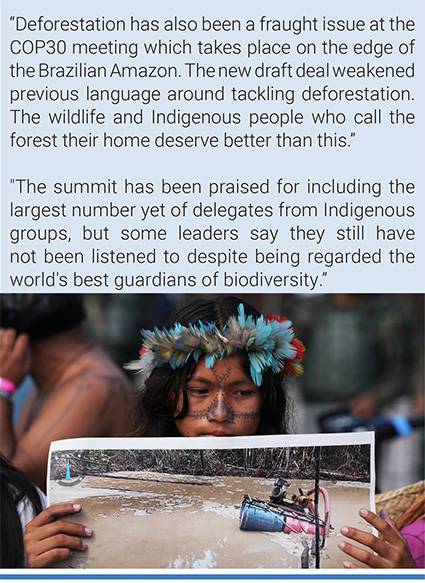
Similar to links between political and scientific stories in November, several media portrayals focused on cultural-themed stories relating to climate change or global warming and a subset of them focused on activities at and around COP30. For instance, BBC News correspondent Georgina Rannard reported, “A bitter row over fossil fuels has broken out at the COP30 UN climate talks in Belém, Brazil, as the meeting formally runs over time. At the heart of the row is a disagreement over how strong a deal should be on working to reduce the world's use of fossil fuels, whose emissions are by far the largest contributor to climate change. The dispute pits groups of countries against each other, but all 194 parties must agree in order to pass a deal at the two-week summit… Deforestation has also been a fraught issue at the meeting which takes place on the edge of the Brazilian Amazon. The new draft deal weakened previous language around tackling deforestation. "The wildlife and Indigenous people who call the forest their home deserve better than this," said Kelly Dent, Director of External Engagement for World Animal Protection. The two-week meeting has been interrupted by two evacuations. Last week a group of protesters broke in carrying signs reading "Our forests are not for sale". On Thursday, a fire broke out, burning a hole through the sheeting covering the venue and causing 13 smoke inhalation injuries. The summit was evacuated and closed for at least six hours. The summit has been praised for including the largest number yet of delegates from Indigenous groups, but some leaders say they still have not been listened to despite being regarded the world's best guardians of biodiversity.” As a second example, Washington Post journalists Jake Spring and Marina Dias wrote, “Brazil intended this year’s United Nations climate talks now underway in the Amazon rainforest, to be the capstone of President Luiz Inácio Lula da Silva’s effort to establish the country as a global environmental leader… Even Brazil, where Lula is extremely vocal about climate change, is struggling with putting environment as its top priority as it pushes ahead with oil drilling and takes steps to weaken conservation. Brazil has heaped high expectations on itself. Lula narrowly won election in 2022 over President Jair Bolsonaro, who dismantled Brazil’s environmental protections and threatened to leave the Paris agreement climate treaty. Left-wing Lula was hailed as an environmental savior at that year’s climate talks, with crowds following him around the venue in Egypt chanting his name, as he pushed for Brazil to host COP30 even before taking office. He also vowed to end deforestation in the country by 2030 and created the first Ministry of Indigenous Peoples”.

Figure 4. Examples of newspaper front pages with climate change stories in November 2025.
This aerial photo taken using drone shows a village affected y a flash flood in Batang Toru. North Sumatra, Indonesia. Photo: Binsar Bakkara/AP. |
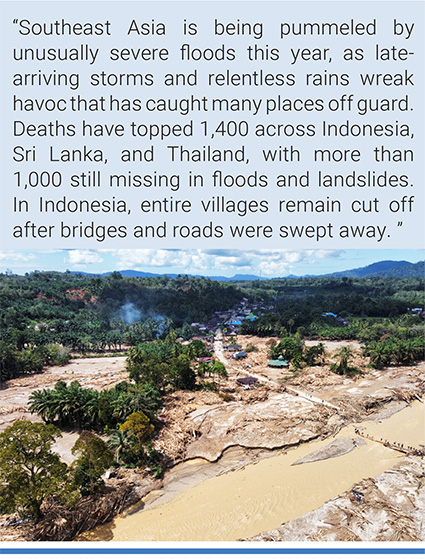
Yet, COP30 did not use up all the ink for climate change coverage in November. As an example of cultural stories not linked to COP30, CBC News reporter Brett Forester reported, the “assembly of First Nations chiefs voted unanimously on Tuesday to demand the withdrawal of a new pipeline deal between Canada and Alberta, while expressing full support for First Nations on the British Columbia coast that strongly oppose the initiative. Hundreds of First Nations leaders are gathered this week in Ottawa for their annual December meeting, where high on the agenda was the federal-provincial memorandum of understanding for a bitumen pipeline to Asian markets announced last week. The deal contemplates changing the federal ban on oil tanker traffic in northern B.C. waters, but AFN delegates responded by passing an emergency resolution affirming their support for the moratorium. "A pipeline to B.C.’s coast is nothing but a pipe dream," said Chief Donald Edgars of Old Massett Village Council in Haida Gwaii, who moved the resolution. The resolution also urges Canada, Alberta and B.C. to recognize the climate emergency and uphold the United Nations Declaration on the Rights of Indigenous Peoples.”
Last, there continued be many media stories relating to ecological and meteorological dimensions of climate change or global warming in November. To illustrate, early in the month the devastation wrought by Typhoons Fung-wong and Kalmaegi – with links made to a changing climate – generated media attention. For example, in early November CBS News reported, “Philippine President Ferdinand Marcos Jr. declared a state of emergency due to the extensive devastation caused by Kalmaegi and the expected damage from Fung-wong, which was also called Uwan in the Philippines…the Philippines is hit by about 20 typhoons and storms each year, but scientists have warned repeatedly that tropical storms are getting more powerful and less predictable due to human-driven climate change. Warmer seas enable typhoons to build into bigger storms more rapidly, and a warmer atmosphere holds more moisture, meaning tropical storm systems bring heavier rainfall.” As a second example, BBC News reporters Kathryn Armstrong, André Rhoden-Paul and Lulu Luo wrote, “The Philippines - located near the area where Pacific Ocean tropical weather systems form - is one of the most vulnerable countries in the world to cyclones. About 20 tropical cyclones form in that region every year, half of which affect the country directly. Climate change is not thought to increase the number of hurricanes, typhoons and cyclones worldwide. However, warmer oceans coupled with a warmer atmosphere - fueled by climate change - have the potential to make those that do form even more intense. That can potentially lead to higher wind speeds, heavier rainfall, and a greater risk of coastal flooding.” As another example, in later November Associated Press correspondents Aniruddha Ghosal and Anton L. Delgado wrote, “Southeast Asia is being pummeled by unusually severe floods this year, as late-arriving storms and relentless rains wreak havoc that has caught many places off guard. Deaths have topped 1,400 across Indonesia, Sri Lanka, and Thailand, with more than 1,000 still missing in floods and landslides. In Indonesia, entire villages remain cut off after bridges and roads were swept away. Thousands in Sri Lanka lack clean water, while Thailand’s prime minister acknowledged shortcomings in his government’s response. Malaysia is still reeling from one its worst floods, which killed three and displaced thousands. Meanwhile, Vietnam and the Philippines have faced a year of punishing storms and floods that have left hundreds dead. What feels unprecedented is exactly what climate scientists expect: A new normal of punishing storms, floods and devastation…Atmospheric levels of heat-trapping carbon dioxide jumped by the most on record in 2024. That “turbocharged” the climate, the United Nation’s World Meteorological Organization says, resulting in more extreme weather. Asia is bearing the brunt of such changes, warming nearly twice as fast as the global average. Scientists agree that the intensity and frequency of extreme weather events are increasing. Warmer ocean temperatures provide more energy for storms, making them stronger and wetter, while rising sea levels amplify storm surges, said Benjamin Horton, a professor of earth science at the City University of Hong Kong. Storms are arriving later in the year, one after another as climate change affects air and ocean currents, including systems like El Nino, which keeps ocean waters warmer for longer and extends the typhoon season. With more moisture in the air and changes in wind patterns, storms can form quickly.”
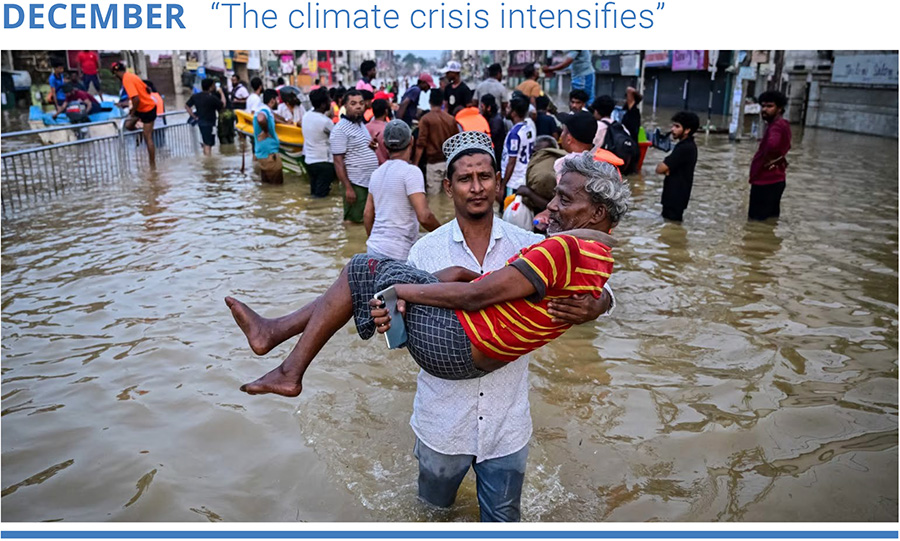
A youth carries an elderly man as they wade through a flooded street after heavy rainfall in Wellampitiya on the outskirts of Colombo. Photo: Ishara S. Kodikara/AFP/Getty Images.

December media coverage of climate change or global warming in newspapers around the globe plummeted 40% from November 2025. Moreover, coverage in December 2025 decreased 27% from December 2024 levels. Figure 1 shows trends in newspaper media coverage at the global scale – organized into seven geographical regions around the world – from January 2004 through December 2025. In particular, stories in Asian outlets in December 2025 went down 37% from November 2025 (Figure 2).
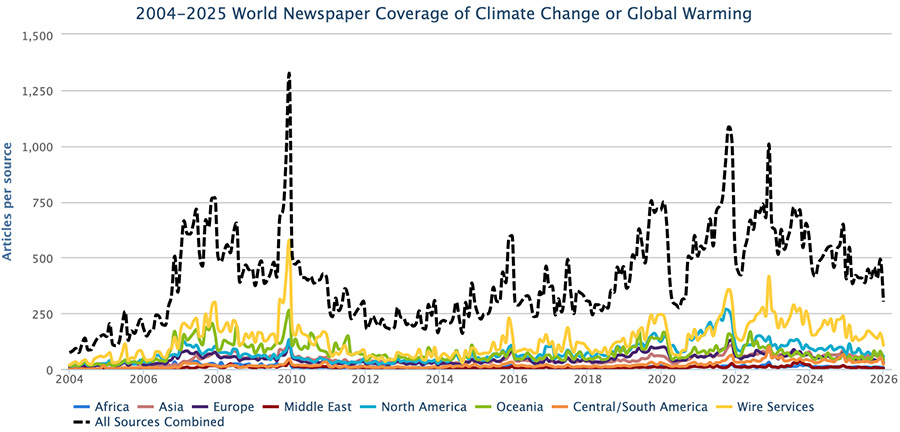
Figure 1. Newspaper media coverage of climate change or global warming in print sources in seven different regions around the world, from January 2004 through December 2025.
At the regional level, December 2025 coverage dropped in every region compared to November 2025: the Middle East (-17%), North America (-21%), Africa (-28%), Asia (-37%), the European Union (EU) (-41%), Oceania (-52%) and Latin America (-61%) compared to November 2025. As an example at the country level, coverage in Korean print newspapers – The Chosun Ilbo, Dong-a Ilbo, Maeil Business Newspaper, and Hankyoreh – decreased 68% from the previous month of November 2025 and was also 32% lower than coverage in December 2024.
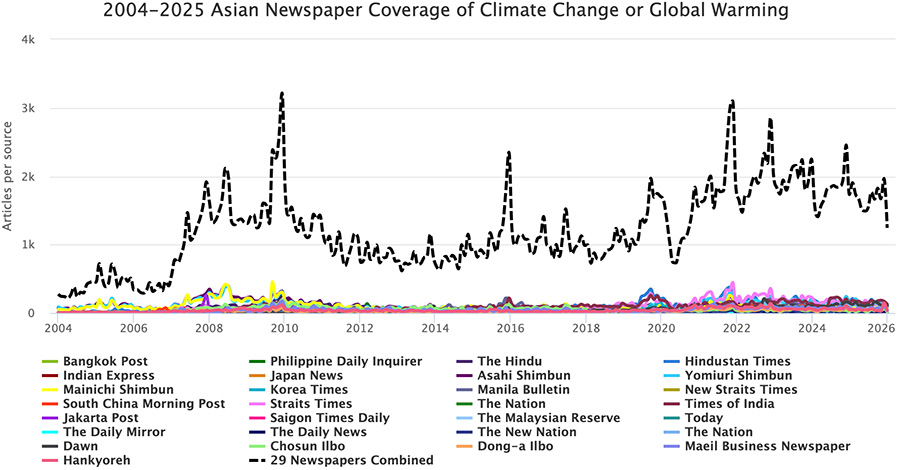
Figure 2. Asian print media coverage – in Bangkok Post (Thailand), Philippine Daily Inquirer (The Philippines), Hindu (India), Hindustan Times (India), Indian Express (India), Japan News (Japan), Asahi Shimbun (Japan), Yomiuri Shimbun (Japan), Mainichi Shimbun (Japan), Korea Times (South Korea), Manila Bulletin (Philippines), New Straits Times (Malaysia), South China Morning Post (China), Straits Times (Singapore), The Nation (Thailand), Times of India (India), Jakarta Post (Indonesia), Saigon Times Daily (Vietnam), The Malaysian Reserve (Malaysia), Today (Singapore), The Daily Mirror (Sri Lanka), The Daily News (Sri Lanka), The New Nation (Bangladesh), The Nation (Pakistan), Dawn (Pakistan), Chosun Ilbo (Korea), Dong-a Ilbo (Korea), Maeil Business Newspaper (Korea), Hankyoreh (Korea) – of climate change or global warming from January 2004 through December 2025.
Examining the content of news coverage in December 2025, numerous media portrayals focused on cultural-themed stories relating to climate change or global warming. For instance, the proliferation of AI data centers has generated news attention along several angles. For example, Guardian reporter Ajit Niranjan wrote, “Datacentres, AI gigafactories and affordable housing may be exempt from mandatory environmental impact assessments in the EU under a proposal that advances the European Commission’s rollback of green rules. The latest in a series of packages to cut red tape calls for permitting processes for critical projects to be sped up and reducing the scope of environmental reporting rules for businesses. The proposed overhaul would expand the list of strategic sectors to count datacentres, in line with the EU’s ambitions to become a global leader in AI, and affordable housing, to improve labour mobility. Member states would be free to decide whether such projects should be subject to environmental impact assessments. Other parts of the simplification plan include repealing a hazardous chemical database that lists “substances of concern in products”; removing requirements on EU polluters to have authorised representatives in member states where they sell their products; and pushing the need for environmental management systems in farms and industry from the level of plants to that of companies”. Meanwhile, New York Times reporters Ivan Penn and Karen Weise noted, “Three Democratic senators said on Tuesday that they are investigating whether and how the operations of technology companies are driving up residential electricity bills. In letters sent on Monday to Google, Microsoft, Amazon, Meta and three other companies, the lawmakers said the energy needs of data centers used for artificial intelligence were forcing utilities to spend billions of dollars to upgrade the power grid. Energy companies typically recoup the money they invest in equipment through the rates they charge all users of electricity. The senators — Elizabeth Warren of Massachusetts, Chris Van Hollen of Maryland and Richard Blumenthal of Connecticut — said they were concerned that customers other than the tech companies would be stuck footing the bill, especially if the A.I. boom ended. “We write in light of alarming reports that tech companies are passing on the costs of building and operating their data centers to ordinary Americans as A.I. data centers’ energy usage has caused residential electricity bills to skyrocket in nearby communities,” the senators said…The biggest tech companies have consistently said they want to pay their fair share of energy costs and in some states have brokered deals with utilities to try to do so. But there is little consensus about exactly how much they should pay. Contracts between data centers and utility companies are almost always confidential, leaving the public in the dark on why electric bills have risen. The lawmakers, who are seeking responses by Jan. 12, cited an article in The New York Times in August that detailed the tech companies’ growing role in the electricity business and their impact on energy costs. Many forces are causing electricity rates to increase, including the replacement of old plants and hardening of power lines against wildfires. But data centers are a particularly hot-button issue given how much their demand is expected to grow. Concern about rising electricity rates has emerged as a leading economic and political issue. Rising electricity prices played a big role in recent elections, including statewide races in Georgia, New Jersey and Virginia”.

Figure 3. Examples of newspaper front pages with climate change stories in December 2025.
NCAR's Mesa Laboratory, in Boulder, CO. The Trump administration announced that it intends to shut down this facility and break up NCAR. Photo: John Greim/LightRocket/Getty Images. |
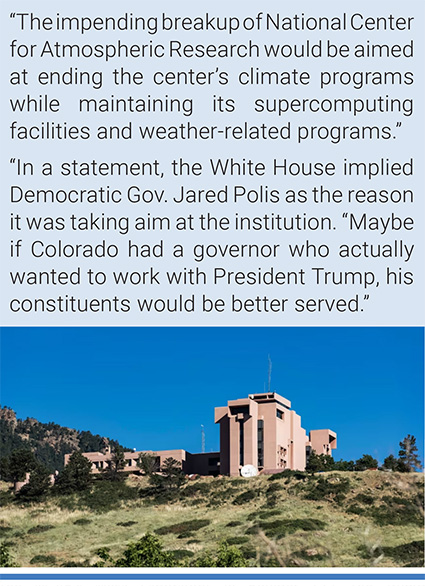
Meanwhile, many December 2025 media stories featured several scientific themes in news accounts. Among these stories, the Trump Administration’s threat to close the Boulder-based National Center for Atmospheric Research garnered attention in US and international news outlets in December. For example, CNN correspondent Andrew Freedman reported, “Stress balls were the swag item of choice at the National Center for Atmospheric Research’s booth Wednesday morning, during the world’s largest gathering of climate scientists. NCAR representatives came to this meeting — the convention of the American Geophysical Union — to talk about their research, which is crucial to the climate and weather community. Instead, they’ve ended up fielding questions about Trump administration plans to break up this Boulder, Colorado-based center, which conducts research and maintains supercomputing facilities on behalf of the government and 129 colleges and universities in the United States and Canada. The impending breakup of NCAR, first reported by USA Today and announced on X Tuesday night by OMB director Russ Vought, would be aimed at ending the center’s climate programs while maintaining its supercomputing facilities and weather-related programs. In his post on X, Vought called the center “one of the largest sources of climate alarmism in the country.” But in a statement, the White House implied Democratic Gov. Jared Polis as the reason it was taking aim at the institution. “Maybe if Colorado had a governor who actually wanted to work with President Trump, his constituents would be better served,” a White House spokesperson told CNN. President Donald Trump has attacked Colorado Gov. Jared Polis in comments and on social media over the governor’s refusal to release Tina Peters, a former election official and prominent 2020 election denier, from prison. Peters, the former Republican clerk of Mesa, Colorado, was found guilty last year on state charges of participating in a criminal scheme with fellow election deniers to breach her county’s secure voting systems, in hopes of proving Trump’s false claims of massive fraud. She was sentenced to nine years in prison and is serving her sentence at a women’s prison in Pueblo, Colorado”. Meanwhile, Washington Post journalists Ruby Mellen and Carolyn Y. Johnson noted, “The Trump administration said Tuesday it was breaking up one of the world’s preeminent Earth and atmospheric research institutions, based in Colorado, over concerns about “climate alarmism” — a move that comes amid escalating attacks from the White House against the state’s Democratic lawmakers… The NCAR laboratory in Boulder was founded in 1960 at the base of the Rocky Mountains to conduct research and educate future scientists. Its resources include supercomputers, valuable datasets and high-tech research planes. The announcement drew outrage and concern from scientists and local lawmakers, who said it could imperil the country’s weather and climate forecasting, and appeared to take officials and employees by surprise”.
The orange tributary of the Kugororuk River in Alaska is an example of a "rusting river." Photo: Josh Koch/U.S. Geological Survey. |
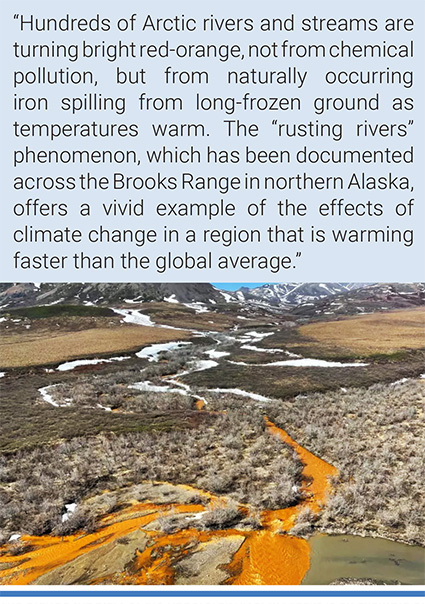
In December, the release of the Arctic Report Card published by researchers at the US National Oceanic and Atmospheric Administration (NOAA) earned media attention. For example, National Public Radio correspondent Barbara Moran reported, “Hundreds of Arctic rivers and streams are turning bright red-orange, not from chemical pollution, but from naturally occurring iron spilling from long-frozen ground as temperatures warm. The "rusting rivers" phenomenon, which has been documented across the Brooks Range in northern Alaska, offers a vivid example of the effects of climate change in a region that is warming faster than the global average. The finding was reported in the National Oceanic and Atmospheric Administration's annual Arctic Report Card, released Tuesday. NOAA has released the report for 20 years as a way to track rapid changes in the northernmost part of the planet. Those decades have seen rapid environmental change in the region. The most recent year was the warmest and wettest in the Arctic's recorded history, said Matthew Druckenmiller, a senior scientist at the National Snow and Ice Data Center, in Boulder, Colorado, and lead editor of this year's report card. He said Arctic warming influences global sea-level rise, weather patterns, and commercial fisheries”.
Next, there continued be many media stories relating to ecological and meteorological dimensions of climate change or global warming in December. Heavy flood events in Asia linked to climate change generated news interest. For example, CNN correspondent Helen Regan wrote, “Looking at the weather map on his computer and seeing three tropical storms forming simultaneously across Asia in late November, climatologist Fredolin Tangang’s first thoughts drifted to the 2004 disaster movie “The Day After Tomorrow.” The film, in which three massive storms plunge the earth into a new ice age, goes beyond the realms of reality. But there was something about the formation of these weather systems swirling across his screen that made Tangang sit up. They were not the strongest storms this year. But they were “unusual,” said Tangang, emeritus professor at the National University of Malaysia. One was churning near the equator off the coast Indonesia – an area where storms rarely take shape because the planet’s spin is too weak there to whip them into existence. Another was tracking for parts of Sri Lanka that are rarely hit by tropical storms. The third was late in the season, and on course to dump yet more rain on already soaked terrain in Vietnam and the Philippines. “You realize this is like a monster,” Tangang said. The cyclonic storms went on to unleash torrential rains and catastrophic flooding – including, in one area, the second-wettest day recorded anywhere in history – across swathes of South and Southeast Asia. They killed more than 1,700 people, according to a CNN tally from disaster agencies’ figures. Multiple countries are struggling to recover from their worst flooding in decades. Hundreds of people remain missing – likely washed away in rapid torrents of floodwater or buried beneath thick mud and debris. The region is used to monsoon rains and frequent flooding, but the enormity of the human toll and level of destruction have shocked many, with scientists warning that, as the climate crisis intensifies, more intense extreme weather events will become the new normal”. Elsewhere, CBS News reported, “The toll in deadly flooding and landslides across parts of Asia climbed past 1,000 on Monday as hardest-hit Sri Lanka and Indonesia deployed military personnel to help survivors. Separate weather systems brought torrential, extended rainfall to the entire island of Sri Lanka and large parts of Indonesia's Sumatra, southern Thailand and northern Malaysia last week. Much of the region is currently in its monsoon season but scientists say climate change is producing more extreme rain events, and turbocharging storms across the planet”.
Satellite images from Planet Labs shows flooding in north eastern Aceh on Indonesia's Sumatra island on September 6, 2025 (top) and November 30, 2025 (bottom). Credit: Planet Labs PBC. |
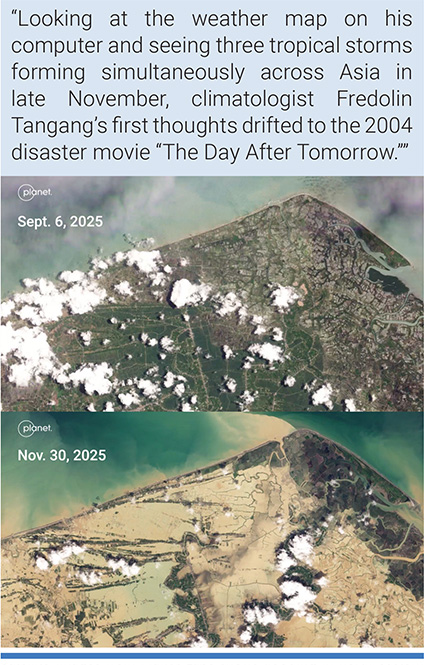
Meanwhile, El Mundo journalist Luis de la Cal wrote, “On the island of Sumatra, in Indonesia, some communities have been literally wiped off the map by floods: dirt roads turned into mud pits, isolated villages, pools of mud where homes once stood. In southern Thailand, images taken from helicopters show children clinging to their parents on rooftops, waiting to be rescued as the water swept away everything around them. Similar scenes were repeated in the low-lying areas of Colombo, the capital of Sri Lanka. A wave of torrential rains, tropical cyclones, and landslides has mercilessly battered vast areas of South and Southeast Asia. The result marks one of the worst natural disasters in the region in recent decades: according to official figures, more than 1,100 people have died. There are hundreds missing and millions displaced. Sri Lanka and Indonesia deployed military personnel yesterday to help the victims…An accumulation of extreme phenomena that, according to experts, is the result of a convergence of unusual weather systems (several cyclones at the same time) and the amplifying effect of climate change.” Concurrently, La Vanguardia journalist Antonio Cerrillo noted, “The economic damage caused this year worldwide by heat waves, wildfires, droughts, and storms has added up to a hefty bill. The ten most significant climate disasters alone have cost the world $122 billion (€103.5 billion), according to a report by the organization Christian Aid. Climate change made the disasters of 2025 even more devastating. The authors of the report conclude that climate change is significantly intensifying extreme weather events worldwide, increasing both their intensity and their cost in terms of lives lost, livelihoods destroyed, and economies damaged.”
Last, in December there were several political and economic-themed media stories about climate change or global warming. To illustrate, the United Nations Environment Program (UNEP) Global Environment Outlook generated media attention at the start of the month. For example, Associated Press correspondent Tammy Weber reported, “The most comprehensive global environment assessment ever undertaken calls for a new approach to jointly tackle the most pressing environmental issues including climate change and biodiversity loss that threaten over 1 million plant and animal species with extinction. The U.N. Environment Assembly — which the U.S. government didn’t attend — produced the new report this week by almost 300 scientists from 83 countries. The issues, which also include land degradation and pollution, are inextricably linked and require solutions that include increased spending and financial incentives to transition away from fossil fuels, encourage sustainable agricultural practices, curb pollution and limit waste, the authors of the U.N. Environment Programme’s Global Environment Outlook said”. As a second example, BBC News reporter Matt McGrath noted, “UN environment report 'hijacked' by US and others over fossil fuels, top scientist says”.

Figure 4. Examples of newspaper front pages with the Asian region of climate change and flooding stories in December 2025.
President Trump, surrounded by executives from the auto industry, in the Oval Office.Photo: Doug Mills/The New York Times. |
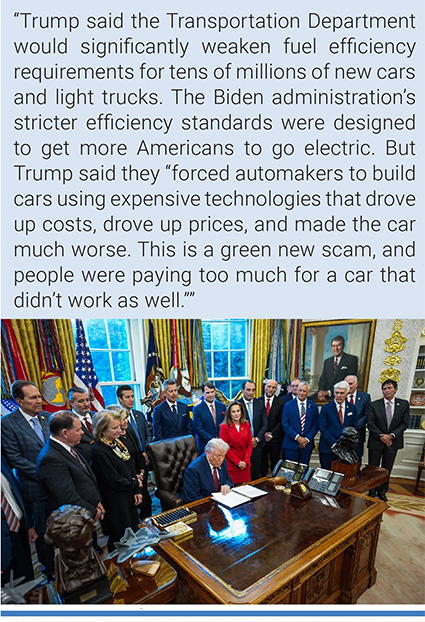
In December, the US Trump Administration actions continued to make news. For example, New York Times journalists Lisa Friedman, Maxine Joselow and Jack Ewing reported, “President Trump on Wednesday threw the weight of the federal government behind vehicles that burn gasoline rather than electric cars, gutting one of the country’s most significant efforts to address climate change and thrusting the automobile industry into greater uncertainty. Flanked by executives from major automakers in the Oval Office, Mr. Trump said the Transportation Department would significantly weaken fuel efficiency requirements for tens of millions of new cars and light trucks. The administration claimed the changes would save Americans $109 billion over five years and shave $1,000 off the average cost of a new car. The Biden administration’s stricter efficiency standards were designed to get more Americans to go electric. But Mr. Trump said they “forced automakers to build cars using expensive technologies that drove up costs, drove up prices, and made the car much worse. This is a green new scam, and people were paying too much for a car that didn’t work as well.” For the past half-century, the efficiency standards have compelled automakers to increase the distance their vehicles can travel on a gallon of gas, reducing fuel consumption and leading to innovations like electric and hybrid cars. The announcement on Wednesday was the second part of a one-two punch against policies promoting electric cars, a central pillar of President Joseph R. Biden Jr.’s strategy for fighting climate change. Transportation is the largest source of greenhouse gases in the United States, and Mr. Biden had adopted a carrot-and-stick approach to reducing these emissions. He offered tax credits to encourage motorists to buy electric cars while requiring that automakers meet stringent fuel efficiency standards to pressure them to sell more nonpolluting models. Mr. Trump and the Republican-controlled Congress got rid of the tax credits earlier this year. They also eliminated fines for automakers who violate the fuel efficiency standards. And now the standards themselves will be watered down. While auto executives publicly praised the announcement, they have privately fretted that they are being buffeted by conflicting federal policies. During the Biden administration, they invested billions of dollars and reoriented their manufacturing to produce electric vehicles and batteries. Now the Trump administration’s tariffs on steel and imported car parts have lopped billions of dollars from carmakers’ bottom lines while disrupting supply chains. Inflation has also made it difficult for many people to afford new cars”. Then, Guardian journalist Oliver Milman reviewed ‘Trump’s startling claims of 2025’ noting, “In the past decade at the forefront of US politics, Donald Trump has unleashed a barrage of unusual, misleading or dubious assertions about the climate crisis, which he most famously called a “hoax”. This year has seen Trump ratchet up his often questionable claims about the environment and how to deal, if at all, with the threats to it”.
Electric vehicles at a BMW factory in Munich. Premier automakers like BMW will benefit if an emission ban in Europe is rolled back. Photo: Laetitia Vancon/The New York Times. |
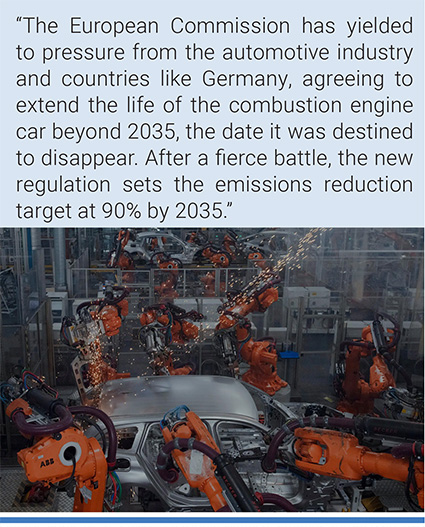
In Europe, European Union debates over the discontinuation of internal combustion engine vehicles continued and media coverage followed it. For example, the newspaper El País treated it as its main front-page story where journalist Manuel V. Gómez wrote, “The European Commission has yielded to pressure from the automotive industry and countries like Germany, agreeing to extend the life of the combustion engine car beyond 2035, the date it was destined to disappear. After a fierce battle, the new regulation sets the emissions reduction target at 90% by 2035, which benefits plug-in hybrids. Stéphane Séjourné, Vice-President of the Commission and the EU's top industrial strategy official, asserted that this decision does not call into question "the decarbonization objectives," but reminded everyone that the sector "is mortally wounded" by China's "unfair competition" with electric cars.”
Meanwhile, Exxon Mobil announced plans to cut spending by 33% on low-carbon projects and that earned media attention. For example, Wall Street Journal correspondent Adriano Marchese reported, “Exxon Mobil expects higher earnings and cash flow through the end of the decade, driven by stronger assets, a more profitable business mix, and lower costs from its multiyear transformation. The energy-and-petrochemical company on Tuesday raised its outlook to $25 billion in earnings growth and $35 billion in cash flow growth from 2024 to 2030, a $5 billion improvement in both metrics compared with its prior forecasts. Earnings growth is projected to average 13% per year through 2030, with double-digit cash-flow growth, while share repurchases are expected to drive per-share growth higher, the company said”.

Report citation: Boykoff, M., Fernández-Reyes, Nacu-Schmidt, A., Osborne-Gowey, J. and Pearman, O. (2026). A Review of Media Coverage of Climate Change and Global Warming in 2025, Media and Climate Change Observatory, Cooperative Institute for Research in Environmental Sciences and SPIKE Center for Sustainability Education, University of Colorado. [https://mecco.colorado.edu/summaries/special_issue_2025.html] |