Monthly Summaries
Issue 112, April 2026 | "The electrostates of the future v the petrostates of the past”
[DOI]
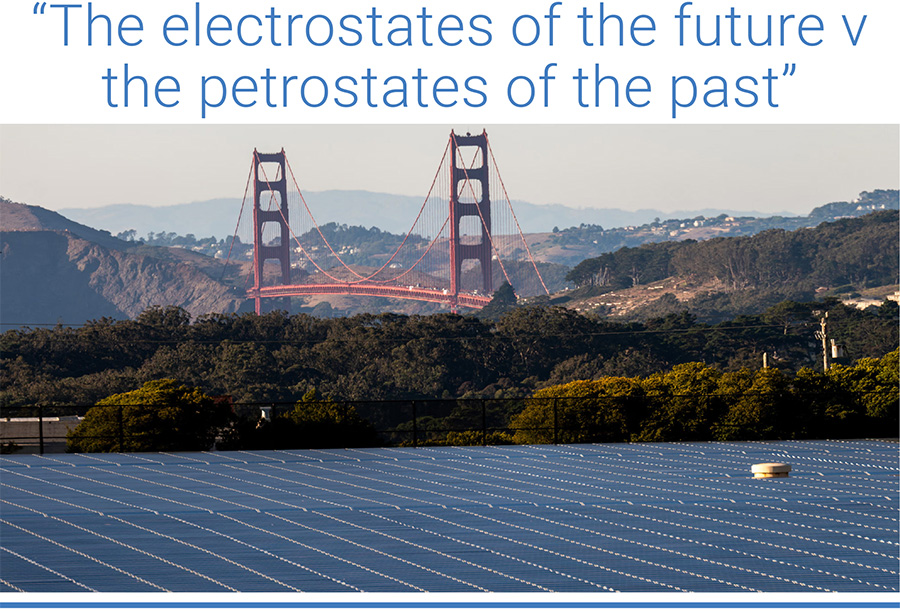
A solar farm in San Francisco, California. The state now generates two-thirds of its electricity from low-carbon sources. Photo: David Paul Morris/Bloomberg via Getty Images.
April media coverage of climate change or global warming in newspapers around the globe rebounded, going back up 4% from March 2026. Yet, coverage in April 2026 was 33% lower than in April 2025. Figure 1 shows trends in newspaper media coverage at the global scale – organized into seven geographical regions around the world – across 22 years, from January 2004 through April 2026.

Figure 1. Newspaper media coverage of climate change or global warming in print sources in seven different regions around the world, from January 2004 through April 2026.
At the regional level, April 2026 coverage decreased in Oceania (-2%) and in Africa (-16%), and remained largely the same in North America (up just 0.5%) but otherwise went up in all other regions: Asia (+3%), the European Union (EU) (+9%), Latin America (+11%), and the Middle East (+67%) (see Figure 2). Yet, a comparison of April 2026 to April 2025, levels of coverage remains diminished in 2026: Oceania (-2%), Asia (-28%), Latin America (-30%), the EU (-34%), North America (-43%), Africa (-53%), and the Middle East (-65%).
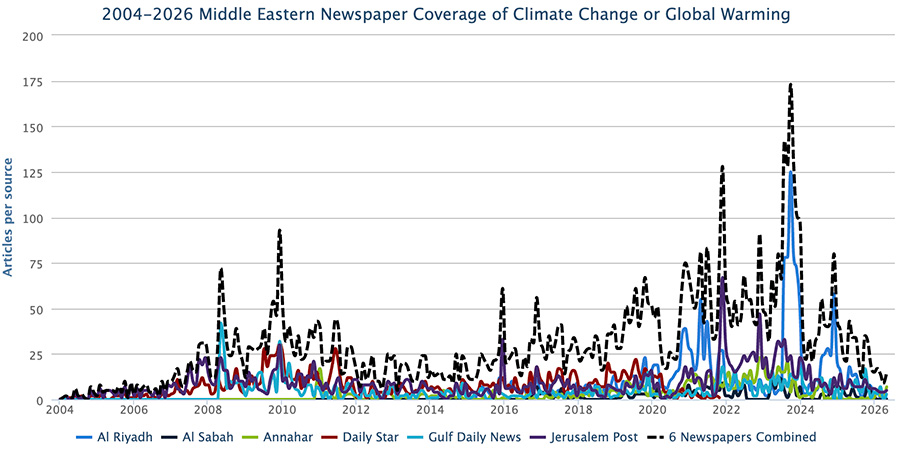
Figure 2. Coverage of climate change or global warming in 6 newspapers in the Middle East from January 2000 through April 2026: Al Riyadh, (Saudi Arabia), Al Sabah (Iraq), Annahar (Lebanon), Daily Star (Lebanon), Gulf Daily News (Bahrain), Jerusalem Post (Israel).
Among our country-level monitoring, in April US print coverage dipped 8% from March 2026 levels of coverage. Yet US television coverage increased 23% in April, compared to March 2026 (see Figure 3).
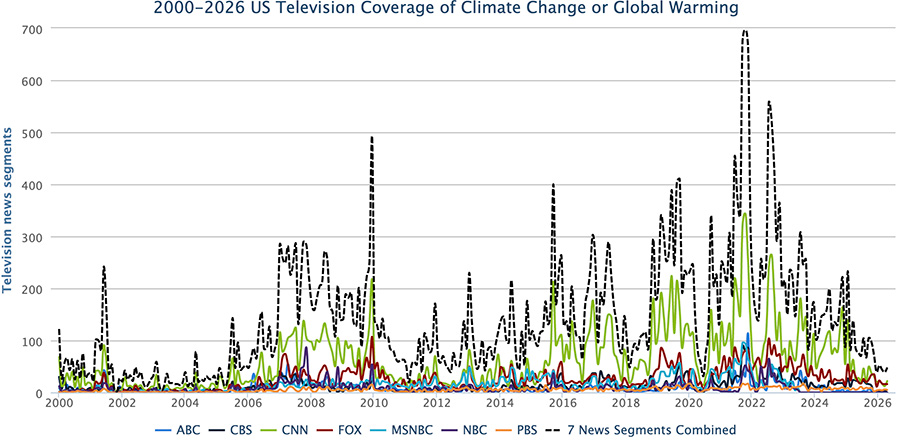
Figure 3. US television coverage of climate change or global warming from January 2000 through April 2026.
The Petron oil refinery in the Philippines, which received crude oil from Russia as countries scramble for alternatives to disrupted Middle Eastern supplies. Photo: Ezra Acayan/Getty Images. |

Moving to content, again in April political and economic-themed media stories about climate change or global warming dominated attention in various outlets. The war in Iran and the choking of transport in the Strait of Hormuz – with some links made to climate change – was at the center of attention. For example, Guardian journalist Fiona Harvey wrote, “The impact of the US-Israel war on Iran – the third global shock in six years, after Russia’s full-scale invasion of Ukraine and the Covid-19 pandemic – has laid bare how reliant our economies still are on fossil fuels. Simon Stiell, the UN climate chief, said in March: “Fossil fuel dependency is ripping away national security and sovereignty and replacing it with subservience and rising costs.” In the past year, the Guardian has examined the 10 countries most responsible for greenhouse gas emissions. They divide broadly into two camps: those wedded to fossil fuels and determined to wring every last drop from them; and those pursuing a low-carbon future to remove the yoke of oil dependence and stave off climate catastrophe. They are the vanguard of a global realignment: the electrostates of the future v the petrostates of the past. “We are at the dawn of the electrostates versus petrostates, and electricity is the holy grail right now for everybody,” John Kerry, the former US secretary of state, said in an interview with the Guardian. “The future is being able to harness the power of electrons and send them where we need them, and use them where and when we need them.” The Iran war has thrown the divergence into sharp relief and shown which of the 10 biggest emitters can expect to emerge stronger from the crisis. Global trends already favoured renewables: last year, the amount of electricity generated from low-carbon sources overtook that produced from coal for the first time. Investment in clean energy now outstrips that into fossil fuels by two to one. Coal-fired power generation fell in China and India for the first time since the 1970s. But the war in Iran, and the Ukraine war before it, have also exposed a sobering reality. Many of the world’s most powerful countries and biggest emitters are beneficiaries of high fossil fuel prices. The US oil and gas sector is set for a $60bn windfall from the war; soaring commodity prices have been a lifeline for Russia, whose economy was floundering under the strain of maintaining war in Ukraine but which has now had some sanctions lifted; Saudi Arabia has been struck by Iranian missiles and was forced to shut its biggest refinery but the share price of its national oil company, Aramco, has surged and its easily accessible reserves are reaping bumper returns. Iran’s oil revenues have increased, despite attacks on its infrastructure that have sent toxic acid rain pouring down on its people. High prices boost petrostates, generating bonanzas they can pour into further expanding their hydrocarbon extraction”.
Elsewhere, stories circulated about how 50 countries gathered in Colombia to negotiate a pact to gradually abandon fossil fuels. For example, La Vanguardia journalist Antonio Cerrillo wrote, “The summit in Santa Marta, Colombia, with the participation of more than 50 countries, has begun its deliberations with the intention of fostering collaboration in the search for solutions that will allow us to move beyond dependence on fossil fuels. The conference, organized by the governments of Colombia and the Netherlands, emerges as an alternative meeting following the resounding failures of the last UN climate conferences. One of its objectives is to accelerate the transition to renewable energy sources that are alternatives to oil, gas, and coal. (...) The conference can serve as a basis for formally recognizing the urgent need to negotiate a new international instrument on fossil fuels that establishes binding obligations, addresses the significant governance shortcomings of existing frameworks, and creates the necessary financial and legal structure for a just global transition that allows us to abandon coal, oil, and gas”.
Workers install a solar park in the Ningxia Autonomous Region, China. Photo: VCG via Getty Images. |

Political and economic news in April also discussed how renewables had continued to outperform coal in electricity production. For example, El País journalist Manuel Planelles noted, “A report points to the rise of solar energy as the engine of an era of clean growth worldwide. For the first time in over 100 years, electricity generation from renewable sources—primarily solar, wind, and hydroelectric—surpassed coal-fired power in 2025. Coal is the fossil fuel that contributes most to climate change. This is one of the key findings of the seventh edition of the annual Global Electricity Review, published by the British analyst group Ember. The report is based on data from 91 countries that account for 93% of global electricity demand. Renewables accounted for 33.8% of global electricity production last year, thanks largely to the rapid and continuous growth of solar generation, and to a lesser extent, wind power. Meanwhile, electricity generated from coal fell by 0.6%, retaining a 33% market share. For the first time in history, coal covered less than a third of power generation, the same analysis highlights”.
Next, there were also several media stories that focused on ecological and meteorological themes in April. For example, Washington Post correspondents Matthew Cappucci and Ben Noll wrote, “Super Typhoon Sinlaku was nearing the Northern Mariana Islands…The storm, which became the planet’s strongest since Hurricane Melissa hit Jamaica in October, had weakened slightly from its Category 5-equivalent status early Monday, when it had winds of 170 mph. It was still an “extremely dangerous super typhoon,” according to the National Weather Service. About 110 miles southwest of the storm’s eye, Guam reported a maximum wind gust of 84 mph early Tuesday. In Saipan, capital of the Northern Mariana Islands, which is expected to take a direct hit, winds were gusting to 108 mph. A typhoon warning was in place for Saipan, Rota and Tinian — also part of the Northern Mariana Islands, a U.S. commonwealth in the Western Pacific home to about 50,000 people. Sinlaku is expected to track near or directly over Tinian or Saipan on Tuesday, with considerable but slightly lesser impacts on Rota and Guam to the southwest. It is unusually early for a super typhoon in the western North Pacific and could be a sign of what’s to come this season. The season is expected to be anomalously active because of a burgeoning El Niño, which induces a warming of water temperatures. That helps air to rise, generating more, and stronger, storms”.
A Heatwave during the past summer in Madrid. Photo: Elena Iriba, El Mundo. |

As a second example, there was news about Europe warming twice as fast as the rest of the world. For example, El Mundo journalist Ricardo F. Colmenero wrote, “Europe continues to warm. Less snow, less ice, more heat waves, more drought, and record temperatures affecting areas from the Arctic to the Mediterranean. These are the main conclusions of the State of the Climate in Europe 2025 (ESOTC) report, prepared by the European Centre for Medium-Range Weather Forecasts, which manages the Copernicus Climate Change Service, and the World Meteorological Organization. The data show that 95% of the continent recorded higher annual temperatures than the previous year, and that river flows were below average for 11 months. The diagnosis confirms an increasingly evident trend: Europe remains one of the fastest-warming continents on the planet. 2025 was its third warmest year since records began, with an average temperature of 10.41 degrees, that is, 1.17 degrees above the average for the period 1991-2020”.
Several April 2026 stories drew on primarily scientific themes when reporting on climate change or global warming. To illustrate, ABC News (Australia)correspondent Tom Saunders reported, “The disparity is due to the natural variability of weather along with the influence of other climate drivers like the Indian and Southern Ocean — the 2023 El Niño is a classic example where the country's driest August to October on record suddenly turned into a wetter than normal November and December due to a totally unrelated prolonged hole in the ozone layer above Antarctica…. Precisely how the year's weather unfolds is uncertain. However, considering the potential strength of El Niño, along with a possible dry phase of the Indian Ocean and the background influence of climate change, it would come as no surprise to see widespread records falling in the next 12 months”.
The view of home from the other side of the moon. Photo: NASA. |
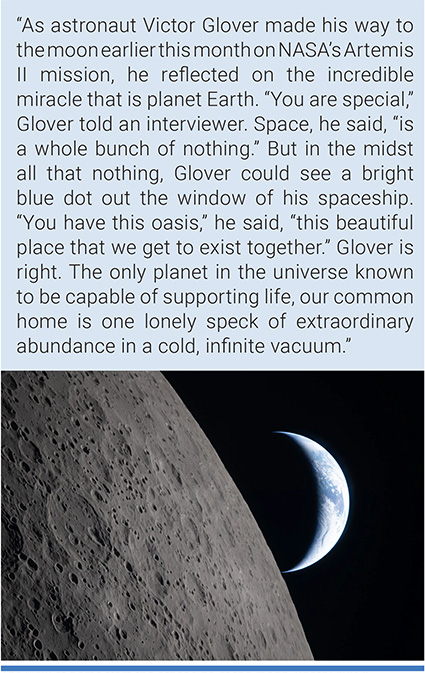
Last, cultural-themed stories relating to climate change or global warming cropped up throughout the month. For example, reflecting on Earth Day (April 22) New York Times journalist David Gelles noted, “As astronaut Victor Glover made his way to the moon earlier this month on NASA’s Artemis II mission, he reflected on the incredible miracle that is planet Earth. “You are special,” Glover told an interviewer. Space, he said, “is a whole bunch of nothing.” But in the midst all that nothing, Glover could see a bright blue dot out the window of his spaceship. “You have this oasis,” he said, “this beautiful place that we get to exist together.” Glover is right. The only planet in the universe known to be capable of supporting life, our common home is one lonely speck of extraordinary abundance in a cold, infinite vacuum. On the climate and environment team at The Times, we spend a lot of time documenting the myriad ways in which human activity is wreaking havoc on Earth’s ecosystems. And there’s no question it’s been another tough year for the planet. Temperatures keep rising. Biodiversity loss is increasing. The United States has withdrawn from global action against climate change. But ahead of Earth Day tomorrow, we also wanted to highlight some of the many things that are going right in the push to slow global warming and protect the planet….Curbing climate change will require replacing substantially all of the energy produced by fossil fuels with energy produced by clean sources, like solar and wind power. And on this front, there’s much to celebrate. While the growth of clean power has slowed in the United States as a result of the Trump administration’s policies, the adoption of renewable and low-carbon energy sources is booming around the world. For the first time, a renewable source — solar — was the biggest single contributor to new energy supply worldwide, accounting for more than 25 percent of energy growth last year, according to data released this week by the International Energy Agency. Globally, electric car sales jumped 20 percent last year, to more than 20 million vehicles. And installations of new wind energy jumped 40 percent over last year with more than 160 gigawatts installed in 2025”.

Figure 4. Examples of newspaper front pages with climate change stories in April 2026.
- report prepared by Max Boykoff, Rogelio Fernández-Reyes, Lucy McAllister, Ami Nacu-Schmidt, Jeremiah Osborne-Gowey and Olivia Pearman