Monthly Summaries
Issue 118, October 2026 | "We procrastinated"
[PDF]
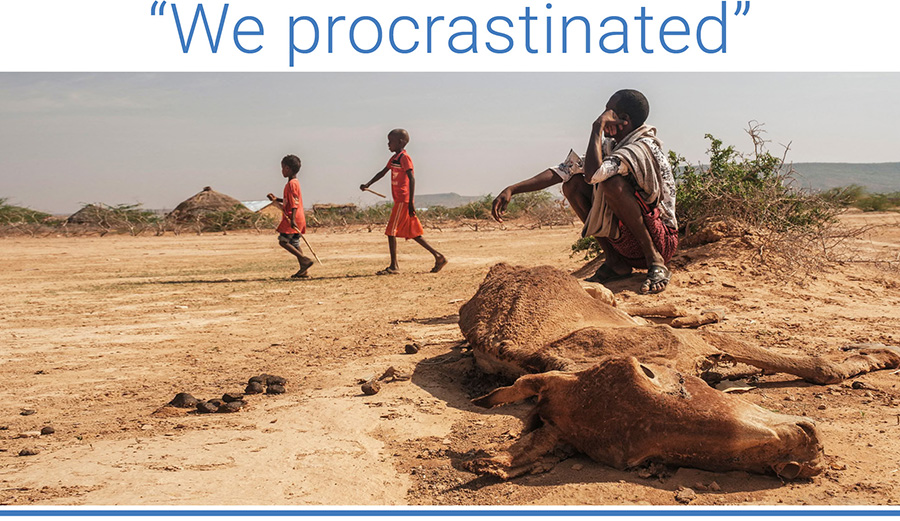
A man sits next to the carcass of a dead cow in Hargududo, Ethiopia. Photo credit: Eduardo Soteras/AFP/Getty Images.
October media coverage of climate change or global warming in newspapers around the globe dropped 5% from September, continuing a pattern of diminished monthly coverage since July. Yet international wire coverage increased 18% in October 2026 from the previous month, and remained 19% higher than a year ago. Overall, coverage in 2026 continues to on trend of less frequent coverage from levels 2025. Comparing the first ten months of 2026 to the first ten months of 2025, coverage has gone down 24%. Meanwhile, frequency of coverage in October 2026 was 15% lower than in October 2025. Figure 1 shows trends in newspaper media coverage at the global scale – organized into seven geographical regions around the world – across 225/6 years, from January 2004 through October 2026.
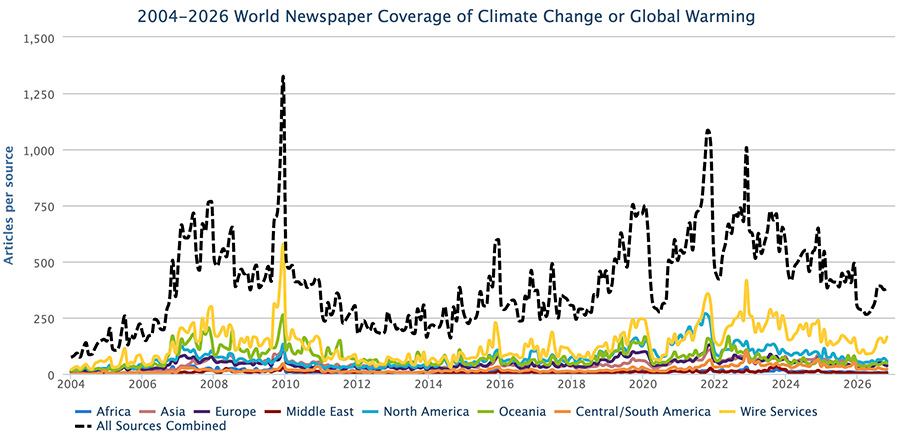
Figure 1. Newspaper media coverage of climate change or global warming in print sources in seven different regions around the world, from January 2004 through October 2026.
October 2026 coverage rose in Latin America (up [+]6%), Africa (+55%) and in the Middle East (+82%) but dropped in the other regions: Oceania (down [-]5%), Asia (-8%), the European Union (EU) (-12%), North America (-20%), Africa (-27%), and Latin America (-40%). A comparison of October 2026 to October 2025 finds levels of coverage down everywhere: the EU (-7%), the Middle East (-35%), Oceania (-15%), North America (-15%), Asia (-23%), and Africa (-16%). Figure 2 shows trends in newspaper media coverage in Central/South America across 223/4 years, from January 2005 through October 2026.
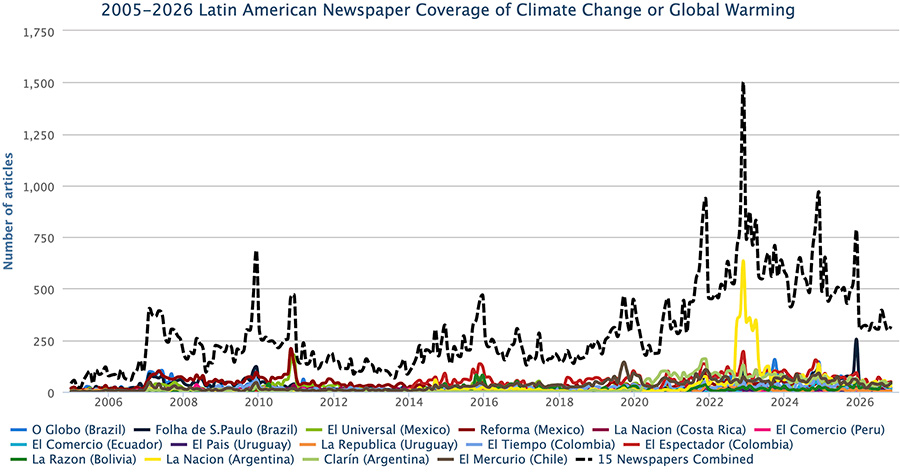
Figure 2. Coverage of climate change or global warming in Central/South America from January 2005 through October 2026 in El Universal (México), Reforma (México), La Nación (Costa Rica), El Comercio (Perú), El Comercio (Ecuador), El País (Uruguay), La República (Uruguay), El Tiempo (Colombia), El Espectador (Colombia), La Razón (Bolivia), O'Globo (Brasil), Folha de S.Paulo (Brazil), La Nación (Argentina), Clarín (Argentina) and El Mercurio (Chile).
Among our country-level monitoring, in October United States (US) print coverage dipped 16% from September 2026. US television coverage decreased 33% from September 2026 and was 22% lower than in October 2025. Figure 3 shows trends in US newspaper coverage across 263/4 years, from January 2000 through October 2026. Coverage in the UK (BBC) and France (RFI) moved the other way, rising 5% from September and 10% compared with October 2025.
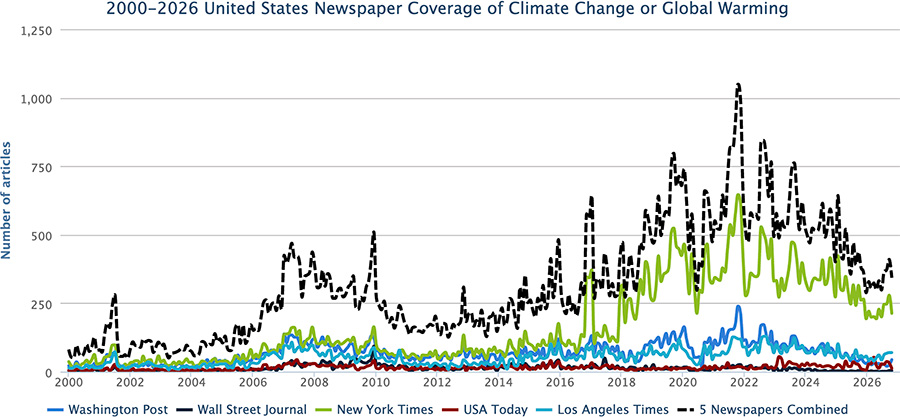
Figure 3. US US newspaper coverage of climate change or global warming – in Washington Post, Wall Street Journal, New York Times, USA Today, and Los Angeles Times – from January 2000 through October 2026.
Workers unloading produce in Manila, where soaring global diesel prices are driving up transport costs and pushing everyday food prices out of reach for consumers. Photo credit: Jes Aznar/New York Times. |
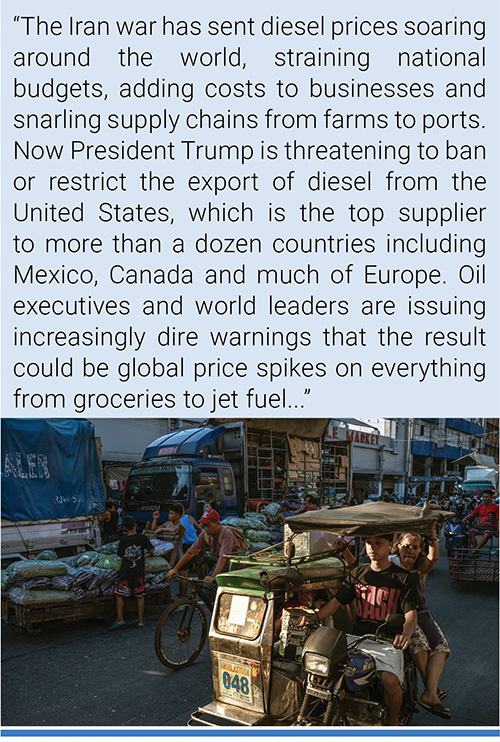
Moving to content in October media stories, we begin by surveying political and economic-themed media stories about climate change or global warming. The high prices for diesel fuel in the US – with connections made to a changing climate – shaped coverage early in the month. For example, New York Times journalists Lisa Friedman and River Akira Davis wrote, “The Iran war has sent diesel prices soaring around the world, straining national budgets, adding costs to businesses and snarling supply chains from farms to ports. Now President Trump is threatening to ban or restrict the export of diesel from the United States, which is the top supplier to more than a dozen countries including Mexico, Canada and much of Europe. Oil executives and world leaders are issuing increasingly dire warnings that the result could be global price spikes on everything from groceries to jet fuel… Europe imports about 1.5 million barrels a day, with a third coming from the United States, according to S&P Global, a market data firm. The dependency on American imports is made more difficult by a reduction in European refineries in recent years because of high operating costs and climate regulations”.
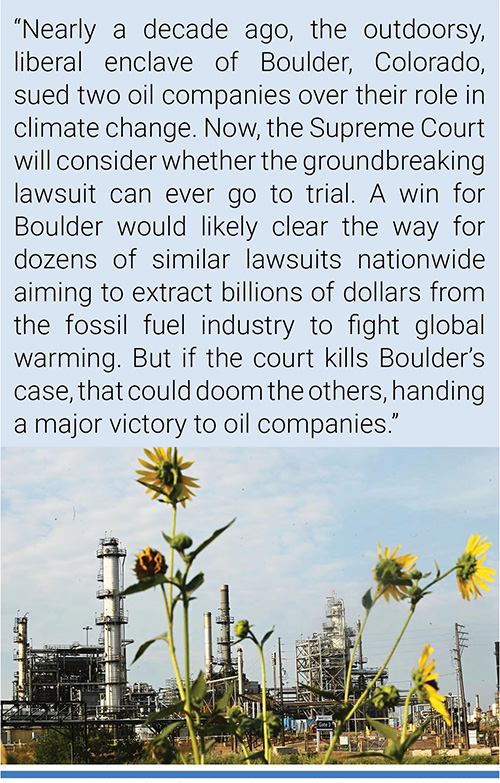
Also, early in October the US Supreme Court case brought by City of Boulder and Boulder County (Colorado) generated news attention. For example, Washington Post correspondent Justin Jouvenal wrote, “The city and county of Boulder are seeking damages from ExxonMobil and Canada’s Suncor Energy, alleging they intentionally misled the public for decades about the impact of climate change and the role fossil fuels play in global warming. The companies deny any wrongdoing, saying Boulder is using Colorado state courts to pursue climate policy that is rightly in the purview of the federal government and Congress. They say the Supreme Court should toss out the suit. The case is the first test of roughly 60 similar suits brought by cities, counties and states. Many are hoping they will be the environmental equivalent of the landmark litigation against tobacco companies and drugmakers that produced billions in damages over smoking and opioids. At their heart, the suits begin to try to answer a vexing question that only grows more urgent with each new wildfire, flood and hurricane: Who should pay for the effects of global warming? Answering that question requires grappling with complexities far more daunting than anything in those earlier rounds of litigation over tobacco or opioids, including whether it is even possible to tease out the role of climate change in any particular wildfire or weather event and assign responsibility to a particular industry”. As a second example, New York Times journalist Karen Zraick reported, “Nearly a decade ago, the outdoorsy, liberal enclave of Boulder, Colo., sued two oil companies over their role in climate change. Now, the Supreme Court will consider whether the groundbreaking lawsuit can ever go to trial. Its decision will resonate far beyond the Rockies. A win for Boulder would likely clear the way for dozens of similar lawsuits nationwide aiming to extract billions of dollars from the fossil fuel industry to fight global warming. But if the court kills Boulder’s case, that could doom the others, handing a major victory to oil companies. Boulder’s lawsuit says the two oil companies, Exxon Mobil and Suncor Energy, should help pay for the damage to the state of Colorado — such as worsening heat waves and wildfires — caused by climate change, which is driven by the burning of fossil fuels. The companies say Boulder’s lawsuit should be thrown out because it was filed under state law, when federal law should have precedence”.
A Suncor refinery in Colorado. Photo credit: Mark Makela/New York Times. |
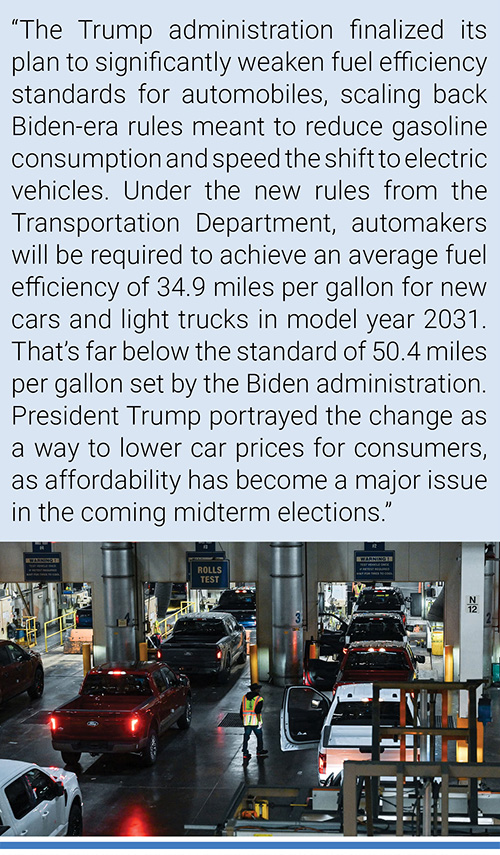
Further US Trump administration decisions shaped US domestic reporting in October, leading into the November 3 elections. For example, New York Times correspondents Brad Plumer and Maxine Joselow reported, “The Trump administration on Monday finalized its plan to significantly weaken fuel efficiency standards for automobiles, scaling back Biden-era rules meant to reduce gasoline consumption and speed the shift to electric vehicles. Under the new rules from the Transportation Department, automakers will be required to achieve an average fuel efficiency of 34.9 miles per gallon for new cars and light trucks in model year 2031. That’s far below the standard of 50.4 miles per gallon set by the Biden administration. President Trump portrayed the change as a way to lower car prices for consumers, as affordability has become a major issue in the coming midterm elections. He posted on social media over the weekend that the new rules marked a “BIG DAY FOR AMERICAN AUTO WORKERS AND CAR BUYERS.” But critics said that less efficient vehicles could cost consumers more at the pump in the long run. U.S. gasoline prices have spiked because of the conflict in the Middle East, with the national average price for unleaded gas near $4.50 per gallon, up more than 40 percent since this time last year. The new standards should be easy for automakers to meet, analysts said, and the agency’s own analysis suggests that new cars sold in model year 2024 already came close to meeting the new rules. Last year, Republicans in Congress also eliminated fines for any automakers that don’t meet the standards, saving them millions of dollars and making the new rules largely toothless. Mr. Trump has sought to dismantle federal policies that had pushed automakers to manufacture more efficient gas vehicles and transition to battery-powered models. He has described those policies as an “E.V. mandate” and has argued that stringent regulations push up the price of new vehicles. Transportation is the country’s largest source of the greenhouse gases like carbon dioxide that are warming the planet. The Biden administration had ratcheted up the mileage standards as part of its sweeping strategy for tackling climate change. But Mr. Trump, who has rejected efforts to address climate change, attacked E.V.s as part of his campaign to retake the White House. His administration has also scrapped a companion rule that would have strictly limited carbon dioxide emissions from new cars and trucks. Those rules had been intended by the Biden administration to align with the fuel-economy standards”.
The new standards should be relatively easy for automakers to meet, analysts said. Photo credit: Kenny Holston/New York Times. |
US Trump administration rollbacks of methane regulations earned news attention too. For example, National Public Radio correspondents Julia Simon and Kirk Siegler noted, “The Trump administration is proposing to dramatically scale back a Biden-era rule that aimed to cut methane emissions from the oil and gas industry at drilling sites nationwide. Methane is a major contributor to climate change and is estimated to be 80 times more planet-warming than carbon dioxide in a twenty-year time frame. In 2023, the Biden administration finalized rules that were meant to rein in methane emissions from the oil and gas sector. President Trump made the announcement while campaigning in Lubbock, Texas, Tuesday, saying his administration's revision, under the Clean Air Act, would save the industry billions in production costs and spur more domestic drilling. The proposal comes as Republicans face a backlash from voters over high gas prices heading into the midterms”. Meanwhile, NBC News journalist Evan Bush wrote, “President Donald Trump said Tuesday his administration plans to ease regulations on methane — a potent greenhouse gas that is the second-biggest contributor to climate change after carbon dioxide. Speaking at a midterm rally in Texas, Trump announced the rollback of methane emissions rules for oil and gas producers that the Biden administration finalized in 2024. “Tonight, I’m officially terminating Biden’s expensive and unnecessary methane regulations to save consumers and energy producers,” Trump said, adding that Democrats had “crushed small oil and gas operators” with excessive regulation. He did not provide further details. The Environmental Protection Agency previewed the changes this month, promising to loosen regulations on methane leaks at lower-production oil wells, among other changes. EPA Administrator Lee Zeldin said at the time: “Americans must be able to afford to heat their homes in the winter and fill up their car and drive to work. They can’t do that when the people producing the energy are weighed down by unnecessary burdens.” Trump made the announcement just a week before the midterm elections, in which numerous polls show that high fuel costs are a key issue for many voters. Methane, the main component of natural gas, traps more heat in the atmosphere than carbon dioxide, though it also breaks down more quickly. Scientists consider methane to be about 80 times more potent than carbon dioxide over 20 years. Methane, which is also released from natural sources like wetlands, is responsible for roughly one-third of all global warming. The Biden administration viewed eliminating methane leaks from oil and gas production as a relatively quick way to drive down emissions. The low-producing wells the rollback would affect (also called stripper wells) produce about 7% to 8% of U.S. natural gas, but they could account for about 50% of the methane that leaks into the atmosphere, research suggests. Many of those wells are near the end of their lives or at risk of falling below the threshold of profitability”.
Minister of Climate, Energy and Environment Kim Sung-whan, visits the Dong Seoul Substation in Hanam, Gyeonggi Province, Photo credit: Ministry of Climate, Energy and Environment. |
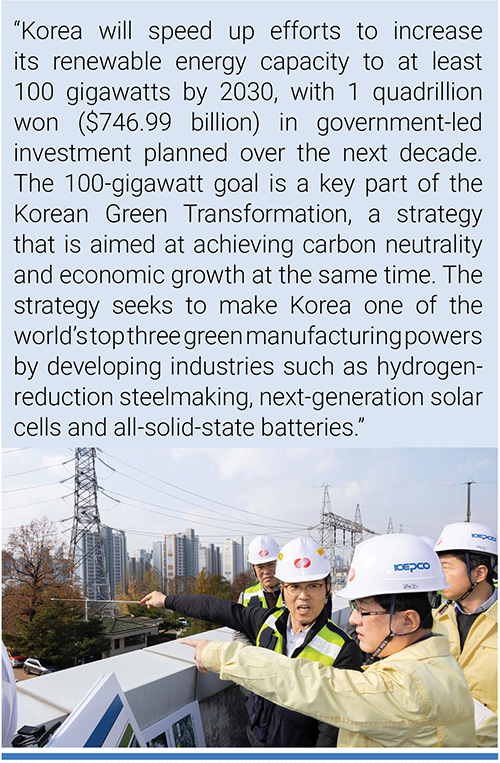
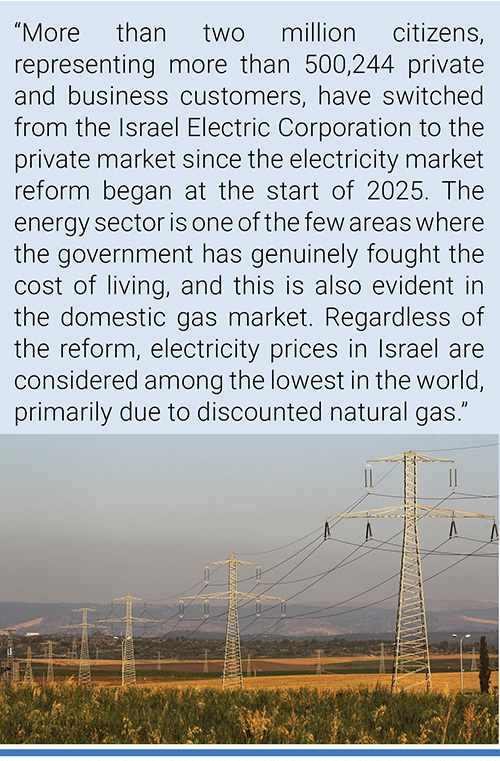
Meanwhile, internationally the continued efforts to decarbonize – with links to reducing climate harms – grabbed news interest. For example, Korea Times journalist Yi Whan-woo reported, “Korea will speed up efforts to increase its renewable energy capacity to at least 100 gigawatts by 2030, with 1 quadrillion won ($746.99 billion) in government-led investment planned over the next decade. The 100-gigawatt goal is a key part of the Korean Green Transformation (K-GX), a strategy unveiled Wednesday that is aimed at achieving carbon neutrality and economic growth at the same time. The strategy seeks to make Korea one of the world’s top three green manufacturing powers by developing industries such as hydrogen-reduction steelmaking, next-generation solar cells and all-solid-state batteries. “The green transition is a sure strategy for the future that will secure international competitiveness while protecting people’s lives and livelihoods from the climate crisis,” President Lee Jae Myung said during a public briefing on the plan. The briefing was attended by about 80 people, including senior government officials, Korea Chamber of Commerce and Industry Chairman Chey Tae-won, representatives of Hanwha Qcells, POSCO Holdings, LG Electronics and Samsung Electronics, industry groups and experts. The president said the green transition would strengthen Korea’s competitiveness while protecting people from the effects of climate change”. As a second example, The Jerusalem Post correspondent Yehuda Sharoni reported, “More than two million citizens, representing more than 500,244 private and business customers, have switched from the Israel Electric Corporation to the private market since the electricity market reform began at the start of 2025, according to data published recently by the Energy Ministry. The energy sector is one of the few areas where the government has genuinely fought the cost of living, and this is also evident in the domestic gas market. Regardless of the reform, electricity prices in Israel are considered among the lowest in the world, primarily due to discounted natural gas”.
Power lines in the town of Bnei Re'em. Photo credit: Nati Shohat/Flash90. |
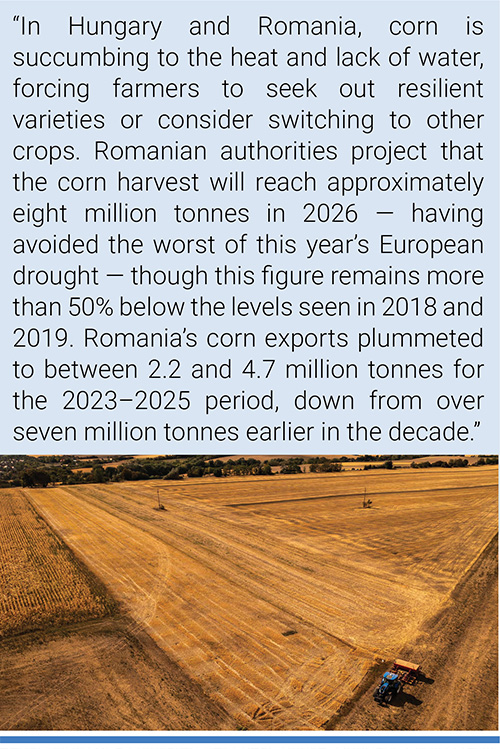
Elsewhere, comparisons to differential emissions in European (EU) news sources continued to shape media discourse with the UN climate negotiations (COP31) on the horizon for November. For example, La Vanguardia journalist Antonio Cerrillo noted, “According to an analysis by Oxfam Intermón (using 2023 data), this 0.1% emits 2,361 million tonnes of CO2, while the poorest 44% of the global population emits 2,312 million tonnes. This 0.1%—the ultra-wealthy—accounts for 7% of total emissions (with the poorest 44% also contributing 7%). The report argues that the super-rich are exacerbating the climate crisis through their excessive per capita emissions, while simultaneously profiting from both the destruction and the subsequent reconstruction. Given that wealthy individuals are responsible for a larger share of global carbon emissions, they also bear a greater responsibility for the increasing frequency and severity of climate-induced disasters, the report notes. An individual belonging to the richest 0.1%—whose emissions are linked to an energy- and carbon-intensive lifestyle—contributes nearly 400 times more to current extreme heatwaves than someone from the poorest half of humanity. Collectively, this small group generates more than three times the carbon emissions of the entire population of sub-Saharan Africa (1.3 billion people).” Meanwhile, El País journalist Raúl Sánchez Costa wrote, “Europe’s breadbasket is scorching. In Hungary and Romania, corn is succumbing to the heat and lack of water, forcing farmers to seek out resilient varieties or consider switching to other crops, such as sunflowers. Romanian authorities project that the corn harvest will reach approximately eight million tonnes in 2026—having avoided the worst of this year’s European drought—though this figure remains more than 50% below the levels seen in 2018 and 2019. Furthermore, according to European Commission data, Romania’s corn exports plummeted to between 2.2 and 4.7 million tonnes for the 2023–2025 period, down from over seven million tonnes earlier in the decade. Cezar Gheorghe, of the consultancy firm AGRIColumn, notes that climate change has been a key factor in the reduction of land dedicated to corn; this has encouraged a shift toward autumn-sown crops and has hit small-scale farmers particularly hard. “Since 2020, they have been planting corn but harvesting nothing,” the expert says, emphasizing that the drought has taken a severe toll on crops.” And as a third example, Expansión journalist Andrés Stumpf noted, “The EU is calling for a "climate shield" to stem losses of 50 billion euros. The European Commission intends to establish an economic and industrial governance framework to prevent disasters from continuing to erode the bloc’s collective GDP, following evidence that the cost of natural catastrophes has surged. Brussels aims to fortify the European Union—as far as possible—against the extreme climate events already damaging its economy. The European Commission has unveiled a proposal for a "Climate Resilience Act," which would require member states to implement a shield to address disasters stemming from global warming. In the plans that countries will be required to develop, Brussels sets out a scientific baseline for global warming—+1.5°C by 2030, +2°C by 2050, and +3°C by 2100—which must serve as the mandatory starting point for budgeting public works, evaluating investments, and designing infrastructure. Furthermore, governments will be required to designate a specific ministry or public body as the "owner" directly responsible for managing each distinct risk—ranging from power grids and coastal protection to general infrastructure—in order to clearly assign accountability in the event of a disaster and put an end to the current, diffuse responsibility that often results in inaction.”
Aerial photo of a cultivated field near Tinnye, Hungary. Photo credit: David Balogh/Xinhua News/Europa Press. |
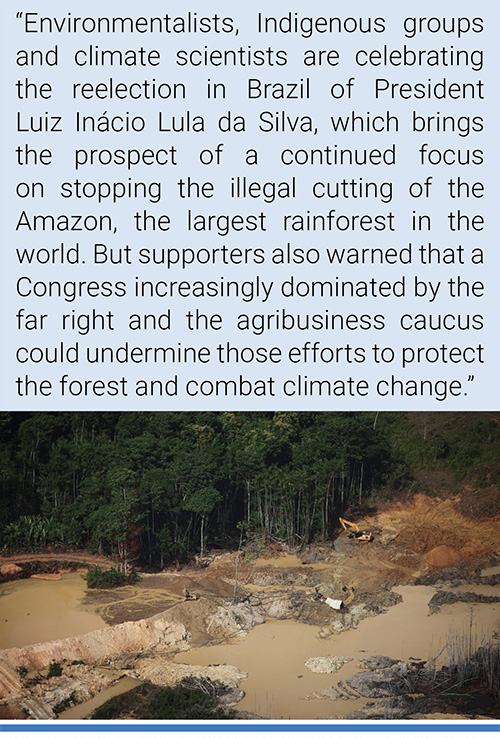
Then in late October, the outcomes – with consequences for climate policy action – of the Brazil elections generated considerable news attention both domestically and internationally. For example, Guardian journalist Jonathan Watts wrote, “The astonishing comeback victory of Luiz Inácio Lula da Silva in Sunday’s presidential runoff against his extreme right challenger Flavío Bolsonaro has brought oceans of rapturous supporters on to the streets, while also thrilling conservationists, climate activists and social justice campaigners across the world. Coming just weeks after the Lula administration announced a record fall in Amazon and Cerrado destruction, they hope Brazil can now go on to achieve its target of zero deforestation by 2030 and continue to support a global transition away from fossil fuels. That would provide a huge boost to flagging global efforts to stabilise the climate and protect degraded ecosystems. It would also set a remarkable example of leadership by the global south”. As a second example, Associated Press journalist Gabriela Sá Pessoa reported, “Environmentalists, Indigenous groups and climate scientists are celebrating the reelection in Brazil of President Luiz Inácio Lula da Silva, which brings the prospect of a continued focus on stopping the illegal cutting of the Amazon, the largest rainforest in the world. But supporters also warned that a Congress increasingly dominated by the far right and the agribusiness caucus could undermine those efforts to protect the forest and combat climate change. Lula defeated Sen. Flávio Bolsonaro, son of far-right former President Jair Bolsonaro, in Sunday's runoff with 51.78% of the vote to 48.21%. After trailing in the first round, Lula staged a comeback to win by 4.4 million votes. "The Amazon can breathe a sigh of relief!" said David Lapola, a Brazilian scientist and lead author of a chapter on so-called tipping points in an upcoming United Nations climate report. Scientists debate the threshold beyond which the dense, humid Amazon rainforest could shift to a drier ecosystem, with irreversible consequences for biodiversity and the climate. The forest absorbs vast amounts of carbon dioxide, a greenhouse gas that drives global warming. About 60% of the Amazon lies in Brazil”.
A gold mining area in the Amazon rainforest during a Greenpeace flyover amid the COP30. Photo credit: Adriano Machado/Reuters.
The area of sea covered by Antarctic ice has peaked at the fourth-lowest level recorded. Photo credit: Hongjie Han/Getty Images. |
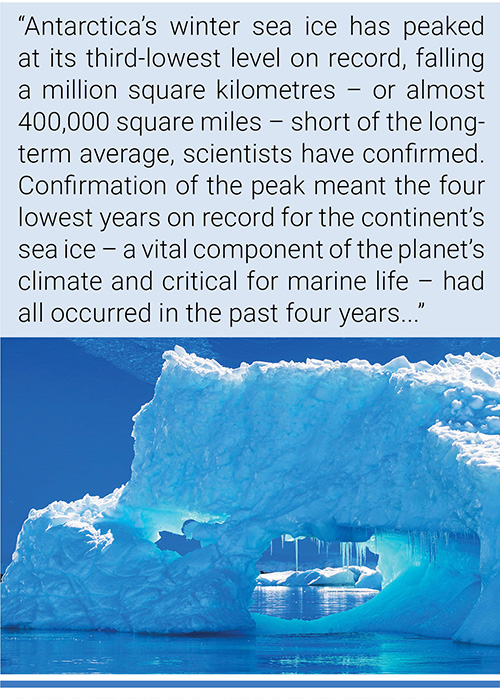
Next, MeCCO monitored scientific themes in media coverage of climate change or global warming in October. Early in the month, Antarctic ice melt earned media reporting. For example, Guardian journalist Graham Readfearn wrote, “Antarctica’s winter sea ice has peaked at its third-lowest level on record, falling a million square kilometres – or almost 400,000 square miles – short of the long-term average, scientists have confirmed. Confirmation of the peak meant the four lowest years on record for the continent’s sea ice – a vital component of the planet’s climate and critical for marine life – had all occurred in the past four years… Dr Will Hobbs, Antarctic sea ice expert at the University of Tasmania, said since reaching its peak earlier this month, Antarctic sea ice had been dropping “faster than usual”. “We could be looking at another low summer and that’s when things get really worrying,” he said, pointing to concerns about impacts on ice shelves. “How sensitive is the global climate system to this loss of sea ice? We are still working to put numbers on that. But the system is changing faster than we are understanding it”.”
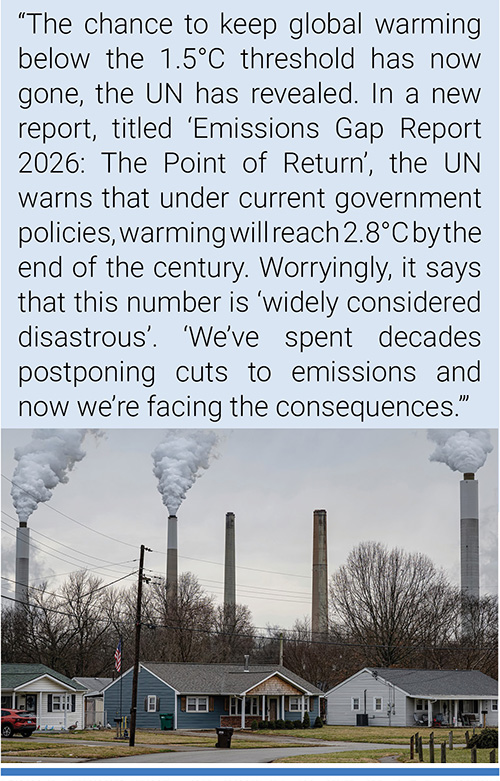
Also in October, a United Nations (UN) Emissions Gap Report released mid-month garnered media attention. For example, The Times of India reporter Vishwa Mohan observed, “NEW DELHI: Rise in global greenhouse gas (GHG) emissions may continue to pose a serious threat of global warming but India reported a decrease in its level of emission in 2025 over the previous year and its trend broke from a longer period of rapid growth, in part due to the weather effects, but also due to the country’s “structural shift towards renewables”, the UN Environment Programme has observed in its annual ‘Emissions Gap Report’ released on Wednesday. The report shows that India is currently the third-largest emitter in terms of total GHG emissions but the country’s per capita emission is not only less than half of the global average but also substantially lower that the top two emitters – China and the US – where total emissions increased each year. Besides India, the EU (27 nations collectively) and Russia too reported decreases in their levels of emissions in 2025 when the total global emissions were similar to the 2024 levels. In terms of the magnitude, the increase in the US far exceeded those of all other countries. The next largest estimated increases were in Türkiye (the host of the upcoming UN climate conference, COP 31), Iran and Indonesia. Thought the efforts are being made in most of the countries to reduce their carbon footprints, the report underlines that the temperature projections are still ‘far too higher’ and the chance to keep global warming below 1.5 degrees Celsius with no overshoot is gone”. Meanwhile, Daily Mail (UK) correspondent Shivali Best wrote, “The chance to keep global warming below the 1.5°C threshold has now gone, the UN has revealed. In a new report, titled 'Emissions Gap Report 2026: The Point of Return', the UN warns that under current government policies, warming will reach 2.8°C by the end of the century. Worryingly, it says that this number is 'widely considered disastrous'. 'We've spent decades postponing cuts to emissions and now we're facing the consequences,' said Anne Olhoff, the Director of the UNEP–Copenhagen Climate Centre. 'The world can still attain the goals of the Paris Agreement but we must work hard to not only meet but surpass our most ambitious climate targets. 'The longer we wait, the larger the risk that we jeopardize the temperature goal.' In a new report, titled 'Emissions Gap Report 2026: The Point of Return', the UN warns that under current government policies, warming will reach 2.8°C by the end of the century. The 1.5°C global warming limit was introduced as part of the Paris Agreement on 12 December 2015. It meant that nations agreed to pursue efforts to limit the temperature increase to 1.5°C above pre–industrial levels. However, the new report warns that this warming limit has gone out the window. In the best case scenario, humanity will limit peak warming to 1.7–1.8°C by around the middle of the century, before bringing temperatures back down to or below 1.5°C. Achieving this goal won't be easy, the UN says. According to the latest calculations, for this situation to play out, we'll need to reduce greenhouse gas emissions by 18 per cent by 2030, 45 per cent by 2035 and 69 per cent by 2040. We'll also have to remove vast quantities of carbon dioxide from the air – around 320 gigatonnes by the end of the century”. As a third example, Guardian environment editor Fiona Harvey noted, “The world needs to cut carbon emissions by nearly a fifth in the next four years, and by close to half within a decade, to avoid overshooting climate targets by a disastrous margin. Although the “window has closed” on holding temperature rises to 1.5C, in line with scientific advice, limiting the “overshoot” of that target is still possible, according to the UN Environment Programme (UNEP). But countries are failing to translate their long-term targets on reducing emissions into short-term actions, a report on the “emissions gap” between climate goals and policies has found. Global carbon output appears to have stalled: the emission levels in 2025 were broadly similar to those of the previous year. But UNEP analysts were wary of calling it a peak or plateau, given the vast uncertainties of geopolitics and an increased reliance on fossil fuels, despite strong growth in renewable energy. Cutting greenhouse gases by 18% by 2030, and by 45% by 2035, would yield a good chance of limiting temperature rises to 1.7C above preindustrial levels. This would still allow events such as the record heatwaves of the last few months to become frequent and common, but could help prevent them from getting drastically worse. Governments were warned for years that time was running out, said Inger Andersen, the executive director of UNEP. “[We used to say] there’s still an opportunity if we make this herculean effort [to stay within the 1.5C limit],” she said. “It’s now clear the herculean effort was not made. We procrastinated, and now we are saying this window has closed.” Nevertheless, she urged countries to keep the 1.5C goal – the centrepiece of the Paris climate agreement”.
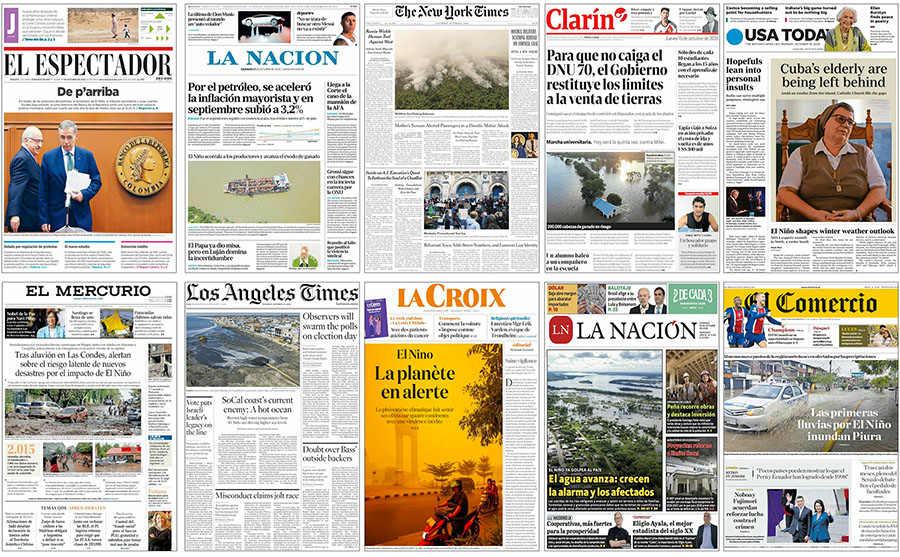
Figure 4. Examples of newspaper front pages with climate change stories in October 2026.
Global temperatures are forecast to rise to 2.8°C above preindustrial levels. Photo credit: Jon Cherry/Getty Images. |
Also, our MeCCO monitoring team has noted several climate change or global warming stories with ecological and meteorological themes. Beginning the month, poor air quality in Southeast Asia linked to wildfires and climate change earned news attention. For example, The Straits Times journalist Ang Qing reported, “South-east Asia is in the grips of one of the worst transboundary haze episodes caused by the fires in Indonesia, a director at the UN’s weather and climate agency said. The crisis could drag on for weeks, even months, until the winds change and rain drenches the fires there, said Ben Churchill, director of the World Meteorological Organisation’s (WMO) regional office for Asia and the Pacific. Speaking to The Straits Times in an interview at the WMO regional office in Tai Seng on Oct 16, Churchill said the ongoing El Nino event is on track to be the strongest one ever observed. The onset of this weather phenomenon – which brings drier, hotter weather to the equatorial ASEAN region – has coincided with the region’s dry season. This has created “the perfect storm” for fires to persist and spread, Churchill said. When land is cleared using traditional slash-and-burn practices, wildfires break out… He said it was important that such early notice of impending weather events like El Nino reaches every layer of society, from policymakers shaping infrastructure and planning, to the agricultural sector. “Everybody can take action at some level or other, whether it is political level, whether it is community level, whether it is individual farmers, or even individuals themselves,” he said. “Everyone has a say, and everyone has the power to do things differently in future, so they don’t happen again.” Such coordination is increasingly urgent as human-driven climate change raises global temperatures, making both El Nino events and severe transboundary haze episodes more frequent and intense”.
People walk through thick haze from wildfires in Palangkaraya, Central Kalimantan, Indonesia. Photo credit: GENDES/EPA. |
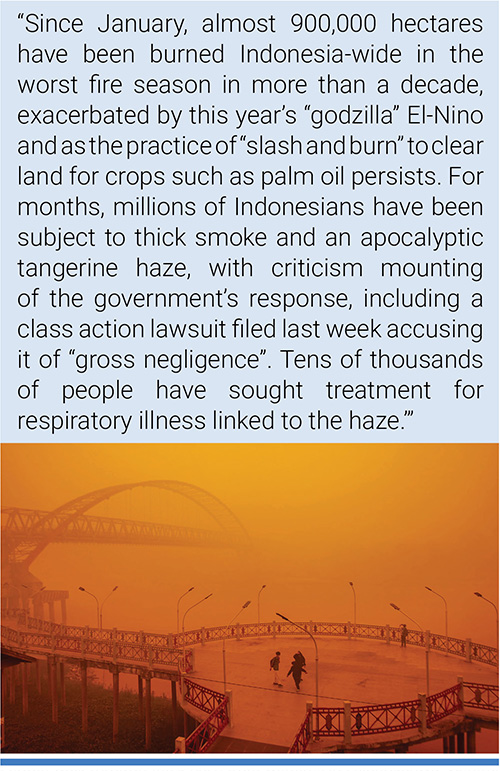
As a second example, Guardian correspondent Kate Lamb wrote, “Since January, almost 900,000 hectares have been burned Indonesia-wide in the worst fire season in more than a decade, exacerbated by this year’s “godzilla” El-Nino and as the practice of “slash and burn” to clear land for crops such as palm oil persists. For months, millions of Indonesians have been subject to thick smoke and an apocalyptic tangerine haze, with criticism mounting of the government’s response, including a class action lawsuit filed last week accusing it of “gross negligence”. Tens of thousands of people have sought treatment for respiratory illness linked to the haze. Air quality has also plummeted in neighbouring countries, shuttering schools, grounding flights and driving a spike in respiratory illness. The haze has drifted into neighbouring Singapore, Malaysia and as far afield as the Philippines. Timor-Leste has said it would shut schools nationwide for three days from Thursday and urged families to keep children indoors or to use “respiratory protection” if going outside. Singapore rolled out subsidies for haze-related medical treatment starting on Monday, a measure last activated in 2015 when similar blazes occurred. The city-state has also begun distributing N95 masks to eligible residents. In the past week, the financial hub of Singapore was listed among the most polluted cities globally. Kuala Lumpur, also deeply affected, was at number two. Indonesian president Prabowo Subianto has ordered firefighting efforts to be stepped up, and called for a crackdown on those suspected of starting fires. But the government has struggled to combat the fires, the worst of which occur in peatland areas, can burn for weeks underground, and are difficult to extinguish. “As time goes by and climate change kicks in, I think it could become a global problem, not just the fix that one country needs to find,” said McRae, of the widening regional issue. “There’s a lot of interconnectedness on a global scale”.”

Figure 5. Examples of newspaper front pages in October 2026 about El Niño, making connections with climate change.
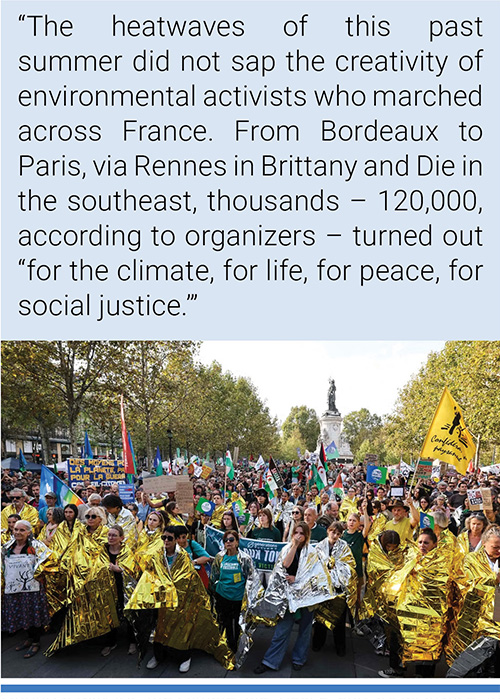
During a rally for 'the climate, life, peace, and social justice' in Paris. Photo credit: Mehdi Fedouach/AFP. |
October news stories also covered ongoing El Niño events with links to climate change or global warming. For example, La Vanguardia journalist Antonio Cerrillo wrote, “September is another month for the climate history books: it was the second-hottest September globally and the warmest in Western Europe (as was also the case in August), while the boiling waters of the Pacific and the Western Mediterranean once again reached historic highs. Last September, global temperatures were 1.63°C above pre-industrial levels, making it the second consecutive month in which global temperatures exceeded the 1.5°C threshold set by the Paris Agreement on climate change. According to Copernicus, this trend is expected to “continue until 2027.” All of this is taking place against the backdrop of intensifying El Niño conditions—a natural warming phenomenon originating in the central Pacific that causes impacts (such as floods and droughts) across much of the globe, as reported by the Copernicus Climate Change Service. This is likely to result in “one of the most intense El Niño events ever recorded.” The average sea-surface temperature outside of the polar regions was the highest ever recorded for that month.”
Last, our MeCCO team continues to monitor intersecting cultural-themed media stories relating to climate change or global warming. For example, Raphaëlle Besse Desmoulières, Benjamin Keltz and Angela Bolis reported in Le Monde, “"Do you want your Earth blue, rare or well done?", "Join the green side of the Force," "Fewer shareholders, more water bombers," "Slow-cooked." The heatwaves of this past summer did not sap the creativity of environmental activists who marched across France on Saturday, September 26. From Bordeaux to Paris, via Rennes in Brittany and Die in the southeast, thousands – 120,000, according to organizers – turned out "for the climate, for life, for peace, for social justice."…More than 260 demonstrations were planned throughout the country. In Montpellier, police counted 2,000 people, 500 in Marseille. In Clermont-Ferrand, central France, the march was interrupted when a car broke through the crowd, lightly injuring four people. In Paris, protesters packed into a small section of Place de la République. Because of the pope's visit, the planned march became a static rally by late afternoon”.
- report prepared by Max Boykoff, Rogelio Fernández-Reyes, Ami Nacu-Schmidt, Jeremiah Osborne-Gowey and Olivia Pearman