Monthly Summaries
Issue 117, September 2026 | "Every fraction of a degree matters"
[PDF]
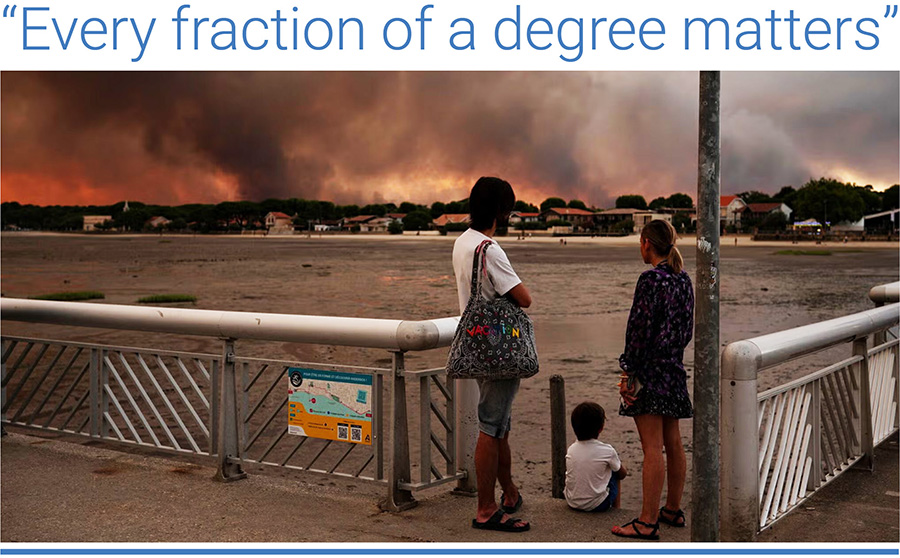
Wildfires burning in southwestern France in summer 2026. Photo credit: Olivier Morin/Agence France-Presse.
September media coverage of climate change or global warming in newspapers around the globe was down 4% from August after 1% dip the month before in July. Similarly, international wire coverage dropped 13% in September 2026. Overall, coverage in 2026 continues to remain lower than 2025. Comparing the first nine months of 2026 to the first eight months of 2025, coverage has remained 25% lower. Meanwhile, frequency of coverage in September 2026 decreased 19% from September 2025. Figure 1 shows trends in newspaper media coverage at the global scale – organized into seven geographical regions around the world – across 223/4 years, from January 2004 through September 2026.
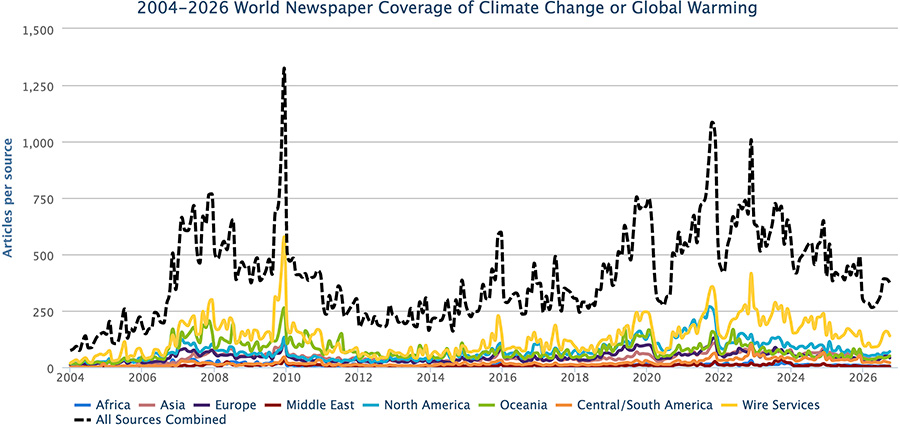
Figure 1. Newspaper media coverage of climate change or global warming in print sources in seven different regions around the world, from January 2004 through September 2026.
September 2026 coverage rose in Asia (up [+]4%), Africa (+6%), North America (+11%), and Oceania (+18%). Meanwhile, September 2026 coverage dropped in other regions: Latin America (down [-]13%), the European Union (EU) (-14%), and the Middle East (-54%). A comparison of September 2026 to September 2025 finds levels of coverage down everywhere but still just higher in the EU (up 1%): Middle East (-69%) Oceania (-38%), North America (-3%), Latin America (-39%), Asia (-27%), and Africa (-46%). Figure 2 shows trends in newspaper media coverage in the Oceania across 223/4 years, from January 2004 through September 2026.
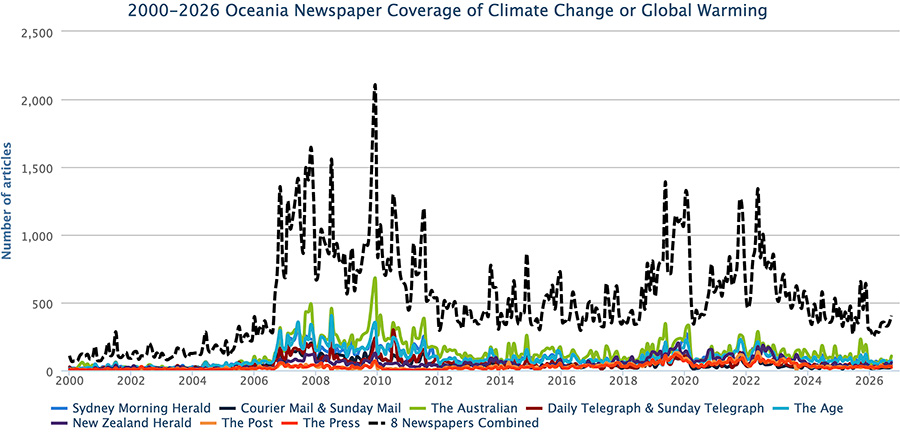
Figure 2. Coverage of climate change or global warming in eight outlets in Oceania from January 2000 through September 2026: Sydney Morning Herald (Australia), Courier Mail and Sunday Mail (Australia), The Australian (Australia), Daily Telegraph & Sunday Telegraph (Australia), The Age (Australia), New Zealand Herald (New Zealand), The Post (New Zealand), The Press (New Zealand).
Among our country-level monitoring, in September United States (US) print coverage went up 10% from August 2026 (after an increase of 2% from July). Despite these gains in the past two months, the amount of US print coverage in the first nine months of 2026 is still 26% lower than the amount of US print coverage in the first nine months of 2025. US television coverage jumped nearly 40% from August (after increasing 8% from August 2026). Despite these gains in the past two months, the amount of US television coverage in the first nine months of 2026 is still 41% lower than the amount of US television coverage in the first nine months of 2025. Figure 3 shows trends in US television coverage across 263/4 years, from January 2000 through September 2026.
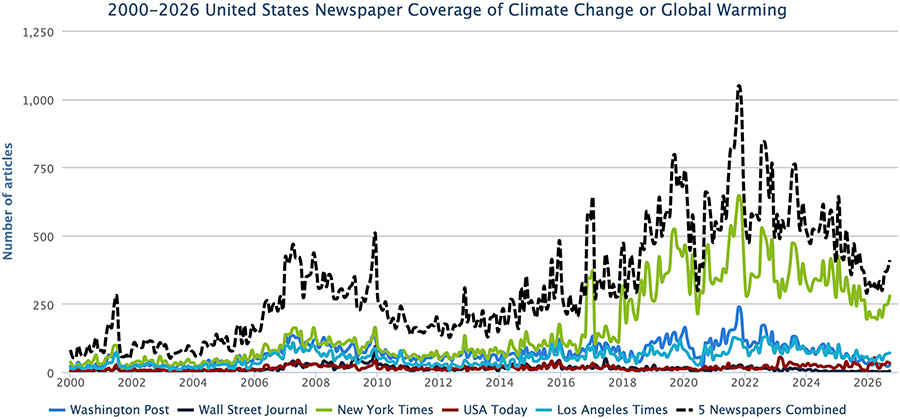
Figure 3. US newspaper coverage of climate change or global warming – Washington Post, Wall Street Journal, New York Times, USA Today, and Los Angeles Times – from January 2000 through September 2026.
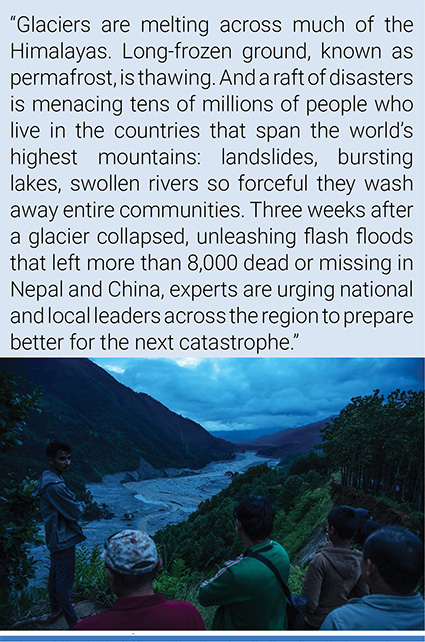
A view of the Trishuli River after the deadly flooding that swept away homes in Betrawati, Nepal. Photo credit: Lam Yik Fei/New York Times. |
Moving to content in September media stories, we begin with a look again at ecological and meteorological themes in media coverage of climate change. Beginning the month, stories continued about record heat from the summer in the Northern Hemisphere. For example, BBC journalist Matt McGrath reported, “August was the joint-hottest month ever recorded, tying with July 2023, according to the EU’s climate service. The record was driven by a combination of climate change and the rising influence of El Niño, pushing heat into the atmosphere across the Pacific. Temperatures for the month were 1.65C above pre-industrial levels – surpassing the critical 1.5C threshold agreed by countries to avoid the worst effect of climate change”. As a second example, Associated Press journalist Seth Borenstein noted, “Earth cooked to its hottest month on record in August, blowing far past a key climate threshold, due to the dangerous double whammy of human-caused climate change and a supersized El Nino, according to the European climate service Copernicus. August’s sizzle also helped push the globe and the United States to swelter through the hottest Northern Hemisphere summer scientists have measured. Last month the world averaged 62.53 degrees Fahrenheit (16.96 degrees Celsius), which technically was one-hundredth of a degree Celsius more than the all-time global mark set in July 2023, but because that’s also the uncertainty level, it’s considered a tie, said Samantha Burgess, strategic climate lead for Copernicus… Global monthly ocean temperatures in August tied a March 2024 all-time record for warmest month recorded, while Aug. 22 set a record for hottest day recorded in the world’s seas, according to Copernicus”. For a third example, La Vanguardia journalist Antonio Cerrillo wrote, “Evidence of global warming continues to mount unabated. Last month was not only the hottest August ever recorded globally but also the warmest month in history across the entire calendar—tying with July 2023. Meanwhile, in Spain, the summer of 2026 was the hottest on record (dating back to 1961), with an average temperature of 24.5°C and 61 days spent under heatwave conditions. "Climate change is clearly the result of a model based on massive reliance on fossil fuels," the Minister for the Ecological Transition stated in Congress.”
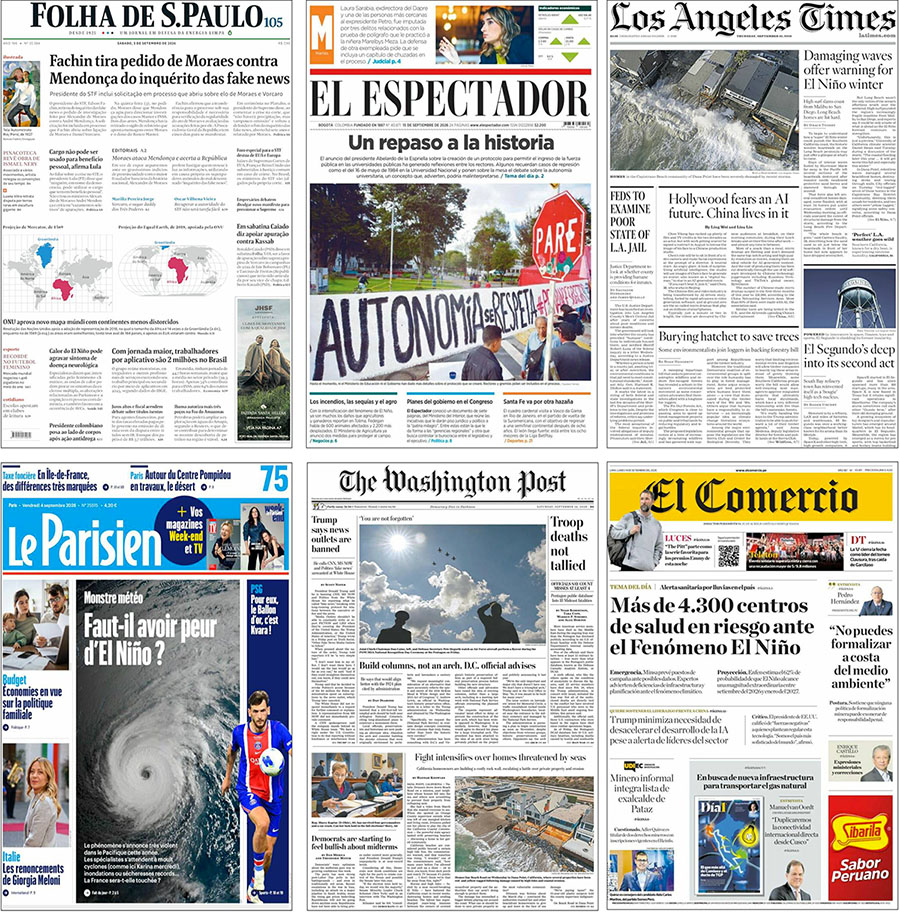
Figure 4. Examples of newspaper front pages in September 2026 covering El Niño, making connections with climate change. |
Yet, warm temperatures in the southern hemisphere – with linkages to a changing climate – also appeared in September news stories. For example, Guardian and Associated Press staff members wrote, “Summer heat is due to arrive early across much of eastern Australia with potentially record early September temperatures predicted for Brisbane and Sydney, while snow was expected in southern New South Wales. Maximum temperatures in Sydney during the first days of September were on track to match the city’s midsummer average of 26.4C, warmer than any other start to spring since the city’s Observatory Hill station opened in 1858. Suburbs across Sydney were expected to reach up to 33C on Saturday afternoon, smashing average September records by up to 13C… The dramatic start to spring comes against the background of a “supersized” El Niño weather phenomenon to Australia’s east, one that is already breaking heat records, and could comfortably surpass previous events. On Thursday, the UN’s weather agency said the event in the Pacific was continuing to strengthen and would probably persist until early 2027, warning it had the “potential to deliver a massive blow to communities and economies across the world”. El Niño events tend to mean hotter and drier conditions for Australia’s south and east in winter and spring, and can increase the risk of heatwaves, drought and bushfires. Australia’s national council for fire and emergency services said fire authorities were predicting a heightened risk of fire across northern and south-eastern NSW, south-east Queensland, north-eastern Tasmania, parts of Western Australia, South Australia and Victoria, and large parts of the Northern Territory”.
Elsewhere in ecological and meteorological reporting associated with climate change, the fallout from the tragedy in Nepal continued to also generate news. For example, New York Times correspondents Somini Sengupta, Hari Kumar and Zane Irwin wrote, “It’s not just Nepal. Glaciers are melting across much of the Himalayas. Long-frozen ground, known as permafrost, is thawing. And a raft of disasters is menacing tens of millions of people who live in the countries that span the world’s highest mountains: landslides, bursting lakes, swollen rivers so forceful they wash away entire communities. Now, three weeks after a glacier collapsed, unleashing flash floods that left more than 8,000 dead or missing in Nepal and China, experts are urging national and local leaders across the region to prepare better for the next catastrophe. That includes more robust monitoring of their shared mountains and rivers, exchanging data with each other, and putting in place early warning systems and evacuation plans… That is all the more worrisome, scientists say, because the Himalayas, a source of water for two billion people downstream, are being pummeled by climate change. A report issued by scientists this week concluded that fossil fuel emissions played a “very strong” role in the Aug. 26 disaster in Nepal and Tibet, as rising temperatures likely destabilized permafrost and ice under the mountain slopes, leading to the catastrophic flood”. As a second example, El País journalist Manuel Planelles noted, “The catastrophic rock and ice avalanche on Mount Langtang Lirung, on Nepal’s northern border—which resulted in 1,300 deaths and left more than 5,000 people still missing 22 days later—was the result of a combination of factors that had been brewing over time, ultimately triggering an unprecedented disaster in the Himalayas. A report published this Thursday by World Weather Attribution (WWA)—a group of scientists specializing in calculating the influence of climate change on extreme weather events—sheds light on the disaster. Among the contributing factors, the authors highlight that “warming has caused considerable glacial retreat, removing the stabilizing ice surrounding” the site where the rupture occurred.”
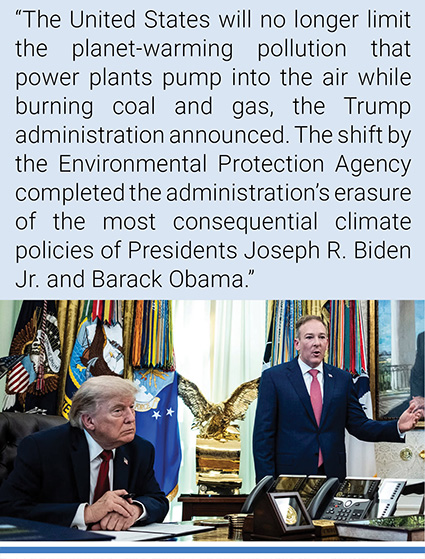
EPA administrator Lee Zeldin speaking next to President Trump in the Oval Office. Mr. Zeldin announced that the agency will no longer limit greenhouse gas emissions from power plants. Photo credit: Pete Marovich/New York Times. |
Next, exploring political and economic-themed media stories about climate change or global warming unearthed many examples in September. Developments related to the political and economic dimensions of the August 31 disaster in Nepal earned ongoing news coverage. For example, Independent journalist Alisha Rahaman Sarkar reported, “Prime minister Balendra Shah said the catastrophic floods that tore through northern Nepal along the Tibet border were driven by the climate crisis and demanded international action as the Himalayan country assessed damage. “The flood in the Bhotekoshi river in Rasuwa was not an ordinary flood,” said Mr Shah in a late-night post on social media”. As a second example, Associated Press correspondents Niranjan Shrestha and Shristi Kafle wrote, “Rescue teams and military helicopters searched Thursday for hundreds of missing people along the mountainous Nepal-China border, where a deadly torrent of water and mud several stories high swept through communities a day earlier following a glacier collapse. Videos of the disaster showed people running before the floodwaters swallowed them up and washed out buildings and bridges. More than 390 people were killed, according to authorities in Nepal and China, and more than 1,400 were missing, including hundreds of foreigners and pilgrims. Hundreds of others were displaced across the Himalayan region. The lush valleys of the Himalayan mountain range — home to many of the world’s highest peaks and remaining glaciers — are especially vulnerable to flooding and landslides. Melting glaciers have become more common because of human-caused climate change… Climate experts at the Kathmandu-based International Center for Integrated Mountain Development said an avalanche from a glacier likely caused [the] flash flood”. For a third example, CNN journalist Stephanie Yang noted, “Work to rebuild trade routes destroyed by catastrophic flooding in Nepal has begun, with a new bridge across the Tadi River that the Nepali Army is calling the “bridge of hope.” Nepal will need a lot of it, as the country starts digging itself out of a disaster-related economic crisis that government officials estimate will cost a least $5 billion in reconstruction receipts alone. What the headline number doesn’t account for, experts said, is the knock-on impacts from losing critical infrastructure the country depends on for travel and transporting goods…Experts are still working out what role climate change played in the disaster, but rising temperatures are destabilizing Nepal’s glaciers and frozen mountain slopes. Nepal’s leaders have made it clear they’re assigning some of the blame for the disaster – and the responsibility to pay for it – on larger countries that generate far more than Nepal’s 0.1% share of global emissions. And they’ve already requested $20 million in compensation from a United Nations fund made to assist developing countries hit by climate-related losses”.
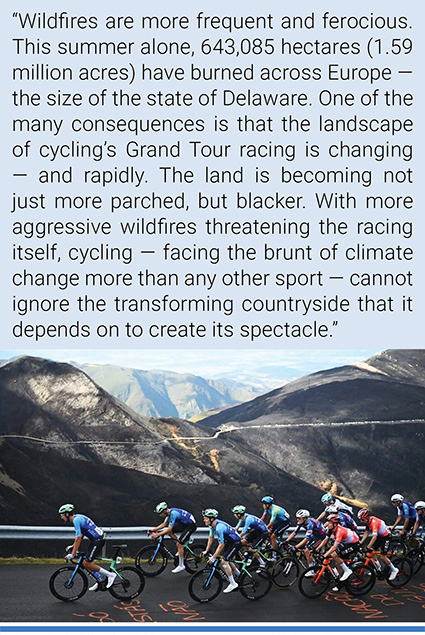
Riders climb Alto De El Morredero in Spain with the effects of wildfires clear to see on the mountains. Dario Belingheri/Getty Images. |
In other political and economic stories, when the US Trump Administration decided to stop limiting global warming pollution from US power plants in September, that generated news. For example, New York Times journalists Maxine Joselow and Lisa Friedman reported, “The United States will no longer limit the planet-warming pollution that power plants pump into the air while burning coal and gas, the Trump administration announced Monday. The shift by the Environmental Protection Agency completed the administration’s erasure of the most consequential climate policies of Presidents Joseph R. Biden Jr. and Barack Obama. If the move survives expected legal challenges, it could also prevent future administrations from regulating greenhouse gas emissions from power plants. The power sector is the second largest source of carbon dioxide and other greenhouse gases in the United States. This pollution accumulates in the atmosphere, where it traps the sun’s heat, raising temperatures and supercharging extreme weather events around the globe. Scientists say the United States and other industrialized nations must sharply cut emissions to avoid the most devastating impacts of climate change. Lee Zeldin, the E.P.A. administrator, announced the change during a meeting of energy ministers from the Group of 20 nations in Houston. In a statement, he accused the Obama and Biden administrations of waging a “war on coal” that forced many coal plants to close prematurely. The E.P.A. minimized the impact of greenhouse gases from American power plants, saying they “have no material impact on global climate change. In fact, if all carbon dioxides were eliminated tomorrow, there would be no meaningful climate impact.” Environmentalists and energy experts strongly disputed these assertions. They noted that if the U.S. power sector were its own country, it would be the fifth-largest climate polluter in the world after China, the entire United States, India and Russia”.
Finally, the annual UN General Assembly (and connected ‘climate week’) in New York City again generated many climate change news stories. For example, Associated Press journalists Seth Borenstein and Anton L. Delgado wrote, “When Palau President Surangel Samuel Whipps Jr. recently took his children to his nation’s Helen Island, two-thirds of it was gone. Rising seas caused by climate change had swallowed generational burial grounds, washing away a people’s entire culture and identity. “For us, it’s devastating,” Whipps told The Associated Press on Friday, 40 years after his previous visit. “It doesn’t mean we should give up.” In the global power game of the United Nations General Assembly, small island states, like Palau, are often on the sidelines, offering moral advice to the mighty who don’t always listen. After all, their countries are tiny. Nearly 11 Marshall Islands, or about 30 Tuvalus, could fit inside New York City, where the United Nations is housed. Now, some of the little land they do have is disappearing. “Sometimes,” Whipps said, “you get drowned out.” He was referring to unequal power dynamics, but it also applies physically. When it comes to climate change, many of the world’s island nations have banded together to be heard better. Their voices play the role of a conscience to a warming world, pleading to stop carbon pollution before it’s too late”. Elsewhere, New York Times correspondent David Gelles reported, “From the moment he took over as United Nations Secretary General in 2017, António Guterres has been raising the alarm about climate change. He called it the “defining issue of our time” and urged countries to embrace renewable energy and phase out the fossil fuels that are dangerously warming the planet. He has called for an end to subsidies for oil and gas, and bans on fossil fuel advertising. Now, the 77-year-old Portuguese diplomat’s time as the head of the U.N. is coming to an end. A new secretary general will be chosen in the coming weeks. And while Guterres’s successor is not yet known, it will be difficult for whoever comes next to match his passion for the climate cause. “No one has done more to rally the world to address climate change than António Guterres,” said Michael Bloomberg, the billionaire, climate donor and former mayor of New York City who has partnered with Guterres on the issue. “His work has been crucial to the significant progress we’ve made over the last decade.” Just how much progress the world has made is a matter of debate”.
Demonstration against the expansion of Barcelona Airport, passing along Passeig de Gràcia. Photo credit: Pol Cartie/Colaboradores. |
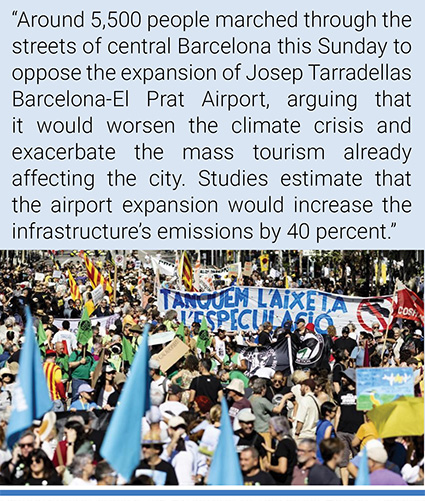
Third, our MeCCO team continues to monitor intersecting cultural-themed media stories relating to climate change or global warming. For example, New York Times correspondent Chris Marshall-Bell reported, “Wildfires have always happened. In some cases, they are beneficial to the ecosystem, as they regenerate the earth by clearing dead vegetation and returning important nutrients to the soil. The problem is that Europe, the fastest-warming continent, is hotter and drier than ever. The upshot is that wildfires are more frequent and ferocious. This summer alone, 643,085 hectares (1.59 million acres) have burned across Europe — the size of the state of Delaware. One of the many consequences is that the landscape of cycling’s Grand Tour racing is changing — and rapidly. The land is becoming not just more parched, but blacker. With more aggressive wildfires threatening the racing itself (fans couldn’t attend the final 45km of stage three of the Tour de France because of a nearby wildfire), cycling — facing the brunt of climate change more than any other sport — cannot ignore the transforming countryside that it depends on to create its spectacle… Five of Spain’s hottest summers have been in the last five years. The existence and effects of climate change are irrefutable”. Also in Europe, there were several stories about citizens rejecting airport expansion with links made to climate change. For example, a news story published in La Vanguardia noted, “around 5,500 people marched through the streets of central Barcelona this Sunday to oppose the expansion of Josep Tarradellas Barcelona-El Prat Airport, arguing that it would worsen the climate crisis and exacerbate the mass tourism already affecting the city. The demonstration, organized by the Zeroport platform with the support of over two hundred environmental, neighborhood, social, and trade union groups, also received backing from ERC, Comuns, and the CUP…In this regard, studies by the organizing platform estimate that the airport expansion would increase the infrastructure's emissions by 40 percent and place further strain on agricultural activity in the Llobregat River delta.”
Photo credit: Saratta Chuengsatiansup/New York Times. |
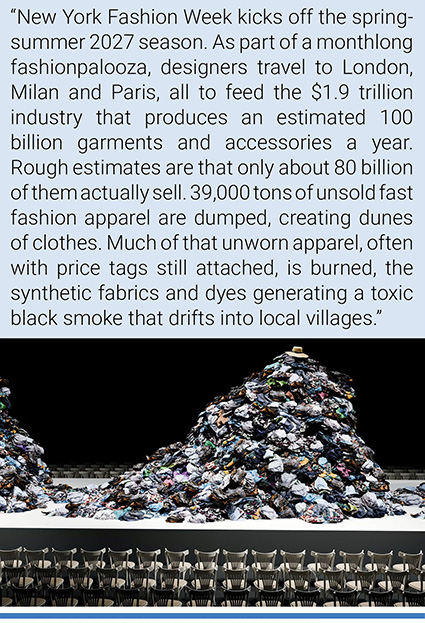
Last, our MeCCO monitoring team has noted several climate change or global warming stories with scientific themes in September. There were connections made with the economic power of the fast fashion industry and greenhouse gas emissions linked to a changing climate stemming from a report from the Apparel Impact Institute. For example, Los Angeles Times correspondent Olivia Raimonde noted, “the fashion industry’s greenhouse gas emissions climbed in 2023 and 2024 due in part to increased global production of fiber, especially polyester, according to a new report by the Apparel Impact Institute. Apparel-sector emissions rose 6.3% in 2024, following an increase of 7.5% the previous year; the year prior to that, emissions declined slightly. 2024 is the most recent year for which the institute has data. Fashion emissions that year were roughly 1 gigaton — about the same as the entire climate footprint of Japan. “The trend is one that’s quite concerning,” said Kurt Kipka, chief impact officer at the institute, a nonprofit that aims to improve sustainability within fashion. “It is a clear sign of increased usage of materials.” He highlighted cost as a significant hurdle for the industry in its efforts to decarbonize. Virgin polyester continues to be cheaper and more available than recycled material, he said, which takes energy to make. Now, as volatility caused by the Iran war is driving up energy prices, Kipka said it shows the need for clothing producers to look to alternatives to oil and gas. “That’s where renewable energy sources and onsite battery storage become a more attractive proposition,” he said…Fashion can point to some successes: The number of apparel companies that have approved science-based climate targets or committed to set them rose from about 100 at the end of 2021 to more than 700 as of this June. Major brands have reported double-digit reductions in their emissions and have ramped up the share of recycled fiber they use in garments, the report finds. Even so, businesses in the sector have walked back green commitments amid political changes and inflation pressures. Earlier this year, Burberry delayed for a decade its previous goal to reach net zero by 2040”. Elsewhere, New York Times contributor Dana Thomas opined, “New York Fashion Week kicks off the spring-summer 2027 season, with brands presenting their latest offerings on runways and in showrooms. As part of a monthlong fashionpalooza, designers will then travel to London, Milan and Paris for more of the same, all to feed the $1.9 trillion industry that produces an estimated 100 billion garments and accessories a year. Rough estimates are that only about 80 billion of them actually sell. What happens to the other 20 billion? Some wind up in outlets and on flash sale sites. Some get dumped in far-off places, like the once majestic Atacama Desert in Chile, where in 2021 Agence France-Presse reported that 39,000 tons of unsold fast fashion apparel were dumped, creating dunes of clothes. Much of that unworn apparel, often with price tags still attached, is burned, the synthetic fabrics and dyes generating a toxic black smoke that drifts into local villages. A court case in Hong Kong revealed that Chanel had until a few years ago engaged in what the industry euphemistically calls “inventory management.” Burberry says it no longer destroys leftover products, but the company revealed in its 2018 annual report that it had incinerated or otherwise destroyed 28.6 million pounds’ worth of unsold clothes, accessories and perfume the previous fiscal year ($37 million), bringing its five-year total to about £100 million ($130 million)…Some companies gesture toward reducing waste. You can deposit discards from any brand at H&M stores, and the company has partnered with organizations that sort the collected clothing for reuse or recycling. But such initiatives often seem to be more about buffing up a company’s public image than truly doing good. In 2023, the Dutch sustainability nonprofit Changing Markets Foundation stashed Apple AirTags inside 21 items that it donated to clothing chains across Europe or posted on resale sites to see where the clothes actually went. It determined that 16 of the items were destroyed, abandoned in warehouses or exported to Africa. Only five were reused or resold within Europe. Overall, according to data from the sustainable fashion nonprofit Textile Exchange, less than 1 percent of clothing is recycled into new fiber each year. Meanwhile, fashion’s greenhouse gas emissions are rising, driven in part by the global production of polyester, an inexpensive petroleum-based synthetic that does not biodegrade. The industry’s annual greenhouse gas emissions have now reached an estimated gigaton — about the same as the entire climate footprint of Japan”.
A wildfire approaches a beach on the Adriatic coast in Croatia. Photo credit: Tom Dubravec/AP. |
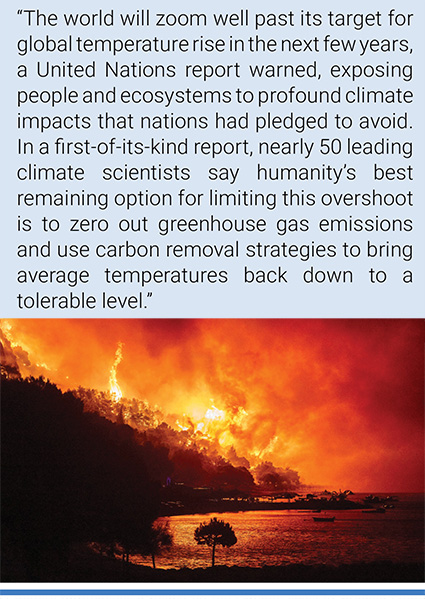
In mid-September, a UN Environment Programme report about climate change and risk earned attention in many news outlets. For example, Washington Post reporter Sarah Kaplan noted, “The world will zoom well past its target for global temperature rise in the next few years, a United Nations report warned Wednesday, exposing people and ecosystems to profound climate impacts that nations had pledged to avoid. In a first-of-its-kind report, nearly 50 leading climate scientists say humanity’s best remaining option for limiting this overshoot is to zero out greenhouse gas emissions and use carbon removal strategies to bring average temperatures back down to a tolerable level. Eleven years after nations at the Paris climate talks pledged to limit warming to 1.5 degrees Celsius (2.7 degrees Fahrenheit) above preindustrial levels, the new report is the first U.N. document to explicitly state that exceeding 1.5 is inevitable and to lay out a strategy for reversing excess temperature rise…Yet the report’s authors urged people to stay focused on what scientists do know: That every fraction of a degree matters. That the sooner humanity acts, the safer our future will be.”. Elsewhere, journalist Chico Harlan at The New York Times wrote, “The most ambitious part of the 2015 Paris climate agreement, to limit global warming to 1.5 degrees Celsius, only came about because of a campaign by some of the world’s poorest and most defenseless countries. Caribbean participants tacked up posters saying “1.5 to stay alive,” and the prime minister of Tuvalu said any temperature rise beyond that mark would “spell the total demise” of his and other low-lying island nations. In the final stage of negotiations, some were chanting, “1.5.” The acknowledgment last week from the United Nations that the planet is going to breach that limit was not a surprise to anyone tracking global temperatures, which keep rising. But it nonetheless formalized a dire outcome: Amid scant progress from global powers to cut pollution from fossil fuels, vulnerable countries will now spend decades, or perhaps centuries, confronting the very climate scenario they’d once said would be untenable. And though that puts them face-to-face with the concerns they’d held in Paris, about rising sea levels and intensifying disasters, they also face new risks few could have imagined a decade ago. Cutbacks in aid from wealthy nations, including the United States, have reduced the humanitarian safety net. The United States, the world’s largest historical emitter, has also withdrawn from the Paris Agreement, as well as from funds meant to help developing countries deal with climate change. Poorer nations say these changes threaten to make the 1.5 Celsius breach even rockier, leaving them fewer resources to deal with disasters while widening global inequities”. For a third example, Guardian correspondent Adam Morton wrote, “Global heating will reach at least 1.8C under even the most optimistic future, well beyond the Paris agreement goal of 1.5C, according to a UN report that warns every fraction of temperature rise intensifies destructive extreme weather, glacier melt, ecosystem loss, and island and coastal city submersion. The report by the Nairobi-based UN Environment Programme confirmed overshooting the 1.5C goal inscribed in the landmark Paris agreement of 2015 was now “unavoidable” and, despite some progress in addressing the human-caused climate crisis driven by burning fossil fuels, likely in the next few years. It said: “There are no good outcomes above 1.5C”. Heating of up to 3C above preindustrial levels could lead to glaciers losing more than a quarter of their mass by 2100, raising sea levels by up to 13cm. Global food production could decline by up to 14% by 2050 if there are not effective strategies to adapt. Human health, water supplies, nature, cities, infrastructure and economies could all be severely damaged. Some losses would be irreversible. Many communities may have to relocate or change their livelihoods”.
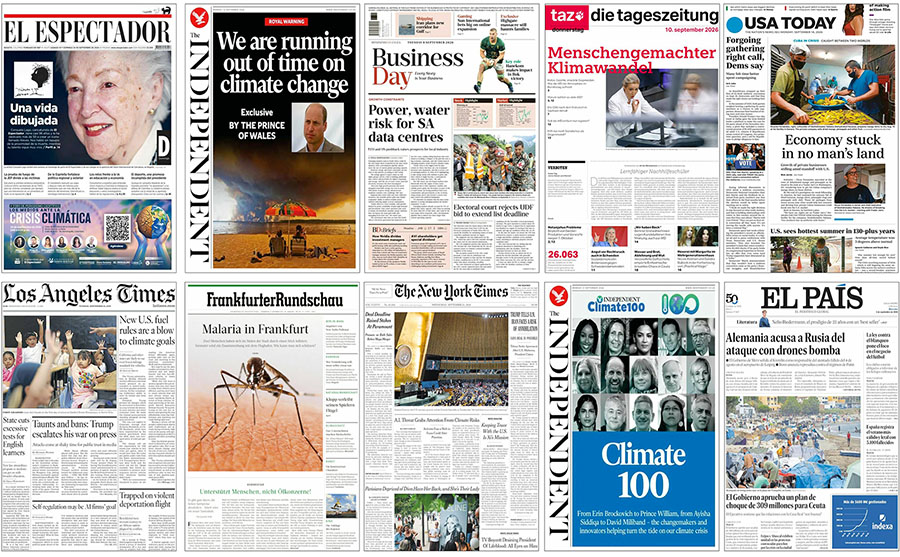
Figure 5. Examples of newspaper front pages with climate change stories in September 2026.
Usually submerged areas of the Danube were exposed in Rasova, Romania, amid exceptionally low water levels. Photo credit: Robert Ghement/EPA. |
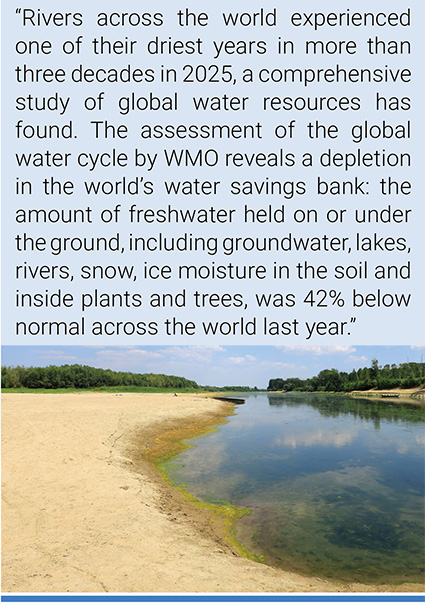
Finally, as drought and drying rivers – with connections to climate change – continue to earn media attention, a new study about the patterns drew media interest. For example, Guardian correspondents Sandra Laville and Carmen Aguilar García wrote, “Rivers across the world experienced one of their driest years in more than three decades in 2025, a comprehensive study of global water resources has found. The assessment of the global water cycle by the World Meteorological Organization (WMO) reveals a depletion in the world’s water savings bank: the amount of freshwater held on or under the ground, including groundwater, lakes, rivers, snow, ice moisture in the soil and inside plants and trees, was 42% below normal across the world last year. The impacts of the climate crisis on extreme weather and the creation of so-called weather whiplash events are driving a more erratic and unpredictable water cycle. From melting glaciers to extreme droughts and flash flooding, the world’s rivers are swinging between having too much and too little water. The last seven years have seen the fewest rivers around the world with “normal” flows since 1991. In 2025, one of the warmest years on record, only about a third of rivers were in the normal range, while 36% of the global river basin area had river flows below or well below normal, and 21% were above- and much-above-normal flows, according to the WMO study, using simulations from 13 global hydrological models, driven by observed weather data”.
- report prepared by Max Boykoff, Rogelio Fernández-Reyes, Ami Nacu-Schmidt, Jeremiah Osborne-Gowey and Olivia Pearman