Monthly Summaries
Issue 116, August 2026 | "Windfall war profits"
[PDF]
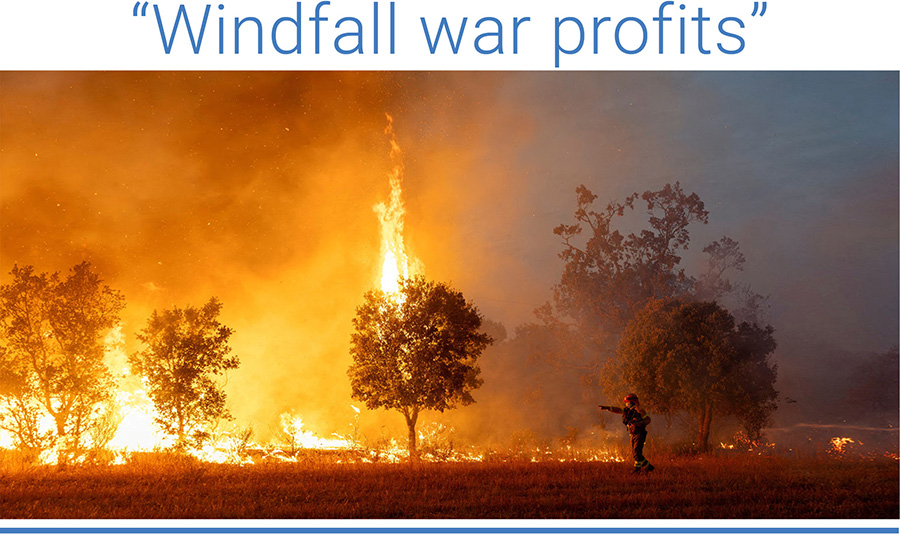
A firefighter works to extinguish an advancing wildfire near Formariz in Zamora province, Spain. Photo credit: Ümit Bektaş/Reuters.
August media coverage of climate change or global warming in newspapers around the globe was slightly down, 1% lower from July after an 19% increase the month before in June. However, international wire coverage was up 6% in August 2026. Overall, coverage in 2026 continues to remain lower than 2025. Comparing the first eight months of 2026 to the first eight months of 2025, coverage has dropped 25%. Meanwhile, frequency of coverage in August 2026 was 2% lower than in August 2025. Figure 1 shows trends in newspaper media coverage at the global scale – organized into seven geographical regions around the world – across 223/4 years, from January 2004 through August 2026.
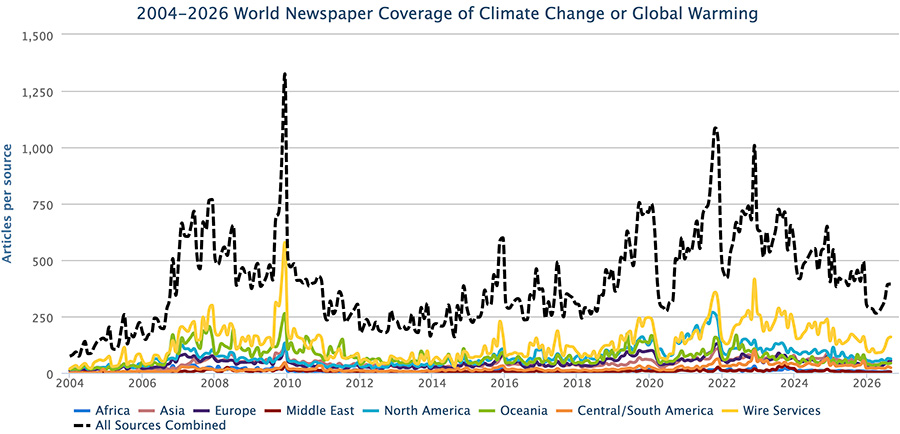
Figure 1. Newspaper media coverage of climate change or global warming in print sources in seven different regions around the world, from January 2004 through August 2026.
August 2026 coverage rose in some regions: Oceania (up [+]4%) the European Union (EU) (+15%), and the Middle East (+20%). August 2026 coverage dipped in other regions: North America (down [-]3%), Latin America (-16%), Asia (-17%), and Africa (-27%). A comparison of August 2026 to August 2025 finds levels of coverage down everywhere but in the EU (up 33%) and in the Middle East (where it doubled): Oceania (-2%), North America (-3%), Latin America (-16%), Asia (-17%), and Africa (-27%). Figure 2 shows trends in newspaper media coverage in the Middle East across 223/4 years, from January 2004 through August 2026.
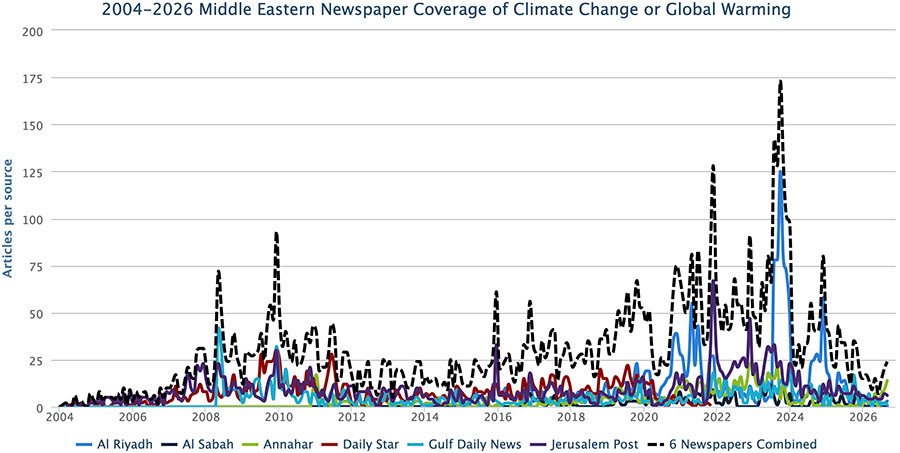
Figure 2. Coverage of climate change or global warming in the Middle East from January 2004 through August 2026: Al Riyadh (Saudi Arabia), Al Sabah (Iraq), Annahar (Lebanon), Daily Star (Lebanon), Gulf Daily News (Bahrain), Jerusalem Post (Israel).
Among our country-level monitoring, in August United States (US) print coverage went slightly up 2% from July 2026. US television coverage increased 8% from July 2026. Yet each of these upward trends have been preceded by drops in preceding months in 2026. Figure 3 shows trends in US television coverage across 263/4 years, from January 2000 through August 2026.
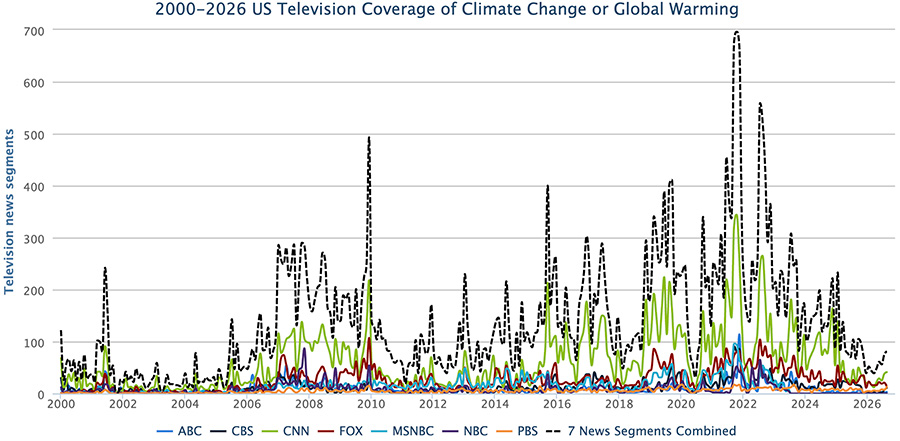
Figure 3. US television coverage of climate change or global warming – in ABC News, CBS News, CNN News, Fox News, MSNBC, NBC News, and PBS News – from January 2000 through August 2026.
Tourists take shelter as they walk in front of the Rome’a ancient Colosseum on August 1, 2026. Photo credit: Alessandra Tarantino/AP. |
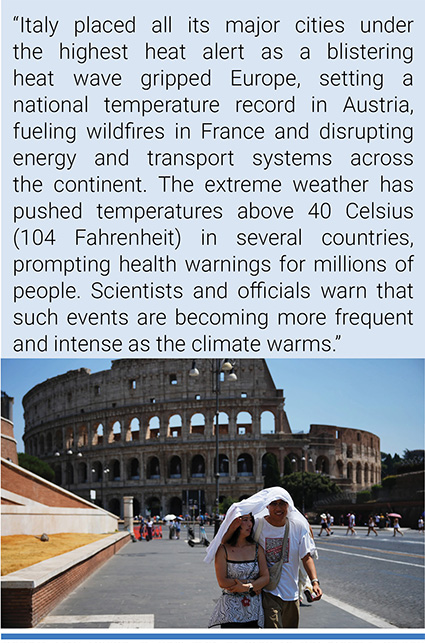
Moving to content in August media stories, we begin with a look again at ecological and meteorological themes in media coverage of climate change. Beginning the month, stories continued about ongoing heat waves in in the Northern Hemisphere – with links made to climate change. For example, Associated Press correspondents Giada Zampano, Kirsten Grieshaber and Justin Spike wrote, “Italy placed all its major cities under the highest heat alert Thursday as a blistering heat wave gripped Europe, setting a national temperature record in Austria, fueling wildfires in France and disrupting energy and transport systems across the continent. The extreme weather has pushed temperatures above 40 Celsius (104 Fahrenheit) in several countries, prompting health warnings for millions of people. Scientists and officials warn that such events are becoming more frequent and intense as the climate warms. The current heat wave has exposed vulnerabilities in public health systems, power generation, transportation networks and tourism infrastructure, forcing governments and businesses to adapt to more frequent periods of extreme weather”. As a second example, Korea Times journalist Jung Da-hyun observed, “Yangsan, South Gyeongsang Province, recorded a temperature of 42.5 degrees Celsius on Sunday, the highest ever measured in Korea since modern weather observation began in 1904, as a record-breaking heat wave grips the country. The temperature was recorded at approximately 1:26 p.m. The southeastern city set a new local temperature record for a fourth straight day since Wednesday, with temperatures climbing higher each day…overlapping high-pressure systems over the Korean Peninsula created ideal conditions for the heat wave. The North Pacific High, a semipermanent anticyclone, brought hot, humid air, while the Tibetan High, a seasonal high-pressure system that forms over the Tibetan plateau, reinforced atmospheric warming to produce clear skies and intense sunshine that drove temperatures even higher. Dry conditions left by below-average monsoon rainfall also intensified the heat, while the stagnant weather pattern allowed it to build across the southeast”. As a third example, La Vanguadia journalists Carina Farreras y Francesc Brasero wrote, “More mosquito-borne diseases raise the alert in Europe. Climate change is expanding the reach of the West Nile virus. The West Nile virus has ceased to be an imported and exceptional pathogen in Europe and has become an annual risk, pushed northward by warmer temperatures that are facilitating its arrival in traditionally colder areas. While until relatively recently it was confined to the southern regions closest to Africa, the spread of the mosquitoes that transmit the disease has now reached Belgium, Austria, Germany, and the Netherlands.”
In the middle of August, stories like these persisted like the heat itself. For example, Agence-France Presse reported, “Western Europe experienced its hottest June-July on record as climate change fuels an historic summer of heat, drought and wildfires across the region, the EU's global warming monitor said Monday. Europe is the world's fastest-warming continent and the first two months of summer have been marked by successive heatwaves, scorching temperatures and bone-dry conditions…Copernicus director Carlo Buontempo said parts of the Mediterranean and Atlantic were unusually warm but the developing El Nino "is probably the driving force" behind the record sea temperatures. "We are now facing a very large El Nino – possibly unprecedented in terms of amplitude”. Also at that time, El País journalist Clemente Álvarez wrote, “As reported by the Copernicus Climate Change Service, the average surface ocean temperature (excluding the poles) reached 21.1°C on August 22, surpassing the previous record of 21.09°C set in March 2024. This intensification of ocean heat is largely due to the El Niño phenomenon, which raises sea surface temperatures in the tropical Pacific. However, it is also another consequence of the climate crisis and a threat to the occurrence of extreme weather events. According to Samantha Burgess, Climate Strategy Officer at the European Centre for Medium-Range Weather Forecasts (ECMWF), “This record is yet another clear sign of an ocean under increasing pressure. El Niño is intensifying global warming, but it is doing so on top of decades of warming caused by human activity. As ocean temperatures continue to rise, so do the risks to marine ecosystems and coastal communities.”
Meanwhile, severe drought continued to set in across continental Europe and this generated ongoing news attention. For example, El País journalists Raquel Villaécija, Eva Millán, Almudena de Cabo and Lorena Pacho wrote, “millions of Europeans are suffering unprecedented limitations in access to water due to the lack of rain. The meager flow of major rivers is hindering trade, hampering energy production, and decimating staple crops such as corn, rice, wheat, and soybeans. The great European drought has not only turned once lush green parks into barren wastelands. It has triggered a complex cascade of emergencies with multiple effects that are falling like dominoes across countless sectors, from food prices and freight transport to energy production and the projected decline of major economies, with the continent's GDP at risk: the short-term economic blow will be at least 50 billion euros. The lack of water in the heart of the continent during this summer of extreme temperatures has brought river flows and water scarcity to historic levels. Millions of people are experiencing water restrictions for the first time, and the impacts are multiplying in countries unaccustomed to water shortages. Suffocating temperatures have claimed the lives of some 25,000 Europeans so far this summer.” As a second example, La Vanguardia journalist Sara Cariñana noted, “Europe's major rivers have seen their flows drastically reduced. The Rhine in western Germany and the Danube in Romania are carrying approximately one-third of their usual volume, while the Loire and the Po are also suffering the effects of the drought plaguing much of the continent. Several nuclear power plants have been forced to reduce or cease electricity production due to their inability to cool their reactors, while the low water levels have hampered navigation and negatively impacted trade and tourism.”
On the other hand, the planet's oceans recorded their highest daily temperature since records began.
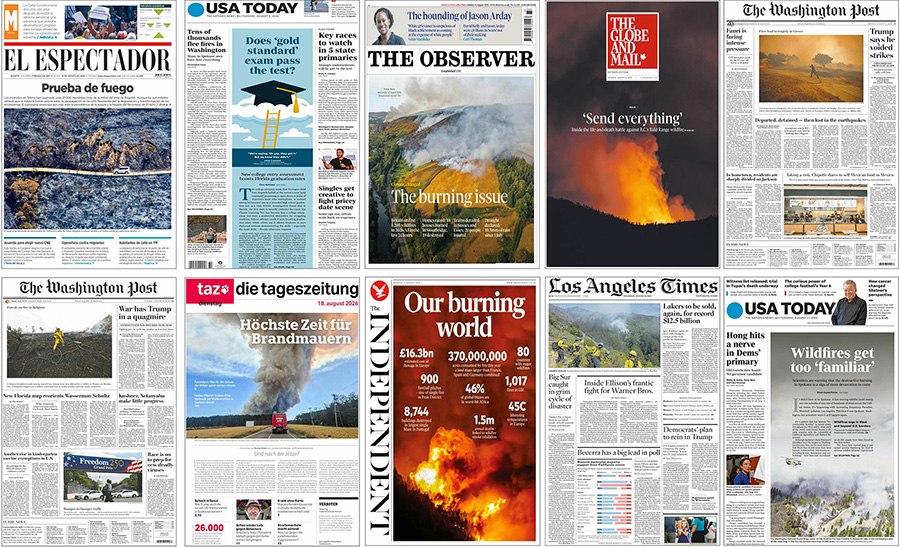
Figure 4. Examples of newspaper front pages in August 2026 covering heat waves and wildfires in Europe, making connections with climate change.
Debris and mud settlements following flash floods on August 28, 2026 in DevGhat village, Nepal. Photo credit: Getty Images. |
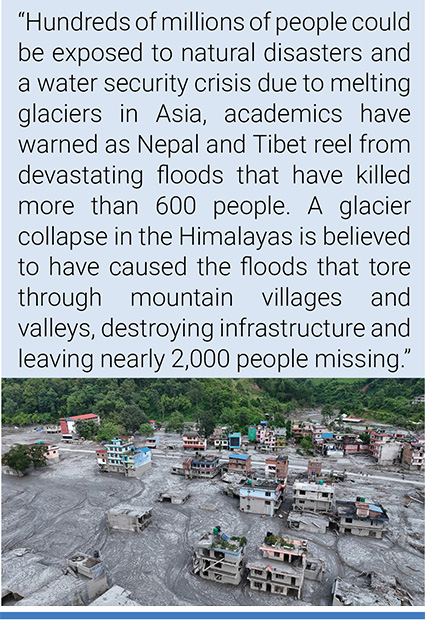
Ending the month was news attention paid to the tragic flood event near the Nepal/Tibet border – with several stories making links to a changing climate – across the world. While immediate climate attribution to events like these can be challenging on short deadline for reporting, these are the kinds of events that have physically become more probable in these times of human-caused climate change. For example, Independent journalist James C. Reynolds reported, “hundreds of millions of people could be exposed to natural disasters and a water security crisis due to melting glaciers in Asia, academics have warned as Nepal and Tibet reel from devastating floods that have killed more than 600 people. A glacier collapse in the Himalayas on Wednesday is believed to have caused the floods that tore through mountain villages and valleys on Wednesday, destroying infrastructure and leaving nearly 2,000 people missing. David Simon, professor of development geography at Royal Holloway, University of London, warned that natural disasters of this scale are likely to continue as climate change brings more intense summers to the continent. As glaciers retreat and more “catastrophic breakoffs” occur, water reservoirs held in the ice will diminish, with “stark” longer-term consequences for the rivers that nourish South Asia and parts of Central Asia and Tibet - if current trends continue in line with the higher climate change scenarios”. As a second example, Associated Press correspondents Niranjan Shrestha and Shristi Kafle wrote, “Rescue teams and military helicopters searched Thursday for hundreds of missing people along the mountainous Nepal-China border, where a deadly torrent of water and mud several stories high swept through communities a day earlier following a glacier collapse. Videos of the disaster showed people running before the floodwaters swallowed them up and washed out buildings and bridges. More than 390 people were killed, according to authorities in Nepal and China, and more than 1,400 were missing, including hundreds of foreigners and pilgrims. Hundreds of others were displaced across the Himalayan region. The lush valleys of the Himalayan mountain range — home to many of the world’s highest peaks and remaining glaciers — are especially vulnerable to flooding and landslides. Melting glaciers have become more common because of human-caused climate change”.
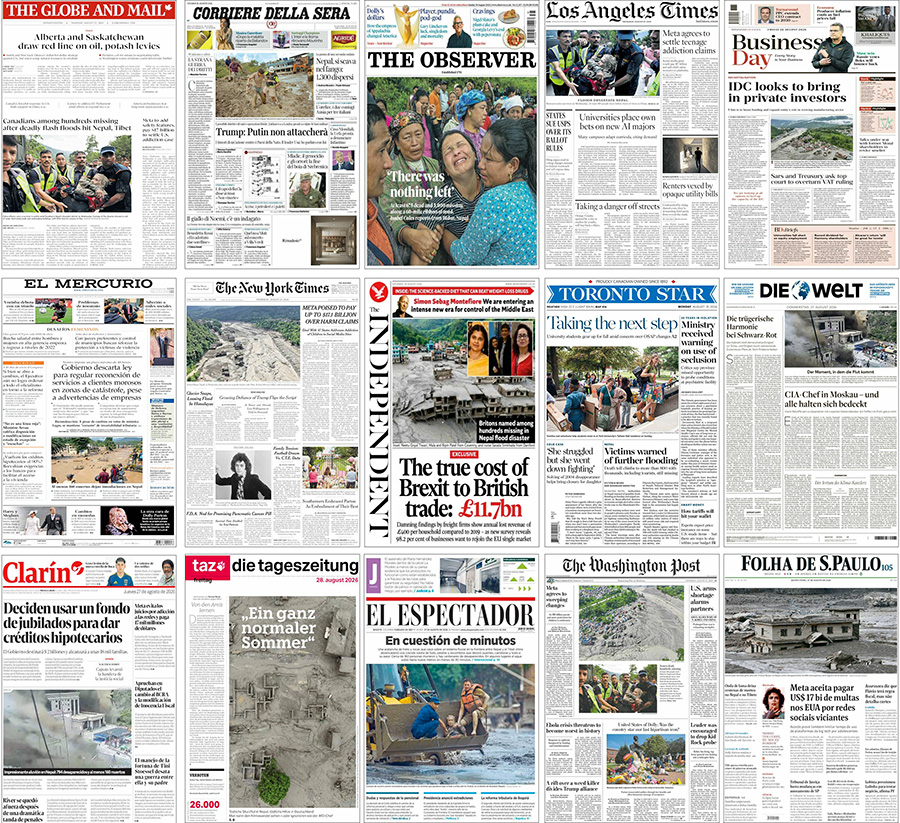
Figure 5. Examples of newspaper front pages in August 2026 covering the tragedy in Nepal and Tibet making connections with climate change.
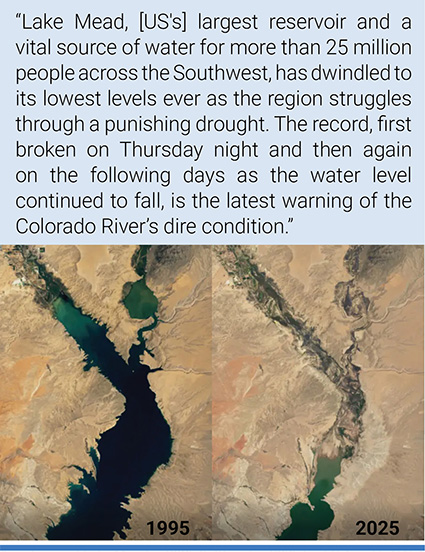
Aerial view of Lake Mead in 2005 (left) and in 2025 (right). Credit: NASA Goddard Space Flight Center. |
Next, we look at political and economic-themed media stories about climate change or global warming. Ongoing reporting related to the war with Iran and the uncertainty in the Strait of Hormuz pushed into climate change news. For example, Guardian correspondents Jillian Ambrose and Damian Carrington revealed, “Eight of the biggest oil companies amassed profits of more than $90bn (£67bn) in just three months as the Iran conflict sent energy prices soaring and the emissions-fuelled climate crisis caused deadly heatwaves. The windfall war profits have reignited calls for oil and gas supermajors such as Saudi Aramco and BP to pay for the environmental damage caused by “cashing in on human misery” and fund a rapid transition to renewable energy. Guardian analysis found that the eight listed oil producers made almost $93bn (£69bn) in the three months to the end of June – the first full financial quarter after the US-Israeli war on Iran triggered a surge in global oil prices to highs above $126 a barrel. The companies have used the biggest disruption of fossil fuel supplies in the market’s history to almost double their combined profits from just under $50bn in the same period last year, with campaigners warning that millions of households are left paying the price in higher bills and climate chaos. The data suggests the eight oil companies – Aramco, BP, Shell, Equinor, TotalEnergies, Eni, Chevron and ExxonMobil – made more than $700,000 of profit every minute over the spring quarter. While their market valuations were swelling by about $600bn to above $3tn, temperatures built towards a run of deadly heatwaves, all made more likely and more severe by burning fossil fuels. Carbon emissions from the world’s biggest fossil fuel firms were directly linked to fatal spells of hot weather for the first time by scientific analysis published last September. It found the emissions from any one of the 14 biggest companies were each enough to cause more than 50 heatwaves that would otherwise have been virtually impossible. The biggest oil profits in the spring quarter were raked in by Saudi Arabia’s state-owned oil company, Aramco, which reported a 34% increase in its quarterly net income to more than $33bn, even as its infrastructure was damaged by drone and missile strikes from Iranian and Houthi forces”.
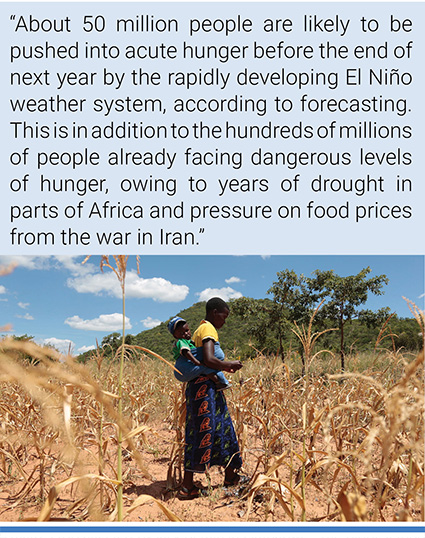
A maize crop affected by lack of rain in Zimbabwe. ‘The biggest food security impact, in southern Africa, will be during the 2027 to 2028 lean season,’ one expert said. Photo credit: Aaron Ufumeli/EPA. |
In the US, record drought in the west has challenged water availability for businesses and families as a Colorado River Compact is negotiated between the upper basin states of Colorado, Utah, Wyoming and New Mexico and the lower basin states of Arizona and California. Links in several stories. For example, New York Times correspondent Reis Thebault reported, “Lake Mead, the nation’s largest reservoir and a vital source of water for more than 25 million people across the Southwest, has dwindled to its lowest levels ever as the region struggles through a punishing drought. The record, first broken on Thursday night and then again on the following days as the water level continued to fall, is the latest warning of the Colorado River’s dire condition. The river system, a lifeblood for much of the Western United States, is threatened by rising temperatures and decades of overuse. The seven states whose cities and farmers rely on it are locked in tense negotiations over how to divvy up what little water remains. Lake Mead’s milestone is a reminder that the clock is ticking…earlier this year, federal officials decided to reduce water flows from Lake Powell in order to keep its level high enough to avoid damaging Glen Canyon Dam infrastructure. The decision cut the water flowing into Lake Mead, effectively sacrificing it to save Lake Powell, said Eric Kuhn, a former general manager of the Colorado River Water Conservation District. It was understandable, he said, because Lake Powell was closer to reaching the point below which its dam could no longer produce power. But, he added, with climate change bringing ever warmer and drier conditions to the region, such strategies can go only so far”.
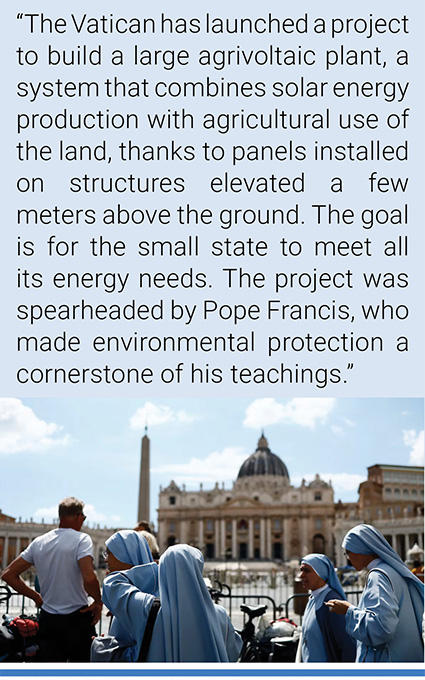
St. Peter's Basilica in Vatican City. Photo credit: Cecilia Fabiano/LaPresse. |
Third, we monitor intersecting cultural-themed media stories relating to climate change or global warming that were evident in August. Ongoing hot conditions across the world earned media coverage as it related to livelihoods and everyday experiences. For example, BBC News correspondents Zoie O'Brien and Henry Moore noted, “There could be a shortage of certain food products if the current drought conditions continue, the National Farmers' Union (NFU) has warned. NFU president Tom Bradshaw said yields of wheat and oats were "very, very poor" this year and warned livestock farmers have had to use their winter feed rations because they have been unable to grow grass. Drought has been declared across large parts of England and the whole of Wales as successive heatwaves left water supplies under strain, with more than 20 million people now under hosepipe bans. Amber heat health alerts have also been issued for large parts of England, including the Midlands, the south-east and south-west of England…after a wet and mild start to the year, it has been exceptionally dry hot and dry with a succession of heatwaves across the UK. The combination of low rainfall and prolonged heat has quickly depleted water reserves in soils, vegetation and rivers. While droughts can occur naturally, climate change is making weather patterns more erratic, and heatwaves more frequent and intense. Scientists say there is a greater risk of droughts happening as a result, and of them being more severe and longer-lasting when they do”. Elsewhere, Guardian Environment editor Fiona Harvey wrote, “About 50 million people are likely to be pushed into acute hunger before the end of next year by the rapidly developing El Niño weather system, according to forecasting. This is in addition to the hundreds of millions of people already facing dangerous levels of hunger, owing to years of drought in parts of Africa and pressure on food prices from the war in Iran. Even if the forecast El Niño is less strong than some models predict, it will tip many countries over the edge, adding more than a fifth to the 225 million people in 45 countries currently in acute food insecurity, the UN’s World Food Programme (WFP) warned on Wednesday. Central and South America, the Caribbean and southern Africa are likely to be worst affected, according to the analysis. In south and south-east Asia there is likely to be less rainfall than usual, which would cause serious problems for agriculture and farmers. This year’s El Niño – a weather system that develops every few years in the Pacific Ocean and brings changes to rainfall patterns around the world – is shaping up to be the strongest in at least 70 years. Some are calling it a “super El Niño”, though this term is not officially recognised. What is certain is that its impacts and strength are being strongly affected by the climate crisis. Earlier this year, experts said a strong El Niño could work in tandem with global heating to deliver the hottest year on record either this year or, more likely, in 2027. Private sector forecasters have already warned of the impact of the gathering El Niño on global food prices, but the report published by the WFP is the first to look closely at global hunger. The WFP said it was hoping to reduce the effects of the extreme weather through early warning systems and “anticipatory” relief efforts, for which at least $80m (£60m) is budgeted. The consequences will still be far-reaching, as farmers may take more than one season to exhaust their food supplies. In southern Africa, for instance, the main growing season stretches from October this year to March 2027, but it will be about nine months later, during the lean season following the harvest, that the worst impacts will bite”.
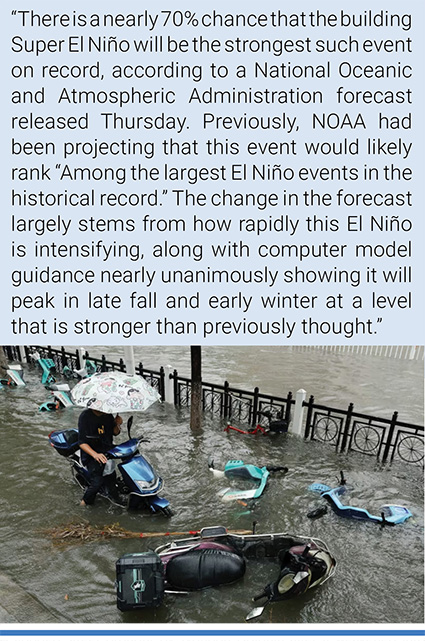
A flooded street brought by Typhoon Dolphin after it weakened into a tropical storm, in Xiangyang, Hubei province, China, on August 11. Photo credit: Go Nakamura/Reuters. |
Elsewhere, news covered how the Vatican is investing in renewable energy with a large solar plant to meet its energy needs. For example, El País journalist Lorena Pacho noted, “The Vatican has launched a project to build a large agrivoltaic plant, a system that combines solar energy production with agricultural use of the land, thanks to panels installed on structures elevated a few meters above the ground. The goal is for the small state to meet all its energy needs. The project was spearheaded by Pope Francis, who made environmental protection a cornerstone of his teachings and who, in 2024, ordered the construction of the renewable energy plant with the apostolic letter Fratello Sole (Brother Sun), a document in which the pontiff, who died last year, reaffirmed his commitment to the energy transition and the use of renewable energy as a response to the climate crisis. One of the first steps toward fulfilling Francis's mandate, now taken up by Leo XIV, came in July 2025, when the Holy See and Italy signed an agreement to regulate both the construction of the plant and its connection to the Italian electricity grid.”
Last, we explore climate change or global warming stories with scientific themes in August. For instance, a US National Oceanic and Atmospheric Association (NOAA) report linking El Niño intensity and climate change generated media interest. For example, CNN journalist Andrew Freedman reported, “There is a nearly 70% chance that the building Super El Niño will be the strongest such event on record, according to a National Oceanic and Atmospheric Administration forecast released Thursday. Previously, NOAA had been projecting that this event would likely rank “Among the largest El Niño events in the historical record.” The change in the forecast largely stems from how rapidly this El Niño is intensifying, along with computer model guidance nearly unanimously showing it will peak in late fall and early winter at a level that is stronger than previously thought. NOAA’s El Niño intensity records date back to 1950. El Niño is a climate cycle characterized by hotter than average ocean temperatures in the central and eastern tropical Pacific. This warmer water transfers vast quantities of heat into the atmosphere via clouds and heavy precipitation. This, in turn, helps shift weather patterns across the globe, favoring drought in Indonesia and Australia, flooding in parts of South America and many other impacts elsewhere. The intensity of an El Niño is determined by how hot the ocean temperatures get compared to average in a benchmark region of the tropical Pacific. NOAA expects this event to exceed even the massive Super El Niño that occurred in 1982 to 1983, which was the previous record-holder for its intensity”.
A man carries a child through sargassum seaweed after cooling off in the ocean in Miami Beach, Florida. Photo credit: Rebecca Blackwell/AP. |
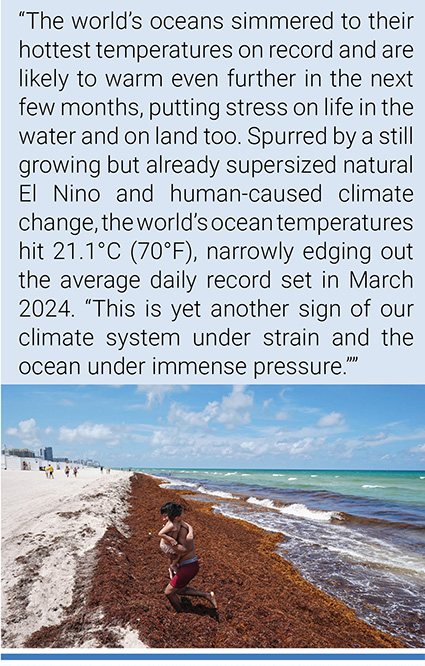
Elsewhere, scientific studies linking heat and health impacts – with links to climate change – earned media attention. For example, Guardian reporter Denis Campbell wrote, “People aged 60 and over face dangers to their health from exposure to heat at much lower temperatures than previously thought, research has found. Older adults will bear the brunt of increasingly frequent sustained spells of extreme heat globally as the world continues to warm up, according to a study in The Lancet Planetary Health. Heatwaves will leave huge and growing numbers of people worldwide of all ages suffering from uncompensable heat stress (UHS) – where the body loses the ability to cool itself – and thus at risk of serious damage to their health, including death… Dr Simon Williams, an expert in the impact of heat on human health and the resulting inequalities at Swansea University, said: “This is a very significant study, with findings suggesting that heatwaves and extreme heat exposure is going to be a growing threat to human health in the coming years. In particular, it shows that heatwaves have unequal health impacts, with older adults particularly vulnerable.” He added that the study suggested older adults were “at risk of harmful and potentially fatal heat stress” at just 1.5C of warming above preindustrial levels, compared with 4C for younger adults. Each additional degree of global heating “exposes roughly one billion more people to at least 180 hours of UHS annually”, the study says. This burden falls disproportionately on older adults. If heating continues to escalate, parts of the tropics and subtropics could become uninhabitable, especially for older people, the authors said. Caroline Abrahams, the charity director at Age UK, said: “These findings are alarming. This study means there’s now no denying that extreme heat poses a very real health threat to our older population”. Meanwhile, Associated Press journalist Seth Borenstein wrote, “The world’s oceans simmered to their hottest temperatures on record over the weekend and are likely to warm even further in the next few months, putting stress on life in the water and on land too, the European climate service Copernicus announced Monday. Spurred by a still growing but already supersized natural El Nino and human-caused climate change, the world’s ocean temperatures hit 21.1 degrees Celsius (70 degrees Fahrenheit) on Friday and Saturday, narrowly edging out the average daily record set in March 2024, said Samantha Burgess, strategic climate lead for Copernicus. “This is yet another sign of our climate system under strain and the ocean under immense pressure,” Burgess said. Jane Lubchenco, an oceanographer and former chief of the U.S. National Oceanic and Atmospheric Administration called the record “very troubling.” “An ocean this warm destabilizes weather patterns and threatens food security, economic prosperity and marine life,” Lubchenco said in an email. “A warmer ocean is not our friend.” When the ocean warms it becomes more acidic and carries less oxygen which hurts food industries that rely on the seas, Burgess said. It also changes ocean currents and weather patterns, giving more juice to storms to make them rainier and make storm surge bigger, Burgess said…Normally, because most of the Southern Hemisphere is ocean, the world’s sea surface temperature peaks in March and April, as the southern summer draws to a close. But this year, the record was set in August, Burgess said. So the oceans will keep getting hotter until the current El Nino — a natural temporary warming of parts of the Pacific that then warps weather and raises temperatures globally — reaches its peak, which is expected sometime between November and January, she said”.

Figure 6. Examples of newspaper front pages with climate change stories in August 2026.
- report prepared by Max Boykoff, Rogelio Fernández-Reyes, Ami Nacu-Schmidt, Jeremiah Osborne-Gowey and Olivia Pearman