Monthly Summaries
Issue 115, July 2026 | "Uncharted territory”
[DOI]
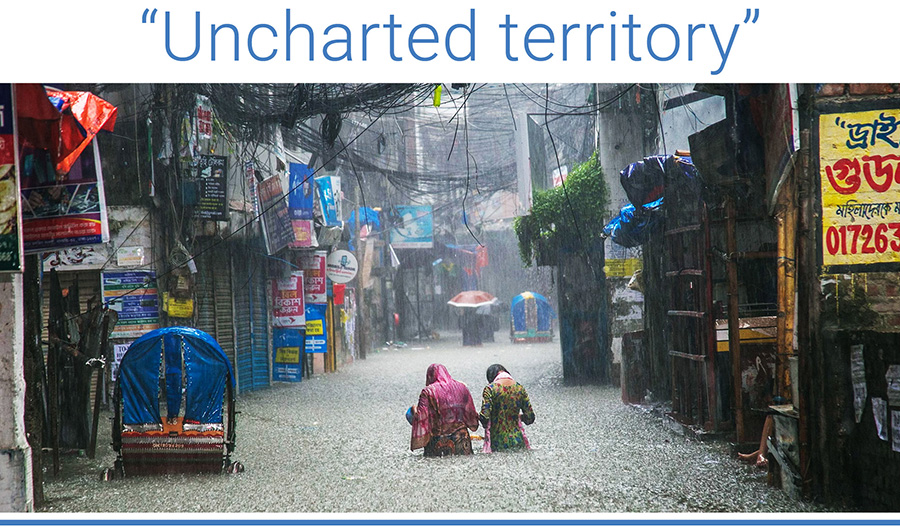
Bangladesh is one of several countries in the region to experience heavy rains and flash floods. Photo credit: Rayhan Ahmed/Zuma Press Wire/Shutterstock.
July media coverage of climate change or global warming in newspapers around the globe continued to increase again, going up 19% from June after an 14% increase the month before in May. International wire coverage also rose 33% in July 2026. That said, coverage in 2026 continues to remain lower than 2025. Comparing the first seven months of 2026 to the first seven months of 2025, coverage has fallen just under 28%, but is making up ground. Meanwhile, frequency of coverage in July 2026 was 9% lower than in July 2025. Figure 1 shows trends in newspaper media coverage at the global scale – organized into seven geographical regions around the world – across 227/12 years, from January 2004 through July 2026.
As political pronouncements diminished, ecological and meteorological events – heat waves, wildfires, drought – with links to a changing climate were prominent of overall coverage this month. Yet, when political leaders, public officials, researchers, journalists, editors, and other leading voices fail to connect the dots, they squander opportunities to further enrich public conversations about these intersecting challenges and threat multipliers in these pivotal times. While immediate climate attribution to 112oF in Sudan and 120oF in Algeria, and to flooding in Vietnam may be challenging on short deadline for reporting, these are the kinds of events that have physically become more probable in these times of human-caused climate change.
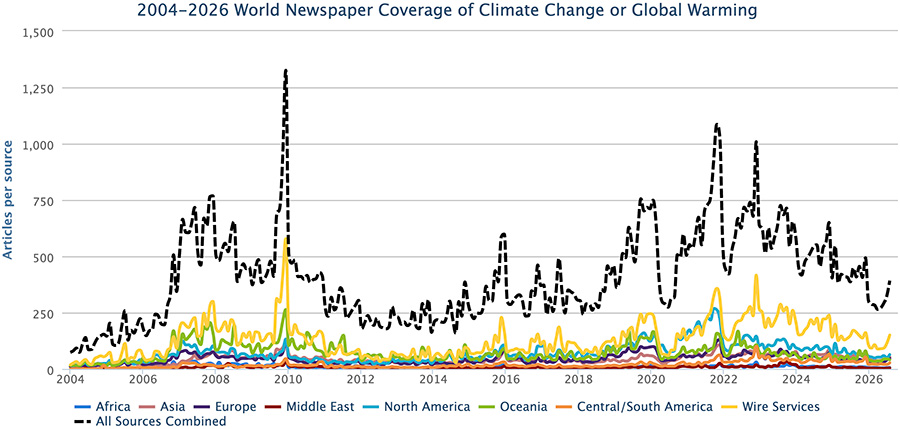
Figure 1. Newspaper media coverage of climate change or global warming in print sources in seven different regions around the world, from January 2004 through July 2026.
At the regional level, July 2026 coverage everywhere but in Oceania (down 8%): Asia ( up [+]13%), Africa (+17%), the European Union (EU) (+23%), North America (+26%), Latin America (+33%), and the Middle East (+43%). It is useful to track increases in climate change coverage in Europe again this month as ecological/meteorological and political/economic stories pervade, in particular. Yet, a comparison of July 2026 to July 2025, levels of coverage still were down everywhere but in the EU (up 8%): the Middle East (down [-]5%), Asia (-13%), Oceania and North America (each -17%), Latin America (-20%), and Africa (-32%). Figure 2 shows trends in newspaper media coverage in Europe (EU) across 267/12 years, from January 2004 through July 2026.
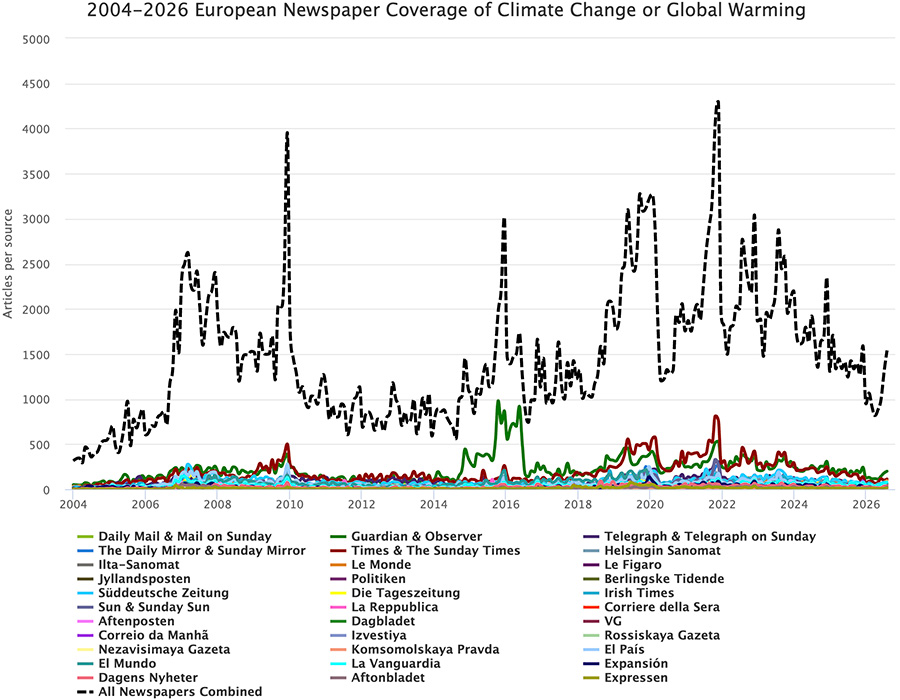
Figure 2. Coverage of climate change or global warming in 33 newspapers in the European Union from January 2004 through July 2026: Daily Mail and Mail on Sunday (England), Guardian and Observer (England), Telegraph and Telegraph on Sunday (England), The Daily Mirror and Sunday Mirror (England), Times and The Sunday Times (England), Helsingin Sanomat (Finland), Ilta-Sanomat (Finland), Le Monde (France), Le Figaro (France), Jyllandsposten (Denmark), Politiken (Denmark), Berlingske Tidende (Denmark), Süddeutsche Zeitung (Germany), Die Tageszeitung (Germany), Irish Times (Ireland), Sun & Sunday Sun (England), La Repubblica (Italy), Corriere della Sera (Italy), Aftenposten (Norway), Dagbladet (Norway), VG (Norway), Correio da Manhã (Portugal), Izvestiya (Russia), Rossiskaya Gazeta (Russia), Nezavisimaya Gazeta (Russia), and Komsomolskaya Pravda (Russia), El País (Spain), El Mundo (Spain), La Vanguardia (Spain), Expansión (Spain), Dagens Nyheter (Sweden), Aftonbladet (Sweden), and Expressen (Sweden).
Among our country-level monitoring, in July United States (US) print coverage increased 22% from June 2026 after a 10% drop from May to June levels of coverage (see Figure 3). US television coverage increased 34% from June 2026 after dropping 8% from May to June 2026. Meanwhile, United Kingdom (UK) print coverage rose 11% in July 2026 from June 2026 coverage, and also rose 2% from a year previous (July 2025). Figure 2 shows trends in newspaper media coverage in the US across 267/12 years, from January 2000 through July 2026.

Figure 3. US print coverage of climate change or global warming – in Washington Post, Wall Street Journal, New York Times, USA Today, and Los Angeles Times – from January 2000 through July 2026.
Moving to content in July media stories, we begin with a look at ecological and meteorological themes. Beginning the month was news attention paid to Super Typhoon Bavi – with links to a changing climate – emerged in several news sources. For example, Independent journalists Stuti Mishra and Sophie Austin reported, “Super Typhoon Bavi made landfall on the US island of Rota in the Pacific, causing widespread destruction and prompting warnings of a life-threatening situation across the Northern Marianas and Guam, as the storm continues westward toward the Philippines. The National Weather Service said the western eyewall of the storm passed directly over Rota Monday morning, with the entirety of the island within the eye. Winds exceeding 150 miles per hour will continue across Rota during eyewall passage, it said, warning of a "catastrophic damage and life-threatening situation."…The storm comes as the World Meteorological Organisation has warned that El Nino, a natural climate phenomenon that warms surface temperatures in the central and eastern equatorial Pacific and alters global wind and rainfall patterns, has already begun and is likely to be strong”.
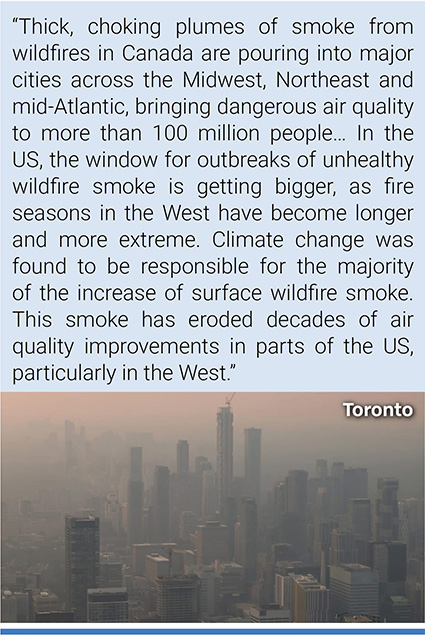
Wildfire smoke seen in Toronto, Canada. Photo credit: AP/Getty Images/Reuters/Imagn Images. |
Throughout the month of July, there were many stories of heat, drought and wildfires. For example, in North America Associated Press journalist Holly Ramer wrote, “Gaining freedom from the heat will be a challenge for the eastern U.S. heading into the long Fourth of July weekend, prompting some communities to cancel, postpone or otherwise alter their Independence Day plans. Dangerous, record-breaking heat will continue across much of the central and eastern U.S. through Friday and will continue along the East Coast through the weekend, the National Weather Service said Thursday. Temperatures in the high 90s Fahrenheit (30 degrees Celsius) were forecast for the Northeast; New York and Boston both hit 100 degrees Thursday. Humidity is expected to make it feel even hotter, all but ensuring that sweat will dampen spirits at many celebrations marking 250 years of American independence”. Meanwhile, USA Today journalists Karissa Waddick and Dinah Voyles Pulver noted, “A heat wave sweeping across much of the eastern and central United States has killed at least 30 people in the past week, according to local officials, as more dangerously hot conditions are expected to soon hit the West. Record-high temperatures in dozens of East Coast communities canceled festivities and sent hundreds to emergency rooms over the Fourth of July weekend. New Jersey officials believe extreme heat has caused 29 deaths since July 2, the most of any state so far. Many of the victims were found in homes without air conditioning, a few were outside of their residences, some were in streets and some were in parked cars, Raynard Washington, the commissioner for the state Department of Health, said during a July 4 news conference. The ages of the victims range from mid-30s to 80s, agency spokeswoman Dalya Ewais said in an emailed statement”.
Wildfires and smoke in North America also generated news. For example, CNN correspondents Dakota Smith and Brandon Miller observed, “Thick, choking plumes of smoke from wildfires in Canada are pouring into major cities across the Midwest, Northeast and mid-Atlantic, bringing dangerous air quality to more than 100 million people…In the US, the window for outbreaks of unhealthy wildfire smoke is getting bigger, as fire seasons in the West have become longer and more extreme. Climate change was found to be responsible for the majority of the increase of surface wildfire smoke. This smoke has eroded decades of air quality improvements in parts of the US, particularly in the West”.
Smoke rising from a wildfire in Pouzols-Minervois in south-France. Photo credit: Idriss Bigou-Gilles/AFP/Getty Images. |
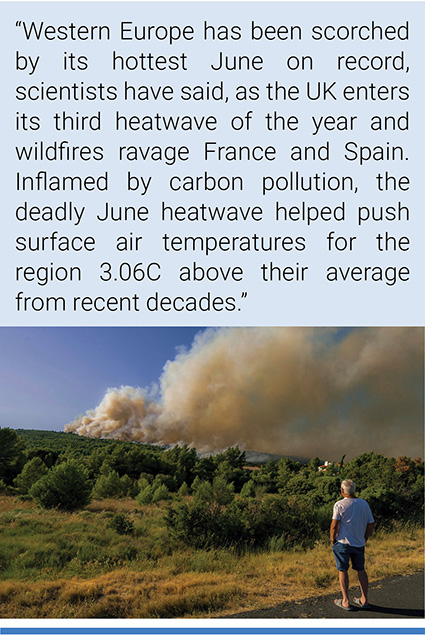
In Europe, stories of heat also proliferated. For example, Le Monde correspondent Delphine Roucaute reported, “A rapid-fire communication was aimed at quashing all speculation over deaths related to France's record-breaking June heatwave, even if it meant presenting a partial picture that could get worse. In an update published on Friday, July 3, Santé publique France, the French national public health agency, estimated that 2,025 additional deaths were recorded between June 22 and June 28 compared to the previous week, an increase of 29.1%. While these figures should be interpreted with caution due to incomplete data, they offer a first snapshot of the fatal effects of the historic heatwave that swept across the country”. Elsewhere, Guardian journalists Ajit Niranjan and Damian Carrington wrote, “Western Europe has been scorched by its hottest June on record, scientists have said, as the UK enters its third heatwave of the year and wildfires ravage France and Spain. Inflamed by carbon pollution, the deadly June heatwave helped push surface air temperatures for the region 3.06C above their average from recent decades, according to the EU’s Copernicus climate monitoring service. Globally, June 2026 was 0.56C hotter than the 1991-2020 average and 1.39C hotter than preindustrial levels, making it the second-warmest June on record, the agency found. The planet’s oceans were hotter than scientists had ever seen them. “Together, these records reflect a climate system continuing to accumulate heat,” said Samantha Burgess, a climate scientist at Copernicus. “The result is increasingly intense heatwaves, a persistently warm ocean, and growing risks for people, ecosystems and infrastructure”.”
Stories of smoke and wildfires also were frequent. For example, Agence France Presse and CBS News reported, “Luggage-clad residents and tourists fled the French peninsula of Cap Ferret by boat and the smell of smoke drifted into parts of Spain's capital Madrid on Friday as wildfires swept through multiple parts of western Europe, triggering states of emergency and calls for EU help. Some 40,000 people have been evacuated in southwestern France due to a fire that has ravaged more than 25,000 acres, Interior Minister Laurent Nunez told AFP, calling the blaze "the largest fire of the season."…In Spain, two separate blazes were raging out of control within 62 miles of Madrid, with some residents of the Spanish capital waking up to the smell of smoke, according to residents. "The gendarmes came and knocked on every door, the fire was about 500 meters (yards) away — we grabbed some things and left," said Patrick Martineau, a 69-year-old resident of Le Porge, near Bordeaux. Three firefighters have been killed as southern Europe endures more severe heat, with temperatures topping the 40 degree Celsius mark (104 Fahrenheit) in some areas. At least 5,700 more people than usual died in France last month amid a historic heat wave, French health officials said earlier this week. That figure represented a sharp increase in the estimated death toll nationwide from June and early July's record temperatures”. Concurrently, El País journalist Manuel Planelles wrote, “Climate change fuels record-breaking wildfires in Spain's hottest July on record. July has been “extremely warm” the classification used by the Spanish State Meteorological Agency (AEMET) for months or seasons that deviate significantly from the norm. So much so that it has become the warmest July on record—tied with July 2022—since official records began in the mid-20th century…in the current climate, events of this intensity are now “expected to occur once every 20 years in southwestern France and once every six years in central Spain.” Also, La Vanguardia journalist Josep Fita noted, “European countries recorded more than 10,000 above-average deaths during the unprecedented heat wave that struck the western part of the continent in late June. The vast majority—more than 9,000—were among people aged 65 and over, according to data published by EuroMOMO, a network supported by the European Centre for Disease Prevention and Control and the WHO. Extreme heat can cause death by exacerbating cardiovascular and respiratory diseases, with older people being the most vulnerable”.
At the close of July, New York Times writer Alicia P.Q. Wittmeyer observed, “I’m writing this on another sweltering 33-degree day in London; at this point, they’ve almost started to feel routine. We’re watching wildfires consume hundreds of thousands of hectares across France and Spain. This year’s fire season is already breaking records, and it’s not over yet. Europe has had a rough summer. A season that not so long ago was associated with holidays and relaxation doesn’t feel quite the same when thousands of excess deaths are being attributed to heat”.
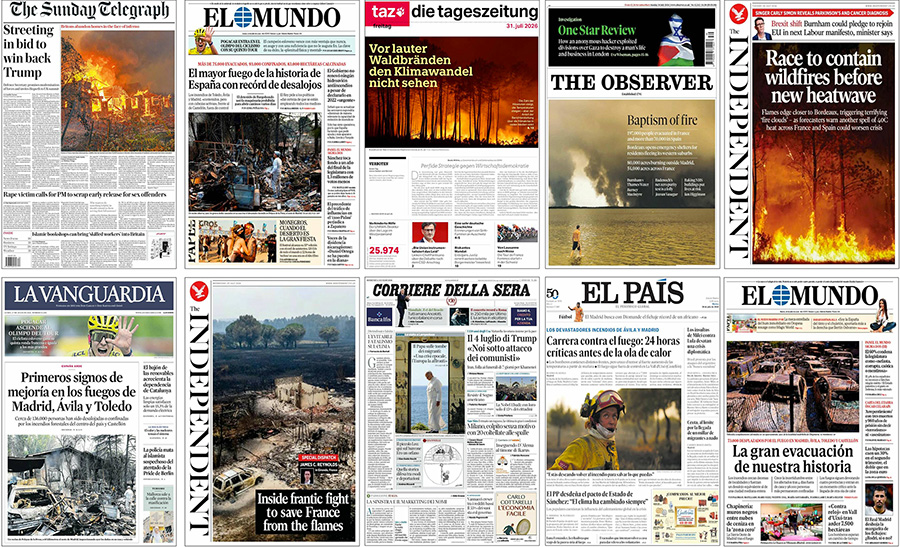
Figure 4. Examples of European newspaper front pages with climate change stories focusing on heat waves and a changing climate in July 2026.
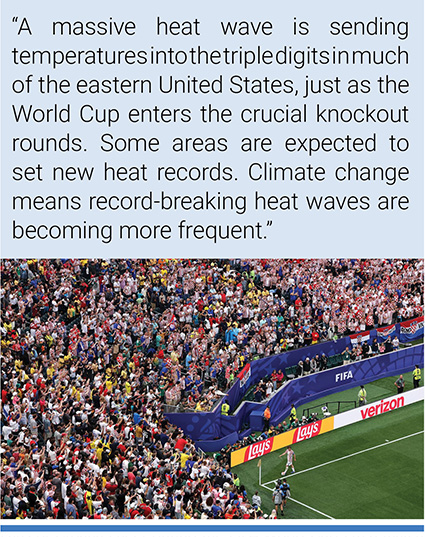
Fans of Croatia cheer during the FIFA World Cup 2026 match between Croatia and Ghana at Philadelphia Stadium. Photo credit: Kevin C. Cox/Getty Images. |
Also in July, flooding in India – with connections to climate change – prompted news coverage. For example, Agence France Presse reported, “Floods triggered by torrential monsoon rains have killed at least 41 people in India's northeast Assam state, officials said Thursday, as authorities pursued rescue and relief operations. Flood-related disasters are an annual occurrence across India during the monsoon months after the region's long summers, with many parts of the country facing water scarcity and drought…Hundreds of millions of people in India rely on the annual monsoon winds to bring rains that sustain agriculture and industry. Deadly weather-related disasters are common during the monsoon season from June till about August but experts say climate change, coupled with urbanisation, is increasing their frequency and severity”. Elsewhere, Guardian correspondents Nathasha May and Jonathan Watts wrote, “The extreme weather across the region can clearly be linked to climate change. Climate scientists have long predicted that large areas of Asia will disproportionately suffer from more intense heat, humidity and drought as a result of climate disruption caused by the burning of gas, oil and coal. The most recent report by the United Nations’ Intergovernmental Panel on Climate Change said rising temperatures raise the threat of “floods in monsoon regions in south, south-east and east Asia, and glacier melting in the Hindu Kush Himalaya region”. And World Weather Attribution scientists have warned that extreme rainfall from cyclones is being “supercharged” in south-east Asia, with a clear pattern of increasingly heavy rain over recent decades. The year 2025 saw devastating storms and rainfall across the region. It also saw ocean temperatures rise to record heights. So far, this year has brought record-breaking heatwaves. Extreme rainfall is more common and more intense because of human-caused climate breakdown across most of the world, particularly in Europe, most of Asia, central and eastern North America, and parts of South America, Africa and Australia. This is because warmer air can hold more water vapour and flooding has most likely become more frequent and severe in these locations as a result”.
Firefighters work on a wildfire in Ille-sur-Têt, southern France on July 6, 2026. Photo credit: Thibault Camus/AP. |
Moving to intersecting cultural-themed media stories relating to climate change or global warming, many were evident in July. The heat conditions in the World Cup in North America and the Tour de France in France and Spain earned media coverage. For example, National Public Radio reporter Rebecca Hersher noted, “A massive heat wave is sending temperatures into the triple digits in much of the eastern United States, just as the World Cup enters the crucial knockout rounds. Some areas are expected to set new heat records. Climate change means record-breaking heat waves are becoming more frequent. Conditions are particularly dangerous in the Northeast, where temperatures in the 90s combined with very high humidity have prompted the National Weather Service to issue warnings about extreme heat, including in cities hosting World Cup matches”. As a second example, as July began Guardian journalists Dharna Noor, Seán Clarke and Paul MacInnes wrote, “Nine matches in the World Cup group stage were played amid potentially dangerous heat and humidity, a Guardian analysis shows, as the global players’ union FIFPRO warned that heat would have to “play a bigger part” in the sport’s future scheduling decisions. The findings come as probably record-breaking heat and humidity will hit the midwest and eastern US this week and could make conditions even more challenging for players and fans at some games. The Guardian’s latest analysis of conditions looked at the World Cup’s 72-game group stage, which ended on Saturday last week, and found an estimated nine matches were played in conditions of severe heat that FIFPRO has previously said should trigger the delay or postponement of games. An additional 13 may have been played in cities with temperatures beyond that level of heat, but where stadiums were cooled by air conditioning. These matches were played amid wet bulb globe temperatures (WBGT) that may have been at or over 28C (82F), according to data for the place and time of the games – conditions FIFPRO has argued should trigger the delay or postponement of games…The lesson for everyone in the industry is that with a warming planet, heat conditions will play a bigger part in tournament and league scheduling decisions in the future,” a spokesperson from the FIFPRO union said in a comment when asked about the Guardian analysis findings. The UN’s top climate official also warned about how the climate crisis was affecting the sport”.
Credit: Guardian. Source: Met Office. |
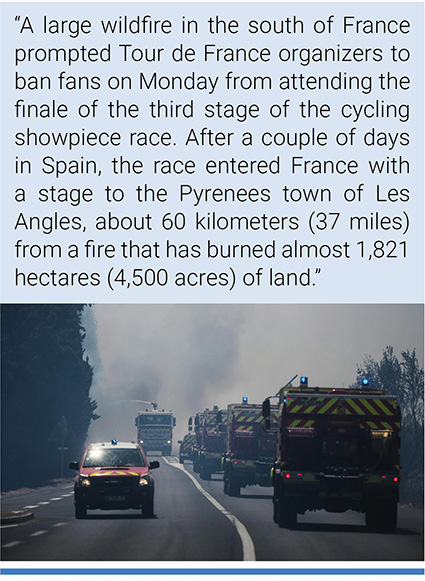
The July Tour de France was impacted by hot temperatures and was re-routed due to wildfires across France and Spain. This caught media interest. For example, Associated Press correspondent Suman Naishadham wrote, “A large wildfire in the south of France prompted Tour de France organizers to ban fans on Monday from attending the finale of the third stage of the cycling showpiece race. After a couple of days in Spain, the race entered France with a stage to the Pyrenees town of Les Angles, about 60 kilometers (37 miles) from a fire that has burned almost 1,821 hectares (4,500 acres) of land. Tour de France organizers said the large wildfire currently in the Pyrénées-Orientales required a large mobilization of wildfire-fighting resources, internal security forces, and other government agencies. “The top priority remains the protection of people, property, and natural areas, as well as bringing the fire under control,” authorities said. As a result, organizers decided that once the peloton reaches France for the last 40 kilometers (25 miles), the publicity caravan — a 10-kilometer (6-mile) procession of sponsor vehicles that precedes the race — would not be able to operate. Only riders and vehicles essential to the race would be allowed on the route, and spectators were asked not to gather on the roadside or at the finish area…Scientists warn that climate change is exacerbating the frequency and intensity of heat and dryness, especially in southeastern Europe, making the region more vulnerable to health impacts and wildfires”. Elsewhere, Times of India reported, “Extreme heat in Europe is not only a challenge for spectators anymore. It affects how top-level endurance athletes get ready to perform at their best. The 2026 Tour de France has been one of the hottest editions in recent years, with riders facing temperatures close to 400C and organisers shortening a stage because of extreme heat…Scientists have warned for years about climate change increasing the frequency and severity of extreme heat. According to the World Meteorological Organization (WMO), Europe is the fastest-warming continent, with the impacts of climate change becoming increasingly evident”.
Credit: CDC. |
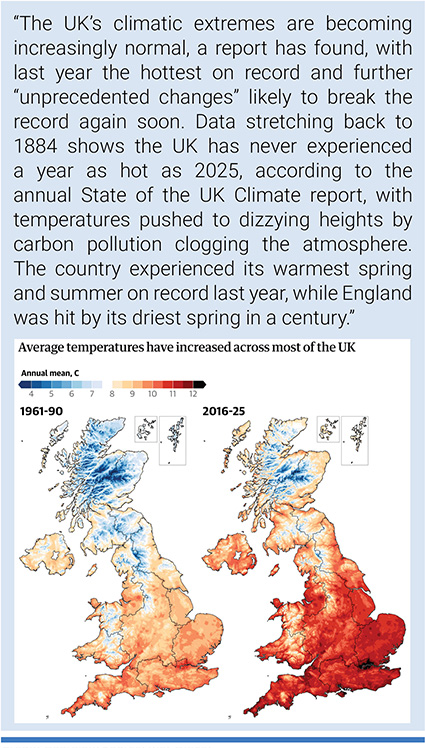
Continuing in the month of July were stories that threaded through scientific themes. Many of these stories grabbed onto the news hook of heat and climate change. For example, Independent correspondent Nicole Wootton-Cane reported, “Last month was the hottest June on record for England, and the second warmest in Wales, the Met Office said. Temperatures broke the previous record of 35.6C set in Southampton in June 1976 on three consecutive days last week, as weather bosses issued a rare “danger to life” red warning across parts of the UK”. Furthermore, Guardian journalist Ajit Niranjan wrote, “The UK’s climatic extremes are becoming increasingly normal, a report has found, with last year the hottest on record and further “unprecedented changes” likely to break the record again soon. Data stretching back to 1884 shows the UK has never experienced a year as hot as 2025, according to the annual State of the UK Climate report, with temperatures pushed to dizzying heights by carbon pollution clogging the atmosphere. The country experienced its warmest spring and summer on record last year, while England was hit by its driest spring in a century. The report comes as the UK faces the third deadly heatwave to have scorched Europe over the last two months. On Tuesday, the Met Office said the UK had already recorded as many 30C (86F) days in 2026 as in the extraordinarily hot year of 1976. “What we used to think of as extreme, we increasingly consider as normal,” said Mike Kendon, a scientist at the National Climate Information Centre and lead author of the report. “We are seeing unprecedented changes continuing … and every year adds to this body of evidence.” The report, published on Wednesday in the International Journal of Climatology, found the last four years in the UK were among the top five hottest on record, with higher averages from climate breakdown making dangerous extremes hotter”. Elsewhere, Guardian journalists Sam Jones and John Henley wrote, “Spain and France are bracing for another possible heatwave that could bring temperatures of 44C (111F) over the coming days, as figures show that June’s extreme heat was responsible for more than 2,000 excess deaths in the two countries. Spain’s state meteorological agency, AEMET, said a mass of dry and very hot air would bring persistently high temperatures to much of Spain from Saturday, adding that temperatures in parts of the south-east could hit 42C to 44C on Tuesday…The agency said the high temperatures could increase the likelihood of forest fires next week and warned older people and those with cardiovascular problems to take extra care in the daytime heat. AEMET said last month was the second-warmest June on record – surpassed only by June 2025 – with an average temperature that was 3.2C (5.8F) above the norm. Scientists have said the heatwave, which was the most severe and widespread to hit western Europe, was possible only due to the climate crisis driven by fossil fuel burning”.
Human-caused climate change made Spanish fires 20 times more likely, scientists calculate. Photo credit: Associated Press. |
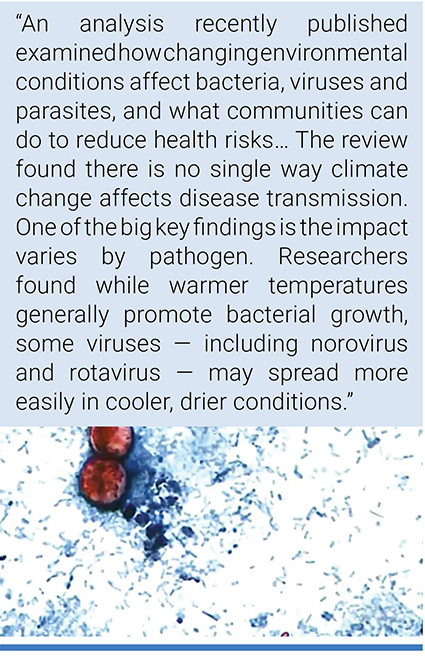
Further research in July made connections to disease and climate change. This attracted media stories. For example, CBS News correspondent Kelly Werthmann shared, “As Colorado experiences more extreme weather, from prolonged droughts and wildfires to heavy rainfall and flooding, researchers are taking a closer look at a consequence of climate change: the potential impact on human health. A new review co-led by researchers from the Colorado School of Public Health at the University of Colorado Anschutz Medical Campus in Aurora found that climate change is altering the conditions that influence the spread of waterborne diseases worldwide. The analysis, recently published in Nature Reviews Microbiology, examined how changing environmental conditions affect bacteria, viruses and parasites, and what communities can do to reduce health risks…The review found there is no single way climate change affects disease transmission. "One of the big key findings is the impact varies by pathogen," Carlton said. Researchers found while warmer temperatures generally promote bacterial growth, some viruses — including norovirus and rotavirus — may spread more easily in cooler, drier conditions. The study also highlights how extreme weather can indirectly increase disease risk. Floods and hurricanes can damage water and sanitation systems, and such disasters may force people into crowded living conditions that create additional opportunities for disease transmission, Carlton explained”.
Meanwhile, studies of warming ocean temperatures also earned media attention. For example, NBC News correspondent Chantal da Silva reported, “Temperatures on the ocean surface hit a record high in June, European scientists warned Wednesday, fueling fears of more dangerous heat waves this summer and fanning concerns over the escalating global climate crisis. Two separate services under the European Union’s Copernicus Earth observation program — the Copernicus Climate Change Service and the Copernicus Marine Service — announced they had both independently confirmed the record temperatures. Carlo Buontempo, director of the Copernicus Climate Change Service, warned that the rising temperatures could mark the “beginning of a new phase.” “With ocean temperatures at these levels and El Niño on the horizon, we are likely to see more temperature records fall in the coming months,” Buontempo said in a statement Wednesday. El Niño is a naturally occurring climate cycle that sees the central and eastern tropical Pacific Ocean become warmer than usual for months at a time. The world could be heading into “uncharted territory,” Buontempo warned”.

Figure 5. Examples of worldwide newspaper front pages with climate change stories in July 2026.
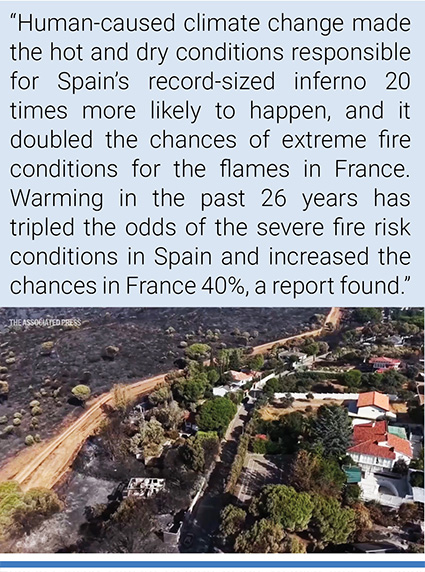
Finishing the month, Associated Press journalist Seth Borenstein wrote about new climate attribution studies – one by Dr. Sarah Feron and colleagues in Scientific Reports – noting, “Climate change’s fingerprints are all over the extreme fire weather that sparked this week’s devastating wildfires in Spain and France and has spiked Southern Europe’s burning the past eight years, two new studies conclude. Human-caused climate change made the hot and dry conditions responsible for Spain’s record-sized inferno 20 times more likely to happen, and it doubled the chances of extreme fire conditions for the flames in France, scientists at World Weather Attribution calculated in a rapid analysis Thursday, conducted while fires were still burning. Warming in the past 26 years has tripled the odds of the severe fire risk conditions in Spain and increased the chances in France 40%, the same report found. At the same time, researchers published a separate study on Thursday — written and edited long before this week’s fires began — that found the number of days that Southern Europe’s weather reached extreme fire-prone levels has more than doubled compared to decades ago. Both studies examined changes in the weather that creates fire-prone conditions. The measurements factor in air temperature, drought conditions, humidity and wind”.
Workers install solar panels on the roof of a house in Antipolo, Philippines. In the wake of the Iran war, the Philippines imported more than $400 million in solar panels from February to May. Photo credit: Ezra Acayan/Getty Images. |
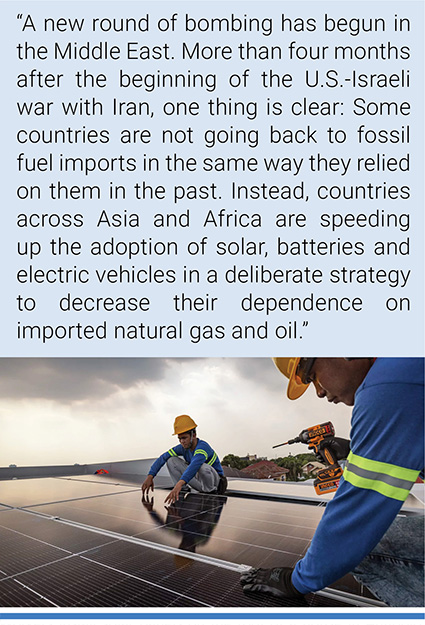
Despite making up a smaller portion of overall news coverage this month, July still saw some political and economic-themed media stories about climate change or global warming drawing attention in various outlets. Ongoing reporting on the war with Iran pushed into climate change news. For example, National Public Radio journalist Julia Simon reported, “A new round of bombing has begun in the Middle East. More than four months after the beginning of the U.S.-Israeli war with Iran, one thing is clear: Some countries are not going back to fossil fuel imports in the same way they relied on them in the past. Instead, countries across Asia and Africa are speeding up the adoption of solar, batteries and electric vehicles in a deliberate strategy to decrease their dependence on imported natural gas and oil. The war has underscored the precarity of oil and natural gas supplies and prices. The effective closure of the Strait of Hormuz cut off more than a fifth of liquified natural gas, or LNG supplies, and prices haven't been the same since. European and Asian prices for natural gas, which is mainly used for electricity and heating, are up more than 50% from when the war began. Oil prices climbed Wednesday after President Trump said the ceasefire was over. Countries are forging a new energy path with renewable and electric vehicle technologies sourced from China. In March, Chinese exports of solar panels were up more than 80% compared to last year, according to energy think tank Ember. China exported more than 2 million electric passenger vehicles between January and May, with nearly half of those exports occurring in April and May, according to a recent analysis note from SIA Energy, an oil and gas consultancy. "If China's car industry were handing out a salesman of the year award for 2026, President Trump would be a leading contender," the SIA Energy note says. Last year, the global use of electric vehicles meant the world avoided consuming around 1.7 million barrels of oil per day, according to the International Energy Agency. That's more than the daily crude oil production of Nigeria. Burning fossil fuels is the primary driver of global warming, so climate scientists see these energy transition technologies that cut into fossil fuel demand as key climate solutions”.
Finishing up the month, New York Times correspondent Claire Brown reported, “Top U.S. oil and gas executives have sold hundreds of millions of dollars’ worth of stock in their own companies since the Iran war triggered a supply crunch that sent energy prices soaring, according to a new analysis shared with The New York Times. Insiders have sold almost $400 million in fossil fuel company stocks in the months since the start of the war, researchers at the environmental nonprofit group Friends of the Earth found. Share prices in the companies rose after the United States and Israel first attacked Iran. Executives at ConocoPhillips reported the highest sales, totaling $96 million. Senior leaders at the natural gas exporters Cheniere Energy and Venture Global came in second and third. For all three companies, the value of executives’ total stock sales in the months since the start of the war is already higher than it was for all of 2025. (Diamondback Energy also reported high insider sales, but the analysis determined they were largely unrelated to the war.)”.
- report prepared by Max Boykoff, Rogelio Fernández-Reyes, Ami Nacu-Schmidt, Jeremiah Osborne-Gowey and Olivia Pearman