Monthly Summaries
Issue 114, June 2026 | "It reads like satire”
[DOI]

Umbrellas protecting from sun, not rain, near London’s Waterloo Station. Photo credit: Toby Melville/Reuters.
June media coverage of climate change or global warming in newspapers around the globe continued to rebound, jumping another 14% from May after an 8% increase the month before from April to May. That said, coverage in 2026 continues to remain lower than 2025. Comparing the first six months of 2026 to the first six months of 2025, coverage has fallen just under 32%. Meanwhile, frequency of coverage in June 2026 was 13% lower than in June 2025. International wire coverage also went up 22% in June 2026. Figure 1 shows trends in newspaper media coverage at the global scale – organized into seven geographical regions around the world – across 22 years, from January 2004 through June 2026.
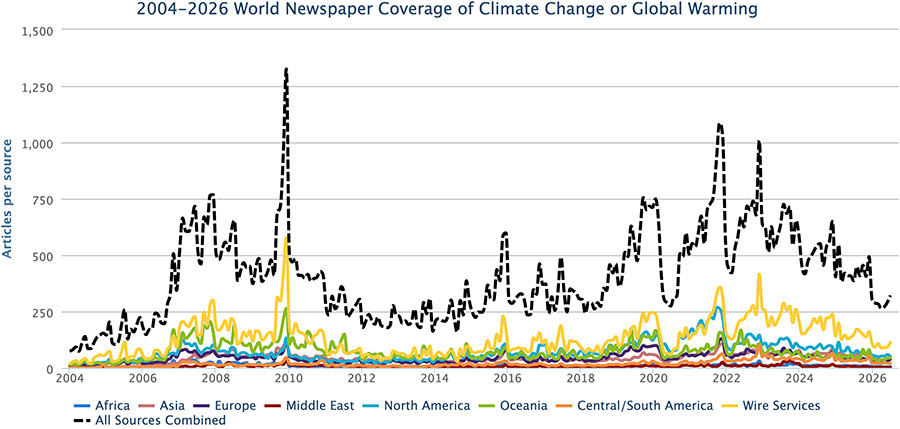
Figure 1. Newspaper media coverage of climate change or global warming in print sources in seven different regions around the world, from January 2004 through June 2026.
At the regional level, June 2026 coverage went down in the Americas: North American coverage dipped 14% and Latin American coverage ticked down 2%. Elsewhere, coverage increased from May 2026: in Oceania (+2%), Asia (+18%), Africa (+24%) and the European Union (EU) (+26%), while doubling in the Middle East. It is useful to track increases in climate change coverage in Europe again this month as ecological/meteorological and political/economic stories pervade, in particular (see Figure 2). Yet, a comparison of June 2026 to June 2025, levels of coverage remains diminished in 2026:
Oceania (-2%), Asia (-28%), Latin America (-30%), the EU (-34%), North America (-43%), Africa (-53%), and the Middle East (-65%).
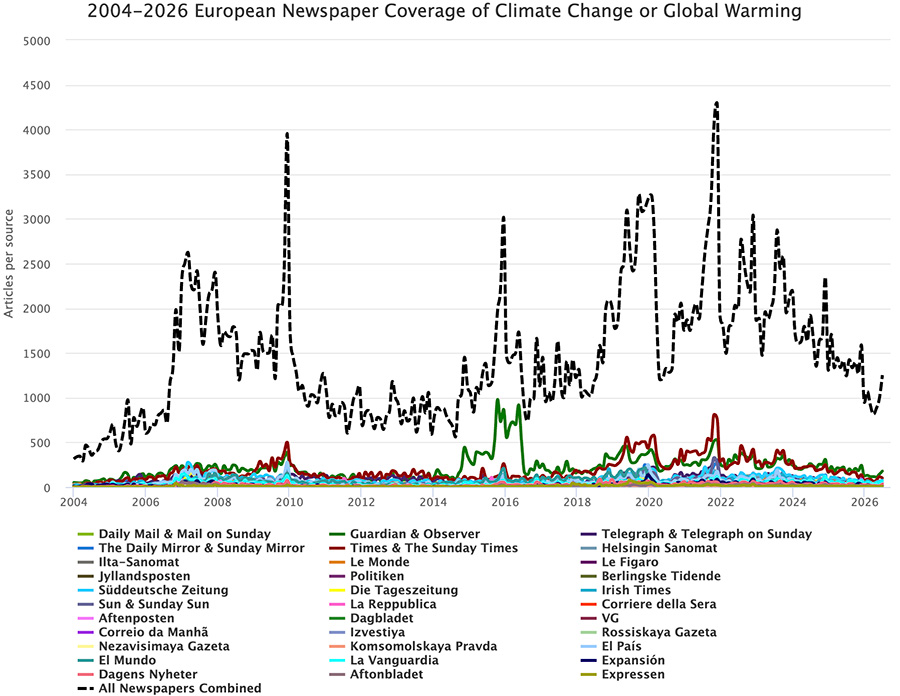
Figure 2. Coverage of climate change or global warming in 33 newspapers in the European Union from January 2000 through June 2026: Daily Mail and Mail on Sunday (England), Guardian and Observer (England), Telegraph and Telegraph on Sunday (England), The Daily Mirror and Sunday Mirror (England), Times and The Sunday Times (England), Helsingin Sanomat (Finland), Ilta-Sanomat (Finland), Le Monde (France), Le Figaro (France), Jyllandsposten (Denmark), Politiken (Denmark), Berlingske Tidende (Denmark), Süddeutsche Zeitung (Germany), Die Tageszeitung (Germany), Irish Times (Ireland), Sun & Sunday Sun (England), La Repubblica (Italy), Corriere della Sera (Italy), Aftenposten (Norway), Dagbladet (Norway), VG (Norway), Correio da Manhã (Portugal), Izvestiya (Russia), Rossiskaya Gazeta (Russia), Nezavisimaya Gazeta (Russia), and Komsomolskaya Pravda (Russia), El País (Spain), El Mundo (Spain), La Vanguardia (Spain), Expansión (Spain), Dagens Nyheter (Sweden), Aftonbladet (Sweden), and Expressen (Sweden).
Among our country-level monitoring, in June US print coverage dipped 10% from May 2026 levels of coverage, after increase of 11% in the previous month. Meanwhile, US television coverage dropped 8% after a previous increase of 27% in May 2026 from the previous month of April (see Figure 3).
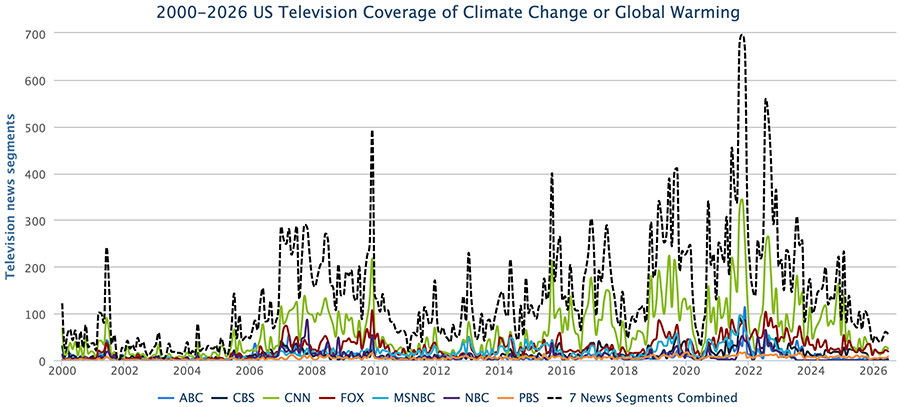
Figure 3. US television coverage of climate change or global warming – in ABC News, CBS News, CNN News, Fox News, MSNBC, NBC News, and PBS News – from January 2000 through June 2026.
|
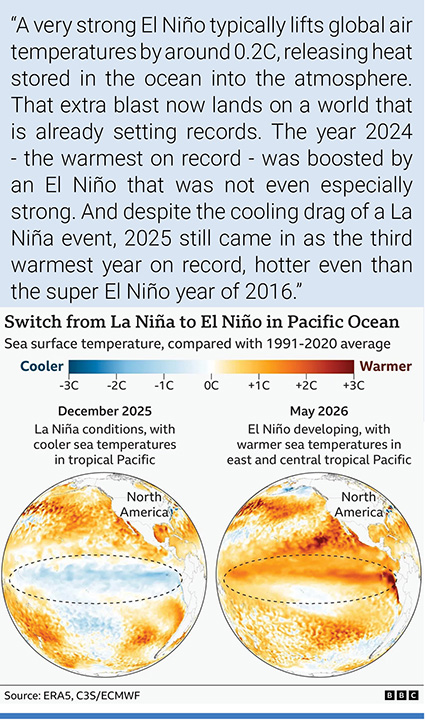
Moving to considerations of what is getting reported on within these stories, we begin this month looking at media accounts that focused on ecological and meteorological themes. Beginning the month was news attention to the El Niño cycle that is forecasted for 2026 on the horizon. For example, Washington Post journalists Matthew Cappucci and Ben Noll reported, “El Niño is here, according to the National Oceanic and Atmospheric Administration. The agency issued an El Niño Advisory on Thursday morning, signifying that Earth has crossed a key threshold into El Niño territory. A chain-reaction process in the atmosphere is underway and will influence global weather patterns in the months ahead. While El Niño begins as a warming of water temperatures in the eastern tropical Pacific, there are domino effects globally. And this installment of El Niño looks to be particularly intense and could develop into a highly anticipated super El Niño. “There is a 63% chance of a very strong El Niño during November-January … that would rank among the largest El Niño events in the historical record going back to 1950,” NOAA wrote in its release early Thursday…El Niño begins when anomalous westerly winds blow over the equatorial Pacific. That’s opposite to the direction of normal easterly trade winds. These westerly winds push the top layer of water, which is heated by the sun, eastward. That piles hot water in the eastern Pacific, heating the air above. That air rises, and, over the course of half a year or so, key weather systems in Earth’s atmosphere are shuffled. It’s important to remember that El Niño doesn’t begin like a switch flipping; even the most dramatic El Niños emerge gradually. That’s why forecasters at NOAA’s Climate Prediction Center use something called the Niño 3.4 index to officially “declare” the commencement of El Niño or La Niña conditions. The index looks at water temperatures in a key zone of the central tropical Pacific (aptly named the “Niño 3.4 region”). El Niño conditions are declared when water temperatures there are running 0.5 degrees Celsius (0.9 degrees Fahrenheit) above average. La Niña necessitates the opposite: waters cooler than average. But it’s not instantaneous; there have to be five consecutive months where the three-month running mean meets that threshold. So by the time an El Niño is declared, Earth’s atmosphere is already beginning to respond. In recent years, it’s been increasingly difficult for scientists to separate the effects of human-induced climate change from the ordinary swings of ENSO. That’s why meteorologists often now use RONI, or the Relative Oceanic Niño Index; it compares sea surface temperature anomalies in the Nino 3.4 region to the real-time global average rather than historical averages”. Meanwhile, BBC News correspondents Matt McGrath, Simon King and Mark Poynting noted, “El Niño - the natural Pacific weather pattern that pushes up global temperatures - has officially begun, US scientists say…The bigger concern is that all this is happening on an already much hotter planet. "We do need to worry about the impacts," said Prof Adam Scaife, head of monthly to decadal prediction at the UK Met Office. "The current El Niño is… riding on top of a substantial amount of global warming. "This means that the actual temperatures in affected regions could well be unprecedented, as the warming from El Niño is being topped up by climate change." A very strong El Niño typically lifts global air temperatures by around 0.2C, releasing heat stored in the ocean into the atmosphere. That extra blast now lands on a world that is already setting records. The year 2024 - the warmest on record - was boosted by an El Niño that was not even especially strong. And despite the cooling drag of a La Niña event, 2025 still came in as the third warmest year on record, hotter even than the super El Niño year of 2016.”
By the end of June, many stories of heatwaves across Europe – with links to a changing climate – earned media attention. For example, El País journalist Raquel Villaécija wrote, “Scenes of a heat wave are being repeated across different parts of Europe, but it will be especially severe in France. More than half of the country's population, 41 million inhabitants, is affected by the high temperatures, which will reach nearly 40 degrees Celsius in some areas, particularly in the central and western regions. The heatwave is also affecting much of Europe. Germany is facing almost universal heat alerts, with temperatures approaching 38 degrees Celsius and a risk of severe storms due to the combination of heat and humidity. In Italy, where temperatures of 36 or 37 degrees Celsius are expected in some areas, the heat is disrupting daily life and tourism: in Rome, visitors queued in the sun in front of the Colosseum and sought relief in the cooler underground spaces beneath the remains of the Temple of Claudius.” Elsewhere, La Vanguardia journalist Celeste López noted, “Spain has recorded 203 deaths linked to high temperatures in five days. 98% of those who died were over 65 years old. The first heat wave of the year in Spain, which arrived on Sunday and ended last night, brought with it the two hottest June days (the 22nd and 23rd) ever recorded in the country since at least 1950, according to AEMET (the Spanish State Meteorological Agency).” On the other hand, climatologists believe the June heat wave is more intense due to climate change. As a third example, La Vanguardia journalist Antonio Cerrillo wrote, “The unprecedented heatwave gripping France and much of Western Europe this June 2026 has been significantly intensified by climate change caused by human activity, according to an analysis by the ClimateMeter team of experts. Similar weather patterns to those causing the current heatwave are now producing temperatures approximately 2 to 4°C warmer, depending on the location, than those recorded during the second half of the 20th century due to greenhouse gas emissions that warm the atmosphere. “The record temperatures observed in France and Western Europe were amplified by anthropogenic climate change, while natural climate variability likely played a secondary role,” says this team of researchers. Without anthropogenic climate change, this event would have been equally warm. However, “it wouldn’t have been the same heat wave,” they maintain.”
A woman uses a face mask to cover from the sun in Madrid, Spain. Photo credit: Pablo Blázquez Domínguez/Getty Images. |
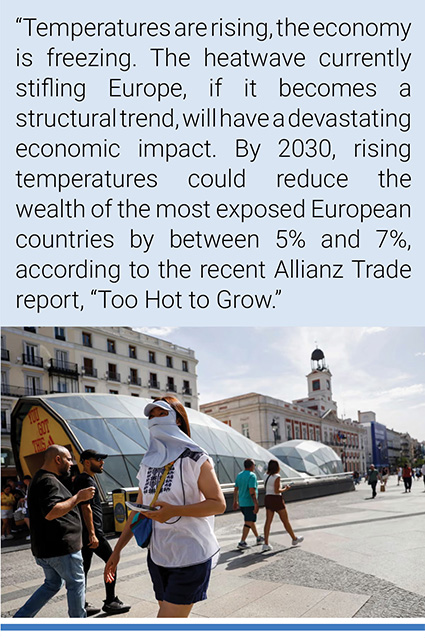
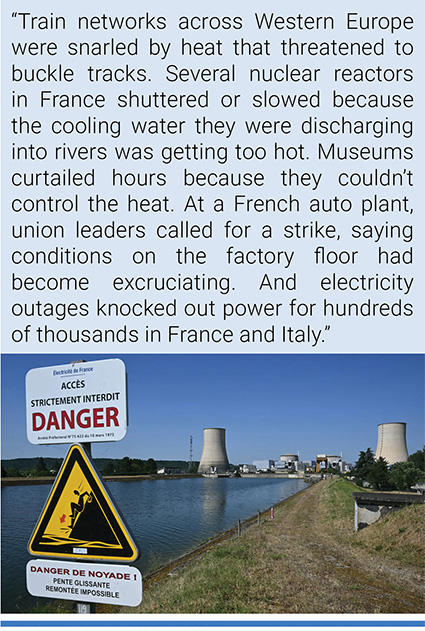
Next, June saw political and economic-themed media stories about climate change or global warming again dominating attention in various outlets. Reporting on extreme heat pushed into other climate change themes across the month. For example, Guardian correspondents Ajit Niranjan and Ashifa Kassam reported, “The UK has broken its all-time temperature record for June and France has recorded its hottest day ever for the second day running, as a heatwave affecting more than 90 million people sweeps across swathes of Europe. As the UK and France registered record-breaking temperatures, the World Health Organization warned that the extreme temperatures are “putting lives at risk”… Outside Buckingham Palace, the ceremonial guard changes were cancelled for the rest of the week, while organisers of the London climate action week said the soaring temperatures had forced them to cancel several events on extreme heat. The Met Office issued a rare red extreme heat warning for 9am on Wednesday until 9pm on Thursday. Further amber warnings are in place for Friday and Saturday. “To see temperatures like this in the UK in June is sobering,” said Stephen Belcher, the Met Office’s chief scientist. “Events like this bring home the implications of climate change, with very high temperatures and humidity bringing significant health implications from heat stress, as well as impacts to a range of sectors such as transport, energy and water supply.” For a second example, La Vanguardia journalist Piergiorgio M. Sandri noted, “Temperatures are rising, the economy is freezing. The heatwave currently stifling Europe, if it becomes a structural trend, will have a devastating economic impact. By 2030, rising temperatures could reduce the wealth of the most exposed European countries by between 5% and 7%, according to the recent Allianz Trade report, "Too Hot to Grow." The combined cost for the coming seasons will reach €560 billion for the continent's four largest economies. Spain alone will suffer a loss of €104 billion. To put these figures into perspective, it's worth recalling that the European Environment Agency (EEA) found in 2023 that "extreme weather events caused losses of €650 billion in the EU between 1980 and 2022." As a point of reference, Allianz's projections suggest that, due to the heat alone, Europe could approach that figure in just five years.” A third example by New York Times correspondent Chico Harlan observed, “This sweltering week, the signs of a breakdown have been everywhere. Train networks across Western Europe were snarled by heat that threatened to buckle tracks. Several nuclear reactors in France shuttered or slowed because the cooling water they were discharging into rivers was getting too hot. Museums curtailed hours because they couldn’t control the heat. At a French auto plant, union leaders called for a strike, saying conditions on the factory floor had become excruciating. And electricity outages knocked out power for hundreds of thousands in France and Italy. The heat seeped through thick-walled apartments and turned cities into hotboxes that couldn’t cool at night. Sleep-deprived Europeans staggered into parks after midnight, or joined in frenzies to buy portable air-conditioning units, or even sought refuge in hotels. “Everyone is asking, why are we not ready?” said Francois Gemenne, a professor and specialist in environmental politics at HEC Paris, a business school. “We are becoming aware of our own vulnerability. “The heat wave, holding its grip for nearly a week, has toppled temperature records in Britain, Spain and France. It’s also hastened a realization that Europe isn’t prepared for what is coming as heat waves intensify because of rising greenhouse gas emissions. The world’s fastest-warming continent is filled with buildings and infrastructure designed for a climate that no longer exists. That is making extreme stretches of high temperatures far more disruptive in Europe than in parts of the world more accustomed to such conditions. A recent report from Allianz, the German financial and insurance company, singled out Italy, France, Germany and Spain as among the “most exposed economies" to economic losses from heat. The insufficient infrastructure has deadly consequences”.
The Golfech nuclear plant in France after officials shut it down as a result of high temperatures. Photo credit: Lionel Bonaventure/Agence France-Presse — Getty Images. |
Meanwhile, the war, MoU and peace talks with Iran led to falls crude oil stockpiles in the US for a sixth straight week. For example, Wall Street Journal correspondent Anthony Harrup reported, “U.S. crude oil inventories extended their decline to six weeks as exports rose and refineries ran near full capacity, according to data released Wednesday by the U.S. Energy Information Administration. Commercial crude oil stocks excluding the Strategic Petroleum Reserve fell by 8 million barrels to 433.7 million barrels in the week ended May 29 and were about 3% below the five-year average for the time of year, the EIA said. Crude stocks were seen falling by 3.3 million barrels in a Wall Street Journal survey of analysts. Oil stored in the SPR fell by 8 million barrels to 357.1 million barrels on continued emergency releases. Oil stocks at Cushing, Okla., the Nymex delivery hub, were down by 583,000 barrels at 22.4 million barrels”.
Elsewhere, aviation emissions continue to rise unabated and this generated some news attention in June. For example, Guardian journalist Gwyn Topham wrote, “The aviation industry’s landmark pledges to be net zero by 2050 will probably not now be achieved, airline leaders have admitted. The collective goal to eliminate net carbon emissions was declared by global airlines only five years ago in 2021, with similar pledges made by national aviation industry leaders and governments, including in the UK, in 2020. However, Willie Walsh, the director general of global airlines body IATA, said “hope was fading fast” and a new “realistic timeline” should be established. Walsh – who was the chief executive of British Airways owner IAG until September 2020 – said fuel suppliers, governments and aircraft manufacturers were largely to blame for the likely failure to hit the target. More than half of the planned decarbonisation of aviation was dependent on the development of sustainable aviation fuels (SAF), with much of the rest reliant on a global emissions trading programme, Corsia, established under the aegis of the UN and its aviation body ICAO. In a speech to delegates at the annual IATA summit in Rio de Janeiro, Walsh said that Corsia was being “undermined” by government inaction, while annual production of SAF would only reach 2.4m tonnes, or 0.8% of airline fuel needs, this year. “The goal is 65% or 500m tonnes by 2050. The gap is wide and not closing fast enough,” he said. He said that governments had, through ICAO, targeted a 5% emission reduction by 2030 by using SAF. However, he cautioned: “To be blunt, there is no path to meet that outcome.” He added: “There is still hope for 2050 – but that’s fading fast … We need an urgent dialogue to determine a realistic timeline given the current state of affairs.””
Solar generation surged 17% from a year earlier, while coal power shrank 11%. Photo credit: Brandon Bell/Getty Images. |
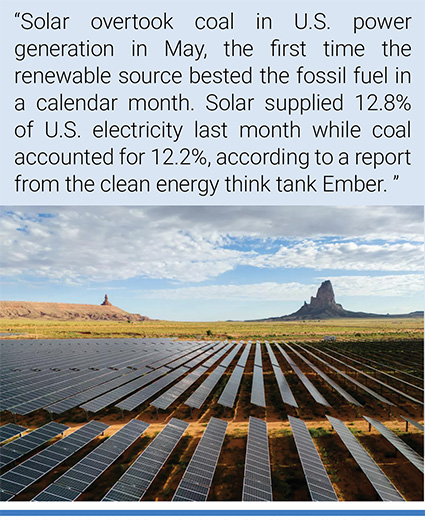
Also, in political and economic news that generated attention in June was the moment that solar eclipsed coal in US energy generation for the first time. For example, Los Angeles Times reporter Emily Forgash wrote, “Solar overtook coal in U.S. power generation in May, the first time the renewable source bested the fossil fuel in a calendar month. Solar supplied 12.8% of U.S. electricity last month while coal accounted for 12.2%, according to a report from the clean energy think tank Ember, which analyzed monthly and hourly data from the U.S. Energy Information Administration. The use of solar is surging just as the U.S. scrambles to add new electricity sources to meet the insatiable power needs of AI data centers. The solar industry has managed to grow even as the Trump administration has taken steps to thwart its rise. The administration favors traditional electric sources, including coal and nuclear, which can produce power around the clock, unlike solar and wind. “This is a structural change in the U.S. power system,” Nicolas Fulghum, a senior data analyst at Ember, said in an interview. Companies are seeking more power, quickly, and are “looking towards solar to be a cheap, affordable and quick-to-deploy source.” Solar generation in May surged 17% from a year earlier, while coal power shrank 11%. Still, the U.S. remains heavily dependent on fossil fuels. Natural gas is the dominant electric source, with 37% of the electric mix in May, according to Ember. Coal, meanwhile, is seeing a surge of support from the government. President Trump and his administration have vowed to keep all U.S. coal plants running. The U.S. Energy Department is blocking utilities from closing several aging power plants, and last week the White House pledged about $700 million in financial support for the industry. However, solar continues to gain share, in part because of wider deployment of batteries that can store energy from panels to be used when the sun isn’t shining, including during peak demand hours at night. Solar and storage together made up 91% of new U.S. capacity installed in the first quarter, according to a separate report released by the Solar Energy Industries Assn. and Wood Mackenzie. That’s likely to continue, with utilities and data center developers increasingly viewing solar paired with batteries as a key energy source”.
Firefighters battle the fast-moving Sorrento fire in San Diego, California on June 8. Photo credit: Anadolu/Getty Images. |
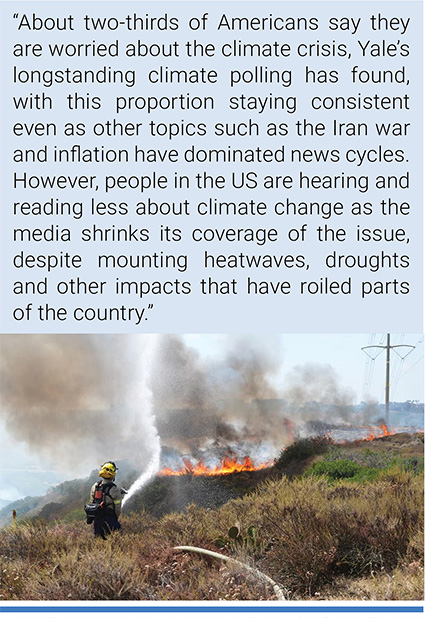
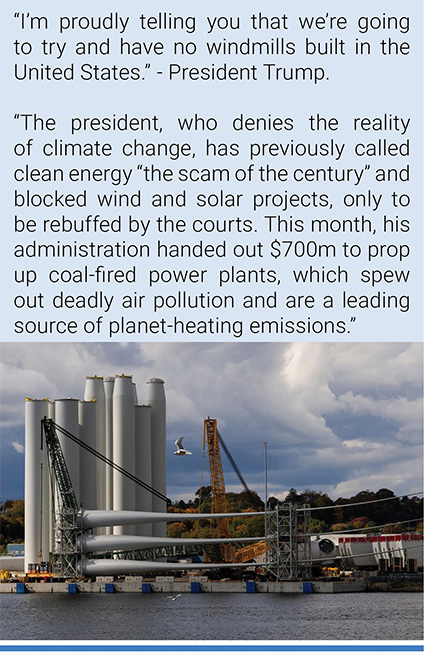
In June, several intersecting cultural-themed media stories related to climate change or global warming. For example, Guardian journalist Oliver Milman reported, “US political and media discourse has drifted away from the climate crisis amid a frontal assault by Donald Trump upon policies to limit global heating and the president’s pugnacious demands to “drill, baby, drill” for more oil and gas. Yet while elite attention on climate has waned, even among some previously vocal Democrats who have wound back on criticism of the fossil fuels that are overheating our planet, the American public remains concerned about the climate crisis and continues to favour action to deal with it, according to experts and polling….About two-thirds of Americans say they are worried about the climate crisis, Yale’s longstanding climate polling has found, with this proportion staying consistent even as other topics such as the Iran war and inflation have dominated news cycles. However, people in the US are hearing and reading less about climate change as the media shrinks its coverage of the issue, despite mounting heatwaves, droughts and other impacts that have roiled parts of the country. Outlets including the Washington Post, NPR and CBS have also cut climate journalist positions. “Voting priorities haven’t changed much in terms of climate but other issues have leapfrogged over it, such as the Iran war, and the lack of coverage in the media means that people aren’t hearing or talking about it as much,” said Leiserowitz. “There is this spiral of climate silence. I’ve even heard some leaders of climate groups say, ‘Don’t mention climate change.’ I don’t know why they’d make that decision, there’s absolutely no evidence that people care about this less than they did.” A majority of US voters now link rising costs in their lives to the climate crisis, Yale has found, despite this lack of coverage, with global dependence on oil resulting in higher gasoline costs as the Iran war dragged on. Meanwhile, Trump’s faltering attempts to halt renewable energy projects and escalate oil, gas and coal production are also broadly unpopular with the American public, despite some assumptions that embracing fossil fuels is a mainstream position. “I’m proudly telling you that we’re going to try and have no windmills built in the United States,” Trump said in March. The president, who denies the reality of climate change, has previously called clean energy “the scam of the century” and blocked wind and solar projects, only to be rebuffed by the courts. This month, his administration handed out $700m to prop up coal-fired power plants, which spew out deadly air pollution and are a leading source of planet-heating emissions”.
Wind turbine tower sections and blades at the Revolution Wind project assembly site in New London, Connecticut. Photo credit: Joe Buglewicz/Bloomberg. |
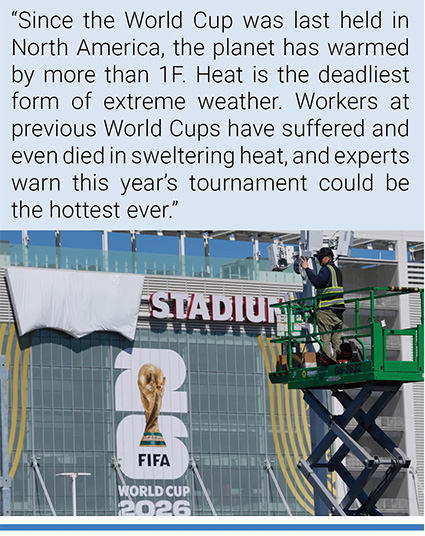
In North America, there has been news connecting World Cup weather conditions and a changing climate. For example, Guardian journalist Dharna Noor reported, “As the World Cup kicks off, labor advocates and scholars warn that the workers making the tournament possible could face serious heat-related risks. “It’s going to be extremely hot, and you just cannot leave people unprotected or you’re going to deal with a lot of injuries,” said Jonathan Alingu, co-executive director of Central Florida Jobs With Justice, which has been calling for worker protections at the Miami games. “Or, God forbid, something even worse.” The FIFA tournament is being played across 16 host cities, including 11 in the US. That includes southern cities such as Miami, Houston, Dallas and Atlanta, where temperatures during games could top 85F or even 90F (29.4C to 92.2C). The matches come as forecasts show much of the US facing above-normal temperatures. Since the World Cup was last held in North America, the planet has warmed by more than 1F. Heat is the deadliest form of extreme weather. Workers at previous World Cups have suffered and even died in sweltering heat, and experts warn this year’s tournament could be the hottest ever. Thousands of World Cup workers are expected to labor in conditions exceeding recommended heat-exposure limits, putting them at risk of heat exhaustion and other illnesses, according to a study published this week…In an emailed statement, FIFA said it was “committed to protecting the health and safety of all players, referees, fans, volunteers and staff”. “Climate-related risks are assessed as part of overall tournament planning and managed in close coordination with the host cities, stadium authorities and national agencies,” a spokesperson said. To avoid the worst heat, FIFA scheduled many matches for late afternoon and evening. Venues will also deploy cooling measures including shaded areas, misting systems and expanded water distribution, the spokesperson said” [note: that study that was mentioned was later reported here].
The San Francisco Bay Area stadium in Santa Clara, California, before the Qatar-Switzerland match. Photo credit: Eugene Hoshiko/AP. |
In Europe, a heat wave generated media attention with several stories linking the hot weather with climate change. For example, New York Times journalist Claire Moses wrote, “It reads like satire: A London Climate Action Week Event — “Extreme Heat: Improving governance and strengthening action around the world” — was canceled because of extreme heat. The event was planned for Wednesday, when much of the country was under a rare red warning for high temperatures. “We regret that this event has been canceled due to the red extreme heat warning issued by the UK Met Office,” the London School of Economics Global School of Sustainability, where the event was scheduled to take place, said on its website. London Climate Action Week 2026, which organizers describe as “one of the world’s largest independent climate events,” started on June 20 and is scheduled to end on June 28. In a statement on Thursday, Simon Stiell, the executive secretary of the United Nations Framework Convention on Climate Change, said Europe’s current heat wave was “the latest price to pay for fossil fuel pollution baking our planet.” “Schools closing, the vulnerable dying, economies sweating: this is what the climate crisis looks like in practice, and it’s just getting started,” Mr. Stiell, who was in London to attend the climate action week, said. As global temperatures rise, Europe has been warming faster than any other continent, and officials have scrambled to react to heat waves that are increasingly intense and happen earlier in the year. Extreme temperatures have disrupted much of Europe’s daily life this week, in the second severe and unusually early heat wave in two months. Urgent warnings were in effect in more than a dozen countries as the heat strained power grids and tested other resources. In England, where most homes and schools do not have air conditioning, sweltering temperatures have forced train cancellations and some hospitals have canceled elective procedures”. As a second example (among many), BBC News correspondents Paul Kirby, Laura Gozzi and Bethany Bell reported, “After days of record-breaking temperatures in France, officials have warned people to adjust their behaviour, with Health Minister Stéphanie Rist saying there were risks to young people as well as the elderly. Prime Minister Sébastien Lecornu said the health alert level was being raised to its highest, to boost hospital staffing and protect the vulnerable… Climate change is driving up temperatures around the world - but particularly in Europe. It is the fastest warming continent, heating up twice as fast as the global average, according to the Copernicus climate service. This is causing increased summer heatwaves, greater pressure on Europe's water supply, and more intense wildfires. Last year, more than 1 million hectares burnt across Europe - a record level - with Spain particularly affected”.

Figure 4. Examples of newspaper front pages with climate change stories focusing on heat waves and a changing climate in June 2026.
Last, some June 2026 stories – a smaller fraction in the overall news of climate change in June – drew on primarily scientific themes. To illustrate, the month started with a politically-infused science story where the National Center for Atmospheric Research (NCAR) was blocked from dismantlement. An example of several stories that covered this development included NBC news affiliate 9News where journalist Spencer Soicher wrote, “A federal judge Monday blocked the Trump administration from stripping a Boulder nonprofit of control over a marquee supercomputing center, finding the move unlawful and likely driven by President Donald Trump's disdain for Colorado. The ruling was issued on the same day convicted former Mesa County Clerk Tina Peters walked out of prison following Democratic Gov. Jared Polis' commutation of her sentence. Peters' imprisonment, and Trump's repeated demands that Colorado free her, are what a federal judge found partially motivated the administration's decision to break up the National Center for Atmospheric Research (NCAR) in the first place. Senior U.S. District Judge R. Brooke Jackson issued the preliminary injunction Monday, halting the National Science Foundation's plan to transfer control of the NCAR-Wyoming Supercomputing Center away from the University Corporation for Atmospheric Research (UCAR), the Boulder-based nonprofit that runs NCAR, one of the country's premier federal weather and atmospheric research labs. The order blocks the federal government from divesting UCAR or NCAR of any rights, resources, or responsibilities related to the supercomputing center while UCAR's lawsuit proceeds”.

Figure 5. Examples of newspaper front pages with climate change stories in June 2026.
- report prepared by Max Boykoff, Rogelio Fernández-Reyes, Ami Nacu-Schmidt, Jeremiah Osborne-Gowey and Olivia Pearman