Monthly Summaries
Issue 113, May 2026 | "We live in troubled times”
[DOI]
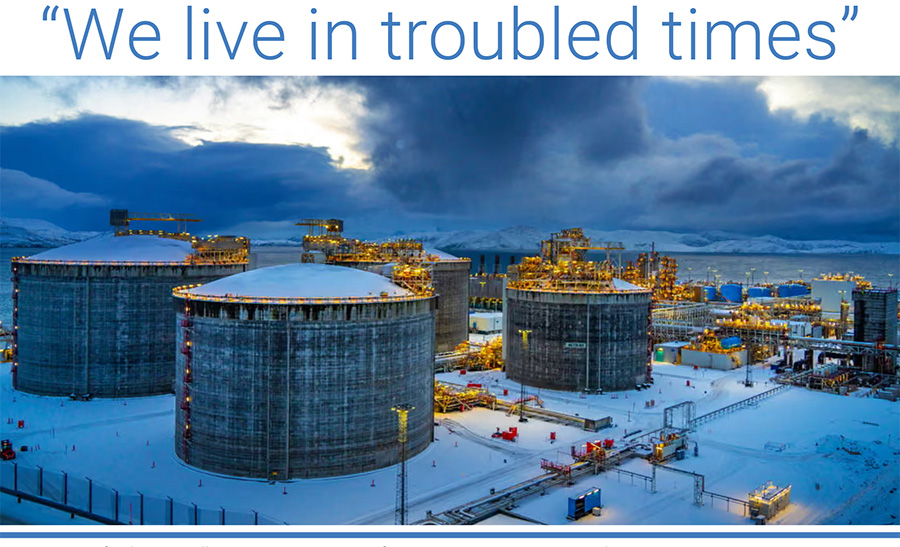
Equinor's LNG facility at Melkøya, outside Hammerfest, Norway. Photo credit: Ole Berg-Rusten/NTB/AFP/Getty Images.
May media coverage of climate change or global warming in newspapers around the globe continued to rebound, rising 8% from April 2026. This follows a 4% rise in April compared to March 2026. That said, coverage in 2026 remains lower. Comparing the first five months of 2026 to the first five months of 2025, coverage has fallen 35%. Levels of coverage in May 2026 was 28% lower than in May 2025. International wire coverage - The Associated Press, Agence France Presse, The Canadian Press, and United Press International (UPI) – increased 3% from April 2026 but remained 32% lower than coverage a year earlier in May 2025. Figure 1 shows trends in newspaper media coverage at the global scale – organized into seven geographical regions around the world – across 22 years, from January 2004 through May 2026.

Figure 1. Newspaper media coverage of climate change or global warming in print sources in seven different regions around the world, from January 2004 through May 2026.
At the regional level, May 2026 coverage decreased in in Africa (-3%), Latin America (-7%), and the Middle East (-53%). Elsewhere, regional coverage rebounded in Oceania (+24%) and increased again in North America (+13%), Asia (+6%), the European Union (EU) (+13%) (see Figure 2). Yet, a comparison of May 2026 to May 2025, levels of coverage remains diminished in 2026: Oceania (-2%), Asia (-28%), Latin America (-30%), the EU (-34%), North America (-43%), Africa (-53%), and the Middle East (-65%).
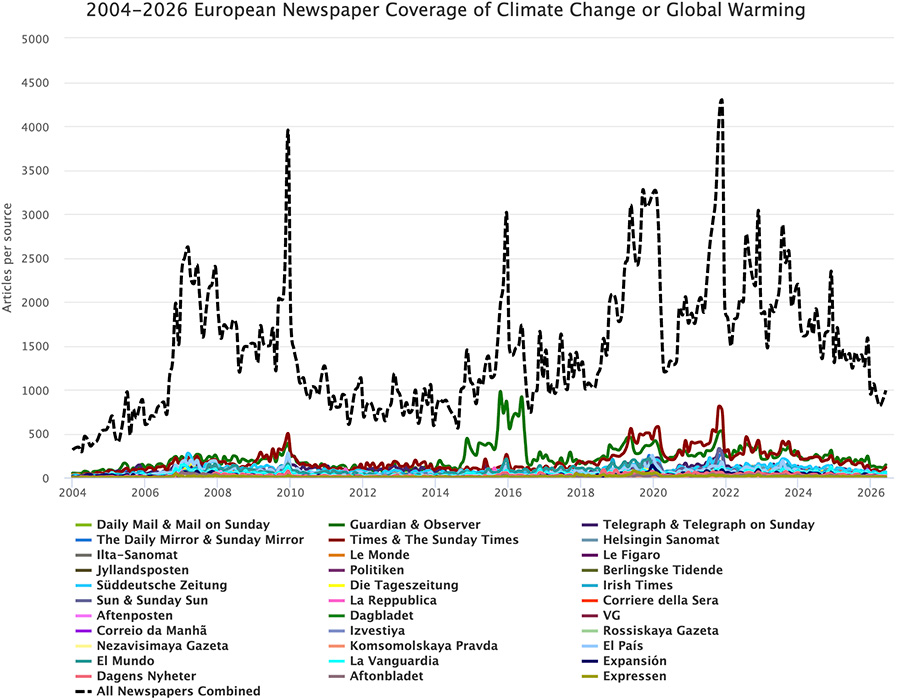
Figure 2. Coverage of climate change or global warming in 33 newspapers in the European Union from January 2000 through May 2026: Daily Mail and Mail on Sunday (England), Guardian and Observer (England), Telegraph and Telegraph on Sunday (England), The Daily Mirror and Sunday Mirror (England), Times and The Sunday Times (England), Helsingin Sanomat (Finland), Ilta-Sanomat (Finland), Le Monde (France), Le Figaro (France), Jyllandsposten (Denmark), Politiken (Denmark), Berlingske Tidende (Denmark), Süddeutsche Zeitung (Germany), Die Tageszeitung (Germany), Irish Times (Ireland), Sun & Sunday Sun (England), La Repubblica (Italy), Corriere della Sera (Italy), Aftenposten (Norway), Dagbladet (Norway), VG (Norway), Correio da Manhã (Portugal), Izvestiya (Russia), Rossiskaya Gazeta (Russia), Nezavisimaya Gazeta (Russia), and Komsomolskaya Pravda (Russia), El País (Spain), El Mundo (Spain), La Vanguardia (Spain), Expansión (Spain), Dagens Nyheter (Sweden), Aftonbladet (Sweden), and Expressen (Sweden).
Among our country-level monitoring, in May US print coverage rose 11% from April 2026 levels of coverage, after a dip of 11% in the previous month (see Figure 3). Yet US television coverage continued to increase 27% after a previous increase of 23% in April 2026 from the previous month of March.
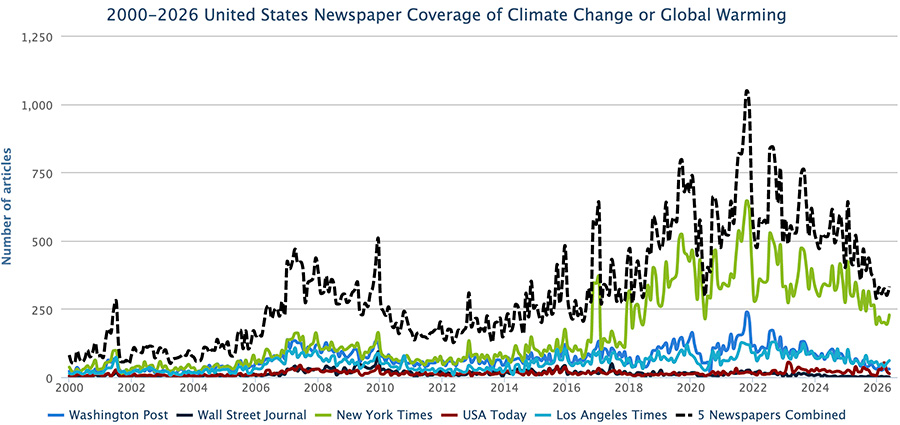
Figure 3. US newspaper coverage of climate change or global warming – in The Washington Post, Wall Street Journal, New York Times, USA Today, and Los Angeles Times – from January 2000 through May 2026.
An illustration published in 1877 depicted a scene in southern India. Millions died from a famine that coincided with an El Niño that year. Credit: Dea/Biblioteca Ambrosiana, via Getty Images. |

Moving to content, we begin this month looking at media accounts that focused on ecological and meteorological themes. An illustration to begin was coverage connecting wildfire threats and climate change. For example, Los Angeles Times reporter Alex Wigglesworth wrote, “Southern California has caught the brunt of the surge. Nearly a dozen fires have, together, consumed more than 26,000 acres of varied terrain in the region over the last week, in remote island chaparral as well as brushy foothills bordering neighborhoods. Six people have been injured and some 45,000 more remain under evacuation orders. At least one home has burned. This level of activity may seem unusual for May, but experts say that, increasingly, that is no longer the case as climate change rolls back the start date of what’s traditionally been considered the peak fire season. There are currently five fires of 1,000 acres or more burning in Southern California, which UCLA professor and hydroclimatologist Park Williams described as abnormal for this time of year but not unprecedented according to a dataset of past fires he maintains. He pointed to a study suggesting that human-caused warming has advanced the onset of the fire season by six to 46 days across most of the state, primarily by drying out vegetation”.
Also in May, discussion of El Niño conditions re-emerging in 2026 earned news attention. For example, New York Times journalist Chico Harlan reported, “Well before it was understood, the El Niño phenomenon was leaving its marks on humanity. El Niño is the name given to powerful shifts in Pacific Ocean winds and water temperatures that can drastically transform global weather patterns. Over the centuries these natural patterns have sparked epic droughts and heat waves, and have intensified epidemics. Some academics even claim to see the fingerprints of El Niño on political and economic crises in ancient Egypt, or on the downfall of the Moche civilization in present-day Peru, more than 1,000 years ago. And in 1877 and 1878, a famine fueled by El Niño killed millions of people across the tropics, hardening inequities that, as one research paper put it, “would later be characterized as the ‘first world’ and ‘third world.’” Right now, the world is entering a new El Niño phase. Researchers are warning it could be one of the strongest on record and are invoking this history as an admonition that natural forces, when they reach their highest magnitude, can lead to profound volatility and hardship. In general, El Niño makes for wetter conditions in some parts of the Americas while suppressing the Atlantic hurricane season. The phenomenon raises the risk of dryness in South and Southeast Asia, Australia, and southern Africa. Of course, the current El Niño is in the early stages of formation and might not live up to the hype. But if the forecasts prove accurate, it would be a whopper and its consequences would play out across a world that has grown far more resilient but also has new vulnerabilities. El Niño events are measured by looking at temperature levels in a vast rectangular zone in the central Pacific. In a moderate El Niño, temperatures might climb, say, 1 degree Celsius, or 1.8 degrees Fahrenheit, above a longer-term average. But in the biggest El Niños of the past 50 years — the ones that started in 1982, 1997, and 2015 — temperatures have soared 2 degrees Celsius or more beyond the norm. Each of those events levied a global economic toll. This year, many forecasts say the temperature could increase by an unprecedented 3 degrees Celsius. Even the 1877 El Niño, by the best estimates, didn’t have that magnitude. “A number of the models now show a real chance for a record-setting El Niño event,” said Zeke Hausfather, a research scientist at Berkeley Earth. “It is still too early to know for sure.” El Niño events typically peak in strength late in a calendar year, and then cause warmer global temperatures on land in the months that follow. As a result, many scientists predict that 2027 will be the warmest year on record”. Moreover, ABC News correspondent Anthony Bordanaro noted, “This Memorial Day weekend did not feel like quite like the unofficial start to summer in Northeast and Central Pennsylvania. "We had a little tease there with the 80s and 90s, then it was right back down to the 50s with rain falling," Raymond Rittenhouse said. The weather is always top of mind for Dominique Shea. She owns Crafty Beans Company, a sip and shop in Dupont. "Whenever I'm giving coffee, I'm always like 'how's the weather out there?'" Shea said. Shea says it does not matter if it's rainy or sunny, cold or warm; each type of weather impacts her customer turnout throughout the day”.
Red heatwave alerts have been issued in several Italian cities including Rome. Photo credit: Getty Images. |
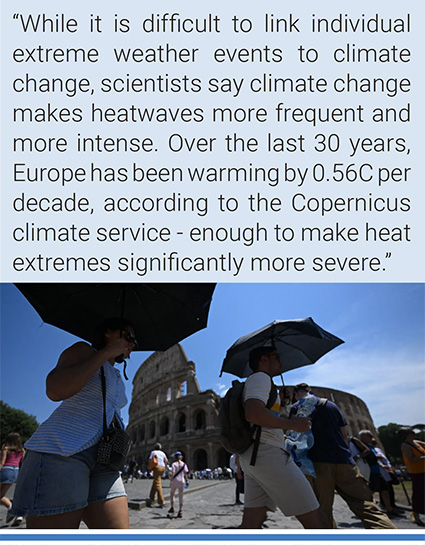
Heat and climate change was an issues in May that earned media attention in Europe. For example, extreme heat reveals a Europe ill-adapted to climate change. La Vanguardia journalist Antonio Cerrillo noted, “The stagnation of a mass of hot air has pushed temperatures to alarmingly high levels across large areas of southwestern Europe this week. The heatwave has arrived in France in the middle of May, where the debate is underway about naming heat waves—a clear acknowledgment of the need for better tools to prevent the effects of extreme heat, episodes of which, according to climatologists, will become more frequent, intense, and longer-lasting. Europe is better prepared than other regions of the world, but it shows significant shortcomings in adapting to climate change. As a result of this disruption to daily life, there is a growing need to improve workplace health and take measures to address the risks of economic losses and decreased productivity.” Meanwhile, Associated Press correspondent Jill Lawless reported, “The United Kingdom smashed a century-old temperature record for the second time in 24 hours on Tuesday as a spring heat wave scorches parts of Western Europe, triggering government warnings about risks to life. Several drownings were reported in Britain and France as people tried to cool down… Unpredictable and extreme weather is becoming more frequent as Earth warms. Experts say unprecedented and deadly weather extremes that sometimes strike at abnormal times and in unusual places are putting more people in danger. “We know beyond a shadow of a doubt that heat wave events such as this have been made more likely and more severe due to climate change arising from our emissions of heat-trapping greenhouse gases,” said Peter Thorne, director of the ICARUS Climate Research Centre, at Maynooth University, in Ireland. “But, nevertheless, many of the records being set, particularly in the U.K. and France, are mind-bogglingly crazy,” he said. After a long weekend that sent people in Britain flocking to beaches, pools and shady parks, London commuters sweltered on Tuesday in subway carriages without air conditioning” And, BBC News reporter Aleks Phillips wrote, “While it is difficult to link individual extreme weather events to climate change, scientists say climate change makes heatwaves more frequent and more intense. Over the last 30 years, Europe has been warming by 0.56C per decade, according to the Copernicus climate service - enough to make heat extremes significantly more severe. The UN warned on Thursday that global average temperatures were likely to continue at or near record levels this year and for the next four years. The 11 hottest years ever recorded all happened from 2015 onwards, and the UN's weather and climate agency said this trend was predicted to continue, with a new hottest-ever year "likely" before 2031”.
Temperature is measured in degrees Celsius WBGT, which takes into account not only air temperature, but also humidity, solar radiation, and wind speed. Credit: El País. |

And from afar, New York Times correspondent David Gelles noted, “It’s not yet summer, and Europe is already suffering from a deadly heat wave. Parts of France hit more than 100 degrees Fahrenheit this week, according to AccuWeather. London set a record for the month of May, reaching 95 degrees. Oxford, where records date back 211 years, notched the highest temperature ever registered this early in the year. Extreme heat was reported in more than half a dozen countries, from Portugal to Switzerland. The culprit was a “heat dome” caused by warm air that moved up from northern Africa and is now stuck under a high-pressure system that has settled across western Europe. And it comes as global temperatures continue their rapid rise in recent years, fueled by the unrelenting burning of fossil fuels. Scientists have said the anomalous warmth is almost certainly linked to human-caused global warming. “This record-breaking heat has the fingerprints of climate change all over it,” Friederike Otto, professor of climate science at Imperial College London, said in a statement. The broiling temperatures represented an early start to the heat season in Europe. Last year, almost all the continent was unusually hot, according to the annual European State of the Climate report. Europe is warming faster than any other continent, and researchers estimate that in recent years it has seen tens of thousands of heat-related deaths annually. ClimaMeter, a group of scientists that studies the link between extreme weather and global warming, issued a report, stating that this heat dome was “an event driven by rare meteorological conditions, whose characteristics are exacerbated by human-driven climate change.”
Heat and climate change also cropped up in some stories in May involving speculation of playing conditions at the upcoming World Cup. For example, El País journalists M. Planelles, Y. Clemente y N. Dale wrote, “Sport is not immune, and competitions like the Winter Olympics and major cycling tours have been or will be seriously affected by global warming. The most-watched sporting event on the planet, the FIFA Men's World Cup, held in North America and set to begin in less than a month, will also be marked by this crisis. A study by scientists from World Weather Attribution (WWA) warns that around 25% of the tournament's matches—26 of the 104 scheduled—will likely be played in conditions that are dangerous for the health of the players and, in some cases, even for the fans attending the stadiums.”
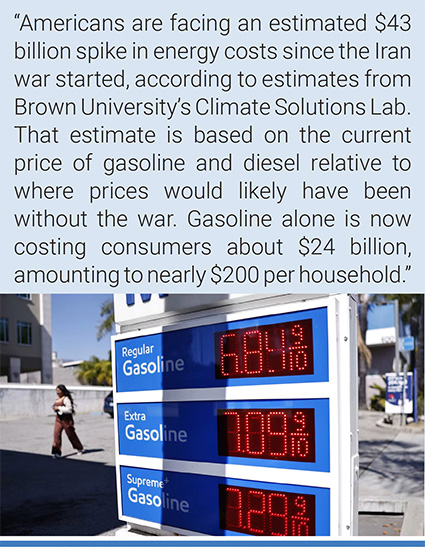
Gas prices at a Mobil gas station on May 11, 2026, in Pasadena, California. Photo Credit: Mario Tama/Getty Images. |
Next, several cultural-themed media stories related to climate change or global warming in May. For example, Los Angeles Times reporter Itzel Luna wrote, “The blame game over surging gas prices is heating up as Gov. Gavin Newsom suggested Chevron could be gouging its customers. California’s governor, who is not shy about promoting his positions with provocative posts, warned Memorial Day travelers on X against pumping gas at Chevron. “Californians, if you’re hitting the road this holiday weekend, be sure to AVOID Chevron,” he said in the post, which included screen grabs showing Chevron gas prices higher than those at nearby unbranded gas stations. “Unbranded gas comes from the same refineries, storage tanks, and pipelines.” The governor’s call-out is part of a larger spat between some California politicians and Chevron. The gas company posted signs at some of its California gas stations blaming the state’s high prices on Sacramento policies. “California politicians are choosing foreign oil and fuels over local jobs and lower costs,” the signs read. It includes a QR code that directs people to a Chevron webpage asking people to “speak up for affordable, reliable energy.” A spokesperson for Chevron did not immediately respond to a request for comment. A Chevron spokesperson told the Associated Press the signs were part of a campaign launched three years ago to educate the public on how California’s policies affect gas prices. Chevron, as well as other top energy companies and experts, has emphasized that higher taxes, fees and standards on gas in California, as well as its restrictions on refining, have bolstered prices at the pump. Gas prices are among the highest in the country, even in the best of times, and recent problems influencing supply from the Middle East have triggered a unique challenge for the state, industry leaders say. The price of gas has skyrocketed in California and across the country since the United States and Israel attacked Iran in late February. Gas prices have not stabilized since, and California’s average is nearly $1.60 higher than the national average. The state’s average gas price is $6.13 as of Friday, according to the American Automobile Assn. A number of factors account for California’s higher costs, including a premium blend of gas that limits pollution, environmental program fees, the relative isolation of the state’s fuels market, and state and local taxes, according to the California Energy Commission. Californians have scaled back holiday travel and cut down on leisure night outs as the prices on the pumps don’t stabilize. Newsom noted in the X post that big oil companies are making billions of dollars off the Iran war. The price of crude oil has surged since the war started, as the Strait of Hormuz, through which oil typically passes, was effectively shut off. Chevron is the state’s biggest branded retailer, controlling 19% of California’s gas market with more than 1,600 stations, according to the state’s energy commission. The commission’s analysis of 2024 gas prices found Chevron had a retail margin of 84 cents. The price difference between the oil company and unbranded gas stations was 48 cents that year. Tensions between the oil giant and the state rose when Chevron relocated its headquarters to Texas in 2024. The move ended the company’s long history in the state, dating back to its founding 145 years earlier. The oil company complained then about Sacramento’s energy and climate policies. Companies, particularly in the tech sectors, have fled the state since then, blaming the state’s high operating costs. California taxes consumers 70 cents per gallon of gas, the highest state tax in the country. Newsom has been a staunch opponent of big oil companies, but the laws he’s passed have largely stalled. He signed a law in 2023 that would penalize oil companies for excess profits. Regulators voted to hold off plans until 2030 after two major oil refineries threatened to close up shop in the state”.
Norway’s Ekofisk oilfield in the North Sea. Photo credit: Carina Johansen/AP. |

Elsewhere, CNN correspondent Matt Egan reported, “Americans are facing an estimated $43 billion spike in energy costs since the Iran war started, according to estimates from Brown University’s Climate Solutions Lab. That estimate is based on the current price of gasoline and diesel relative to where prices would likely have been without the war. Gasoline alone is now costing consumers about $24 billion, amounting to nearly $200 per household, according to the Brown research. Voters are frustrated with how President Donald Trump has handled what used to be a signature issue for him. Just 21% of Americans approve of Trump’s performance on gas prices, according to a CNN poll released last week. A majority of Republicans disapprove of his handling of gas prices. The vast majority of Americans (75%) say the war with Iran has had a negative effect on their finances, the CNN poll found”.
Then, again in May political and economic-themed media stories about climate change or global warming dominated attention in various outlets. The war in Iran and the choking of transport in the Strait of Hormuz – with some links made to climate change – was at the center of attention. For example, Guardian journalists Miranda Bryant and Jillian Ambrose wrote, “The Norwegian government has been heavily criticised for approving plans to reopen three North Sea gasfields nearly three decades after they were closed to help fill the gap in energy supplies created by the Middle East war. Amid sharp price rises in oil and gas since the US and Israel’s attack on Iran in February, Oslo has also given its approval for oil and gas companies to explore in 70 new locations in the North Sea, Barents Sea and Norwegian Sea. The decision by the Labour-run government goes against the advice of the country’s environment agency and has infuriated left-leaning parties. “We live in troubled times,” the prime minister, Jonas Gahr Støre, said as he announced the decision, which would “create great value for the community, lay the foundation for good jobs throughout the country, ensure our common welfare and contribute to Europe’s energy security and safety”. The Albuskjell, Vest Ekofisk and Tommeliten Gamma gasfields in the North Sea were closed in 1998. The government plans to spend 19bn kroner (£1.5bn) on restarting them by the end of 2028 with production to continue until 2048. The gas will be sent by pipeline to Germany with light oil sent to the UK. Norway set out the plan to expand its North Sea oil and gas production amid a row in the UK over the future of hydrocarbons in UK waters. The Labour government has banned new exploration licences, but the energy secretary, Ed Miliband, is under pressure to decide on whether to allow two projects which were granted licences under the previous Conservative government to go ahead. Norway’s state oil company, Equinor, hopes to develop the Rosebank oilfield, while Shell is waiting for a government decision on its Jackdaw gas project. Climate campaigners have said the projects would undermine the UK’s climate agenda, while some industry experts have argued that domestic fossil fuels would lead to lower emissions than US imports and would bring greater economic benefits”.
Bleached coral on the island of Nguna, Vanuatu. Photo credit: Joel Carrett/AAP. |
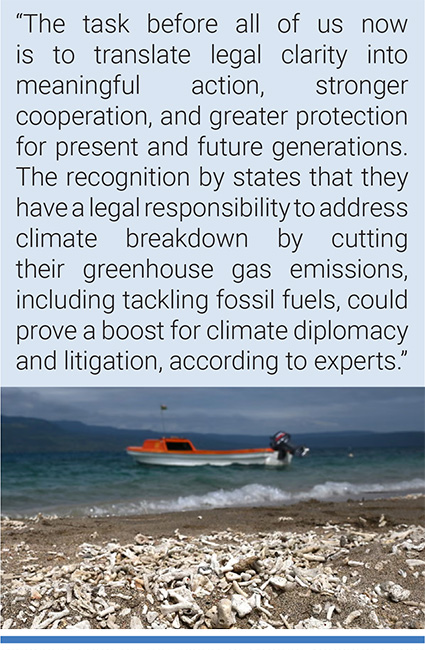
Elsewhere, the United Nations General Assembly vote regarding the International Court of Justice ruling generated press attention. For example, Guardian correspondent Isabella Kaminsky reported, “When the UN general assembly voted overwhelmingly in favour of a landmark climate crisis ruling on Wednesday, the Pacific island of Vanuatu’s prime minister hailed the result as the start of “a new chapter” in climate action. “The task before all of us now is to translate legal clarity into meaningful action, stronger cooperation, and greater protection for present and future generations,” said Jotham Napat. The recognition by states that they have a legal responsibility to address climate breakdown by cutting their greenhouse gas emissions, including tackling fossil fuels, could prove a boost for climate diplomacy and litigation, according to experts. While the international court of justice’s (ICJ) 2025 advisory opinion was at the time hailed as a “historic win” for small island states particularly vulnerable to the effects of the climate crisis, it has so far proved weak as a diplomatic lever. To try to help it make a difference on the ground, Vanuatu led negotiations on a new UN resolution, a lengthy process that required numerous compromises. The final version, co-sponsored by 90 countries, urges states to transition away from fossil fuels in a “just, orderly and equitable manner” to reach net zero by 2050, and to phase out “inefficient fossil fuel subsidies that do not address energy poverty or just transitions as soon as possible”. But the resolution explicitly does not attribute responsibility to any particular state. Although the final resolution did not achieve the unanimity Vanuatu had sought, 141 countries voted in favour, with 28 abstentions. Eight states voted against it, including some of the world’s biggest producers of oil and gas: the US, Saudi Arabia, Russia, Belarus, Iran, Israel, Yemen and Liberia”.
Meanwhile, some coverage from the late-April Santa Marta Colombia conference on transitioning away from fossil fuels continued into May. For example, El País journalist Manuel Planelles wrote, “The conference in the Colombian city of Santa Marta opens a path to address the transition to combat climate change “without taboos”. For three decades of negotiations at the UN, it has been virtually impossible to incorporate the reality of what is happening to the planet into the agreements that emerge from climate summits: humanity is overheating it to dangerous levels through the continued burning of fossil fuels (oil, gas, and coal). Translating this scientific evidence into the summit texts has been impossible due to the firm veto of the main producing countries against any mention of these fuels…This meeting, in which representatives from 57 countries—which together account for 30% of global GDP and fuel consumption—participated, has given rise to a coalition that aims to promote the energy transition and share initiatives on how to carry it out.”
Other political news in May touched on domestic climate change policy efforts. For example, Times reporter Adam Vaughan wrote, “Britain will adopt one of the world’s most ambitious climate targets as Labour takes on Reform and Conservative opposition to net zero and moves to neuter the Green Party’s rise. The Times can reveal ministers have accepted the recommendation of their advisers, the Climate Change Committee (CCC), to set a legally binding goal of cutting carbon emissions 87 per cent by 2040. Reform and the Tories immediately suggested they would oppose the target, while the Lib Dems and Greens indicated they would back it. Landscapes would change too: there would be more woodland to meet tree-planting goals. In gardens, petrol lawn mowers would need to be phased out for “better and more efficient” battery models. The 2040 milestone is seen as a vital stepping stone to the country reaching net-zero emissions by 2050, the target that the Tories and Reform have pledged to scrap”.
Crude oil tanker, Anatoly Kolodkin. Credit: Wall Street Journal. |
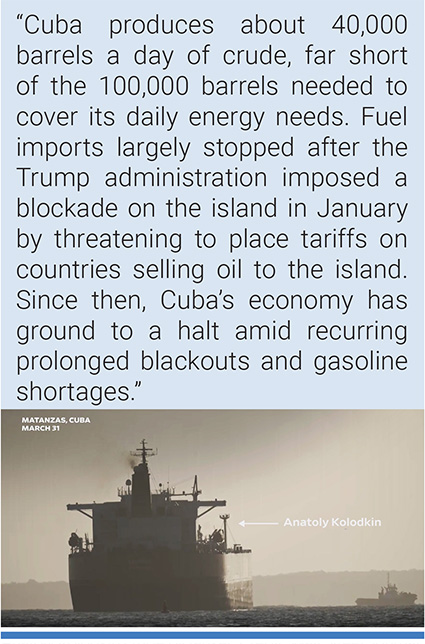
Last, difficult political and economic conditions in Cuba generated some stories linked to climate change. For example, Wall Street Journal reporters José de Córdoba and Santiago Pérez wrote, “Cuba produces about 40,000 barrels a day of crude, far short of the 100,000 barrels needed to cover its daily energy needs. Fuel imports largely stopped after the Trump administration imposed a blockade on the island in January by threatening to place tariffs on countries selling oil to the island. Since then, Cuba’s economy has ground to a halt amid recurring prolonged blackouts and gasoline shortages. Fuel rationing has led to public-transport cuts and school closures. Food spoils because of a lack of refrigeration, and people can’t use air conditioning or fans as temperatures rise to the high 80s. Basic goods are hard to find because fuel shortages affect production and distribution”.
Last, some May 2026 stories drew on primarily scientific themes when reporting on climate change or global warming. To illustrate, Washington Post correspondent Naema Ahmed reported, “Starbucks recently touted their cold-beverage cups as “widely recyclable” — but new findings from an advocacy group indicate none of the ones they tracked ended up in a recycling facility. The findings released Wednesday by Beyond Plastics, an environmental group advocating against plastic pollution, highlights the extent to which recycling efforts in the United States continue to fall short. On Feb. 2, Starbucks and allied groups announced that polypropylene “to‑go cups are entering a new era of recyclability,” and more than 60 percent of U.S. households could recycle them curbside. “Plastic that is collected for recycling versus plastic that is actually recycled into other products are two completely different things,” said Susan Keefe, who led the report and is Beyond Plastics’ Southern California director. “And that gap is really the whole story.” Keefe mentioned that of the small fraction of plastic that is being recycled in the U.S., hardly any of it is polypropylene 5. To test the recent claim from Starbucks, Beyond Plastics placed 53 Bluetooth-enabled trackers inside the company’s in-store recycling bins in 35 locations across nine states and Washington, D.C. A total of 36 trackers provided data over the course of three months, the group reported, and none of them sent a signal from an actual recycling facility”.
Covering another scientific study, The Canadian Press correspondent Jordan Omstead wrote, “Ancient bedrock exposed by disappearing permafrost is releasing toxic metals into Canada's northern rivers, a new study says, with once-pristine subarctic streams now comparable in some cases to highly acidic, contaminated mining sites…Permafrost blanketing Canada's North is disappearing faster than it ever has since the last ice age due to human-caused climate change driven by the burning of fossil fuels, the study says. The region, and the North broadly, is warming faster than the global average, with temperatures rising by around 2.6 C since the 1960s. Homes are being relocated and roads and airport runways are slumping as the ice-rich ground thaws and buckles in on itself or collapses into the Arctic Ocean. Methane released from decomposing soil is further heating the planet, a climate feedback loop that thaws more permafrost. As that frozen ground thaws, ancient bedrock is also being exposed to water and oxygen”.
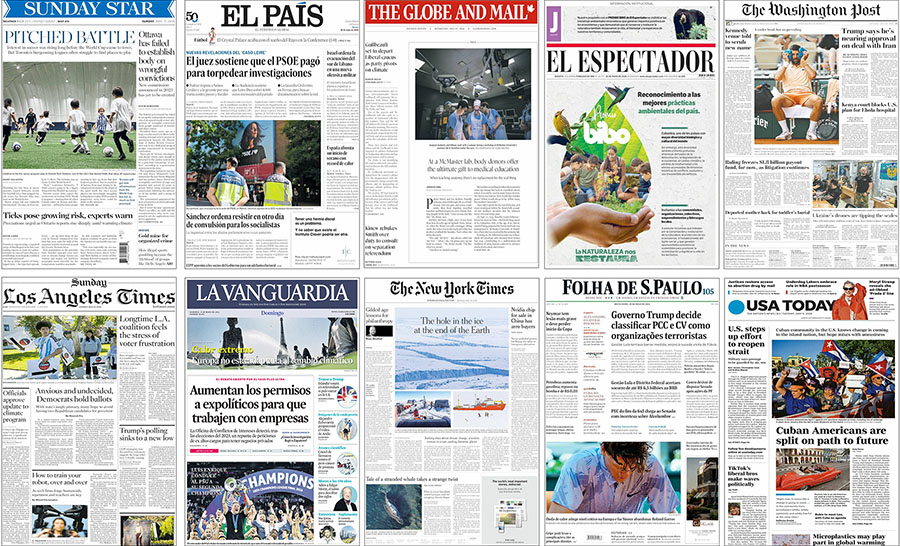
Figure 4. Examples of newspaper front pages with climate change stories in May 2026.
- report prepared by Max Boykoff, Rogelio Fernández-Reyes, Lucy McAllister, Ami Nacu-Schmidt, Jeremiah Osborne-Gowey and Olivia Pearman