Monthly Summaries
Issue 111, March 2026 | "The fog of war emanating from the Trump administration”
[DOI]
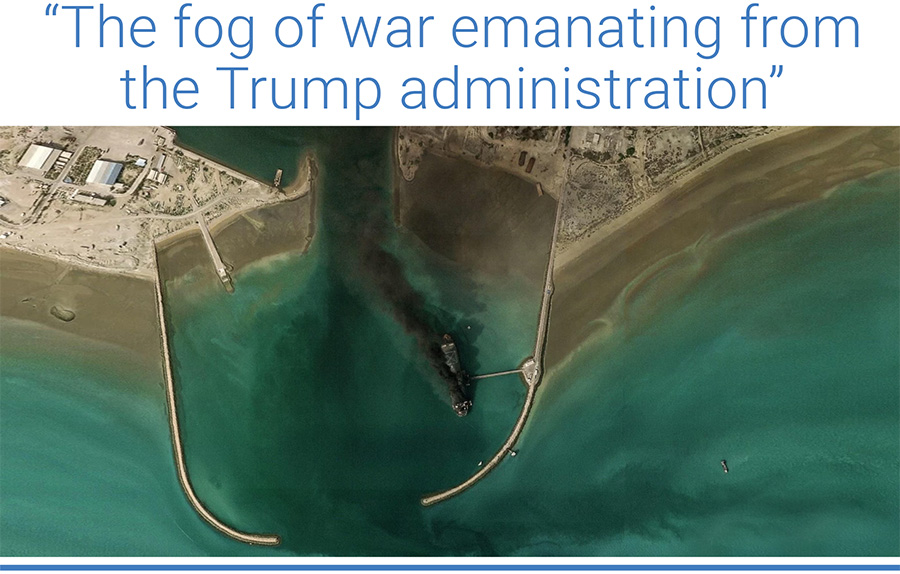
This satellite image taken by 2026 Planet Labs PBC shows smoke billowing from a vessel following an explosion from the port of Bandar Abbas along the strait of Hormuz. Photo: AFP.
March media coverage of climate change or global warming in newspapers around the globe continued on a downward trend, decreasing 5% from February 2026. Meanwhile, coverage in March 2026 dipped another 38% from March 2025. Along the same trend detected here – and extending from previous months – in March international wire service coverage decreased 18% from the month earlier (February) and was 39% lower than March 2025. Figure 1 shows trends in newspaper media coverage at the global scale – organized into seven geographical regions around the world – across 22 years, from January 2004 through March 2026.
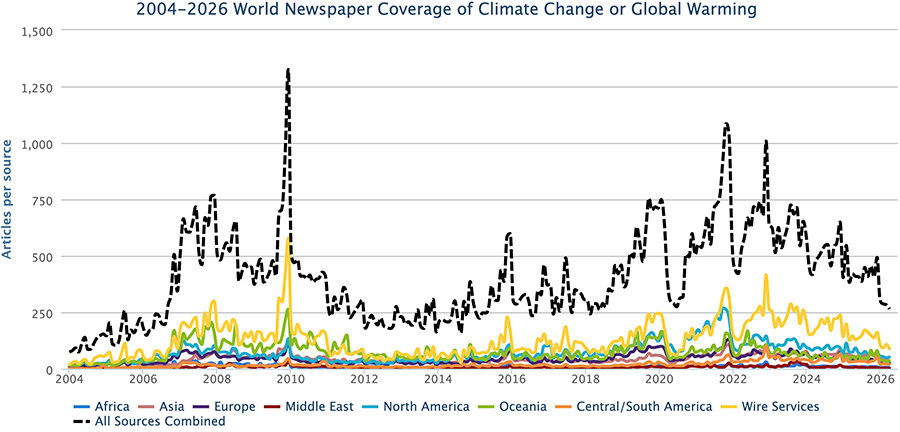
Figure 1. Newspaper media coverage of climate change or global warming in print sources in seven different regions around the world, from January 2004 through March 2026.
At the regional level, March 2026 coverage only avoided a decrease in North America (going up 7%) and in Oceania (rising 14%) from February. In all other regions, the amount of coverage of climate change or global warming went down: in Asia (-2%), Latin America (-7%), the European Union (EU) (-11%), Africa (-17%) and the Middle East (-36%) (see Figure 2). Comparing March 2026 to March 2025 levels of coverage, numbers dramatically lower in all regions (following the same trend in the previous month of February 2025): North America (-8%), Oceania (-23%), Africa (-24%), Latin America (-26%), the EU (-31%), Asia (-38%), and the Middle East (-42%).
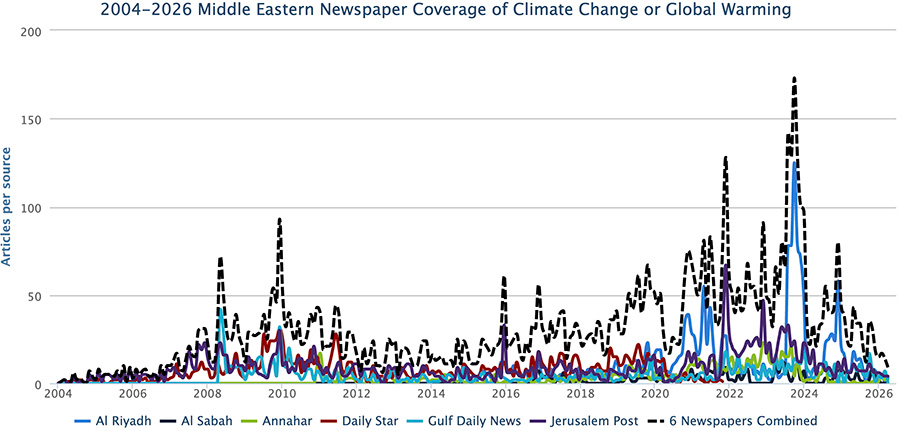
Figure 2. Coverage of climate change or global warming in 6 newspapers in the Middle East from January 2000 through March 2026: Al Riyadh, (Saudi Arabia), Al Sabah (Iraq), Annahar (Lebanon), Daily Star (Lebanon), Gulf Daily News (Bahrain), Jerusalem Post (Israel).
Among our country-level monitoring, in March US print coverage (see Figure 3) increased 6% from February 2026 levels of coverage. Yet US television coverage dipped 11% in March, compared to February 2026.
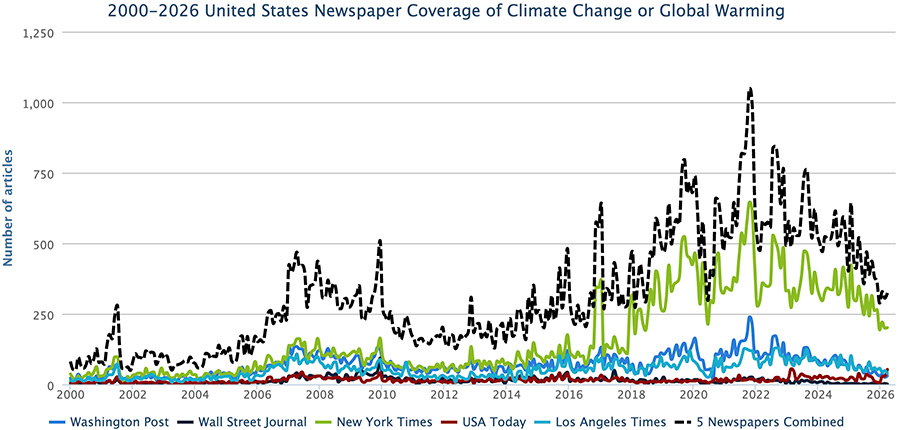
Figure 3. US newspapers’ – Los Angeles Times, New York Times, USA Today, Wall Street Journal, and Washington Post – coverage of climate change or global warming from January 2000 through March 2026.
Dubai's port of Jebel Ali with smoke plumes billowing after an Iranian projectile attack. Photo: 2026 Planet Labs PBC/AFP/Getty Images. |

Moving to content, again in March political and economic-themed media stories about climate change or global warming dominated attention in various outlets in March. Most prominent in March were links made to the war in Iran. For example, Guardian journalist Rob Davies reported, “Iran has responded to US and Israeli attacks by launching a series of counterstrikes against states across the Middle East, with serious consequences for the oil and gas industry and the global economy. Tehran has attacked oil facilities in neighbouring countries, while shipping traffic through the strait of Hormuz – the crucial bottleneck at the mouth of the Gulf – has all but ground to a halt. The seaway between Iran and Oman – barely more than 20 miles (32km) wide at its narrowest point – is an unavoidable choke point through which about 20% of the world’s oil supplies travel out into the Indian Ocean and on to the rest of the world… The longer the Iran crisis continues, the greater the risk of more pronounced price rises, triggering a domino effect that engulfs almost every aspect of the economy. More expensive oil would mean rising prices at the petrol pumps and on global fuel markets, feeding through to the cost of any goods transported by air, sea or road. “With many households still carrying debt from the last gas crisis, the spike in prices is a worrying sign that bills for both homes and businesses could rise again,” said Jess Ralston of the Energy and Climate Intelligence Unit thinktank”. Elsewhere, as the war continued to unfold Wall Street Journal correspondents David Uberti and Xavier Martinez noted, “For days, the global oil market has swung wildly while traders from New York to London to Singapore have watched footage of drones and missiles flying across the Middle East. Tuesday’s selloff was sparked in part by a social-media post. A plunge in oil prices intensified in the early afternoon after Energy Secretary Chris Wright said on X that “The U.S. Navy successfully escorted an oil tanker through the Strait of Hormuz to ensure oil remains flowing to global markets.” The prospect of a prolonged energy shock momentarily dimmed. Futures for oil, diesel and gasoline slid. Stocks jumped. But the message vanished within minutes, leaving investors the world over struggling to see through the fog of war emanating from the Trump administration itself”. As the effects of the war reverberated across the globe, Asahi Shimbun in Japan noted, “Japan will release part of its petroleum reserves as early as March 16 in response to soaring crude oil prices driven by escalating tensions in the Middle East without waiting for an internationally coordinated release. “Crude oil tankers remain virtually unable to pass through the Strait of Hormuz,” Prime Minister Sanae Takaichi told reporters on March 11 in announcing the decision. “Crude oil imports to Japan are expected to sharply decline from late this month.” She said Japan will draw down the equivalent of 15 days’ worth of private-sector reserves and one month’s worth of state stockpiles. The release will total 80 million barrels, the largest volume ever, according to the industry ministry. This marks the first time that Japan has independently released national reserves”.
Entrance to the Northwest Tehran Oil Depot, attacked last night by Israel. Photo: Jaime León/EFE. |
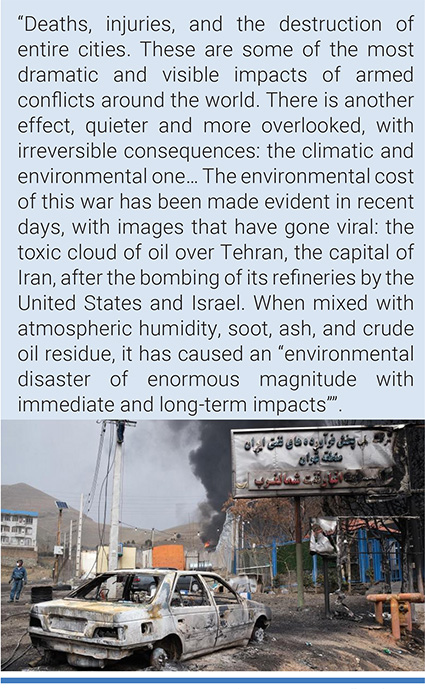
Meanwhile, in Europe news was generated from 16 Ibero-American countries who promoted a declaration of support for major pacts and environmental multilateralism. For example, El País journalist Manuel Planelles noted, “The governments approved the so-called Ibero-American Environmental Agenda, a document with a series of measures to increase collaboration among these countries on issues such as early warnings for natural disasters, which climate change is making more severe and frequent. They also adopted a political declaration of support for the most important environmental treaties at a time of intense pressure on these types of policies…Although the Ibero-American Environmental Agenda document had been in development for three years, at the last minute the representative of Argentina, governed by the far-right Javier Milei, requested that this country's objections to gender policies, the sustainable development goals, and indigenous peoples be explicitly included.” As a second example, La Vanguardia journalist Andrés Actis wrote, “Deaths, injuries, and the destruction of entire cities. These are some of the most dramatic and visible impacts of armed conflicts around the world. There is another effect, quieter and more overlooked, with irreversible consequences: the climatic and environmental one…The environmental cost of this war has been made evident in recent days, with images that have gone viral: the toxic cloud of oil over Tehran, the capital of Iran, after the bombing of its refineries by the United States and Israel. When mixed with atmospheric humidity, soot, ash, and crude oil residue, it has caused an “environmental disaster of enormous magnitude with immediate and long-term impacts,” warn scientists from the Conflict and Environment Observatory (CEOBS), an observatory specializing in the environmental impact of wars (…) According to Greenpeace, Israel’s offensive on Gaza has released 652,000 tons of carbon dioxide into the atmosphere, equivalent to burning more than 1.5 million barrels of oil.”
Asia boosts coal use as Iran war squeezes global LNG supplies. Photo: Associated Press. |
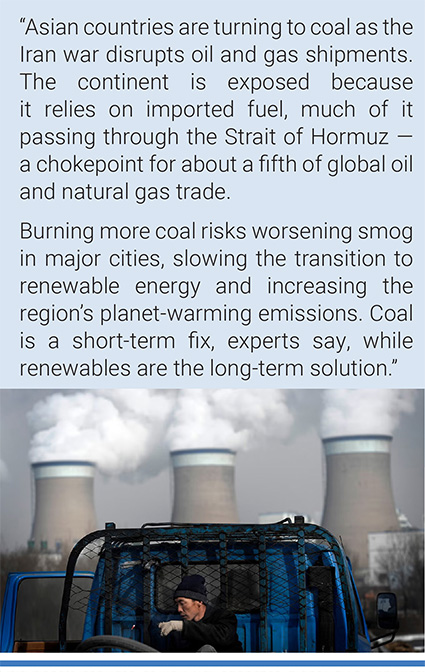
Elsewhere, the economics of decarbonization continue to pervade coverage. For example, Associated Press correspondent Allan Olingo wrote, “Africa’s flagship clean energy fund plans to more than double its financing to $2.5 billion over the next two years, as momentum builds behind the continent’s energy transition. Contributions to the African Development Bank’s Sustainable Energy Fund for Africa (SEFA) rose last year, signaling renewed investor confidence in African renewables. Since its launch, the fund has mobilized about $1 billion in commercial capital alongside its own commitments”. Yet there were many signs of resistance to change too. For example, Independent journalists Anton L. Delgado and Aniruddha Ghosal reported, “Asian countries are turning to coal as the Iran war disrupts oil and gas shipments. The continent is exposed because it relies on imported fuel, much of it passing through the Strait of Hormuz — a chokepoint for about a fifth of global oil and natural gas trade. LNG is a natural gas cooled to liquid form for easy storage and transport. It has been promoted as a bridge fuel in the shift from oil and coal to cleaner energy sources. The U.S. has sought to expand exports of LNG across Asia. It burns cleaner than coal, but still emits climate change -causing gases, especially methane. The war has countries shifting back to coal to cover LNG shortfalls. India is burning more coal to meet higher summer demand. South Korea has lifted caps on electricity from coal. Indonesia is prioritizing using its domestic supply. Thailand, the Philippines and Vietnam are boosting coal-fired power. Burning more coal risks worsening smog in major cities, slowing the transition to renewable energy and increasing the region’s planet-warming emissions. Coal is a short-term fix, experts say, while renewables are the long-term solution”.
Havana during a blackout this month. Photo: Adalberto Roque/Agence France-Presse — Getty Images. |
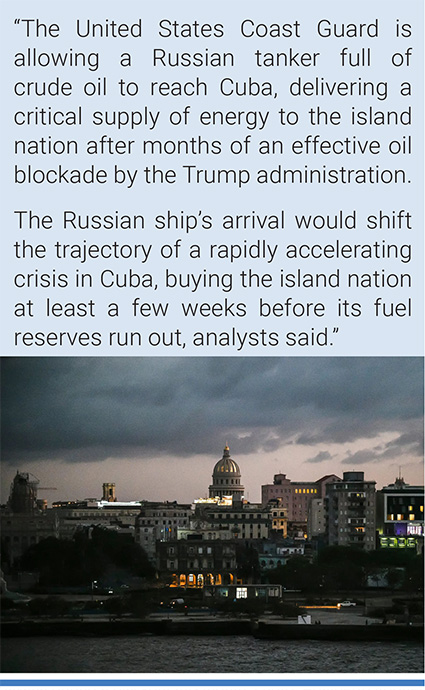
Next, cultural-themed stories relating to climate change or global warming also were evident in March. To illustrate, New York Times journalists Jack Nicas and Eric Schmidt wrote, “The United States Coast Guard is allowing a Russian tanker full of crude oil to reach Cuba, delivering a critical supply of energy to the island nation after months of an effective oil blockade by the Trump administration, according to a U.S. official briefed on the matter. The tanker, which is carrying an estimated 730,000 barrels of oil and is owned by the Russian government, was within several miles of Cuban territorial waters on Sunday evening, according to Marine Traffic, a ship-data provider. At its speed of 12 knots, it could reach its expected destination of Matanzas, Cuba, by Monday night. The Russian ship’s arrival would shift the trajectory of a rapidly accelerating crisis in Cuba, buying the island nation at least a few weeks before its fuel reserves run out, analysts said. It would also reduce pressure on a Cuban government facing a looming economic collapse and escalating threats from Washington, and show that, at least for now, the island can still depend on its longtime ally Russia. The Trump administration had been enforcing what amounted to an oil blockade around Cuba since January, threatening nations that had been sending fuel to the country and, in one case, escorting a tanker heading toward Cuba away from the island”.
The Mediterranean Breaks Records: 31.87ºC in Mallorca on August 12, 2025. Photo: Joan Mateu Parra/Shootin /Colaboradores. |

In March, there were also several media stories that focused on ecological and meteorological themes. For example, Associated Press reporter Seth Borenstein wrote, “Nearly every part of the United States is getting walloped by wild weather or just about to be. Days of downpours have begun in Hawaii. The Southwest will soon bake with day after day of record 100-degree-plus (38 Celsius-plus) heat. Two storms will dump snow by the foot over northern Great Lakes states. And the dreaded polar vortex will again invade the Midwest and East with soul-crushing Arctic chill. This forecast of extremes comes as weather whiplash has already hit much of the East. On Wednesday, Washington, D.C., residents walked around in shorts in record-breaking 86 degrees Fahrenheit (about 30 C). On Thursday, it snowed…Numerous studies have connected unusual jet stream and polar vortex activity to shrinking Arctic sea ice and human-caused climate change”. Meanwhile, USA Today correspondent Taylor Ardrey noted, “Footage and photos capture the aftermath of catastrophic flooding in Hawaii, deemed the worst in two decades. It comes after severe rain and damaging winds that resulted in evacuation orders, more than 200 rescues, power outages and enough damage that could cost over $1 billion, officials said”. And Los Angeles Times journalist Clara Harter reported, “The most destructive wildfires in Southern California history. The region’s wettest holiday season. The hottest March heat wave on record. In the last 15 months, the Southland has seen a trio of extreme weather events, and UC climate scientist Daniel Swain says there’s one clear through-line connecting them all. “All of the superlative extremes we’ve seen in recent years — from extreme heat to extreme dryness to extreme wetness, and even the severe wildfires — they all have clear links to climate change,” he said. The ongoing heat wave shattering dozens of temperature records in Southern California is no exception, Swain said. Climate change warms the atmosphere, raising baseline temperatures and making heat-trapping weather patterns more intense and longer-lasting. As a result, we see more frequent and more severe heat waves. This unseasonable March streak of scorching heat is not only notable in its intensity, but also in its duration and its scale”.
Elsewhere, stories about climate change in the Mediterranean earned news coverage. For example, La Vanguardia journalist Andrés Actis wrote, “The Mediterranean is increasingly resembling the Caribbean: the fauna, flora, and species are already changing. In 2025, the Mediterranean Sea reached temperatures in some areas up to 6.5°C above the average recorded between 1982 and 2015, with an average of 190 days of marine heatwaves across its basin. The Balearic Islands recorded the warmest sea surface temperature in their history. This thermal anomaly is becoming chronic, with records being broken in recent years (…) The scientific community has been warning for some time that, as a result of anthropogenic climate change, the water surrounding the Iberian Peninsula is becoming tropicalized.”
Figure 4. Examples of newspaper front pages with climate change stories in March 2026. |
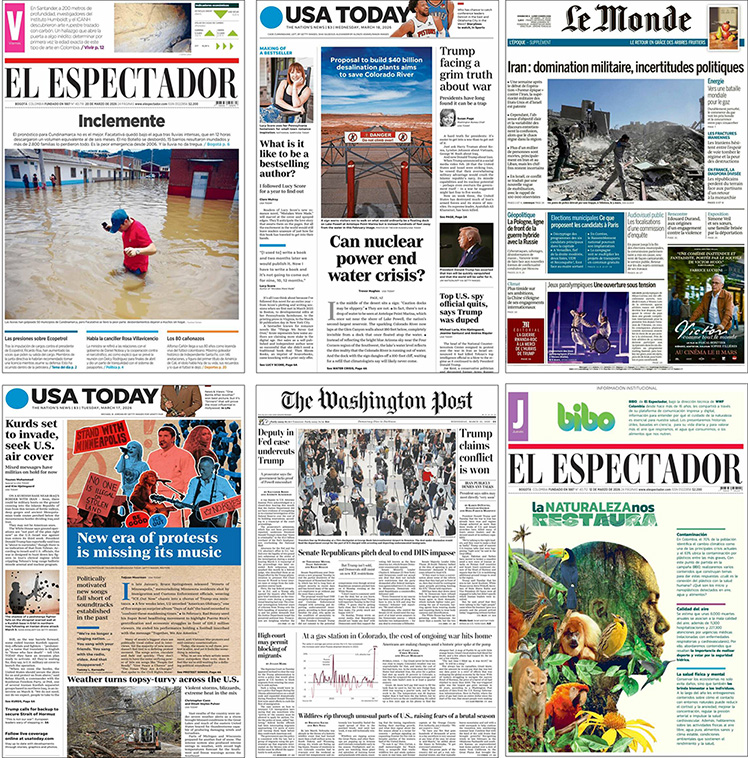
Finally, many March 2026 stories drew on primarily scientific themes when reporting on climate change or global warming. For example, New York Times journalists Kenneth Chang and Hiroko Tabuchi reported, “A start-up company wants to light up the night with 50,000 big mirrors orbiting Earth, bouncing sunlight to the night side of the planet to power solar farms after sunset, provide lighting for rescue workers and illuminate city streets, among other things. Scientists have questions about that. It is an idea seemingly out of a sci-fi movie, but the company, Reflect Orbital of Hawthorne, Calif., could soon receive permission to launch its first prototype satellite with a 60-foot-wide mirror. The company has applied to the Federal Communications Commission, which issues the licenses needed to deploy satellites... Reflect Orbital’s satellites could be a tool to reduce the burning of fossil fuels and thus slow climate change. One of the biggest weaknesses of solar power is that electric generation stops when the sun goes down. Astronomers have raised alarms about the toll taken on their observatories by the rapidly rising number of satellites crisscrossing the night sky. The constellation of nearly 10,000 Starlink satellites operated by Elon Musk’s SpaceX now routinely produces bright streaks across photographs of the universe taken by ground-based telescopes. Some companies, including SpaceX, have voluntarily worked to minimize light pollution in the night sky by making their satellites less reflective”.
- report prepared by Max Boykoff, Rogelio Fernández-Reyes, Lucy McAllister, Ami Nacu-Schmidt, Jeremiah Osborne-Gowey and Olivia Pearman