Monthly Summaries
Issue 110, February 2026 | "A huge harmful effect on the world and future generations”
[DOI]
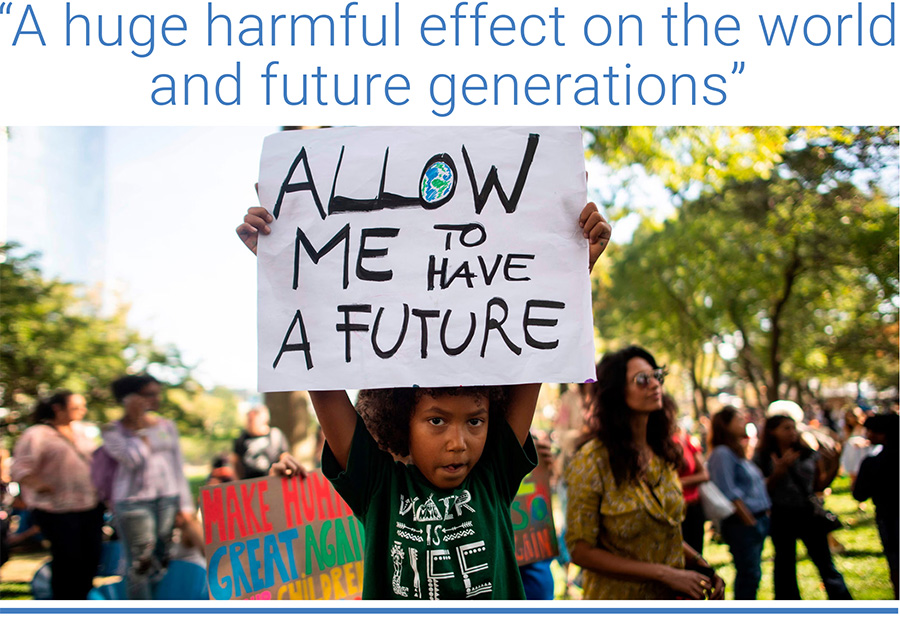
Photo: Johannes Eisele/AFP/Getty Images.
February media coverage of climate change or global warming in newspapers around the globe dropped 8% from January 2026. Meanwhile, coverage in February 2026 plummeted 31% from February 2025. In February, international wire service coverage decreased 16% from the month earlier (January) and 15% from February 2025. Figure 1 shows trends in newspaper media coverage at the global scale – organized into seven geographical regions around the world – across 22 years, from February 2004 through February 2026.
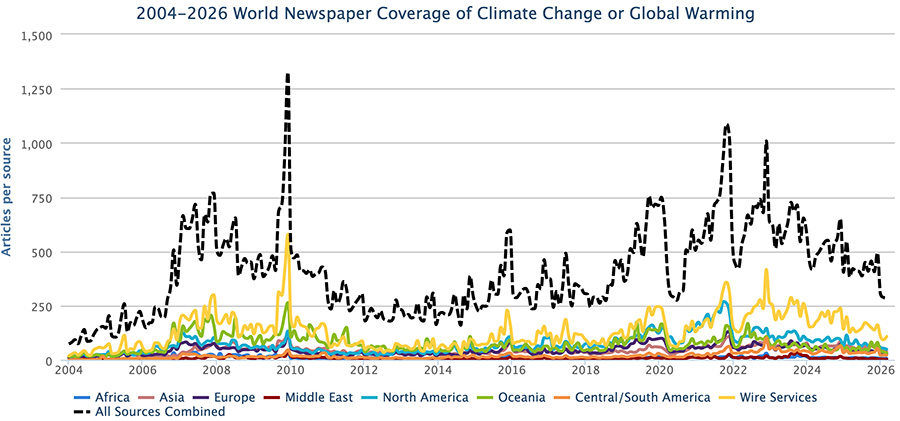
Figure 1. Newspaper media coverage of climate change or global warming in print sources in seven different regions around the world, from January 2004 through February 2026.
At the regional level, February 2026 coverage went down in North America (-8%), Asia (-12%), Oceania (-14%), the European Union (EU) (-14%) and the Middle East (-18%) while increasing in in Latin America (+1%) and Africa (+16%) (see Figure 2). Comparing February 2026 to February 2025 levels of coverage, numbers dramatically lower in all regions (following the same trend in the previous month of January 2025): North America (-8%), Oceania (-23%), Africa (-24%), Latin America (-26%), the EU (-31%), Asia (-38%), and the Middle East (-42%).
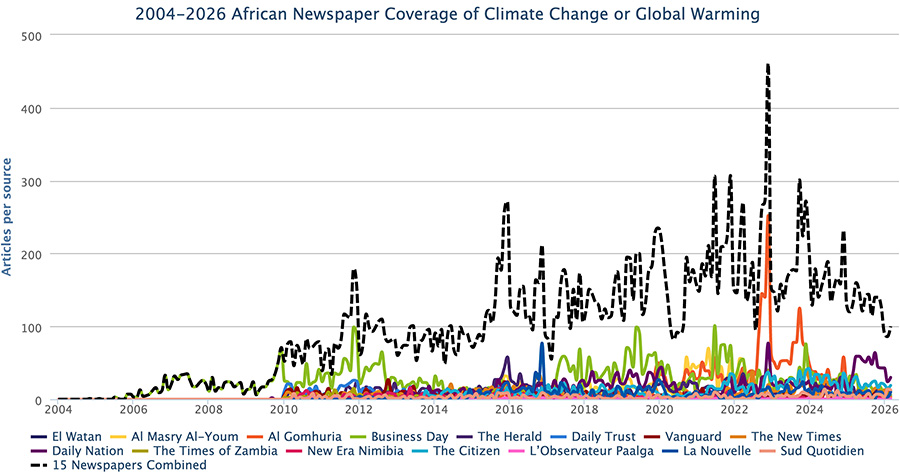
Figure 2. Coverage of climate change or global warming in 15 African newspapers from January 2000 through February 2026: El Watan (Algeria), Al Masry Al-Youm (Egypt), Al Gomhuria (Egypt), Business Day (South Africa), The Herald (Harare Zimbabwe), Daily Trust (Nigeria), Vanguard (Nigeria), The New Times (Rwanda), Daily Nation (Kenya), The Times of Zambia (Zambia), New Era Nimibia (Namibia), The Citizen (Tanzania), L’Observateur Paalga (Burkina Faso), La Nouvelle (Morocco), Sud Quotidien (Senegal).
Among our country-level monitoring, in February US print coverage (see Figure 3) dropped 7% from January 2026 levels of coverage. Yet, US television coverage increased 18% in February, compared to January 2026.
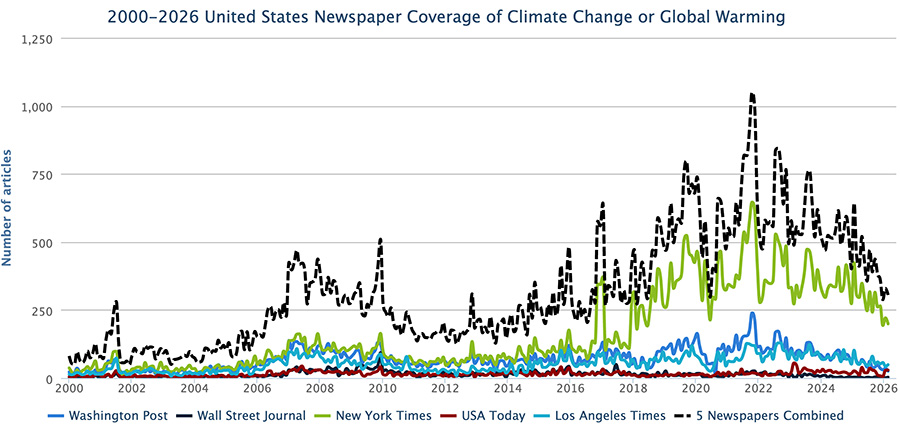
Figure 3. US newspapers’ – Los Angeles Times, New York Times, USA Today, Wall Street Journal, and Washington Post – coverage of climate change or global warming from January 2000 through February 2026.
Travelers are stuck in a traffic jam in Chicago, Illinois. Photo: Kamil Krzaczynski/Reuters. |
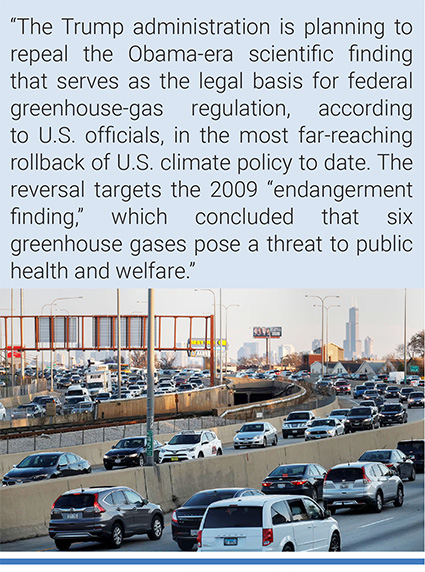
To start our analysis of themes of coverage, political and economic-themed media stories about climate change or global warming fought for attention in various outlets in February. To begin, news of the US Trump Administration repeal of the ‘endangerment finding’ generated significant US news attention. For example, Wall Street Journal correspondents Meridith McGraw and Benoit Morenne reported, “The Trump administration is planning this week to repeal the Obama-era scientific finding that serves as the legal basis for federal greenhouse-gas regulation, according to U.S. officials, in the most far-reaching rollback of U.S. climate policy to date. The reversal targets the 2009 “endangerment finding,” which concluded that six greenhouse gases pose a threat to public health and welfare. The finding provided the legal underpinning for the Environmental Protection Agency’s climate rules, which limited emissions from power plants and tightened fuel-economy standards for vehicles under the Clean Air Act. “This amounts to the largest act of deregulation in the history of the United States,” EPA Administrator Lee Zeldin said in an interview. The final rule, set to be made public later this week, removes the regulatory requirements to measure, report, certify and comply with federal greenhouse-gas emission standards for motor vehicles, and repeals associated compliance programs, credit provisions and reporting obligations for industries, according to administration officials. It wouldn’t apply to rules governing emissions from power plants and other stationary sources such as oil-and-gas facilities, the officials said. But repealing the finding could open up the door to rolling back regulations that affect those facilities. The move is likely to be seen as a victory for the fossil-fuel industry, which for years has pushed back against federal climate regulations. Since taking office, President Trump has sought to repeal rules that his allies in the oil-and-gas industry have cited as overly burdensome. Trump has framed fossil fuels as vital to economic and national security, and he has argued that expanded reliance on them will help lower energy prices.”
Meanwhile, New York Times journalists Lisa Friedman and Maxine Joselow wrote, “In the summer of 2022, Democrats in Congress were racing to pass the biggest climate law in the country’s history and President Joseph R. Biden Jr. was declaring that global warming posed a “clear and present danger” to the United States. But behind the scenes, four Trump administration veterans were plotting to obliterate federal climate efforts once Republicans regained control in Washington, according to documents reviewed by The New York Times and interviews with more than a dozen people familiar with the matter. Two of them, Russell T. Vought and Jeffrey B. Clark, were high-profile allies of Donald Trump. Mr. Vought, who has railed against “climate alarmism,” and Mr. Clark, who has called climate rules a “Leninistic” plot to seize control of the economy, drafted executive orders for the next Republican president to dismantle climate initiatives. The other two, Mandy Gunasekara and Jonathan Brightbill, were lesser-known conservative attorneys with long histories of fighting climate initiatives. Ms. Gunasekara, a onetime aide to the most vocal global warming denialist in the Senate, and Mr. Brightbill, who had argued in court against Obama-era climate regulations, collected an “arsenal of information” to chip away at the scientific consensus that the planet is warming, documents show. The overwhelming majority of scientists around the world agree that carbon dioxide, methane and other greenhouse gases are dangerously heating the planet and supercharging storms, droughts, heat waves and sea level rise, directly contradicting the four conservatives. Nevertheless, their efforts are now paying off. In the coming days, the Environmental Protection Agency is expected to revoke a determination that has underpinned the federal government’s ability to fight global warming since 2009. That scientific conclusion, known as the endangerment finding, determined that greenhouse gases threaten public health and welfare. It required the federal government to regulate these gases, which result from the burning of oil, gas and coal.”
Donald Trump and Lee Zeldin, the EPA administrator, at a rally in 2024. Photo: Elizabeth Frantz/Reuters. |
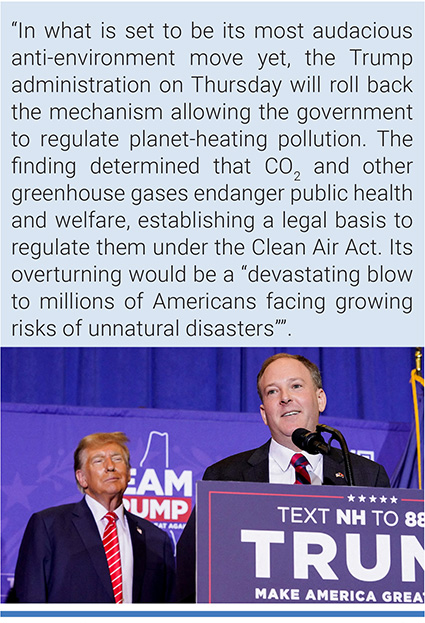
From outside the US, Guardian journalist Dharna Noor noted, “In what is set to be its most audacious anti-environment move yet, the Trump administration on Thursday will roll back the mechanism allowing the government to regulate planet-heating pollution, the White House press secretary has told reporters…The finding determined that CO2 and other greenhouse gases endanger public health and welfare, establishing a legal basis to regulate them under the Clean Air Act. Its overturning would be a “devastating blow to millions of Americans facing growing risks of unnatural disasters,” said Meredith Hankins, federal climate legal director at the environmental advocacy non-profit Natural Resources Defense Council. Meanwhile, Associated Press reporter Seung Min Kim wrote, “The Trump administration is expected this week to revoke a scientific finding that long has been the central basis for U.S. action to regulate greenhouse gas emissions and fight climate change, according to a White House official. The Environmental Protection Agency will issue a final rule rescinding a 2009 government declaration known as the endangerment finding. That Obama-era policy determined that carbon dioxide and other greenhouse gases endanger public health and welfare.”
In Europe, discussions and debates about decarbonization made news. For example, United Nations (UN) Secretary General Antonio Guterres defended renewables while the US Trump Administration threatened to leave the International Energy Agency. El País journalist Manuel Planelles wrote, “The meeting of energy ministers from the member countries of the International Energy Agency (IEA), taking place this Wednesday in Paris, reflects the tension surrounding the push for a green energy transition. This transition to renewables is being countered by repeated attempts from the Trump administration to hinder it both domestically and internationally, even threatening to withdraw from the IEA—which would significantly reduce its budget—if it does not move towards a zero-emissions energy sector. United Nations Secretary-General António Guterres has chosen a side in this struggle in a recorded message for Wednesday's IEA meeting: “We have entered the era of clean energy. Renewables are now the cheapest, fastest, and most secure source of new electricity almost everywhere. Investors know this,” the UN chief stated. Guterres has also criticized the “interests” of the fossil fuel sector, which remains “determined to hinder progress” and does not hesitate to “spread misinformation” or “pretend that a transition is unrealistic or unaffordable.”
Ralph Regenvanu, Vanuatu's minister for climate change adaption, at a demonstration ahead of an ICJ session. Photo: John Thys/AFP via Getty Images. |
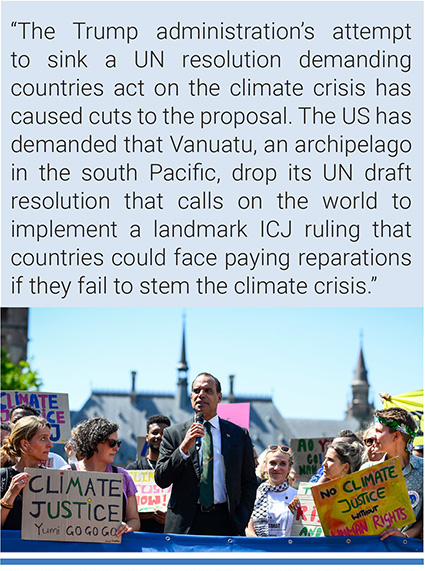
In Oceania, the Vanuatu government decisions to introduce a UN draft resolution gained US Trump Administration scrutiny. This earned media attention internationally. For example, Guardian correspondent Oliver Milman reported, “The Trump administration’s attempt to sink a UN resolution demanding countries act on the climate crisis has caused cuts to the proposal but hasn’t entirely killed it, according to the tiny Pacific island country spearheading the effort. The US has demanded that Vanuatu, an archipelago in the south Pacific, drop its UN draft resolution that calls on the world to implement a landmark international court of justice (ICJ) ruling from last year that countries could face paying reparations if they fail to stem the climate crisis. Vanuatu, one of several Pacific island countries that consider themselves existentially threatened by the climate crisis despite doing little to cause it, said it had to remove sections of its proposed resolution in the hope that a reduced version could be adopted at the UN in a vote later this month. “Having the Trump administration actively intervening in the market to stop the phase-out of fossil fuels is very frustrating, it’s beyond what you’d expect a government to do,” Ralph Regenvanu, Vanuatu’s minister for climate change adaption, said. “It’s going to have a huge harmful effect on the world and future generations.”
Next, media portrayals in February also focused on ecologicaland meteorological themes in various stories. To start the month, Washington Post journalists John Muyskens and Shannon Osaka wrote, “For about 40 years — from 1970 to 2010 — global warming proceeded at a fairly steady rate. As humans continued to pump massive amounts of greenhouse gases into the atmosphere, the world warmed at about 0.19 degrees Celsius per decade, or around 0.34 degrees Fahrenheit. Then, that rate began to shift. The warming rate ticked up a notch. Temperatures over the past decade have increased by close to 0.27 degrees C per decade — about a 42 percent increase. Those data — combined with the last few years of record heat — have convinced many researchers that the world is seeing a decisive shift in how temperatures are rising. The last 11 years have been the warmest years on record; according to an analysis by Berkeley Earth, if we assume a constant rate of warming since the 1970s, the last three years have a less than 1-in-100 chance of occurring solely due to natural variability…Even as the United States languishes under a frigid cold snap, the rest of the world is still experiencing unusually warm temperatures. Nuuk, Greenland, for example, saw temperatures in January more than 20 degrees Fahrenheit above average. Parts of Australia, meanwhile, have seen temperatures push past 120 degrees Fahrenheit amid a record heat wave. Some of that change was predicted by climate models. For decades, a portion of the warming unleashed by greenhouse gas emissions was “masked” by sulfate aerosols. These tiny particles cause heart and lung disease when people inhale polluted air, but they also deflect the sun’s rays. Over the entire planet, those aerosols can create a significant cooling effect — scientists estimate that they have canceled out about half a degree Celsius of warming so far. But beginning about two decades ago, countries began cracking down on aerosol pollution, particularly sulfate aerosols. Countries also began shifting from coal and oil to wind and solar power. As a result, global sulfur dioxide emissions have fallen about 40 percent since the mid-2000s; China’s emissions have fallen even more. That effect has been compounded in recent years by a new international regulation that slashed sulfur emissions from ships by about 85 percent. That explains part of why warming has kicked up a bit. But some researchers say that the last few years of record heat can’t be explained by aerosols and natural variability alone. In a paper published in the journal Science in late 2024, researchers argued that about 0.2 degrees C of 2023’s record heat — or about 13 percent — couldn’t be explained by aerosols and other factors. Instead, they found that the planet’s low-lying cloud cover had decreased — and because low-lying clouds tend to reflect the sun’s rays, that decrease warmed the planet…Even a few years ago, many researchers weren’t ready to claim that warming was accelerating. Some are still waiting for more data. “It’s still too early to definitively conclude there’s an increase in the rate of warming,” Smith said. While the changes in aerosols make sense intuitively, he said, he wants to see a few years of additional data. But other scientists say that the shift is becoming clearer and clearer. Rohde points out that measures of the Earth’s energy imbalance — how much energy the planet receives from the sun versus emits out into space — has increased dramatically over the past two decades. That, combined with the last few years of dangerous heat, has been enough to convince him that humanity needs to prepare for faster temperature increases — and all the risks they entail.”
A forest fire in the Epuyén mountains. Photo: Gonzalo Keoganafp/AFP. |

Meanwhile, in South America as devastating fires consumed areas of Patagonia many news outlets made connections with a changing climate. For example, El Mundo journalist Sebastián Fest wrote, “Years of drought, increased tourism, more thunderstorms, and a growing population living near forests all contribute to complaints about the reduction in their firefighting budget. Every year there are fires in Argentine Patagonia, but very rarely have they reached the level of destruction and anguish seen in the first weeks of 2026. After more than a month of uncontrolled blazes, the debate in the country centers on whether Javier Milei's government is underfunding firefighting brigades. "It's the worst environmental tragedy in 20 years," said Abel Nievas, Secretary of Forests for the province of Chubut, the hardest hit by the fires, with towns like Epuyén and El Hoyo largely evacuated due to the uncontrolled threat. So far, more than 55,000 hectares have burned, an area equivalent to the size of a city like Madrid. This is "another alarming symptom of the global climate crisis and of state inaction regarding mitigation and prevention," stated a number of environmental organizations, pointing the finger at Milei's government.”
In February in continental Europe, the Iberian Peninsula suffered eight high-impact storms since the beginning of the year and this earned news coverage. For example, El País journalist Manuel Planelles, Esther Sánchez y Yolanda Clemente Pomeda noted, “While records are being broken and the ground is becoming saturated, exacerbating flooding, experts point to climate change as making storms more powerful (…) Experts are clear that this is not your average rain. To explain what's happening, meteorologists look directly to what's known as the polar jet stream, a current of strong winds located about nine kilometers at an altitude and, normally, in northern latitudes, near the pole. “It's like a life preserver that keeps cold air confined to higher latitudes, such as the northern regions of Europe,” explains meteorologist and RTVE presenter Martín Barreiro. “When it loses intensity, meanders form and the jet stream drops to lower latitudes, as far south as the Iberian Peninsula, as it is now,” he adds. The result is “a kind of slide down which storms travel from the Caribbean to the Peninsula and the Mediterranean.”
Next, several February 2026 stories drew on primarily scientific themes when reporting on climate change or global warming. For instance, New York Times journalist Lisa Friedman reported, “A federal judge on Friday ruled the Energy Department violated the law when Secretary Chris Wright handpicked five researchers who reject the scientific consensus on climate change to work in secret on a sweeping government report on global warming. The Energy Department issued the report which downplayed the dangers of warming in late July without having held any public meetings or made records available to the public. Lee Zeldin, the administrator of the Environmental Protection Agency, then cited the report to justify a plan to repeal the endangerment finding, a landmark scientific determination that serves as the legal foundation for regulating climate pollution. But the Federal Advisory Committee Act of 1972 does not allow agencies to recruit or rely on secret groups for the purposes of policymaking. Judge William Young of the U.S. District Court for the District of Massachusetts said the Energy Department did not deny that it had failed to hold open meetings or assemble a balance of viewpoints, as the law requires, when it created the panel, known as the Climate Working Group.”

Figure 4. Examples of newspaper front pages with climate change stories in February 2026.
Soldier Hollow Nordic Center, a venue for events during the 2002 Winter Olympics in January 2026. The city, which will host the 2034 Games, saw just 0.1 inches of snow in January. Photo: Matthew Hamon. |
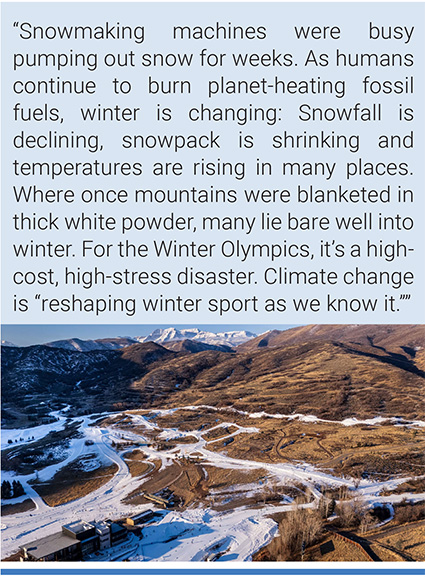
Last, cultural-themed stories relating to climate change or global warming also were evident in February. To illustrate, snowfall and climate change considerations permeated news coverage of the 2026 winter Olympics. For example, CNN correspondents Laura Paddison and Samuel Hart reported, “Jessie Diggins is an endurance athlete. The Olympic cross-country skier describes the intensity of suffering her sport can inflict as a “pain cave.” It doesn’t frighten her; she’s used to digging deep, she can control the pain. What does terrify her, however, is how rapidly her sport is changing because of something completely out of her control: climate change. She sees the effects everywhere. “I’ve raced World Cups where it was pouring rain and there was barely a strip of snow to ski on, entire seasons were reshaped overnight,” Diggins said. It’s become impossible to hold a winter sporting event without fake snow, she wrote in a blog. The Milan Cortina Winter Games in the Italian Alps, which will mark Diggins’ final Games, are no different. Snowmaking machines were busy pumping out snow for weeks. As humans continue to burn planet-heating fossil fuels, winter is changing: Snowfall is declining, snowpack is shrinking and temperatures are rising in many places. Where once mountains were blanketed in thick white powder, many lie bare well into winter. For those who rely on snow for their livelihoods, every ski season is a nail-biter. For the Winter Olympics, it’s a high-cost, high-stress disaster. Climate change is “reshaping winter sport as we know it,” said a spokesperson for the International Olympic Committee. As athletes compete in Italy, the future of the Winter Olympics hangs in the balance. People are not just questioning how to keep the Games alive, but whether they should be kept alive at all.”
In Europe, considerations of food and climate change – including viniculture – generated media attention. For example, Irish Times journalist John Wilson wrote, “Many of us choose our wine by grape variety, working on the theory that if we like one cabernet sauvignon, we are likely to enjoy another. However, as climate change takes hold, the grape varieties producers grow are likely to change. Last week, I looked at the white wines we will be drinking in the future and the heatproof varieties that will produce the grapes. Red grapes equipped for climate change tend to share the same characteristics as white varieties: a tolerance of drought, resistance to heat, a long growing season and an ability to retain acidity. As temperatures rise, some regions in Europe are already starting to allow growers to plant new varieties. It’s not too big a problem in the southern hemisphere where producers can plant whatever they fancy, but in regions such as Burgundy in France, only five grapes are permitted, and chardonnay and pinot noir make up 90 per cent of all plantings. There was quite a stir in 2021 when the authorities in Bordeaux approved four new red grape varieties and two white. The reds are marselan, castets, arinarnoa and Touriga Nacional. Few people will have heard of the first three; marselan and arinarnoa are crosses of cabernet sauvignon with other varieties and castets is a long forgotten local variety. Touriga Nacional is well known and very highly regarded in its home territory of northern Portugal.”
Jørgen Kristensen, 62, riding with his sled dogs in Ilulissat, Greenland, on January 27, 2026. Photo: Evgeniy Maloletka/AP. |
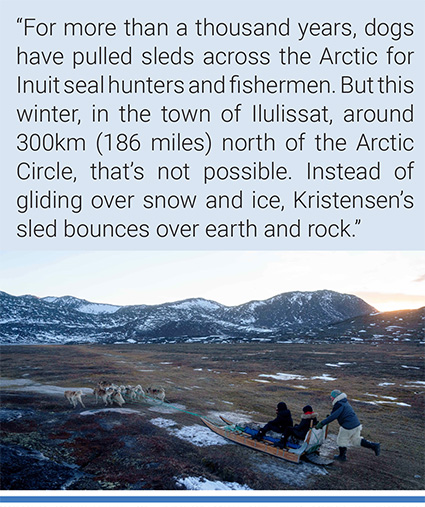
Meanwhile, threats to hunting and fishing in the Arctic – with connections to global warming – appeared in February media stories. For example, Associated Press correspondents Emma Burrows, Evgeniy Maloletka and Kwiyeon Ha reported, “For more than a thousand years, dogs have pulled sleds across the Arctic for Inuit seal hunters and fishermen. But this winter, in the town of Ilulissat, around 300km (186 miles) north of the Arctic Circle, that’s not possible. Instead of gliding over snow and ice, Kristensen’s sled bounces over earth and rock. Gesturing to the hills, he said it’s the first time he can remember when there has been no snow — or ice in the bay — in January. The rising temperatures in Ilulissat are causing the permafrost to melt, buildings to sink and pipes to crack but they also have consequences that ripple across the rest of the world. The nearby Sermeq Kujalleq glacier is one of the fastest-moving and most active on the planet, sending more icebergs into the sea than any other glacier outside Antarctica, according to the United Nations cultural organization UNESCO. As the climate has warmed, the glacier has retreated and carved off chunks of ice faster than ever before — significantly contributing to sea levels that are rising from Europe to the Pacific Islands, according to NASA.”
Last, the February decision in the US court in North Dakota against the non-profit organization Greenpeace USA generated news coverage in February. For example, New York Times journalist Karen Zraick reported, “A North Dakota judge finalized a potentially fatal verdict against Greenpeace on Friday, affirming a $345 million jury award against the storied environmental group that Greenpeace has said may force it into bankruptcy in the United States. The verdict was reached last year after a bruising trial brought by the pipeline company Energy Transfer over Greenpeace’s role in protests against the Dakota Access Pipeline, a 1,172-mile pipeline that carries oil from North Dakota to Illinois. Energy Transfer claimed Greenpeace had played a major role in the protests a decade ago, forcing construction delays and costing the company money. Greenpeace has said that the lawsuit, which was argued last year in state court in Mandan, N.D., was baseless and designed to silence it, and that the verdict undermined free-speech rights in the United States….The judge in the case, James Gion, had previously cut the jury award nearly in half, from roughly $670 million to about $345 million, split among three different Greenpeace entities. On Tuesday, Judge Gion noted in court filings that the Greenpeace groups — two based in the United States and one in the Netherlands — had asked him to overturn or at least further reduce the verdict, which was much larger than expected. But he said he did not find reason to do so.”
- report prepared by Max Boykoff, Rogelio Fernández-Reyes, Lucy McAllister, Ami Nacu-Schmidt, Jeremiah Osborne-Gowey and Olivia Pearman