Monthly Summaries
Issue 108, December 2025 | "The climate crisis intensifies"
[DOI]
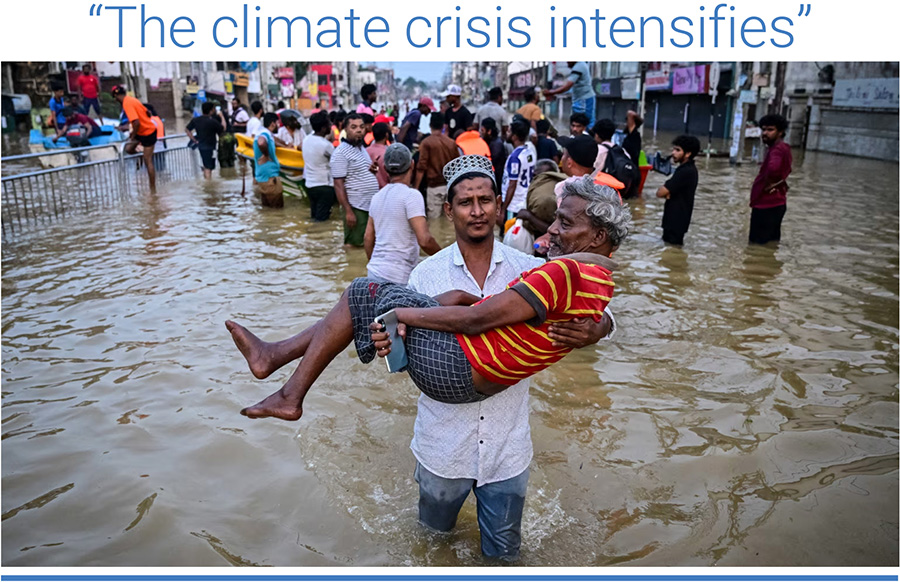
A youth carries an elderly man as they wade through a flooded street after heavy rainfall in Wellampitiya on the outskirts of Colombo. Photo: Ishara S. Kodikara/AFP/Getty Images.
December media coverage of climate change or global warming in newspapers around the globe plummeted 40% from November 2025. Moreover, coverage in December 2025 decreased 27% from December 2024 levels. Figure 1 shows trends in newspaper media coverage at the global scale – organized into seven geographical regions around the world – from January 2004 through December 2025. In particular, stories in Asian outlets in December 2025 went down 37% from November 2025 (Figure 2).
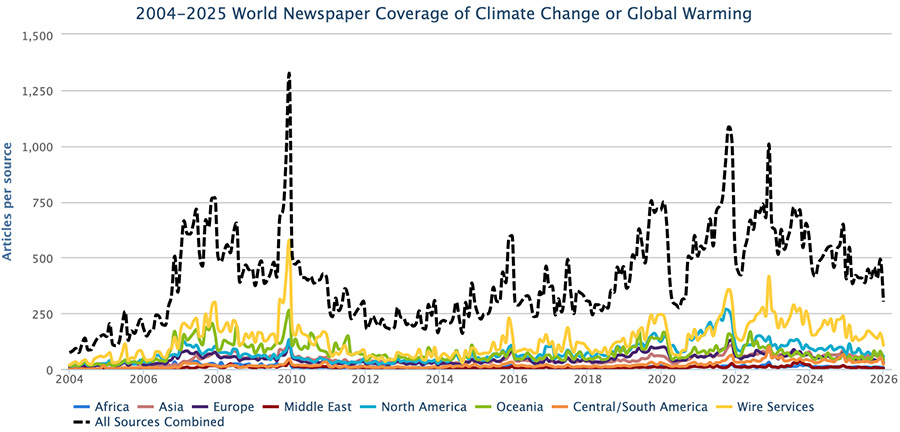
Figure 1. Newspaper media coverage of climate change or global warming in print sources in seven different regions around the world, from January 2004 through December 2025.
At the regional level, December 2025 coverage dropped in every region compared to November 2025: the Middle East (-17%), North America (-21%), Africa (-28%), Asia (-37%), the European Union (EU) (-41%), Oceania (-52%) and Latin America (-61%) compared to November 2025. As an example at the country level, coverage in Korean print newspapers – The Chosun Ilbo, Dong-a Ilbo, Maeil Business Newspaper, and Hankyoreh – decreased 68% from the previous month of November 2025 and was also 32% lower than coverage in December 2024.
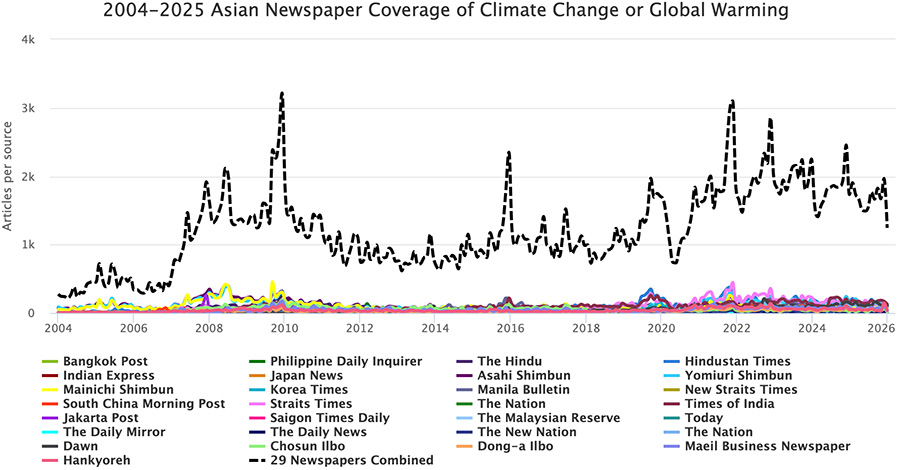
Figure 2. Asian print media coverage – in Bangkok Post (Thailand), Philippine Daily Inquirer (The Philippines), Hindu (India), Hindustan Times (India), Indian Express (India), Japan News (Japan), Asahi Shimbun (Japan), Yomiuri Shimbun (Japan), Mainichi Shimbun (Japan), Korea Times (South Korea), Manila Bulletin (Philippines), New Straits Times (Malaysia), South China Morning Post (China), Straits Times (Singapore), The Nation (Thailand), Times of India (India), Jakarta Post (Indonesia), Saigon Times Daily (Vietnam), The Malaysian Reserve (Malaysia), Today (Singapore), The Daily Mirror (Sri Lanka), The Daily News (Sri Lanka), The New Nation (Bangladesh), The Nation (Pakistan), Dawn (Pakistan), Chosun Ilbo (Korea), Dong-a Ilbo (Korea), Maeil Business Newspaper (Korea), Hankyoreh (Korea) – of climate change or global warming from January 2004 through December 2025.
Examining the content of news coverage in December 2025, numerous media portrayals focused on cultural-themed stories relating to climate change or global warming. For instance, the proliferation of AI data centers has generated news attention along several angles. For example, Guardian reporter Ajit Niranjan wrote, “Datacentres, AI gigafactories and affordable housing may be exempt from mandatory environmental impact assessments in the EU under a proposal that advances the European Commission’s rollback of green rules. The latest in a series of packages to cut red tape calls for permitting processes for critical projects to be sped up and reducing the scope of environmental reporting rules for businesses. The proposed overhaul would expand the list of strategic sectors to count datacentres, in line with the EU’s ambitions to become a global leader in AI, and affordable housing, to improve labour mobility. Member states would be free to decide whether such projects should be subject to environmental impact assessments. Other parts of the simplification plan include repealing a hazardous chemical database that lists “substances of concern in products”; removing requirements on EU polluters to have authorised representatives in member states where they sell their products; and pushing the need for environmental management systems in farms and industry from the level of plants to that of companies”. Meanwhile, New York Times reporters Ivan Penn and Karen Weise noted, “Three Democratic senators said on Tuesday that they are investigating whether and how the operations of technology companies are driving up residential electricity bills. In letters sent on Monday to Google, Microsoft, Amazon, Meta and three other companies, the lawmakers said the energy needs of data centers used for artificial intelligence were forcing utilities to spend billions of dollars to upgrade the power grid. Energy companies typically recoup the money they invest in equipment through the rates they charge all users of electricity. The senators — Elizabeth Warren of Massachusetts, Chris Van Hollen of Maryland and Richard Blumenthal of Connecticut — said they were concerned that customers other than the tech companies would be stuck footing the bill, especially if the A.I. boom ended. “We write in light of alarming reports that tech companies are passing on the costs of building and operating their data centers to ordinary Americans as A.I. data centers’ energy usage has caused residential electricity bills to skyrocket in nearby communities,” the senators said…The biggest tech companies have consistently said they want to pay their fair share of energy costs and in some states have brokered deals with utilities to try to do so. But there is little consensus about exactly how much they should pay. Contracts between data centers and utility companies are almost always confidential, leaving the public in the dark on why electric bills have risen. The lawmakers, who are seeking responses by Jan. 12, cited an article in The New York Times in August that detailed the tech companies’ growing role in the electricity business and their impact on energy costs. Many forces are causing electricity rates to increase, including the replacement of old plants and hardening of power lines against wildfires. But data centers are a particularly hot-button issue given how much their demand is expected to grow. Concern about rising electricity rates has emerged as a leading economic and political issue. Rising electricity prices played a big role in recent elections, including statewide races in Georgia, New Jersey and Virginia”.

Figure 3. Examples of newspaper front pages with climate change stories in December 2025.
NCAR's Mesa Laboratory, in Boulder, CO. The Trump administration announced that it intends to shut down this facility and break up NCAR. Photo: John Greim/LightRocket/Getty Images. |
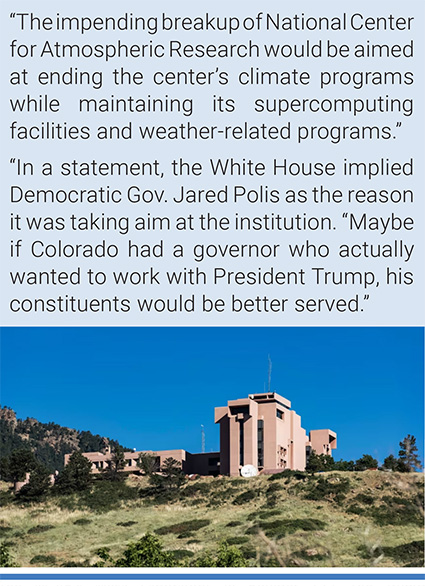
Meanwhile, many December 2025 media stories featured several scientific themes in news accounts. Among these stories, the Trump Administration’s threat to close the Boulder-based National Center for Atmospheric Research garnered attention in US and international news outlets in December. For example, CNN correspondent Andrew Freedman reported, “Stress balls were the swag item of choice at the National Center for Atmospheric Research’s booth Wednesday morning, during the world’s largest gathering of climate scientists. NCAR representatives came to this meeting — the convention of the American Geophysical Union — to talk about their research, which is crucial to the climate and weather community. Instead, they’ve ended up fielding questions about Trump administration plans to break up this Boulder, Colorado-based center, which conducts research and maintains supercomputing facilities on behalf of the government and 129 colleges and universities in the United States and Canada. The impending breakup of NCAR, first reported by USA Today and announced on X Tuesday night by OMB director Russ Vought, would be aimed at ending the center’s climate programs while maintaining its supercomputing facilities and weather-related programs. In his post on X, Vought called the center “one of the largest sources of climate alarmism in the country.” But in a statement, the White House implied Democratic Gov. Jared Polis as the reason it was taking aim at the institution. “Maybe if Colorado had a governor who actually wanted to work with President Trump, his constituents would be better served,” a White House spokesperson told CNN. President Donald Trump has attacked Colorado Gov. Jared Polis in comments and on social media over the governor’s refusal to release Tina Peters, a former election official and prominent 2020 election denier, from prison. Peters, the former Republican clerk of Mesa, Colorado, was found guilty last year on state charges of participating in a criminal scheme with fellow election deniers to breach her county’s secure voting systems, in hopes of proving Trump’s false claims of massive fraud. She was sentenced to nine years in prison and is serving her sentence at a women’s prison in Pueblo, Colorado”. Meanwhile, Washington Post journalists Ruby Mellen and Carolyn Y. Johnson noted, “The Trump administration said Tuesday it was breaking up one of the world’s preeminent Earth and atmospheric research institutions, based in Colorado, over concerns about “climate alarmism” — a move that comes amid escalating attacks from the White House against the state’s Democratic lawmakers… The NCAR laboratory in Boulder was founded in 1960 at the base of the Rocky Mountains to conduct research and educate future scientists. Its resources include supercomputers, valuable datasets and high-tech research planes. The announcement drew outrage and concern from scientists and local lawmakers, who said it could imperil the country’s weather and climate forecasting, and appeared to take officials and employees by surprise”.
The orange tributary of the Kugororuk River in Alaska is an example of a "rusting river." Photo: Josh Koch/U.S. Geological Survey. |
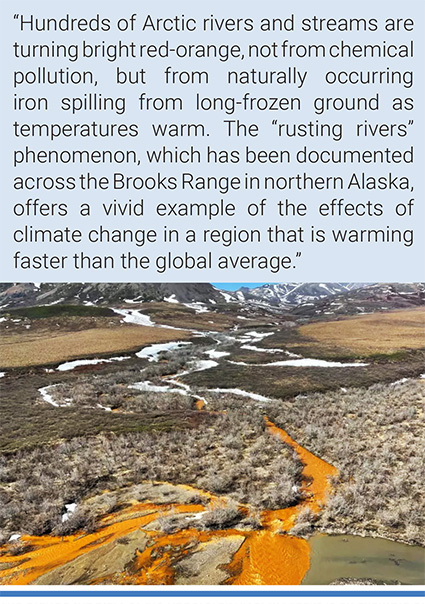
In December, the release of the Arctic Report Card published by researchers at the US National Oceanic and Atmospheric Administration (NOAA) earned media attention. For example, National Public Radio correspondent Barbara Moran reported, “Hundreds of Arctic rivers and streams are turning bright red-orange, not from chemical pollution, but from naturally occurring iron spilling from long-frozen ground as temperatures warm. The "rusting rivers" phenomenon, which has been documented across the Brooks Range in northern Alaska, offers a vivid example of the effects of climate change in a region that is warming faster than the global average. The finding was reported in the National Oceanic and Atmospheric Administration's annual Arctic Report Card, released Tuesday. NOAA has released the report for 20 years as a way to track rapid changes in the northernmost part of the planet. Those decades have seen rapid environmental change in the region. The most recent year was the warmest and wettest in the Arctic's recorded history, said Matthew Druckenmiller, a senior scientist at the National Snow and Ice Data Center, in Boulder, Colorado, and lead editor of this year's report card. He said Arctic warming influences global sea-level rise, weather patterns, and commercial fisheries”.
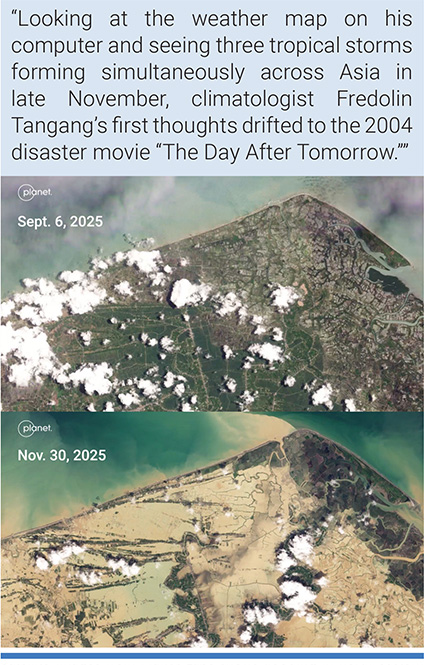
Next, there continued be many media stories relating to ecological and meteorological dimensions of climate change or global warming in December. Heavy flood events in Asia linked to climate change generated news interest. For example, CNN correspondent Helen Regan wrote, “Looking at the weather map on his computer and seeing three tropical storms forming simultaneously across Asia in late November, climatologist Fredolin Tangang’s first thoughts drifted to the 2004 disaster movie “The Day After Tomorrow.” The film, in which three massive storms plunge the earth into a new ice age, goes beyond the realms of reality. But there was something about the formation of these weather systems swirling across his screen that made Tangang sit up. They were not the strongest storms this year. But they were “unusual,” said Tangang, emeritus professor at the National University of Malaysia. One was churning near the equator off the coast Indonesia – an area where storms rarely take shape because the planet’s spin is too weak there to whip them into existence. Another was tracking for parts of Sri Lanka that are rarely hit by tropical storms. The third was late in the season, and on course to dump yet more rain on already soaked terrain in Vietnam and the Philippines. “You realize this is like a monster,” Tangang said. The cyclonic storms went on to unleash torrential rains and catastrophic flooding – including, in one area, the second-wettest day recorded anywhere in history – across swathes of South and Southeast Asia. They killed more than 1,700 people, according to a CNN tally from disaster agencies’ figures. Multiple countries are struggling to recover from their worst flooding in decades. Hundreds of people remain missing – likely washed away in rapid torrents of floodwater or buried beneath thick mud and debris. The region is used to monsoon rains and frequent flooding, but the enormity of the human toll and level of destruction have shocked many, with scientists warning that, as the climate crisis intensifies, more intense extreme weather events will become the new normal”. Elsewhere, CBS News reported, “The toll in deadly flooding and landslides across parts of Asia climbed past 1,000 on Monday as hardest-hit Sri Lanka and Indonesia deployed military personnel to help survivors. Separate weather systems brought torrential, extended rainfall to the entire island of Sri Lanka and large parts of Indonesia's Sumatra, southern Thailand and northern Malaysia last week. Much of the region is currently in its monsoon season but scientists say climate change is producing more extreme rain events, and turbocharging storms across the planet”.
Satellite images from Planet Labs shows flooding in north eastern Aceh on Indonesia's Sumatra island on September 6, 2025 (top) and November 30, 2025 (bottom). Credit: Planet Labs PBC. |
Meanwhile, El Mundo journalist Luis de la Cal wrote, “On the island of Sumatra, in Indonesia, some communities have been literally wiped off the map by floods: dirt roads turned into mud pits, isolated villages, pools of mud where homes once stood. In southern Thailand, images taken from helicopters show children clinging to their parents on rooftops, waiting to be rescued as the water swept away everything around them. Similar scenes were repeated in the low-lying areas of Colombo, the capital of Sri Lanka. A wave of torrential rains, tropical cyclones, and landslides has mercilessly battered vast areas of South and Southeast Asia. The result marks one of the worst natural disasters in the region in recent decades: according to official figures, more than 1,100 people have died. There are hundreds missing and millions displaced. Sri Lanka and Indonesia deployed military personnel yesterday to help the victims…An accumulation of extreme phenomena that, according to experts, is the result of a convergence of unusual weather systems (several cyclones at the same time) and the amplifying effect of climate change.” Concurrently, La Vanguardia journalist Antonio Cerrillo noted, “The economic damage caused this year worldwide by heat waves, wildfires, droughts, and storms has added up to a hefty bill. The ten most significant climate disasters alone have cost the world $122 billion (€103.5 billion), according to a report by the organization Christian Aid. Climate change made the disasters of 2025 even more devastating. The authors of the report conclude that climate change is significantly intensifying extreme weather events worldwide, increasing both their intensity and their cost in terms of lives lost, livelihoods destroyed, and economies damaged.”
Last, in December there were several political and economic-themed media stories about climate change or global warming. To illustrate, the United Nations Environment Program (UNEP) Global Environment Outlook generated media attention at the start of the month. For example, Associated Press correspondent Tammy Weber reported, “The most comprehensive global environment assessment ever undertaken calls for a new approach to jointly tackle the most pressing environmental issues including climate change and biodiversity loss that threaten over 1 million plant and animal species with extinction. The U.N. Environment Assembly — which the U.S. government didn’t attend — produced the new report this week by almost 300 scientists from 83 countries. The issues, which also include land degradation and pollution, are inextricably linked and require solutions that include increased spending and financial incentives to transition away from fossil fuels, encourage sustainable agricultural practices, curb pollution and limit waste, the authors of the U.N. Environment Programme’s Global Environment Outlook said”. As a second example, BBC News reporter Matt McGrath noted, “UN environment report 'hijacked' by US and others over fossil fuels, top scientist says”.

Figure 4. Examples of newspaper front pages with the Asian region of climate change and flooding stories in December 2025.
President Trump, surrounded by executives from the auto industry, in the Oval Office.Photo: Doug Mills/The New York Times. |
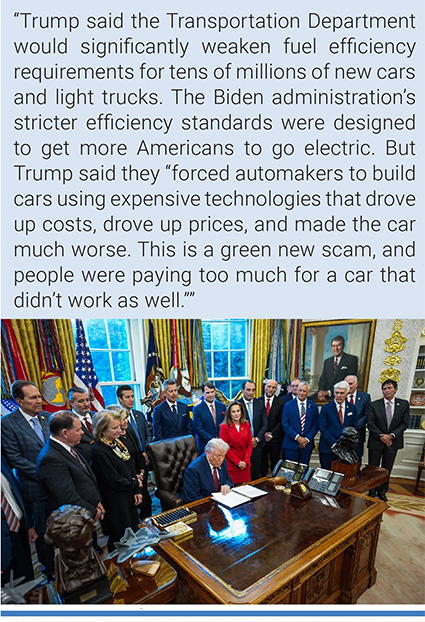
In December, the US Trump Administration actions continued to make news. For example, New York Times journalists Lisa Friedman, Maxine Joselow and Jack Ewing reported, “President Trump on Wednesday threw the weight of the federal government behind vehicles that burn gasoline rather than electric cars, gutting one of the country’s most significant efforts to address climate change and thrusting the automobile industry into greater uncertainty. Flanked by executives from major automakers in the Oval Office, Mr. Trump said the Transportation Department would significantly weaken fuel efficiency requirements for tens of millions of new cars and light trucks. The administration claimed the changes would save Americans $109 billion over five years and shave $1,000 off the average cost of a new car. The Biden administration’s stricter efficiency standards were designed to get more Americans to go electric. But Mr. Trump said they “forced automakers to build cars using expensive technologies that drove up costs, drove up prices, and made the car much worse. This is a green new scam, and people were paying too much for a car that didn’t work as well.” For the past half-century, the efficiency standards have compelled automakers to increase the distance their vehicles can travel on a gallon of gas, reducing fuel consumption and leading to innovations like electric and hybrid cars. The announcement on Wednesday was the second part of a one-two punch against policies promoting electric cars, a central pillar of President Joseph R. Biden Jr.’s strategy for fighting climate change. Transportation is the largest source of greenhouse gases in the United States, and Mr. Biden had adopted a carrot-and-stick approach to reducing these emissions. He offered tax credits to encourage motorists to buy electric cars while requiring that automakers meet stringent fuel efficiency standards to pressure them to sell more nonpolluting models. Mr. Trump and the Republican-controlled Congress got rid of the tax credits earlier this year. They also eliminated fines for automakers who violate the fuel efficiency standards. And now the standards themselves will be watered down. While auto executives publicly praised the announcement, they have privately fretted that they are being buffeted by conflicting federal policies. During the Biden administration, they invested billions of dollars and reoriented their manufacturing to produce electric vehicles and batteries. Now the Trump administration’s tariffs on steel and imported car parts have lopped billions of dollars from carmakers’ bottom lines while disrupting supply chains. Inflation has also made it difficult for many people to afford new cars”. Then, Guardian journalist Oliver Milman reviewed ‘Trump’s startling claims of 2025’ noting, “In the past decade at the forefront of US politics, Donald Trump has unleashed a barrage of unusual, misleading or dubious assertions about the climate crisis, which he most famously called a “hoax”. This year has seen Trump ratchet up his often questionable claims about the environment and how to deal, if at all, with the threats to it”.
Electric vehicles at a BMW factory in Munich. Premier automakers like BMW will benefit if an emission ban in Europe is rolled back. Photo: Laetitia Vancon/The New York Times. |
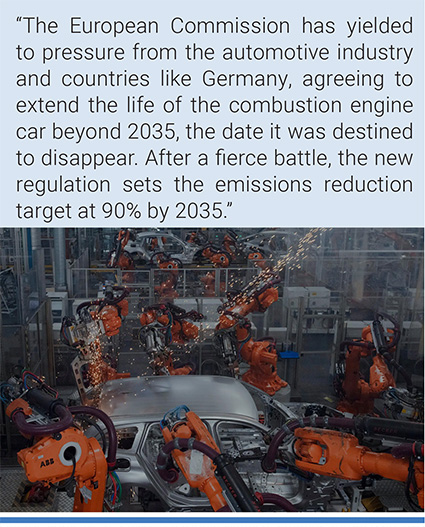
In Europe, European Union debates over the discontinuation of internal combustion engine vehicles continued and media coverage followed it. For example, the newspaper El País treated it as its main front-page story where journalist Manuel V. Gómez wrote, “The European Commission has yielded to pressure from the automotive industry and countries like Germany, agreeing to extend the life of the combustion engine car beyond 2035, the date it was destined to disappear. After a fierce battle, the new regulation sets the emissions reduction target at 90% by 2035, which benefits plug-in hybrids. Stéphane Séjourné, Vice-President of the Commission and the EU's top industrial strategy official, asserted that this decision does not call into question "the decarbonization objectives," but reminded everyone that the sector "is mortally wounded" by China's "unfair competition" with electric cars.”
Meanwhile, Exxon Mobil announced plans to cut spending by 33% on low-carbon projects and that earned media attention. For example, Wall Street Journal correspondent Adriano Marchese reported, “Exxon Mobil expects higher earnings and cash flow through the end of the decade, driven by stronger assets, a more profitable business mix, and lower costs from its multiyear transformation. The energy-and-petrochemical company on Tuesday raised its outlook to $25 billion in earnings growth and $35 billion in cash flow growth from 2024 to 2030, a $5 billion improvement in both metrics compared with its prior forecasts. Earnings growth is projected to average 13% per year through 2030, with double-digit cash-flow growth, while share repurchases are expected to drive per-share growth higher, the company said”.
- report prepared by Max Boykoff, Rogelio Fernández-Reyes, Ami Nacu-Schmidt, Jeremiah Osborne-Gowey and Olivia Pearman